


Mobile apps have transformed how consumers interact with businesses. Today, people spend significant time on their smartphones, and much of that time is dedicated to using apps.
In the United States, around 70% of all digital media time is now spent in mobile apps. Globally, usage is similarly high; users in top mobile-first markets averaged over 5 hours per day using mobile apps. With such engagement, it’s no surprise that billions of apps are downloaded annually. These numbers highlight a simple truth: customers live on mobile apps.
So, what are the main advantages of mobile apps? Are there any drawbacks to consider? This article will help you discover these important details. Let’s get started!
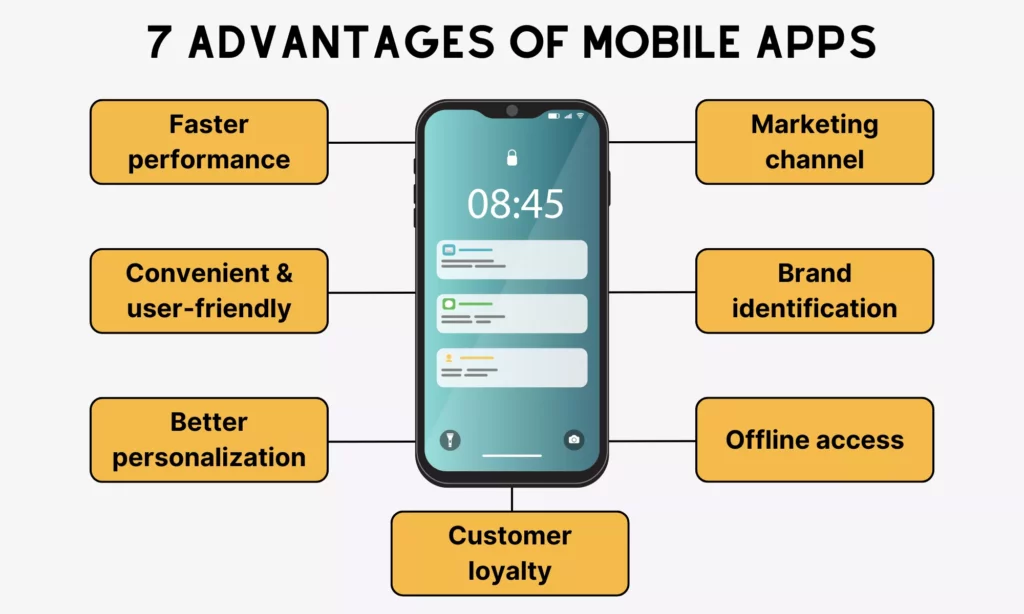
Advantages of Mobile App
Whether you decide to build a mobile app, it’s crucial to learn about what benefits the app can give you over a website. Here, in this section, we’ll learn about the six major advantages of mobile apps you should know:
Faster Performance
Mobile apps run faster and more smoothly than mobile websites. They store data locally and can pre-load content, reducing wait times.
How can it be? To explain this further, we have to talk about a bit of technical stuff. Mobile apps are purpose-built for mobile devices, and they keep their essential ingredients directly on the mobile phones, including the app’s framework, design elements, and even cached content (e.g., profile information or past articles).
Besides, mobile apps, especially native ones, are developed with platform-specific languages (e.g., Swift or Kotlin). The code is compiled directly into machine code that the device’s processor can handle instantly. This direct communication with the OS and hardware allows mobile apps to run significantly faster.
Meanwhile, websites often rely on remote web servers (and strong internet connections) to get all of their data (structure, content, images). This dependence slows performance down.
More Convenient and User-Friendly Than Websites
One major advantage of mobile apps is their higher convenience and user-friendliness compared with websites.
Apps can use smartphone features like the camera, GPS, or push notifications in ways a website cannot. This creates a more interactive and personalized experience. For example, a retail app can let customers scan products in-store for reviews, or a banking app can allow mobile check deposit via the camera – conveniences not easily achieved through a browser.
Users also recognize and appreciate the convenience of a well-designed app. A mobile app can save them significant time. With an app, a regular task (like ordering food or paying a bill) can often be done in a few taps, without re-entering login details or loading a website each time. The intuitive interfaces and stored preferences in apps streamline the user journey.
The consistency of the app experience across sessions drives usage. Once users install an app, it’s readily accessible with a single tap, and it often remembers their preferences, past orders, or personalized settings. This continuity makes customers more inclined to return.
Better Personalization to Users
Mobile apps also unlock advanced personalization that is harder to achieve on other platforms. An app can track user interactions (with proper privacy considerations) to learn about preferences and usage patterns. Using this data, businesses can tailor the content each user sees.
Personalized product recommendations, special offers based on past purchases, and content curated to the user’s interests can significantly boost engagement and sales. In fact, personalized recommendations are a major revenue driver – they are estimated to account for up to 31% of e-commerce revenues for some companies.
An app provides the ideal environment to deliver these personalized experiences seamlessly. For example, a company’s app can send a targeted reminder about items left in the shopping cart, or a personalized notice when a user’s favorite product is back in stock.
When users feel that an app “knows” them and consistently provides value, they are more likely to remain active and make repeat purchases. One research indicated that customers who are opted-in to push notifications have 13% more purchases than opted-out customers.
Building Customer Loyalty and Retention
Mobile apps can foster customer loyalty. They are not just a point of sale, but also designed for loyalty programs, rewards, and communities.
Many successful brands have incorporated their loyalty schemes directly into their apps. This makes it convenient for customers to earn and redeem points, get exclusive deals, or participate in challenges. This integration engages and encourages customers to stick with the brand.
For example, the Starbucks app doubles as a loyalty card – users earn stars for each purchase and can exchange them for free products.
This strategy has been enormously effective. Starbucks Rewards, the in-app loyalty program, grew to over 34 million active members in the U.S., who contribute nearly 60% of Starbucks’ store sales. By centralizing payments and rewards in one place, Starbucks has made its app indispensable to its most loyal customers and captured a large share of their wallet.
Mobile apps also improve retention by increasing the frequency of customer interactions. For example, an app provides continual touchpoints through push notifications – from daily habit-forming uses to occasional alerts that bring lapsed users back. Over time, this helps convert one-time customers into repeat buyers.
Apps can even include engagement mechanics like streaks, referral bonuses, or personalized content feeds that encourage regular use. All these elements deepen the customer’s relationship with the brand.
Offline Access
This feature is what a mobile website simply cannot replicate with the same efficacy. Although both mobile apps and websites need internet and 5G connections to work, the former still offers an offline mode to run some manipulations when the Internet is unavailable or weak.
The app structure and much of the content are already stored locally on the device. In other words, developers can strategically cache data—they essentially save copies of important information, like past articles, account details, or maybe even your last few orders, locally.
This means users could still browse a product catalog, for instance, or read their downloaded articles, or even compose a message that the app will cleverly send later when a connection is re-established. So, it has the incredible ability to provide functionality even when users are completely offline.
Brand Identification
In today’s market, having an app strengthens brand presence. When customers install your app, your brand’s icon lives on their phone screen. This creates daily visibility – every time they scroll through their apps, they see your logo. Even if they’re not using the app every day, that constant presence keeps your business in mind.
Additionally, an app allows a company to control its branding and messaging within a dedicated environment. Unlike on social media or third-party platforms, where many distractions and competing messages exist, your app is a space solely for your brand and your customers. This can lead to more consistent brand interactions and a stronger brand image.
Further, having an app also gives you a significant competitive advantage. If your business doesn’t provide an app but a key competitor does, you risk losing customers to a more accessible or feature-rich mobile experience offered elsewhere.
But with a great app in your niche, it can help differentiate your brand. It shows that the company is innovative and attentive to customer needs. Small businesses and enterprises alike are recognizing this. So it’s becoming standard across industries to invest in mobile apps as a core part of the customer experience.
Additional Marketing Channel for Business
A mobile app isn’t just a sales channel – it’s also a direct marketing channel that a business controls end-to-end. Apps enable companies to communicate with customers in real time through push notifications and in-app messages.
Unlike emails or social media posts, which can be missed or filtered out, a push notification pops up on the user’s phone screen. This is a powerful way to deliver timely updates, promotions, or personalized offers. For example, a restaurant can send a push notification about a lunch discount at 11:30am, reaching customers at exactly the right moment to influence their decision on where to eat.
Notably, user engagement through push notifications tends to be much higher than traditional channels like email. Push notifications delivered straight to a user’s phone can achieve an average click-through rate of around 28%, far above the roughly 1–2% click rates typical for marketing emails. This means that app-based messages are much more likely to be seen and acted upon by customers.
Disadvantages of Mobile Apps
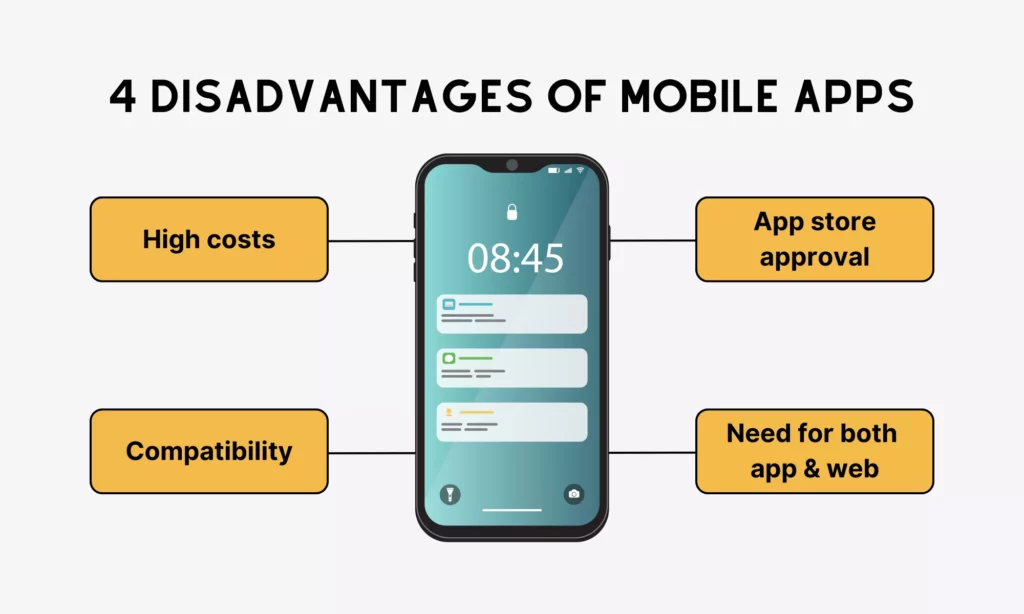
Mobile apps are not without limitations, honestly. We have talked about the huge advantages of these digital products. Now, let’s learn about their possible shortcomings:
High Development and Maintenance Cost
Developing a truly quality mobile app is expensive. When it comes to mobile app development costs, don’t just think about the hourly rate of developers you hire. The total cost can increase significantly, depending on feature complexity, ongoing maintenance, and even custom integrations with your legacy infrastructure.
Let’s say: if you just want to create a simple login, it’s definitely much cheaper than integrating generative AI capabilities. Further, your team may build and deploy custom APIs to connect the app with your current software that standard APIs don’t support.
When your app is launched, you’re not finished. You have to frequently update your app because Apple and Google constantly release new OS versions, which may add new features but may impact your app’s code. Therefore, you need a team to regularly monitor the app’s performance, gather user feedback, fix bugs, and push out updates.
All these factors definitely add up to your total cost.
Compatibility and Platform Limitations (iOS vs Android)
Building a mobile app may be more complicated than a website, as you have to ensure the former works seamlessly with iOS and Android operating systems.
If you choose to build native apps, this means developing two separate products for two platforms. Each requires different programming languages, development environments, and even design philosophies. Besides, your app has to adhere to the strict guidelines of Apple’s App Store and Google Play Store if you want to publish it there.
If you find native app development surpasses your budget, you may want cross-platform apps instead by using cross-platform frameworks (e.g., Flutter or React Native). These apps can work more smoothly across operating systems and devices. However, what you have to trade off is a bit of performance and even limitations on using the device’s specific native features.
App Store Approval and Policy Constraints
You have finished testing a mobile app, and now you need to publish to app stores. These stores help distribute your apps to users globally. However, they also enforce stringent rules that your app needs to meet.
Getting your app approved can be stressful. The review process, particularly for Apple, can be opaque, taking days or even weeks. Sometimes, they can reject your app for some minor policy violations. This forces you to return back to your drawing board and fix the issues. Besides, you also need to update your app to meet new terms that the app stores often publish.
Need Both a Website and an App for Full Accessibility
You spend all that time and money building a beautiful app, only to realize that you still need a robust mobile-optimized website. Why?
First, discoverability. You can’t search for app content in Google the same way you can search for website content. If someone Googles “best tech blog,” your website pops up. If they Google your app’s specific content, the website is still your primary way to capture that traffic.
Second, think about the funnel. A user generally doesn’t download an app just to check your company out for the first time; they find you via search, click on your website link, and then decide if they like you enough to commit to a download. It’s a commitment! Downloading an app takes time and space on their phone. Therefore, the website acts as the necessary first touchpoint and crucial marketing and conversion tool.
You simply can’t get away with just an app. This means that to be fully accessible and maximize your reach, your development budget has to stretch to cover two distinct products: a mobile app (native/cross-platform) and a fully optimized website.
What Are Advantages of Mobile Application over Websites?
You have learned about the advantages and disadvantages of mobile apps. So, you may wonder, “What are their benefits over websites?” Honestly, we partly answer this question through the detailed pros discussed above. That’s why we now just briefly clarify the core difference between a mobile app and a mobile website.
Basically, the main, undeniable advantage of a native mobile app is its ability to tap directly into the device’s hardware and operating system (OS).
Think of your smartphone as a highly specialized toolkit, a complete package of sensors and processing power. A website? It can only look at the toolkit from the outside, peering through the browser window, and it’s quite limited in what it can actually touch. An app, on the other hand, is installed inside the OS and gets its own master key to the whole kit. It’s a fundamental difference in access, right there.
This access allows for a few game-changing things that a website just can’t replicate well. For example, a mobile app allows for super-fast performance, because the app’s code is already running natively on the device.
And that’s critical, because users have zero patience for lag. It also means you can use features like the camera, GPS, accelerometer, and, critically, push notifications without the clunky permissions and limitations of a browser.
And don’t forget offline functionality, which is pretty huge for user convenience. An app can cache data and continue working seamlessly, even if the user suddenly loses signal, which a website simply can’t do without some serious, slightly complicated workarounds. For this reason, mobile apps inherently make a user experience more personal, faster, and much more engaging.
Conclusion
Today, users average 5+ hours each day inside mobile apps—time that brands cannot afford to miss. Global consumer spending on those apps bounced back to US $233 billion in 2026, confirming robust demand. Retail data shows apps now convert shoppers at least 4× better than mobile sites. These figures prove the advantages of mobile apps are real.
We see the same story on every project we ship. Since 2013, Designveloper has delivered 100+ software projects across 20 industries, logging 500 000+ development hours.
Our flagship app Lumin PDF now serves 80 million users worldwide, all supported by our code. We also scale platforms like WorkPacks for construction pros, and Wave for the solar industry, turning web tools into high-retention mobile experiences.
Our work has received positive feedback and reviews from reputable websites, like Clutch, GoodFirms, and TechReviewer, for our active communication and technical excellence. Our solutions have helped clients increase organic traffic, streamline business workflows, and improve the UX.
Partner with us, and we will turn those advantages of mobile apps into faster launches, deeper engagement, and measurable revenue.