


Developing a website doesn’t simply involve designing a layout and coding some features. This job engages many people with different roles, processes, tech stacks, and timelines. All needs to be well managed unless you want web development to become a mess. So, web development project management is a non-negotiable component.
In this article, we clarify the basics of project management in web development. They include the six key phases, common methodologies, potential challenges, and success factors. Keep reading!
What Is Web Development Project Management?
The name clarifies what it is. Web development project management is the process of managing the entire web development project, from when the idea comes up to when the website goes live and beyond (maintenance, we mean!).
In a web project, a project manager acts as a conductor of an orchestra. He guides and manages all people involved – let’s say UI/UX designers, full-stack developers, QA testers, and more – to do the right job and deliver the desired outcomes in each phase.
Without project management, unexpected events (like a client asking for a small change or a developer missing the deadline) can significantly impact the whole process. As a result, both the development team and the client must confront serious consequences, like higher costs than planned or costly rework.
You don’t want those to happen, do you? If so, plan effective project management for your web project. This keeps everything on the right track, even when something interferes with your project halfway.
Key Phases of a Web Development Project
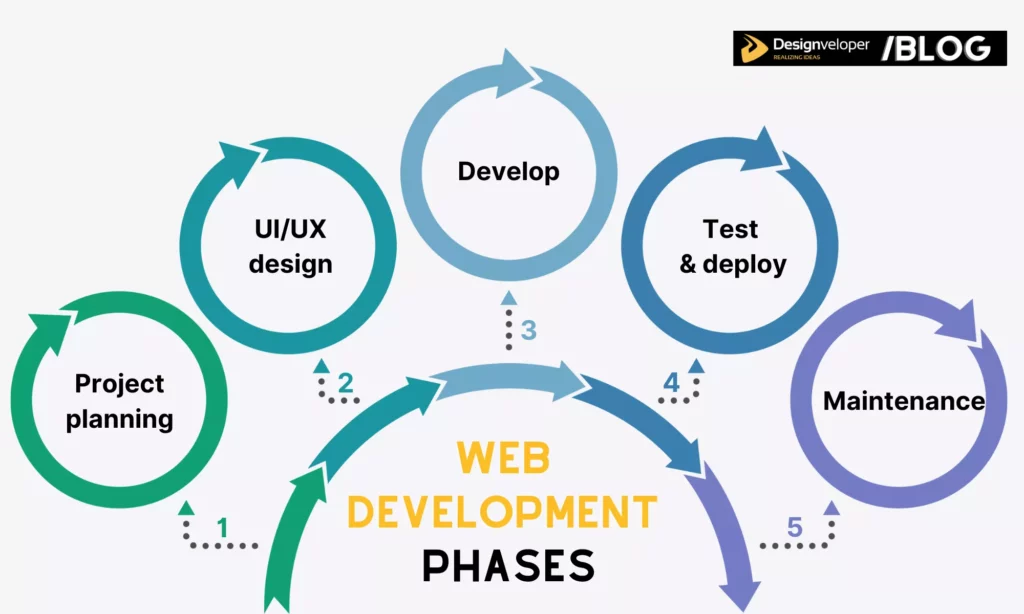
Now, let’s dive into the five key phases of executing and managing a web development project, from planning to maintenance:
1. Project planning & requirements
Don’t skip this phase, as it navigates the whole development team on where to go and which destination to arrive at. In this phase, whether your client is an internal department or an external entity, it’s crucial to gather their requirements, understand their ultimate goals, and identify the scope of work.
You can ask questions or ask the client to fill out a questionnaire, as long as you get enough information to know:
- What does the client truly want with the website (e.g., increasing brand identity or driving sales)?
- Who actually cares about the website, and why (e.g., dental clinics looking for a trusted equipment installation company)?
- Who are project stakeholders, and how will the project manager talk with them about the progress (e.g., via email or in weekly meetings)?
- What must be delivered (e.g., an MVP)?
- What are the deadlines and budget constraints?
- Are there any potential risks to notice?
Knowing all the essential information helps you avoid misunderstandings, clarify the exact work scope, identify roles, and prepare a priority list of truly important features. Otherwise, your team has to circle back many times and get nothing done.
2. Design & UX
Now, let’s focus on how the website looks and how it feels to use. This refers to designing an intuitive user interface (UI) and creating a seamless user experience. Designers need to focus on not only layouts, colors, typography, and spacing, but also how the site’s visitors move around.
Start with wireframes and prototypes and get feedback for the site’s structure instead of rushing to pixel-perfect details. Further, your team should adopt a design system – a set of UI rules and reusable components – to keep design consistent.
At Designveloper, for example, our team uses the Google Material 3 Design principles to manage the design system easily. These principles help us standardize design elements (e.g., colors, elevations, dimensions, and typography) efficiently and export the JSON design file through a plugin to developers.
3. Development
When developers receive the final design file, they start coding to bring design elements to life.
Frontend and backend development play a crucial role in this phase, and they happen in parallel. While the former focuses on implementing user interfaces and building features you can interact with on the website, the latter handles behind-the-scenes jobs, usually including API development, database management, and many more.
In this phase, to make development more effective, your team can adopt professional methods, like Pair Programming or Pomodoro. At Designveloper, these approaches make our development team more productive and help us hit deadlines. We also hold weekly meetings to review our work (and achievements, of course!), keep our clients updated about the progress, and receive feedback.
4. Testing & deployment
Testing, actually, doesn’t start at this phase, but is executed by developers during development to ensure code works as expected.
Then, QA testers will implement other rigorous tests to check the website’s features, performance, browser compatibility, and more. A handful of real users can engage in this phase and use beta releases. By conducting A/B tests, your team can check real reactions and get feedback from a user’s point of view before full deployment.
Your website is done testing? Great! It’s time to put it to live by uploading it to a domain, hooking up analytics, submitting sitemaps, and even training the client’s team if needed.
5. Maintenance
Launching the website is not the end. When user demands increase and the competition with similar websites becomes more intense, you absolutely want your website to stay competitive or even stand out. That’s why maintenance is crucial in web development project management.
Maintenance occupies a huge part of your total long-term cost, so plan maintenance carefully. What can your maintenance do? Maintenance is usually not about adding new features, but about performance monitoring, server scaling, security updates, bug fixes, and SSL certificate updates. All these tasks keep the website stable, secure, and help it meet growing user bases or request volumes.
Project Management Methodologies for Web Development
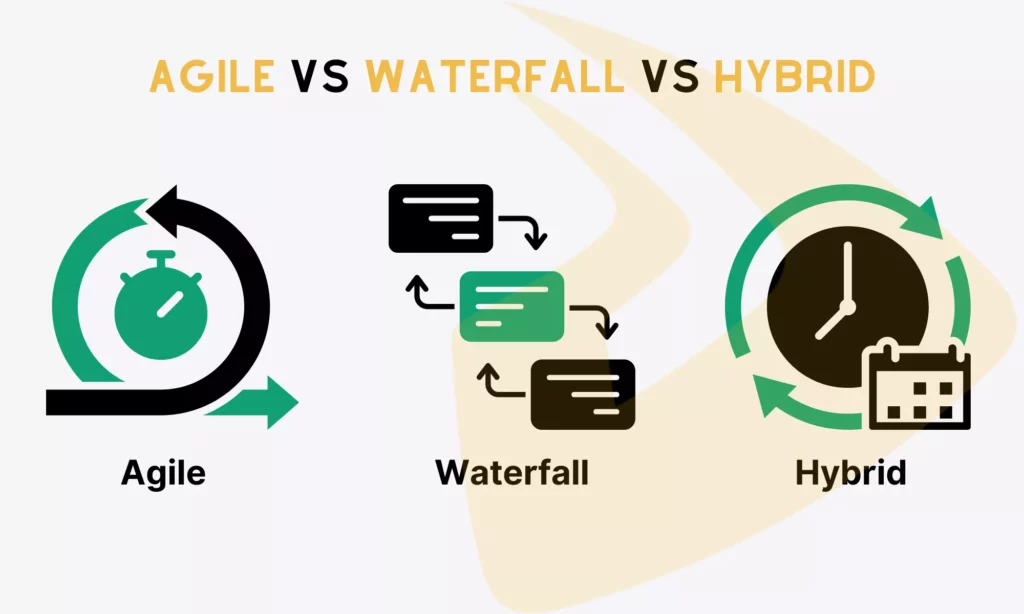
Project management methodologies shape how work actually gets done. Choosing the right approach doesn’t guarantee success, of course, but it does make the road a little smoother and far less chaotic.
Agile – and specifically the Scrum framework – is pretty popular in tech departments these days. At its core, it’s about breaking things down into manageable chunks.
Instead of trying to build the entire “dream website” in one go, your team focuses on these intense, short cycles called sprints. You build the most critical features first, see if they actually work, and then adjust based on reality. It’s perfect if the requirements are initially unclear and if your client wants a quick time-to-market.
Waterfall is the traditional, linear way of doing things. You finish one phase, you hand it off, and you move to the next. The output of the last step is the input for the next one.
If your project has a fixed scope, a set budget, and a hard deadline that isn’t going to budge, Waterfall provides a kind of clarity that Agile sometimes lacks.
The truth is, most of us don’t live in a perfect world where we can be “purely” Agile or Waterfall. Sometimes, you need the structure of a fixed timeline but the flexibility to change how a specific feature is built. This is where the Hybrid approach comes in.
It’s essentially a “best of both worlds” scenario. You might use a Waterfall-style roadmap for your high-level planning and budgeting, but let the dev team use Scrum for the actual execution. According to the 18th State of Agile Report from Digital.ai, about 77% of companies are now using some kind of hybrid or “homegrown” approach.
Roles and Responsibilities in Web Development Project Management

Web development projects don’t succeed because of tools or a well-structured process alone. They also succeed because people know what they’re responsible for.
The project manager is the connective tissue of the whole operation. They are not the boss of everyone, but a person planning timelines, managing resources, tracking progress, and preventing risks. They run meetings and document decisions.
The product owner represents the business perspective. If the project manager focuses on how work gets done, the product owner focuses on what gets built and why.
The product owner gathers input from stakeholders, users, and leadership, then turns it into something usable, like user stories, acceptance criteria, or feature priorities. They define priorities, maintain the product backlog, and make judgment calls about scope.
Designers and developers are the builders. They turn ideas into something you can see, click, and use.
The main job of designers is to focus on layout, visual clarity, and usability. They also identify how users move around the website. Meanwhile, developers are in charge of bringing those designs to life. Of which, frontend developers deal with what users interact with on the website, while backend developers handle business logic, data flows, and API integrations on the server-side.
QA testers look for what others miss, like broken flows or small inconsistencies that can damage user trust. They don’t just find bugs; they reduce risk.
Some teams still treat QA as a final checkpoint, while others involve it much earlier. The latter tends to work better. When QA understands requirements from the start, they can help shape better outcomes, not just validate them.
Stakeholders, meanwhile, provide direction, approvals, and funding. Their feedback matters, though timing matters too.
Common Challenges in Web Development Project Management

In web development project management, it’s crucial to consider potential challenges you may encounter.
- Unclear or Shifting Requirements
A project kicks off with requirements that feel “clear enough.” Then design starts, and questions pop up. Development begins, and assumptions get tested. Suddenly, what seemed obvious isn’t.
Some people argue this shouldn’t happen if planning is done right. This isn’t wrong, but web projects live in fast-moving environments. Let’s say that markets shift or stakeholders rethink ideas after seeing a prototype. And you hardly plan all those unexpected events.
So, the real challenge isn’t change itself, but unmanaged change. When scope shifts without adjusting timelines, budgets, or expectations, pressure builds quietly.
Web development involves different disciplines speaking different languages. Designers talk in flows and visuals. Developers focus on logic and constraints. Stakeholders think in outcomes and ROI. Everyone is right, in their own way. But problems start when these perspectives don’t connect.
So, good communication is a must. This means clearer communication and shared understanding.
- Time and Resource Constraints
Web development projects often run on tight margins and deadlines. But developers get sick, priorities shift, or a task takes longer than estimated because it turns out to be harder than expected. All these things can happen and slow down your development.
In this case, project managers need to balance delivery pressure with team sustainability or use project management tools to solve problems.
There’s a quiet tension in almost every web project: move fast, but don’t break things. Deadlines push teams forward. But quality pulls them back, asking for just a bit more time. In reality, most teams handle this problem by adopting Agile or hybrid approaches, focusing on the most important features, and getting improvements based on feedback through sprints.
Key Success Factors to Successful Web Projects

Do you want your project to be successful? If so, don’t miss the following key factors that contribute to the overall success of your web development.
In successful web projects, communication isn’t just frequent but clear. As said above, different people excel at different things.
So, how can the client convey the right message to the development team and vice versa? More meetings don’t help. Focus on purposeful communication instead. This involves clear updates, shared documentation, and open channels where questions are welcome.
Web projects live in dynamic environments. It’s when business priorities shift, new ideas surface once stakeholders see a design or prototype, or users behave differently than expected.
Successful projects have a clear process for handling change requests. When someone submits a request, the impact is assessed in terms of time, cost, and resources to make wise decisions on what to do next. By managing unexpected changes, your team can avoid burning out and keep everything on the right track.
Risks are unavoidable when you start a web project, but they rarely announce themselves clearly. Risks can be anything, from overloaded developers to unstable third-party integrations.
If you want to implement successful web projects, be aware of them. Accordingly, your team should identify potential risks early – resource shortages, technical uncertainties, dependency delays – and think through countermeasures before they’re needed. These measures include backup plans, buffer time, or alternative approaches.
Tools support how the team actually works.
Project management platforms like Jira, Trello, or Asana help your team track work, visualize progress, and keep priorities visible. Used well, they reduce confusion and cut down on repetitive questions.
The same goes for DevOps tools. CI/CD pipelines, automated testing, deployment scripts – they smooth out delivery and reduce human error.
Web Development Project Management vs Software Project Management
At first glance, web development project management and software project management can look like the same. From same meetings and timelines to shared core principles in planning, resource allocation, risk management, stakeholder communication.
The difference between them lies in the nature of a digital solution built: a website and software.
A website represents the brand online. It’s tied closely to branding, marketing, and user perception. Accordingly, web project managers need to spend more time juggling design feedback, content updates, browser compatibility issues, and even last-minute stakeholder opinions. This makes sure the website can convey the right message to the target audience.
Software often serves more complicated purposes, so software project management may deal with deeper technical complexity. Backend systems, integrations, security layers, performance at scale – you can say.
Software can be often heavier and more expensive to implement. So, software projects may lean more on upfront planning, stricter documentation, and longer development cycles.
So, is one harder than the other? Not really. They’re just different flavors of complexity. Web development is like managing a busy storefront that’s always open. Software development feels more like building the specialized machinery handling certain tasks.
Designveloper: Bridging Web Development with Confidence
Designveloper is a Vietnam-based leading company that excels at web and software development.
With 12 years of hands-on experience delivering both custom software solutions and high-performing web platforms, we’ve built a reputation for getting things done on time and within budget. We adopt Agile approaches, mainly Scrum, and plan carefully to deal with projects of all sizes and complexities.
What sets us apart is our ability to manage ever-changing expectations and communicate well with clients to turn their ideas into working solutions.
Clients also appreciate our cross-functional expertise, from project management to seamless UI/UX design and technical skills. Our commitment to excellence and structured project management help us build hundreds of successful projects over the years. From e-commerce websites to healthcare platforms, we help our clients increase organic traffic and user engagement.
Wanna start your web development project with a trusted partner? Contact us now and let’s discuss your idea further!