


Meta has published its latest quarterly performance update, which shows an increase in total users across its Family of Apps (Facebook, Instagram, WhatsApp, Messenger and Threads), and a jump in revenue in Q4 2026.
Which makes sense, given the holiday campaign rush, but it underlines Meta’s dominant market position, which will ensure that it can bet big on future tech, and the next stage of digital connectivity.
First off, in terms of users, Meta added 40 million users in Q4, taking it to 3.58 billion daily active users across its apps.
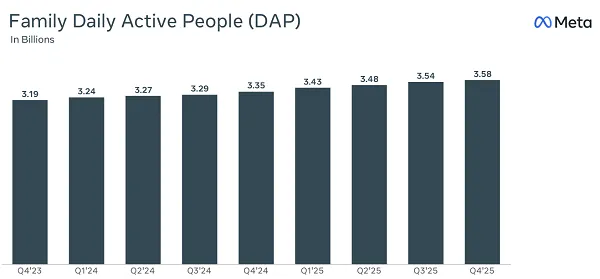
Which remains a truly impressive number, and one that you probably need to take a step back from to really appreciate. The population of the world is around 8 billion people, so the fact that 45% of them are using a Meta app every day, when that also includes people aged under 14, and the elderly, is a crazy point of note.
What’s slightly interesting here is that Meta also claims to have deleted 544,000 profiles in Australia in response to the Australian government’s newly implemented teen social media ban, which restricts social apps to those over the age of 16.
544k is probably too small a number to really make a dent in Meta’s overall figures, but there’s no real indication of any slowdown in Meta’s user numbers, which could suggest that teen users are simply starting new accounts to circumvent the new age detection measures.
Either way, more continued growth for Meta’s apps, which somehow keep adding millions of users every three months, despite presumably reaching saturation point in many regions.
In terms of revenue, Meta brought in $59.89 billion for the quarter, taking it to $200.97 billion for the full year.
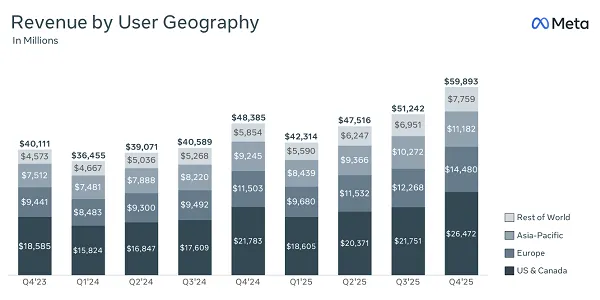
Meta saw an expected boost in ad sales over the holidays, which boosted its performance, while it also continues to see strong sales of its AI glasses, adding another revenue path.
Though Reality Labs, its VR/AR division, is still losing a lot of money.
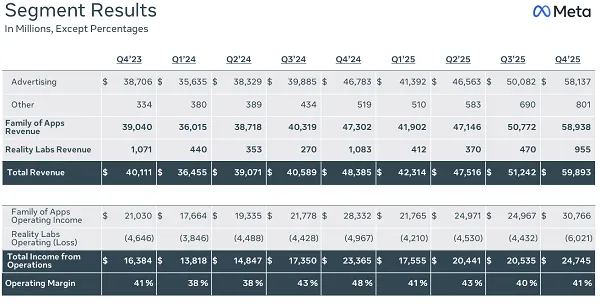
As you can see, Reality Labs saw a $6 billion loss in the period, which is not surprising, given its ongoing investment in the tech, as it looks towards the future. But it remains a significant blight on Meta’s books.
Meta’s also gained a new revenue stream in Threads Ads, which are now available to all advertisers, while it continues to push Meta Verified subscriptions with expanded offerings.
Meta Verified take-up also seems to be rising, with its “Other” revenue stream bringing in $801 million for the period, an increase of $572 million since the launch of Meta Verified in Q2 2023.
Meta doesn’t provide a breakdown of the contributors within this element, but that’s a significant increase in “Other” revenue since the introduction of the offering, which, at an average of $15 per subscriber, could correlate to around 30 million or so paying Facebook and IG users.
That’s not an exact breakdown, as there are other elements that contribute to this figure. But either way, it’s another feed in for Meta’s coffers, which contributes to its overall money pile.
Which is important for its big picture planning.
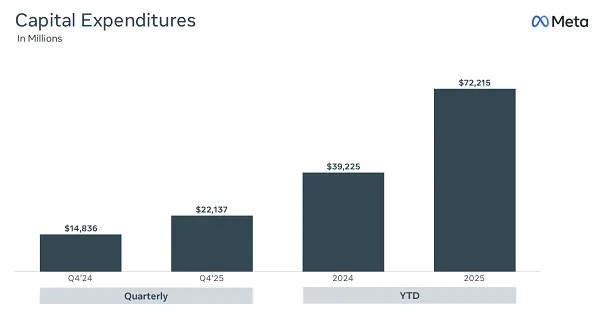
Meta remains focused on its long-term bets, which means short-term impacts, as it outlays hundreds of billions ($70 billion last year alone) to build expansive new AI data centers.
To be clear, Meta has been working on the development of AI for over a decade, and is well ahead of OpenAI or xAI on this front. But OpenAI changed the game with ChatGPT, which doesn’t use AI as such (there’s no “intelligence” or thinking in ChatGPT’s process), but instead is a re-angling of machine learning, in a way that replicates conversational language.
So while it may seem like you’re getting human-type responses from the latest AI chatbots, these are really just data matching, working out what likely symbols correlate with those that you’re entered as a query. The perception then is that these tools are providing you with a considered answer, but ChatGPT has no concept of the output that it provides, it’s just giving you the most logical, data-matched output based on its reference sources.
True AI extends beyond this, and will replicate neurons in the human brain with digital elements. That’s what Zuckerberg is working towards, and it seems like the arrival of ChatGPT has reiterated his desire to be the pioneer on this front, and deliver real AGI to the world.
We’re not close to that yet, but that’s what Meta is building towards, which could eventually give Meta a huge advantage in the broader market, if it can actually simulate human-like thought within a machine.
Or it’ll kill us all, but one way or another, that’s what Meta’s “Superintelligence” team is working towards, a step beyond the existing tools that we’re now referring to as AI.
So while most people now view AI as the generative AI tools we have, which use the internet as their brain (and will always be both fallible and limited because of this), Meta’s real aim is the next stage, which will have real applications in terms of replicating and expanding human thought.
So what does that mean for the metaverse, and Meta’s other long-term bet?
Many saw Meta’s recent job cuts in its Reality Labs division as a signal that it’s scaling back its metaverse ambitions, but I saw this more as a reflection of Meta’s increasingly reliance on AI tools for coding and engineering work.
During an appearance on the Joe Rogan podcast, Zuckerberg discussed the rapid development of AI systems, and noted that:
“Probably in 2025, we at Meta, as well as the other companies that are basically working on this, are going to have an AI that can effectively be a sort of mid-level engineer that you have at your company that can write code.”
This is especially relevant for VR development, with AI systems now enabling simplified VR object and environment creation based on conversational prompts.
I suspect that, at least part of Meta’s job planning involves a percentage of some work being outsourced to its evolving AI processes, and as noted, that could be particularly relevant in VR development.
Does that mean that Meta doesn’t think VR will be the next plane of digital connection?
While I do think that there are some significant challenges in VR adoption, aside from compelling offerings to boost take-up (like motion sickness and the mental impacts of VR immersion), I also believe that, logically, the VR metaverse does make sense as the next evolution of online connection.
We’ve moved from text-based messages to images to video, as technological advances have enabled such. VR seems like the logical next step, and when you also consider that the next generation of consumers are already conducting a lot of their social interactions in metaverse-like spaces, through gaming worlds, this all aligns, and points to VR being a significant future opportunity.
Meta’s keen to lead the AI charge for the moment, because it presents such significant opportunities for an eager market, but don’t take its staffing changes as a definitive indicator of a move away from VR (in fact, Reality Labs chief Andrew Bosworth has reiterated that Meta will continue to invest in VR, while mobile adoption of Horizon Worlds is rising).
Given all of these future-looking considerations, it’s hard to take much away from Meta’s earnings, other than it continues to strengthen its core business, which will give it a solid foundation for such investment.
Whether that investment pays off is another thing, but Meta is eyeing these future areas of opportunity, and will be well-placed, if not best-placed, to capitalize on such when the time comes.