


Rigid IT frameworks used to be IT’s best way to restore order to chaos. But the traditional ticket-based, request-approval-wait approach doesn’t work anymore. Business demands have grown beyond the bounds of ITIL, leaving IT scrambling to catch up.
Unfortunately, catching up is neither sufficient nor desirable. Tickets introduce “wait states,” said Ryan Scott, technical editor and developer at consulting firm School Aid Specialists. If a developer waits four hours for a server to be provisioned, that’s four hours of value down the drain, he explained.
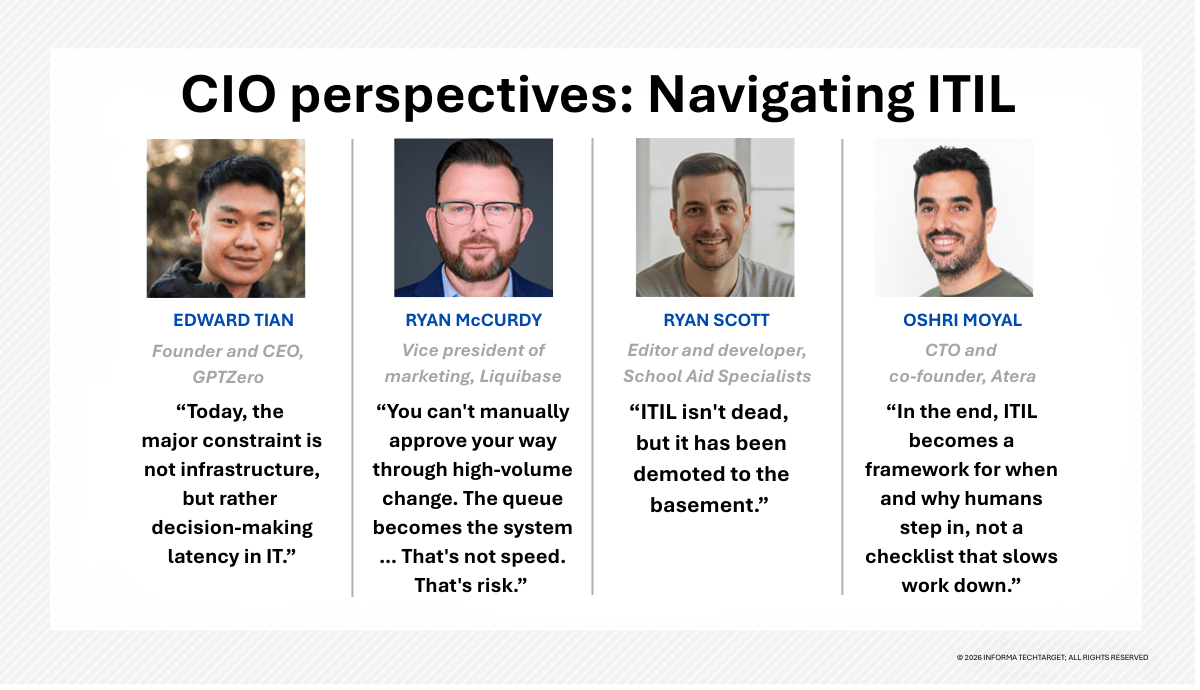
“ITIL isn’t dead, but it has been demoted to the basement,” Scott said, adding that the U.K.-born framework is “still excellent” for slow physical layers like data center cabling and hardware procurement, but for software delivery, it is an obstruction.
“You cannot apply a three-day change advisory board process to code that needs to deploy 10 times a day,” he explained.
When the framework slows the business down, teams will work around it. Those workarounds may provide short-term relief, but they can be painful and alarming, said Ryan McCurdy, vice president of marketing at Liquibase, a database security provider.
“You can’t manually approve your way through high-volume change,” McCurdy said. The queue becomes the system, leading to side-door approvals and decisions with no evidence. “That’s not speed. That’s risk.”
What replaces the service desk?
Some contend that the service desk will remain an IT mainstay, albeit in a different form.
“Nothing really replaces it. It just can’t sit off to the side anymore,” said Phil Christianson, CPO of Xurrent, an IT service management provider. “While replacing laptops and resetting passwords will always be part of the service desk’s role, resources need to pivot toward more complex tasks as more automation becomes available.”
Think of it less as the IT service desk is history, he added, and more as the service desk evolving from a call center to an automation platform.
Whether the service desk stays or goes, the consensus is that its central function is on its way out. To understand what comes next, it helps to examine what caused its collapse, said Edward Tian, founder and CEO at GPTZero, an AI content detector tool.
“At its inception, ITIL was created to manage scarcity by focusing on limited computing resources, limited time for change and limited trust. Today, the major constraint is not infrastructure, but rather decision-making latency in IT,” he explained.
What likely follows is a push to shorten or eliminate decision latency. Oshri Moyal, CTO and co-founder of Atera, an IT management platform, argues the traditional service desk is transforming into an AI-driven service orchestration layer.
Instead of acting as a ticket intake and routing function, it becomes an autonomous system that anticipates issues, resolves routine problems automatically, and escalates only what truly requires human judgment,” he said. “In the end, ITIL becomes a framework for when and why humans step in, not a checklist that slows work down.”
The SLA is dead, long live the SLA
In an IT environment that’s mostly automated and moving at the speed of AI, does anyone care about 99.99% uptime promises in service-level agreements (SLAs) anymore?
“SLAs are for lawyers; SLOs [service-level objectives] are for engineers. An SLA is a contract you breach, and an SLO is a reliability target you engineer against,” said Scott, drawing a distinction between contract-based uptime guarantees and engineering-managed reliability.
“We are seeing a shift where internal teams don’t care about 99.9% uptime contracts; they care about error budgets — how much risk can we take to ship faster?” Scott added.
Aligning with what customers actually want appears to be taking precedence over yesteryear SLA language, at least at the level where the work gets done.
“Customers care about fixes and security as much as uptime. They don’t care what bucket the issue falls into. They care that you prevented it, resolved it quickly, and can explain exactly what changed and why,” McCurdy said.
That’s not to say that a formal SLA contract is no longer a business requirement, however.
“SLAs still exist for a reason, but they don’t tell the whole story,” Christianson said. “You can hit every response target and still have a bad outcome.”
He said teams now pay more attention to how quickly the impact is reduced and whether the same issues keep coming back.
Why culture, not tools, is the hard part
Making changes to the traditional service desk can be as much a cultural rupture as an operating model change. The service desk has functioned as the human face of IT for decades. It was a familiar escalation path, a safety net, and a comforting assurance that someone would help when things break.
Scott argued that because people can’t be trained to like bureaucracy, the only way to shift culture to a new system is to make the right way the easiest way.
“If your new self-service platform is faster than filing a ticket, adoption happens overnight without a single seminar. We call this ‘Golden Path’ engineering, paving the road you want them to walk on,” he said.
That means organizations must manage not only new tooling, but also new expectations.
Employees will need to:
-
Trust automated resolution.
-
Accept more self-service responsibility.
-
Recognize that support is increasingly invisible until an exception occurs.
Without deliberate change management, the transition can feel like abandonment rather than modernization. This is especially true in companies and departments where the service desk is seen as a proxy for company care and responsiveness.
IT’s shift to proactive orchestration
Culturally, this evolution forces IT to redefine its identity from reactive helper to proactive orchestrator. That requires leadership, communication and new incentives.
“Shifting incentives toward outcomes like system stability, user experience and time freed for strategic work reinforces the new operating model,” Moyal said.
Tian echoed that cultural change is the most challenging aspect of the service desk evolution. CIOs will need to coach their IT teams to think in terms of systems, rather than queues, and “to place a premium on prevention instead of producing maximum output,” Tian said, adding that the “change in thought process, more than any technology, distinguishes the leaders from the laggards.”
Specifically, teams accustomed to measuring value through ticket closure and responsiveness must shift toward preventing friction, governing automation and designing resilient employee experiences.
That means retraining service desk staff into roles in workflow engineering, experience operations and AI oversight. All while also helping the broader workforce understand new support pathways.
“This is the hardest part. People do what they’ve been trained and rewarded to do. For years, that’s been closing tickets,” Christianson said. If leaders want different behavior, they have to be explicit about what they expect. “The right tools can make that shift much easier by giving teams time back and removing friction.”