


As AI infrastructure balloons, the tech industry is facing a memory shortage expected to persist through 2027 and possibly longer. While data center operators and hyperscalers with deep pockets are securing the memory capacity needed to build AI servers, their demand is outpacing supply. The shift is already driving price increases across the IT market.
As the likes of Microsoft, Google, Meta and Amazon snap up the majority of the global silicon wafer capacity, memory manufacturers — including Samsung Electronics, SK Hynix and Micron Technology — are prioritizing “higher-margin enterprise-grade components,” according to IDC. As a result, there’s a shortage of wafers for mid-range smartphones and consumer laptops, and the cost of those devices has increased.
Memory shortages are raising IT equipment costs
The memory shortage is already affecting IT equipment pricing and availability — a shift that is beginning to affect CIO budget planning and infrastructure investment timing. Alvin Nguyen, senior analyst for Forrester, said the memory shortage is having a significant impact not only on data center and workplace equipment but also “standard IT equipment such as servers, storage, network, desktops, laptops, and workstation equipment. This means less flexibility with device configuration, equipment shortages, and increased costs — all of which we are already seeing.”
The three major PC manufacturers — Lenovo, Dell and HP — are already raising prices this year due to dynamic random-access memory (DRAM) shortages. During the company’s fiscal year Q1 earnings call, HP Interim CEO Bruce Broussard noted that rising prices of DRAM and NAND flash memory are increasing HP’s input costs, and the company expects this “volatility” to continue this year and potentially into fiscal year 2027. The company’s CFO, Karen Parkhill, said memory costs have increased nearly 100% quarter-over-quarter.
Memory costs are only increasing as constrained production is running up against rising AI-driven demand. Samsung, which holds about 32% of the NAND market share, is expected to raise NAND prices by as much as 100% in Q2 after similar increases in Q1, effectively doubling prices this year. Looking at the DRAM market, revenue increased 51% year over year in Q3 2025 to $40.4 billion, analyst firm Omdia reported.
“Right now, the production is capped for this whole year — it is simply not possible to produce more memory, which means that it is an outright pricing battle in order to secure that capacity,” said Runar Bjorhovde, a research analyst at Canalys.
How CIOs are adjusting to IT price increases
To adjust their budgets in response to higher prices driven by the memory shortage, CIOs can examine how to extend the lifecycle of existing infrastructure and delay refresh cycles, Bjorhovde said.
Nguyen echoed that view: “Memory prices for some technologies are already 575% higher than last year. For IT decision-makers, adjusting to acquire systems with less memory or extending the equipment lifespans are options to minimize the impact.”
Marc Hoit, CIO at North Carolina State University, said the memory shortage is already affecting budget planning, and said he will likely end up “buying less equipment.” His IT team is “looking at options like extending the life of current equipment or re-using RAM,” he said. He also noted that quotes for servers are coming back two or three times as expensive as a month ago — and are valid for only a few days, whereas a quote would typically be good for a month.
In addition to extending the lifecycle of existing hardware through upgrades or optimization efforts, CIOs may increase their use of cloud services to access capacity without reducing dependency on physical infrastructure, said Terry White, associate chief analyst at Omdia. Vendor negotiations and partnerships will also become more critical “to ensure priority access to limited resources,” he added.
“Beyond budgets and procurement, CIOs will need to consider the potential ripple effects on innovation and digital transformation initiatives. A prolonged shortage could slow down the adoption of emerging technologies that rely on high-performance memory,” White said.
The impact is uneven across IT spending. Nearly $6 trillion will be spent in the IT market in 2026 globally, but devices — PCs, smartphones, etc. — account for only about $836 billion of that total, according to Gartner. Device spending is up 6% year-over-year. Server spending, by comparison, is expected to grow nearly 37% year-over-year, while data center spending is forecast to increase about 32% to more than $650 billion.
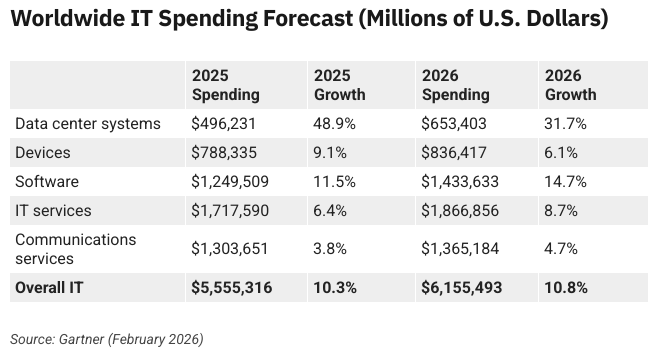
While the memory shortage is driving up the cost of IT equipment, it isn’t hitting all spending categories equally. Some of the line items hit the hardest by price increases, such as devices, represent a relatively small portion of total IT spend. Device spend is forecast to account for about 14% of total IT spending in 2026, while data center systems account for about 11%, according to Gartner.
This gives CIOs some flexibility in how they respond. In practice, that may mean delaying purchases of new devices until the memory market levels out, while adjusting plans for servers and data center capacity — either eating the higher costs or shifting some workloads to the cloud.
Some relief to the memory price spike could come as soon as later this year. The memory market has historically been cyclical, which means a downturn is likely on the horizon.
“The big concern is when the AI bubble/market correction happens,” Nguyen said. “If one or more corrections happen this year, then there will be some immediate relief in terms of pricing, although the shift to producing more AI-targeted memory (DDR5 and HBM) means the types of other IT devices that can take advantage may be initially limited.”


