


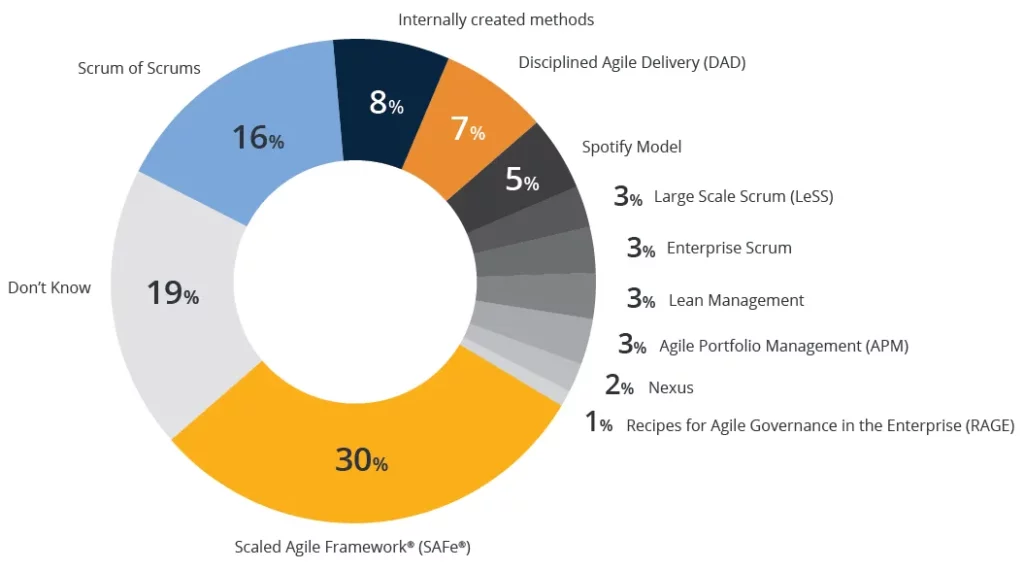
Enterprise Agile gets hard once one team becomes many teams. Backlogs split. Dependencies grow. Leaders want clearer funding, planning, and delivery signals. That is why many enterprises look at the scaled agile framework. Recent survey data shows that 71% of survey takers use Agile in the SDLC, 63% use Scrum at team level, and SAFe leads enterprise frameworks at 26%. So, SAFe sits in an important spot between team agility and enterprise coordination. This guide explains what SAFe is, how it works, where it fits, and when it makes sense for large organizations.
What Is The Scaled Agile Framework (SAFe)?
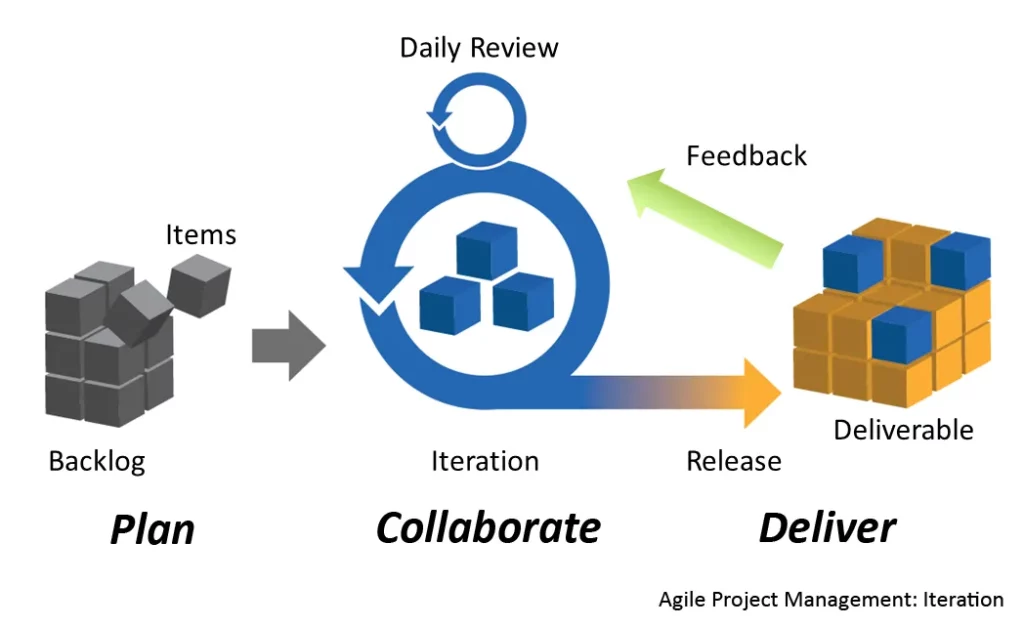
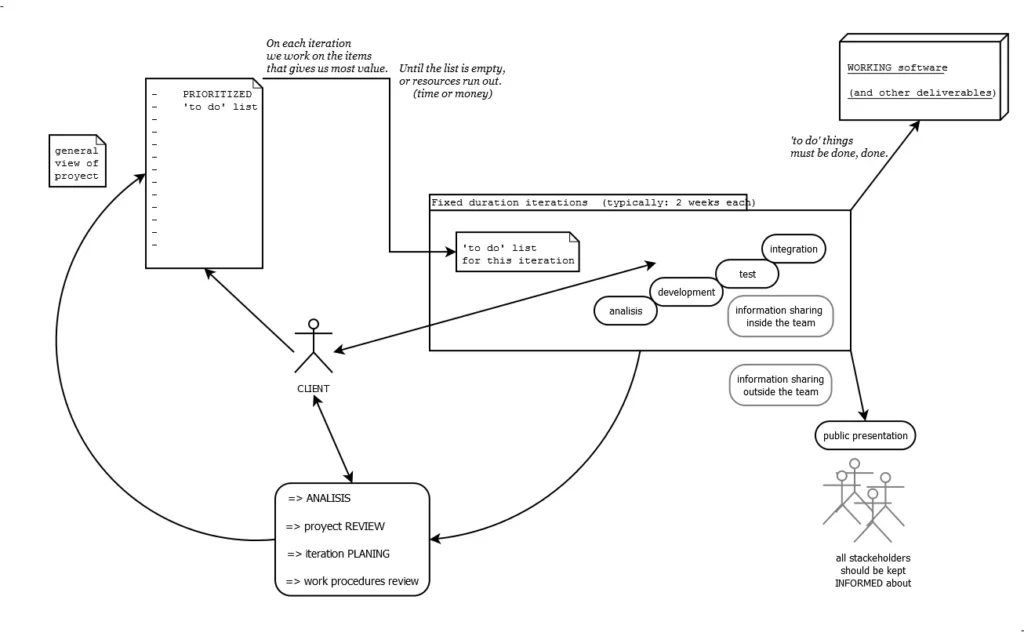
SAFe is not just a bigger Scrum board. It is a structured system for business agility. Scaled Agile defines SAFe as a knowledge base of proven, integrated principles, practices, and competencies for achieving business agility. In simple terms, it helps enterprises align strategy, funding, teams, and delivery around value.
That matters because large companies do not struggle only with sprint execution. They also struggle with portfolio priorities, cross-team coordination, architecture, compliance, and release timing. SAFe addresses those issues with shared planning rhythms, defined roles, value streams, and portfolio governance. As a result, it gives executives and delivery teams a common operating model instead of a collection of local Agile habits.
Many teams also ask, “what is scaled agile framework SAFe?” The direct answer is this: SAFe is an enterprise framework that combines Lean, Agile, and DevOps ideas so many teams can plan, build, and release together without losing alignment. It tries to scale agility without leaving leadership, budgeting, and coordination behind.
| What Enterprises Need | How SAFe Responds |
|---|---|
| Shared direction | Strategic themes, portfolio alignment, and PI objectives |
| Cross-team coordination | Agile Release Trains, common cadence, and system demos |
| Better funding flow | Lean Portfolio Management and value stream funding |
| Large-solution delivery | Solution-level roles, events, and artifacts where needed |
| Continuous improvement | Inspect and Adapt, Measure and Grow, and learning culture |
SAFe Core Values And Principles
1. SAFe Core Values
SAFe starts with values before it moves into mechanics. The official framework centers on alignment, transparency, respect for people, and relentless improvement. These values matter because enterprise agility breaks down fast when teams optimize locally, hide risk, or treat process as more important than people.
Alignment keeps teams, trains, and leaders pointed at the same goals. Transparency makes problems visible early. Respect for people protects trust and decision quality. Relentless improvement turns every planning cycle into a learning cycle. Together, these values keep SAFe from becoming a rigid command system. They push it toward coordinated learning instead.
2. The 10 Core Principles Of SAFe
The principles explain how leaders and teams should think when they apply the framework. In practice, they push enterprises to make economic trade-offs, see the whole system, preserve options, learn through small increments, base decisions on working outcomes, improve flow, use cadence, support knowledge workers, decentralize decisions, and organize around value. That mix is why SAFe feels broader than a team method. It gives decision rules, not just ceremonies.
- Take an economic view.
- Apply systems thinking.
- Assume variability and preserve options.
- Build incrementally with fast learning cycles.
- Base milestones on objective evaluation of working systems.
- Make value flow without interruptions.
- Use cadence and synchronization for cross-domain planning.
- Unlock the intrinsic motivation of knowledge workers.
- Decentralize decision-making.
- Organize around value.
These principles also explain why SAFe can work in complex settings. Large organizations face uncertainty, technical interdependence, and long feedback loops. Therefore, they need a system that supports both local autonomy and enterprise alignment. That is what the principles try to balance.
3. The Foundation Of SAFe
The framework has a formal foundation. In the SAFe glossary, the foundation is described as anchored by Lean-Agile leadership and continuous learning culture, with the mindset, values, principles, and implementation guidance needed to achieve business agility. That detail is important because many failed rollouts copy events first and ignore mindset first.
So, the real foundation of SAFe has two layers. The first layer is behavioral. Leaders must model Lean-Agile thinking. Teams must learn continuously. The second layer is operational. The roadmap, roles, and planning structure turn those beliefs into repeatable action. Without both layers, enterprises usually get process theater instead of durable change.
SAFe Configurations And Levels
SAFe does not force every enterprise into one shape. Instead, it offers several configurations. That flexibility matters because a bank with multiple digital products does not need the same operating model as a defense contractor building a system of systems.
| Configuration | Best Fit | Main Focus |
|---|---|---|
| Essential SAFe | Organizations starting their SAFe journey | ARTs, team alignment, and basic delivery flow |
| Large Solution SAFe | Complex solution environments | Coordinating multiple ARTs and suppliers |
| Portfolio SAFe | Organizations needing strategy-to-execution alignment | Funding, governance, and portfolio flow |
| Full SAFe | Very large enterprises with portfolio and solution complexity | All levels together |
1. Essential SAFe
Essential SAFe is the simplest starting point. The official definition says it provides the minimal elements necessary for Agile Release Trains to deliver solutions. So, enterprises often begin here when they want shared cadence and shared planning without adding full portfolio structure on day one.
This level works well when one train, or a small number of trains, can deliver a product family with manageable dependencies. It keeps the focus on roles, ART events, and delivery basics. That makes it a practical entry point for change.
2. Large Solution SAFe
Large Solution SAFe adds coordination for enterprises building large and complex solutions that do not need portfolio concerns. It is useful when multiple ARTs and suppliers must work toward one integrated outcome. Common examples include cyber-physical systems, large platforms, regulated infrastructure, and other environments where system integration is a major challenge.
At this level, the Solution Train becomes important. It helps multiple trains align to one vision, one intent, and one backlog at the solution level. That keeps integration from becoming a late-stage surprise.
3. Portfolio SAFe
Portfolio SAFe connects strategy and execution. The framework describes a SAFe portfolio as a set of value streams delivering a continuous flow of solutions within a common funding and governance model. That means leaders do not just approve projects. They shape investment flow, set guardrails, and help teams work on the right problems.
This configuration suits organizations with multiple products or value streams that compete for funding and capacity. It also helps when enterprise leadership wants clearer visibility into outcomes, not only delivery status.
4. Full SAFe
Full SAFe is the broadest configuration. Scaled Agile describes it as the most comprehensive version of the framework, supporting enterprises that build and maintain a portfolio of large and complex solutions. In other words, Full SAFe combines portfolio concerns with large-solution coordination.
However, bigger is not always better. Enterprises should not choose Full SAFe just because it looks complete. They should choose it only when their operating reality truly requires both strategic portfolio governance and multi-train solution coordination. Otherwise, they create more structure than value.
How The Scaled Agile Framework Works
The scaled agile framework works by giving many teams one planning rhythm, one delivery system, and one way to connect execution to business goals. It does not remove team-level agility. Instead, it links team agility to train-level and portfolio-level coordination.
1. Agile Release Trains (ARTs)
The ART is the core delivery construct in SAFe. The official definition describes an ART as a team of Agile teams aligned to shared business and technology goals, and typical ART size is 50–125 people. That size is large enough to deliver meaningful value and small enough to keep coordination manageable.
ARTs matter because enterprises usually suffer from handoffs across functions. SAFe answers that by putting cross-functional teams into one long-lived delivery organization. Product management, architecture, team execution, and business ownership all align around the same roadmap and backlog.
2. Program Increment (PI) Planning
PI Planning is the event that turns alignment into action. Scaled Agile describes it as a cadence-based event for the entire ART, and it is usually a 2-day event every 8–12 weeks. During that time, teams plan together, surface dependencies, identify risks, and commit to PI objectives.
This is one reason SAFe feels different from looser scaling approaches. It does not rely on occasional coordination. It creates a recurring enterprise planning moment. That rhythm helps large groups move with fewer surprises, especially when many teams share architecture, features, or compliance constraints.
3. Roles, Responsibilities, And Team Alignment
SAFe works because it makes key responsibilities explicit. Product Management steers feature priorities. The Release Train Engineer supports flow and facilitation. System Architects guide technical direction. Product Owners manage team-level backlog content. Scrum Masters or Team Coaches support team execution. Business Owners connect delivery to economic outcomes.
That role clarity helps in enterprises where accountability often gets blurred. Instead of one overloaded project manager trying to do everything, SAFe spreads responsibility across business, product, architecture, and team leadership. This makes decisions faster and trade-offs clearer.
4. Delivering Value Across Multiple Teams
SAFe connects work from strategy to delivery through linked backlog levels. At portfolio level, leaders manage epics. At train or solution level, work becomes capabilities or features. At team level, teams implement stories. Scaled Agile describes these work-item tiers as the structure that carries intended solution behavior from larger initiatives down to detailed implementation.
Meanwhile, system demos, Inspect and Adapt, and release practices create fast feedback. So, value does not wait for a giant end-of-project reveal. Teams integrate often, show progress often, and adjust often. That is how SAFe tries to keep scale from slowing learning.
The 7 Core Competencies Of SAFe
SAFe uses core competencies to describe what a business-agile enterprise must be able to do well. These competencies matter because ceremonies alone do not create agility. Enterprises need repeatable capability across leadership, delivery, portfolio management, and culture.
| Competency | What It Means In Practice |
|---|---|
| Lean-Agile Leadership | Leaders drive and sustain organizational change by modeling the mindset and empowering teams. |
| Team And Technical Agility | High-performing Agile teams use sound technical and team practices to build quality into delivery. |
| Agile Product Delivery | In current SAFe language, this sits within Product Development Flow and focuses on customer-centric, continuous value delivery. |
| Enterprise Solution Delivery | In current SAFe language, this sits within Large Solution Integration and Delivery for very large and sophisticated solutions. |
| Lean Portfolio Management | Strategy, investment funding, portfolio operations, and governance stay connected. |
| Organizational Agility | Business teams and leaders adapt processes and commitments quickly when conditions change. |
| Continuous Learning Culture | The enterprise keeps improving knowledge, competence, performance, and innovation. |
Two points deserve extra attention. First, SAFe terminology has evolved. What many practitioners still call Agile Product Delivery and Enterprise Solution Delivery now maps to Product Development Flow and Large Solution Integration and Delivery in the current framework. Second, the competencies show that SAFe is broader than software delivery. It reaches leadership behavior, budgeting, operational process design, and learning systems too.
Benefits Of SAFe
Benefits are one reason enterprises keep evaluating SAFe. Still, honest expectations matter. No framework guarantees results. Outcomes depend on leadership, product clarity, technical discipline, and how well the organization changes its habits. Even so, Scaled Agile reports that 68% report some or significant employee satisfaction gains, and 72% say Scaled Agile learning resources were very or extremely useful. In addition, the SAFe implementation roadmap highlights directional business results of 10–50% engagement, 20–50% productivity, 25–75% quality, and 30–75% time-to-market. These figures come from SAFe sources, so they are best read as indicative benchmarks rather than universal promises.
Better Alignment Across Teams. SAFe gives leaders, product people, and delivery teams a shared cadence and shared objectives. That reduces local optimization. It also makes dependencies visible earlier. The broader Agile survey data points to improved collaboration and better alignment to business needs as leading benefits when Agile works well.
Faster Delivery At Scale. SAFe pushes enterprises toward flow. ARTs, backlog hierarchy, system demos, and release practices all work toward shorter handoff chains and faster feedback. When teams stop waiting on disconnected planning and late integration, value moves sooner.
Improved Visibility And Coordination. PI Planning, common objectives, and Inspect and Adapt events create a predictable rhythm. Leaders see risks sooner. Teams see dependency pressure sooner. Therefore, enterprises can solve coordination problems before they become program delays.
Stronger Business And Technology Collaboration. SAFe puts business ownership, product management, and engineering in the same delivery system. That is important because large transformations often fail when business teams stay detached. Survey data shows that weak business adoption, weak leadership participation, and weak management sponsorship remain common Agile barriers. SAFe tries to solve that by design, not by wishful thinking.
How To Implement SAFe
1. Train Leaders And Change Agents
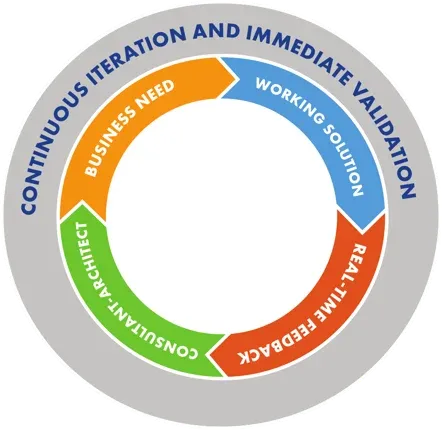
SAFe implementation should start with leadership, not tooling. The official roadmap describes a 14-article series of change steps, and early steps focus on training Lean-Agile change agents, creating a Lean-Agile Center of Excellence, and training executives, managers, and leaders. This sequence matters because enterprise change fails when leaders delegate it and move on.
In practice, enterprises usually develop internal change capability through SPCs and a LACE. Those groups help explain why the change matters, coach teams, and keep the rollout coherent across departments. Without that internal backbone, SAFe often becomes a short workshop followed by old habits.
2. Identify Value Streams And Agile Release Trains
Next, the organization must organize around value. That means identifying how value actually flows to customers and then aligning people around those streams instead of legacy silos. In SAFe terms, value streams connect strategy, funding, and delivery. ARTs then become the main execution vehicle inside those streams.
This step is more than org-chart redesign. It asks leaders to rethink boundaries, dependencies, and accountability. If teams still depend on many external functions to finish work, the ART will struggle. Therefore, value-stream design is one of the most important decisions in the whole rollout.
3. Launch And Expand SAFe Across The Organization
Once leaders train and value streams are clear, the enterprise prepares for ART launch, trains stakeholders, forms teams, launches the train, coaches execution, and then expands into more ARTs and value streams. The roadmap treats this as a staged expansion, not a one-time reorganization.
A practical rollout usually starts with one meaningful value stream. That gives the organization quick learning and visible proof. After that, leaders can expand with less guesswork. This approach is slower than a company-wide “big bang,” but it is usually safer and more effective.
SAFe Vs Scrum And Other Frameworks
1. SAFe Vs Scrum
Scrum and SAFe solve different problems. The Scrum Guide defines Scrum as a framework whose elements serve a specific purpose and whose core design should not be changed casually. Scrum is excellent for one team, or a small group of teams, working on complex problems. SAFe builds on Agile and Scrum ideas, but it adds train-level planning, portfolio alignment, funding models, and enterprise roles.
So, Scrum asks, “How should one team work?” SAFe asks, “How should an enterprise coordinate many teams, leaders, budgets, and delivery systems?” That is why SAFe can feel heavier. It covers more organizational ground because its target problem is larger.
2. SAFe Vs LeSS
LeSS takes a much lighter path. The official LeSS description says it is a scaled-up version of one-team Scrum, with one Product Owner, one Product Backlog, one Definition of Done, and one Sprint across teams. It also distinguishes between up to eight teams in LeSS and up to a few thousand people in LeSS Huge.
That makes LeSS appealing when a company wants minimal additional structure and strong product focus. By contrast, SAFe fits organizations that need more explicit coordination, governance, and portfolio mechanisms. LeSS optimizes for simplicity. SAFe optimizes for broader enterprise control and alignment.
3. SAFe Vs Spotify Model
The Spotify model is not a formal enterprise framework in the same way. Spotify’s own engineering post describes its setup as a journey in progress, with significant variation from squad to squad. That point matters because many companies copied Spotify labels without copying the context that made them work.
So, the main difference is this: SAFe is prescriptive enough to guide large enterprise adoption, while the Spotify approach is more of a cultural pattern. It inspires team autonomy and networked collaboration, but it gives less formal guidance for portfolio funding, train-level planning, or governance-heavy environments.
4. When To Choose SAFe
Choose SAFe when many teams must align to shared business outcomes, when dependencies are high, when enterprise funding and governance matter, or when large solutions need coordinated delivery. It also makes sense when leadership wants a formal path from strategy to execution instead of isolated Agile pockets.
Do not choose SAFe just because it is popular. A small product company with one product area may do better with Scrum or LeSS. SAFe also struggles when leaders want Agile language without changing decision-making, sponsorship, or org design. In those cases, the framework can become overhead instead of leverage.
Scaled Agile Framework gives enterprises a serious answer to a serious problem: how to keep agility when work spans many teams, products, and decision layers. Its value does not come from extra process alone. It comes from linking leadership, portfolio choices, architecture, delivery flow, and learning into one system. When an enterprise truly needs that level of coordination, SAFe can create clarity and momentum. When it does not, a lighter framework may win. The best choice depends on structure, complexity, and the organization’s willingness to change how it plans, funds, and delivers.
Conclusion
The scaled agile framework can help large enterprises align strategy, teams, and delivery. Yet the framework alone does not create results. Teams still need clear product direction, strong technical practices, and leaders who support change every day. That is why SAFe works best when companies treat it as an operating model, not just a set of events. At Designveloper, we are an AI-driven custom software development company in Vietnam, and we bring that practical mindset to every engagement. Since we were founded in 2013, we have learned that scaled delivery succeeds when business goals, architecture, and execution stay connected from the start.
That experience comes from real product work, not theory alone. Across 100+ projects, we have helped clients build and improve digital products in many domains. Our portfolio includes WorkPacks for construction management, ODC for healthcare services, and HRM for internal people operations. We also support businesses with AI-powered business software, custom software, web app development, mobile app development, VoIP application development, and cybersecurity consulting. So, if your enterprise wants to adopt SAFe, modernize delivery, or build a scalable product ecosystem, we can help you turn that plan into working software with the right structure, the right team, and the right roadmap.