


While the data privacy permission pop-ups that appear on every website can be annoying, it turns out the reason they exist still has widespread support in the EU. A new Politico European Pulse survey showed that the vast majority of EU web users do not trust U.S. or China-based companies with their data.
According to the survey of 6,698 adults in the EU region, about 84% of respondents said they don’t trust U.S.-based tech companies to handle their personal data responsibly. Meanwhile, 93% said they don’t trust China-based providers with their data.
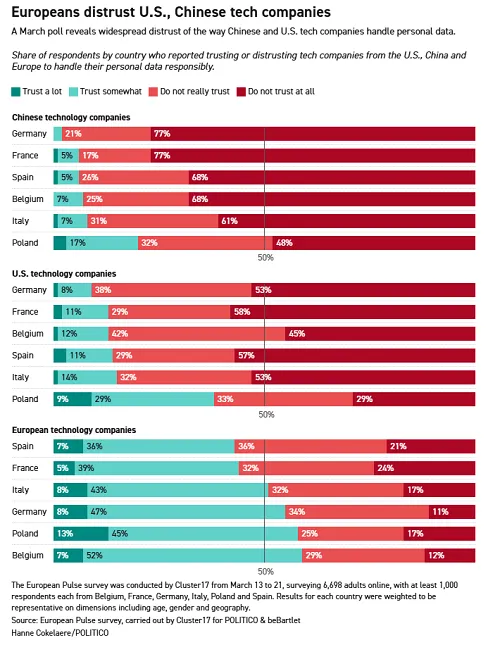
The survey also found that trust in EU-based technology companies is far higher. It’s possible that’s a result of the EU Commission’s ongoing efforts to regulate data protection and ensure that EU users are able to maintain a level of control over how their information is used by the tech giants.
This is why those cookie acceptance pop-ups appear on every website. The EU GDPR regulations mean that all EU-based visitors need to have the option to restrict cookie tracking if they so choose.
So while cookie pop-ups do add an extra level of friction to the web browsing experience, the data shows that EU users still remain skeptical of data usage by foreign providers. This would suggest that there is also a level of support for these types of control measures.
Though the EU, like all regions, has also been accused of implementing regulatory measures that can work as taxes on foreign companies, with U.S.-based social media platforms effectively killing off local ad markets.
The rise of social media platforms has also led to an increased interest in using them as outreach tools. That has gradually led to more ad dollars shifting away from local publishers. It has also forced many local publishers to shutter as a result. Given the influence of these outlets on local voter behaviors, logically, politicians have an incentive to prop these publications up however they can, which has led to the development of various systems designed to extract money from Meta and others, which can then be fed back into the local ad sector.
Australia’s News Media Bargaining Code is one example. Its approach effectively forced social media apps to pay local publishers for any use of their content, including links to their sites.
Yet that approach hasn’t worked, at least not to the scale that Australia-based regulators had hoped it would. In response to the initial proposal, Meta restricted Australia-based news publisher content from its platform entirely. Over time, Meta also deprioritized news links in its apps and is now looking to stop payments under this process.
Canada tried a similar approach in 2023, with its Online News Act. Links from local news publishers have been banned on Facebook since that passed.
EU regulations are different, in that the primary emphasis is on the use of EU user data, as opposed to a scheme that would feed money directly back to local publishers. But EU regulators have also been accused of the same, in using these rules and legal approaches to essentially penalize Meta, in particular, for its success in the local media market.
The U.S. government has also criticized this. U.S. President Donald Trump even threatened sanctions against Europe in response to any rules that penalized U.S. businesses.
There’s been no escalation along these lines as yet, but the White House made its opposition to such approaches clear. This could eventually lead to more significant conflict if EU regulators continue to issue large-scale penalties against U.S. businesses.
But the data in Politico’s survey underlines why EU regulators are pushing ahead with these laws. Outside of the U.S., significant concerns remain about data misuse and how social platforms can extract and utilize personal information.
So while those pop-ups might be annoying, they exist for this reason, and the relative concern remains high among EU users.