


Meta CEO Mark Zuckerberg seems to have an odd obsession with replacing himself with an artificial intelligence-powered duplicate, and potentially also allowing others to create digital replicas of themselves that will be able to interact with people on their behalf.
Today, the Financial Times reported that Zuckerberg is developing an AI clone version of himself, which is being trained on his mannerisms and conversation style. Supposedly, the bot will eventually be able to interact with Meta employees, giving them more opportunity to connect with the Meta founder.
Of course, people won’t be engaging with Zuckerberg, but an AI depiction, which doesn’t seem like it will have the same resonance, or relevance, in practice.
But still, Zuckerberg is very keen on building AI clones of both himself and others, which he seemingly believes will offer some value within the broader social experience.
This is not the first time the concept has been floated by Meta.
In 2024, Meta launched its AI Studio platform, which enables creators on Instagram to build AI versions of themselves that can interact with fans via DM.
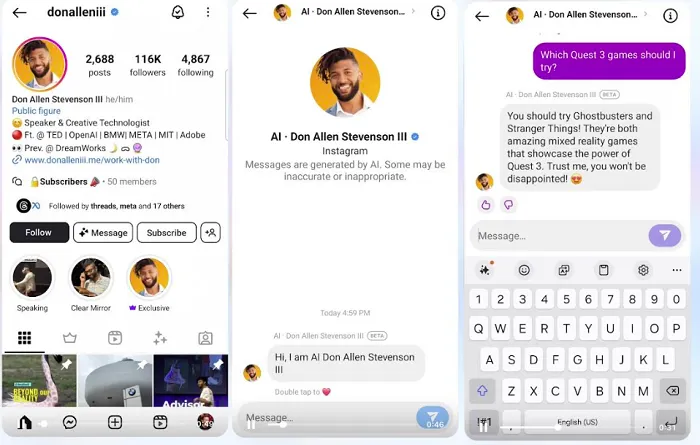
Meta has also been working on tools to generate video versions of influencers that can interact in the same way. It’s also built a coupld of different versions of AI chatbots based on celebrities, which aim to provide some form of additional connection for fans and let them interact with a version of each star at any time.
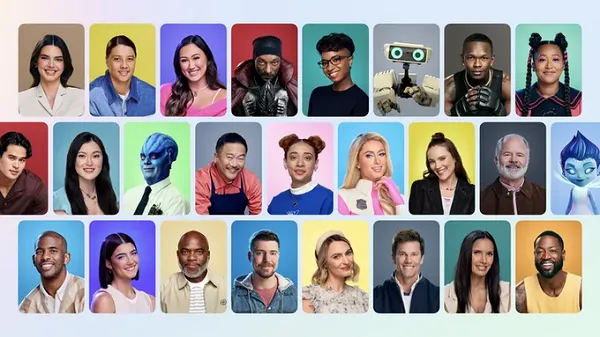
But users of these tools aren’t really engaging with these celebrities, or indeed, anybody at all. Instead, users are inputting queries into a digital database, which then converts those queries into answers that mimic the conversation style of these people.
Zuckerberg’s own AI approach is somewhat different, in that he’s been training his AI clone to essentially do parts of his job for him, by tracking all of his daily processes and responses in order to replicate his way of thinking.
In this sense, the expansion into having an AI depiction of himself that can interact with people may just be a bonus. But even so, it is strange that Zuckerberg is so keen to use AI-powered systems to replace real people, and potentially disrupt the value of connectivity that he’s built a multi-billion dollar empire around.
This plan also extends to regular people. Meta is reportedly developing AI-powered bot profiles that will simulate conversation on Facebook and Instagram through increasingly life-like engagements.
This is all tied back to the company’s quest for “superintelligence” and building digital systems that can replicate the human brain.
That’s a more ambitious goal, which is well beyond the data connections that power current AI systems. But replicant projects like this could provide another step towards building AI tools that can pass as human, and which could eventually be able to replicate actual human thinking based on interactions with real people.
Maybe that’s the whole aim, to get these AI clones engaging in conversation as part of a broader development approach that will better align them with real human interaction and engagement.
But still, it’s concerning that one of the richest, most powerful people in the world is working to find ways to dilute humanity, even his own, through AI advancement.
Does society really want a future based on interacting with human-trained AI clones?
Why would people want to engage with a bot that sounds like a person, rather than an actual human? Why would a social media company, founded on human connection, be actively seeking ways to replace those same connections with artificial versions?
This, once again, feels like a clash between the optimization mindset of engineering folk and the way people actually interact. Sure, engineers can create systems that will replicate people, but is that a good thing? Is that what these big tech giants are investing hundreds of billions of dollars to achieve?
And if they are, then what’s the end game? An online world totally populated by bots talking to other bots, where actual human interaction becomes a novelty?
With advancing AI technology, this seems totally plausible, but haven’t users spent years, virtually the entire existence of social media, complaining about how bots ruin the experience?