


Snap Inc., the parent company of Snapchat, has published its Q1 2026 earnings report, which shows a continued decline in usage in its key markets, though its ad business remains steady.
First off, on users. Snapchat added 9 million more daily active users over its Q4 count, taking it to 483 million total DAU. That’s a significant result, considering that Snapchat lost 3 million users, quarter-over-quarter, in the last reporting period.
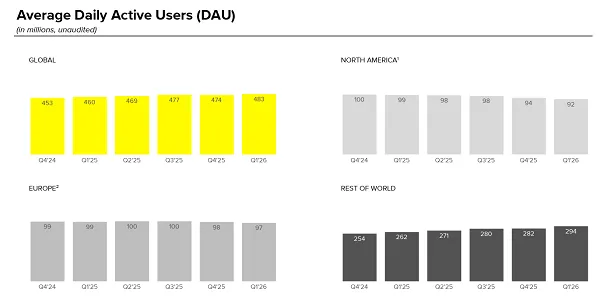
The topline growth, however, isn’t reflective of Snap’s key markets.
In the North American market, where Snapchat generates the majority of the platform’s income, the app’s daily usage declined by another 2 million, sliding to 92 million DAU, while in the EU, Snap usage shrunk by a million people versus the previous quarter.
In other words, all of Snap’s growth is coming from regions where it’s still developing its business tools, and doesn’t generate as much income.
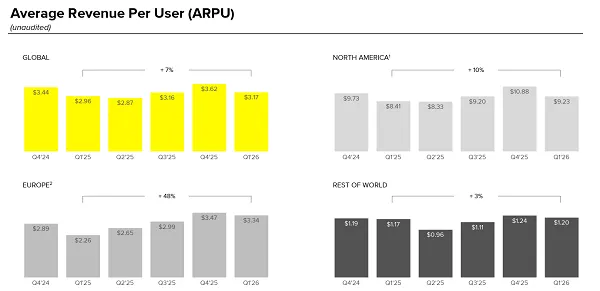
Snapchat is improving on this front, but as the above chart shows, Snap is still generating significantly less revenue per user in the markets where it’s seeing growth.
So while overall growth is a positive note, it’s still somewhat problematic for Snap, unless the platform can find a way to generate more income from these users.
Another key challenge for Snap is the increasing push for increased age restrictions on social media use. Many regions are looking to follow Australia’s lead in implementing bans for users under the age of 16, in order to limit the negative impacts of social media use and exposure.
That could hurt Snap more significantly than other platforms, given its popularity among younger audiences.
In February, Snapchat reported that Australia’s teen ban had forced it to lock or disable the accounts of 415,000 users. That’s in a nation with a population of around 27 million, so it’s not hard to imagine the expanded impact teen bans would have in, say, Germany (84 million population), the U.K. (69 million) or Spain (49 million), all of which are also considering teen social media bans.
The cumulative effect, then, could have a major impact on Snap’s broader growth plans, which is another significant risk factor for the app.
Snapchat also reported that monthly active usage increased to 956 million overall, up from 946 million in Q4.
On the revenue front, Snapchat brought in $1.53 million for the quarter, which represents a 12% year-over-year increase.
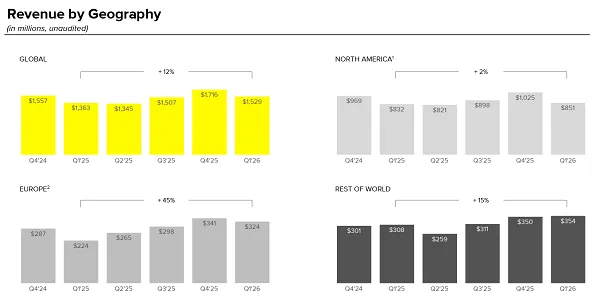
Snap said that Sponsored Snaps drove strong performance gains, while its Dynamic Product Ads revenue grew more than 30% year-over-year, and saw particular growth among SMB customers.
So Snap is diversifying its ad revenue, and driving more gains with a broader range of brands. Though its growth, at present, is steady, and future expansion will be tied to overall usage to a significant degree.
Essentially, Snapchat needs to maximize its business opportunities in more regions, because its declining usage in the U.S. and EU will limit its capacity.
Also, its costs remain high:
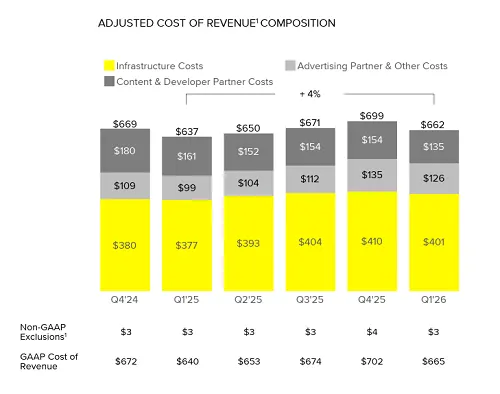
Snapchat has been working to cut costs, and improve its overall viability, as it continues to develop its ads business, and build on its existing opportunities.
But the challenge is clear.
Snap CEO Evan Spiegel has called this a “crucible moment” for the app, as it works to compete with the tech giants, while also fending off competition from rising startups looking to tap into its core market.
And while Snapchat’s growth has essentially slowed, and reversed in key markets, it is still a key focus app for many users. The problem for Snapchat is that it doesn’t remain a critical app as those same users shift into older demographics, so its opportunity is inherently limited, meaning its market capitalization is also confined to some degree.
Snap has been trying to buck this, by finding new ad opportunities, like ads in user DMs, and expanded placements to help advertisers reach its influential audience. But that also has an upper limit, and it seems like only a matter of time before Snap users start to complain about the influx of ads interrupting their connective experience.
And looking at Snapchat’s overall growth strategy outline, which it presented to investors last month, it does seem like it’s going to be tough going.
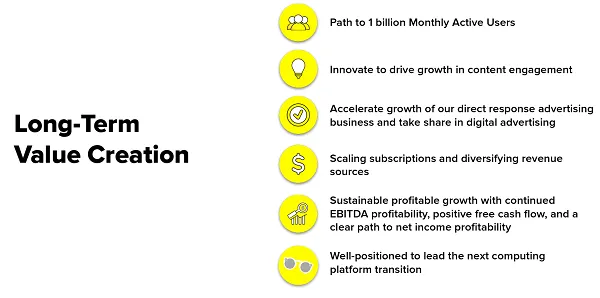
Snapchat is still progressing towards the first goal here, though as noted, its growth in its major markets is going backwards, so that may not end up being as impressive as the topline figure suggests.
Snapchat’s innovation also hasn’t evolved a lot in recent years, beyond adding Spotlight, which it copied from TikTok. And while subscription revenue is growing, Snapchat+ income is never going to compare to its ad intake.
Which then leaves improved performance in driving more advertiser interest, which could become a problem if users get sick of so many ads.
And then it’s AR glasses, which Snap is still looking to launch this year.
But Snapchat’s chunky, heavy AR device looks set to be inferior to Meta’s AI glasses right off the bat, and even with advanced AR functionality, I’m not sure that there’s going to be big consumer demand for the device.
And if Meta releases its own AR glasses in 2027, as it has planned, I don’t expect Snap’s AR wearables to be a big winner either.
So Evan Spiegel is right, this really is a crucible moment, in regards to it being a major test of Snap’s capacity to compete. Now, we wait and see what comes next.