


Since this has been a key talking point in social media circles over the last week, it’s worth discussing the merits of the latest “Facebook is dead” proclamations.
Last week, the New York Times published an opinion piece by Julia Angwin in which she argued that Meta’s recent decline in daily active users is the beginning of the end for Facebook, and for the company in general.
Angwin said that Facebook is now entering its “zombie era,” largely because young users view the platform as “peak cringe.”
As per Angwin: “Death is different on the internet. Lifeless companies like AOL and Yahoo are still technically with us. You can visit their websites. They have customers. They may even be profitable, as they cut staff and monetize their last remnants of traffic. … As a company’s brand ages, its founders leave. The excitement evaporates. The stock shrivels to a fraction of its former glory as the user base withers to those captured by an old email account or friend group.”
Angwin predicted that, based on the declining popularity of Facebook, its flagship social media platform, Meta “is at the start of a long, slow decline that will trigger aftershocks to our economy and our society.”
But is that true? Could Meta actually be on the way out, based on a three-month tally of daily active user decline, which is also the first time there has been a decline like that in the company’s history?
In some ways, Angwin has some valid points. But overall, it’s far too early to be sounding the alarm on the business.
Yes, Meta’s daily active user count did decline in Q1 2026, with 20 million fewer people combined logging into Facebook, Instagram, WhatsApp, Messenger and Threads in the first three months of this year, compared to Q4.
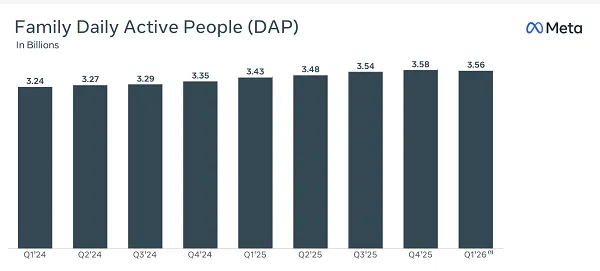
Twenty million people is a lot, but at Meta’s scale, it’s only a small fraction of its overall audience.
The population of the world is around 8.3 billion people, according to Worldometer, so even at 3.56 billion daily active, almost half of the entire population of the planet is still checking into a Meta-owned platform every single day.
Though that’s not really Angwin’s point. As Angwin said, it’s not necessarily about user counts, as there are clearly a lot of people who still check into Facebook every day to see what their friends and relatives have posted. It’s more about resonance, and on that front, this is a valid argument.
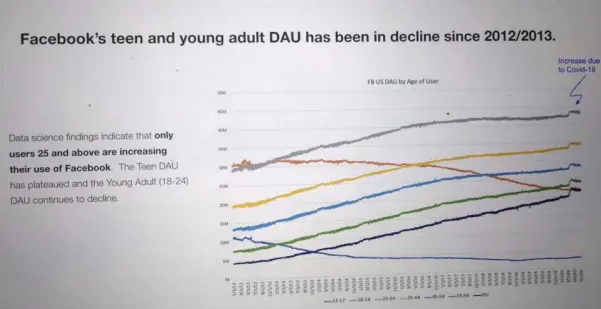
Meta’s active usage among younger audiences has been in decline for years. Data released as part of the Facebook Files expose in 2021 showed that the app has seen declining usage among people aged under 25 for some time.
Meta also shared data last year as part of its defense against an antitrust case brought by the FTC. That data showed that user posting has declined significantly in recent years, with time spent viewing content posted by friends now only a minor element of FB and IG.
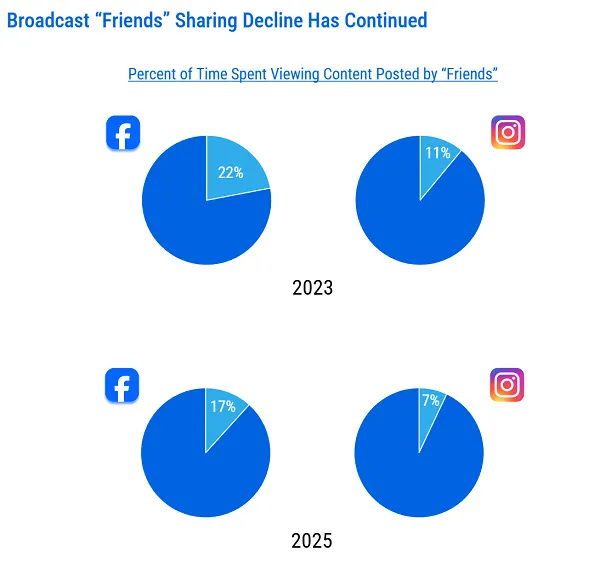
The reason for using Facebook, in particular, has evolved significantly, with people now spending more time on TikTok and Instagram than they are checking out Facebook posts and clips.
In broader terms, the whole concept of social media has shifted more towards entertainment than connection, which is a more fundamental shift. But that also means that while people are still logging onto Facebook, most are only checking out if their friends and family have shared any updates. Then they move onto other apps where they spend more time.
So in that respect, Angwin’s argument holds some weight, in that Facebook itself is less relevant than it once was, based on overall engagement per user per session.
But that’s also why Meta is looking to the next stage, and investing heavily in the latest technological developments, in order to ensure that it can remain a relevant, valuable connective platform for the next stage of digital interactivity.
In this respect, it’s also easy to point to the perceived failure of the metaverse as another signal of the company’s potential decline. But the fact that Meta was able to spend over $100 billion on VR development, and then pivot to AI, underlines the fiscal strength of its business, as well as the capacity it has to take on such bets.
Eventually, if these artificial intelligence investments don’t pay off, that will be a major concern for the business. But Meta made $200.97 billion in 2025, representing a 22% year-over-year increase. In addition, the company has basically destroyed the local ad businesses in many regions.
To suggest that Meta, as a company, could be on its way towards obsolescence seems more like clickbait than anything else.
Meta is investing in the technologies that are most likely to take the mantle in the next era. And while the company may have deprioritized VR, Meta is still exploring the potential of VR connection, which could still be the next logical evolution of online interactivity. At the same time, Meta is investing in AI-powered wearables, and advancing them with AR overlays, which Meta CEO Mark Zuckerberg believes could eventually see these glasses supersede phones as our key connective device.
Will that bet prove correct? There’s no way to be certain, but it seems likely, given the rising adoption of AI glasses: According to CNBC, Meta sold 3x more pairs of smart glasses in 2025 than it did in 2023 and 2024 combined. In addition, the company is also looking to lead the way on AI development, and even recently acquired a humanoid robot company, eyeing another potential opportunity.
With its resources, Meta has the power to dominate virtually any tech trend moving forward, while its ad business continues to drive more intake. It’s also reducing staff costs by integrating more AI systems. Overall, it’s hard to see Meta falling away anytime soon.
Facebook may be declining in relevance, but it’s still a critical connector for more than half of the people who access it. On that front, suggesting that Facebook is on the decline is not a new take, nor is it the focus of Angwin’s post.
The title of the article is “Meta is dying.” Which is an absurd, attention-seeking suggestion.