

An AI automation agency helps a business turn repeated manual work into reliable workflows that use automation, AI, and software integrations. It does not only “set up AI tools.” It studies how work moves, where people lose time, which systems need to talk to each other, and where AI can make a useful decision.
This topic matters because AI has moved from test projects into daily operations. McKinsey’s recent State of AI survey found that 88 percent report regular AI use in at least one business function. Yet adoption does not always create value by itself. IBM notes that only around 25% of AI initiatives deliver expected ROI. That gap explains why many companies now look for partners who can connect AI to real business workflows.
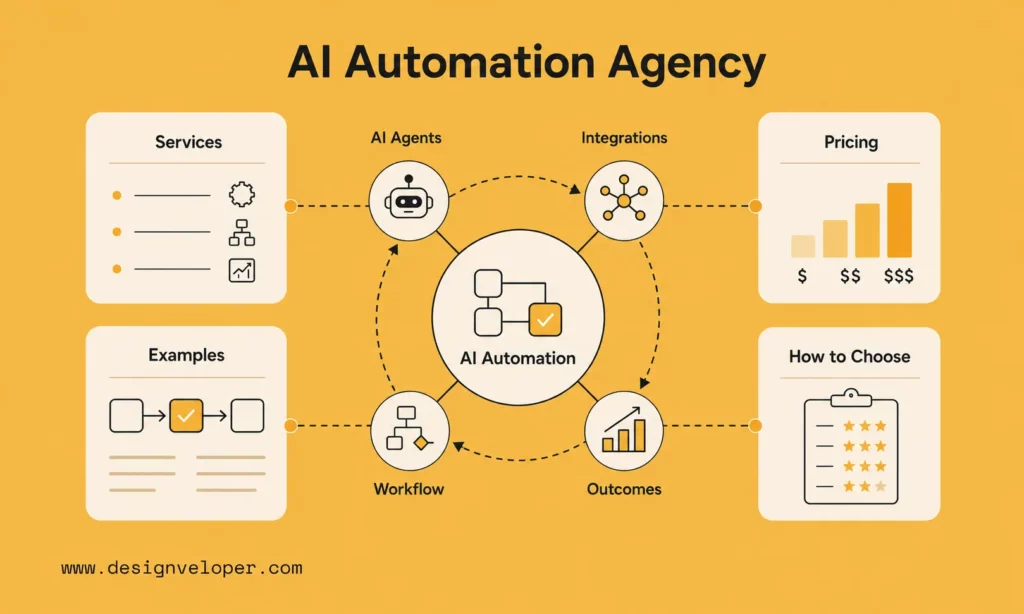
This guide explains what an AI automation agency does, which services matter, how pricing works, what examples look like, and how to choose the right partner. It also covers the AI automation agency business model and gives a short founder-focused note on how to start an AI automation agency without confusing buyer intent.
- An AI automation agency should start with workflows, not tools.
- The best projects have a clear trigger, AI step, system action, and KPI.
- Pricing depends on complexity, integrations, governance, and support.
- Good agencies prove delivery skill through process logic, not only demos.
- The safest first project is usually one narrow workflow with measurable value.
What Is an AI Automation Agency?
1. Direct Definition
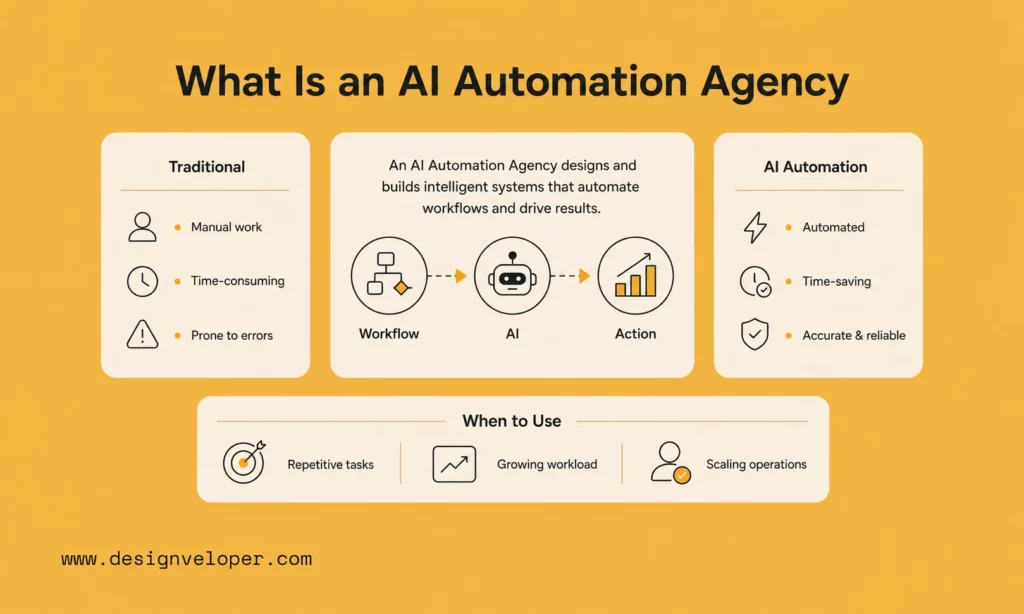
An AI automation agency is a service partner that helps companies design, build, launch, and maintain workflows powered by AI and automation. It usually combines process mapping, software integration, AI model setup, data handling, testing, documentation, and support.
The keyword “what is ai automation agency” often appears because the market uses many similar names. Some vendors call themselves AI consultants. Some call themselves automation experts. Others sell chatbots, agents, or no-code workflows. The real difference is scope.
A serious AI automation agency does not stop at advice. It turns a repeated business process into a working system. For example, it may automate lead qualification, support triage, invoice extraction, employee requests, sales follow-up, or internal reporting. Then it connects that workflow to tools such as a CRM, help desk, database, email platform, internal app, or dashboard.
2. How It Differs From a Traditional Automation Agency
A traditional automation agency usually builds rule-based workflows. These workflows follow fixed logic. For example, if a form arrives, send an email. If a task changes status, notify a manager. This still matters because many business tasks need simple routing.
However, AI automation handles messier inputs. It can summarize text, classify intent, extract fields, score urgency, draft replies, detect anomalies, or choose the next step based on context. This makes it useful when work depends on human interpretation.
| Partner Type | Best At | Weak Point | Buyer Fit |
|---|---|---|---|
| Traditional automation agency | Fixed triggers, rules, notifications, and simple routing | Less useful when inputs are unstructured | Teams with clear and stable processes |
| AI automation agency | Workflows that need interpretation, drafting, scoring, or AI-assisted decisions | Can become risky if the process is vague | Teams with repeated manual work across several systems |
| No-code freelancer | Fast experiments and simple internal automations | Limited governance, testing, and handoff | Small teams with low-risk workflows |
| AI strategy consultant | Roadmaps, audits, and opportunity planning | May not own implementation | Executives who need strategy before build work |
3. When a Business Needs One
A business usually needs an AI automation agency when the same process slows down teams every week. The issue often appears as delayed responses, duplicate data entry, long approval cycles, manual reporting, or too much coordination across email and chat.
The best signal is not interest in AI. The best signal is process pain. If a team can name the bottleneck, estimate its impact, and give access to the systems involved, an agency can usually move faster.
Here are practical signs that a company is ready:
- The workflow happens often enough to measure time savings.
- The team already knows where the bottleneck sits.
- The work crosses several tools or departments.
- Employees spend time copying, checking, routing, or reformatting data.
- Managers need better visibility into process status.
- The company wants implementation support, not only AI advice.
AI Automation Agency Services
1. Workflow Automation and Process Design
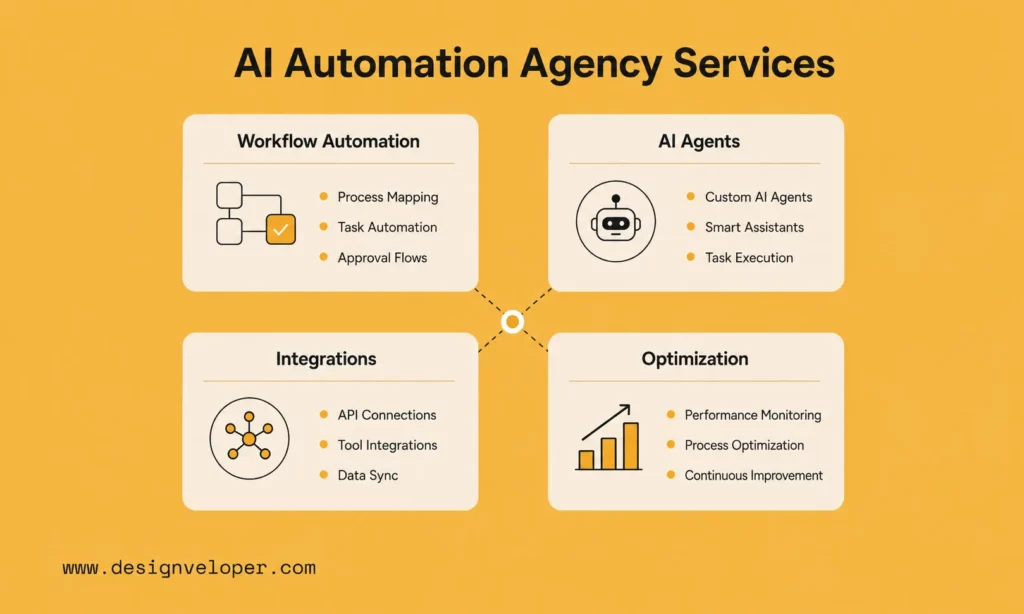
AI automation agency services should begin with workflow design. This step maps the current process, finds waste, defines the target state, and decides where AI adds value. Without this step, teams often automate broken work.
A good agency asks simple but important questions. What starts the workflow? Who owns the next step? Which tool holds the source data? Which decisions need human review? What happens when AI confidence is low? These questions make the final system safer and easier to support.
Common deliverables include:
- Workflow map and bottleneck analysis
- Automation scope and delivery plan
- Trigger and routing logic
- AI decision points and review rules
- Integration plan across business tools
- Testing checklist and launch plan
2. AI Agents and Assistants
Many buyers contact agencies because they want an AI agent. However, a strong agency first checks whether the workflow truly needs an agent. Some tasks only need rules. Others need an assistant that suggests actions. A smaller group needs an agent that can take action under guardrails.
Gartner has warned that over 40% of agentic AI projects will be canceled by the end of 2027. This is why agencies must be careful. A chatbot demo is easy. A production agent that handles permissions, errors, fallback paths, and audits is much harder.
Useful AI agents and assistants often support tasks like these:
- Answering employee questions from internal knowledge
- Drafting support responses with account context
- Summarizing calls and creating CRM notes
- Classifying tickets and routing them to the right team
- Extracting document fields for human approval
- Suggesting next actions for sales or operations teams
3. Integration and Orchestration
Integration is where many AI projects become real. A workflow only creates value when it moves information between the right systems. That may include CRMs, help desks, ERPs, HR tools, spreadsheets, knowledge bases, payment systems, data warehouses, or custom apps.
AI can read, classify, draft, or recommend. Yet business value appears when the workflow also updates records, creates tasks, routes exceptions, logs decisions, and alerts the right owner. This is why orchestration matters.
| Service Area | What the Agency Builds | Business Value | Risk to Manage |
|---|---|---|---|
| Workflow automation | Triggers, routing rules, approvals, notifications, dashboards | Less manual coordination | Automating a weak process |
| AI assistant | Knowledge search, summaries, drafts, recommendations | Faster employee or customer response | Incorrect answers without review |
| AI agent | Multi-step actions under permissions and guardrails | More complete task execution | Too much autonomy too soon |
| System integration | APIs, webhooks, data sync, access logic, monitoring | Connected operations across tools | Hidden integration debt |
| Managed optimization | Logs, tuning, reports, fixes, governance updates | Stable performance after launch | No clear long-term owner |
4. Maintenance, Governance, and Improvement
AI automation does not end at launch. Workflows change. Teams add tools. Policies shift. Users find edge cases. Model behavior can also drift when prompts, data, or upstream systems change.
That is why a mature agency offers post-launch support. This may include monitoring, prompt tuning, error handling, documentation, user feedback review, and workflow updates. It may also include governance rules such as permission checks, human review thresholds, audit logs, and incident handling.
IBM’s agentic AI research shows how fast this area is changing. The report says 24% of executives say that AI agents take independent action in their organization. As autonomy grows, governance becomes a core service, not a nice add-on.
AI Automation Agency Examples
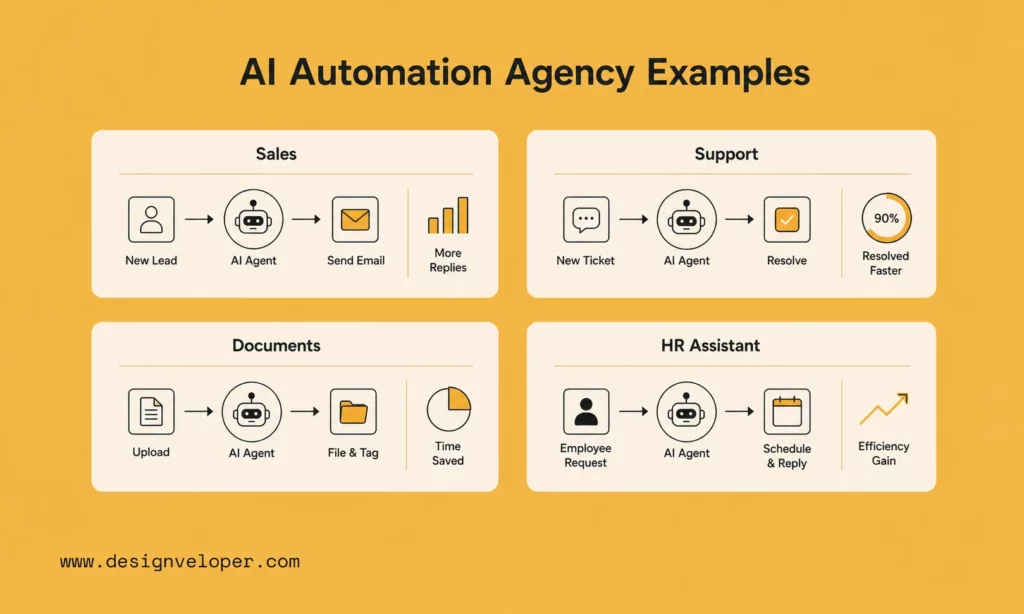
1. Sales Lead Capture and Follow-Up
Sales automation is one of the clearest AI automation agency examples. Many companies lose opportunities because lead handling depends on manual checking, slow replies, or inconsistent CRM updates.
A better workflow starts when a lead submits a form or sends an email. The system enriches the lead, checks fit, summarizes context, drafts a reply, updates the CRM, assigns the right owner, and creates a booking prompt. A human can review high-value or low-confidence leads before outreach.
| Workflow Part | Example |
|---|---|
| Trigger | New inbound form, email, or chat request |
| AI step | Classify intent, summarize need, and draft first response |
| System action | Update CRM, assign rep, and create follow-up task |
| KPI | First-response time, booked meetings, qualified pipeline |
2. Customer Support Triage
Support teams often handle many repeated issues written in different ways. AI helps because it can interpret intent and summarize context before a human agent opens the ticket.
A support workflow may detect the issue type, score urgency, retrieve knowledge, draft a response, and escalate the ticket when confidence is low. The agency should also define sensitive categories. Billing disputes, legal questions, account risk, and angry customers often need human review.
This type of automation can create real operational impact. In one automation case study, Remote reported 2,219 days saved every month across departments. The lesson is simple. The strongest results come from repeated tasks with clear workflow ownership.
3. Document and Back-Office Automation
Back-office teams spend time reading documents, copying fields, checking exceptions, and routing approvals. AI can reduce that load when the agency designs the workflow carefully.
For example, an invoice workflow may ingest a document, extract fields, compare them with purchase data, flag anomalies, route exceptions to finance, and update the accounting system after approval. The AI step handles interpretation. The workflow logic handles control.
This pattern also fits contracts, onboarding forms, insurance documents, expense claims, tax records, and compliance packets. However, the agency must add human review for edge cases. Document automation works best when the system supports people instead of hiding risk.
4. Internal HR and Operations Assistants
Internal assistants reduce repeated questions and small requests. They can answer policy questions, route leave requests, check onboarding steps, or help employees find the right internal resource.
A practical HR assistant should not act like a public chatbot. It should respect permissions, use approved knowledge, log requests, escalate exceptions, and connect with HR systems when actions require approval.
This is where Designveloper has relevant implementation proof. We bring delivery experience from 100+ projects across 20+ industries, including public examples around AI financial assistance, document intelligence, and internal workflow automation. For buyers, that kind of proof matters because AI automation needs both software delivery and process thinking.
AI Automation Agency Pricing
1. Why Pricing Varies So Much
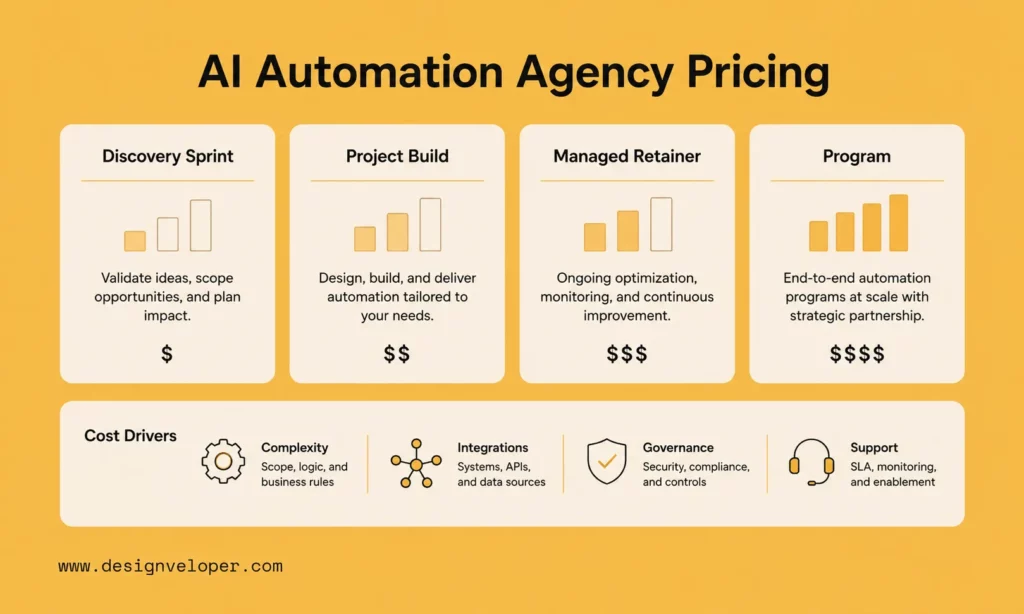
AI automation agency pricing varies because every workflow has different complexity. A simple internal automation may need a few tool connections. A production AI assistant may need knowledge setup, permission logic, testing, user training, monitoring, and long-term support.
Public pricing data for pure AI automation agencies is still uneven. However, AI development pricing gives useful context. Clutch’s pricing guide says AI development projects reviewed on Clutch range anywhere from $10,000 to $49,999. This does not mean every automation project fits that range. It only shows why buyers should expect pricing to depend on scope.
The best agencies do not quote before discovery. They first define the workflow, systems, users, data, risks, and success metrics. Then they recommend a delivery model.
2. Main Pricing Models
Most AI automation agencies use a mix of fixed-scope projects, discovery sprints, retainers, and program-level roadmaps. Each model fits a different buyer stage.
| Pricing Model | Best Fit | What the Buyer Gets | Main Watchout |
|---|---|---|---|
| Discovery sprint | A team knows the pain point but not the solution | Workflow audit, scope, architecture, and roadmap | Should lead to a clear build decision |
| Fixed-scope project | The workflow is narrow and well understood | A working automation or assistant with agreed deliverables | Change requests can expand cost |
| Managed retainer | The company expects ongoing tuning and more workflows | Support, monitoring, updates, and backlog delivery | Scope must stay visible |
| Program partnership | Automation spans teams, systems, and long-term change | Roadmap, implementation, governance, and improvement cycle | Requires executive ownership |
3. Cost Drivers Buyers Should Check
Price usually rises when the workflow has more systems, more edge cases, more compliance pressure, or more users. AI itself may not be the hardest part. The surrounding process often creates the real work.
Key cost drivers include:
- Workflow clarity: unclear processes take longer to automate.
- Integration depth: more tools mean more testing and failure handling.
- Data quality: messy inputs reduce automation reliability.
- AI autonomy level: suggested actions are safer than automatic actions.
- Security needs: permissions, logs, and audits add delivery work.
- Human review design: sensitive decisions need strong escalation paths.
- Post-launch support: workflows need tuning after real users touch them.
4. A Simple ROI Framework
A buyer should estimate value before buying. Start with the workflow volume. Then estimate the time spent per case, the cost of delays, the error rate, and the value of faster action. This creates a practical business case.
The logic is simple. If the workflow happens often, consumes skilled time, creates delays, or affects revenue, automation can justify more investment. If the workflow is rare or unclear, start smaller.
Buyers should ask the agency to define success before launch. Good success metrics include response speed, cycle time, handoffs removed, manual touches reduced, backlog cleared, conversion improved, and service quality stabilized.
How an AI Automation Agency Works With Clients
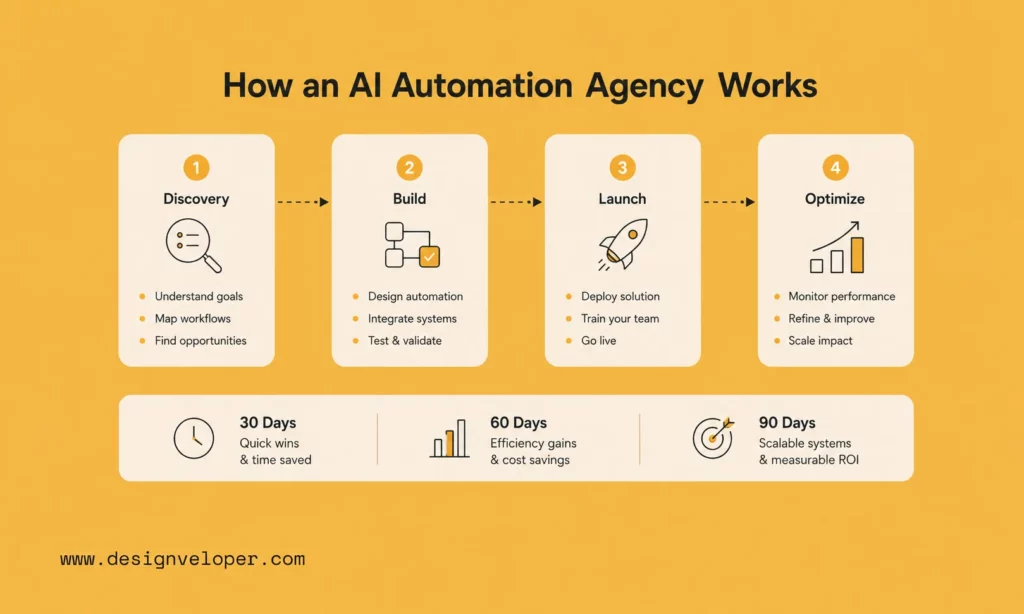
1. Discovery and Workflow Audit
The first phase should identify the workflow that deserves automation. The agency should interview process owners, inspect tools, review sample data, and define the current pain. This prevents tool-first thinking.
A good discovery phase produces a workflow map, key bottlenecks, required integrations, data needs, risk points, and a recommended scope. It should also state what not to automate yet. That decision saves time.
2. Build and Integration
The build phase turns the workflow plan into a working system. The agency may configure automation tools, write custom code, connect APIs, design prompts, set guardrails, and create dashboards or admin views.
Testing matters here. AI outputs can look correct while still missing context. Zapier found that 58% spend 3+ hours weekly fixing AI workslop. That is why agencies should test real cases, not only ideal examples.
3. Launch and Human Review
Launch should start with controlled use. The team can run the workflow with review steps before giving the AI more freedom. This helps users trust the system and catch edge cases early.
The agency should define human override rules. It should also log failures, unclear inputs, manual edits, and user feedback. These signals show where the workflow needs improvement.
4. Optimization and Ownership
After launch, the agency should help the client decide who owns the workflow. Some companies keep the agency on a support retainer. Others train an internal operations or IT owner. Both can work if documentation is clear.
Ownership should cover prompt updates, access control, integration errors, tool changes, reporting, and user requests. Without ownership, the system slowly becomes less reliable.
How to Choose the Right AI Automation Agency
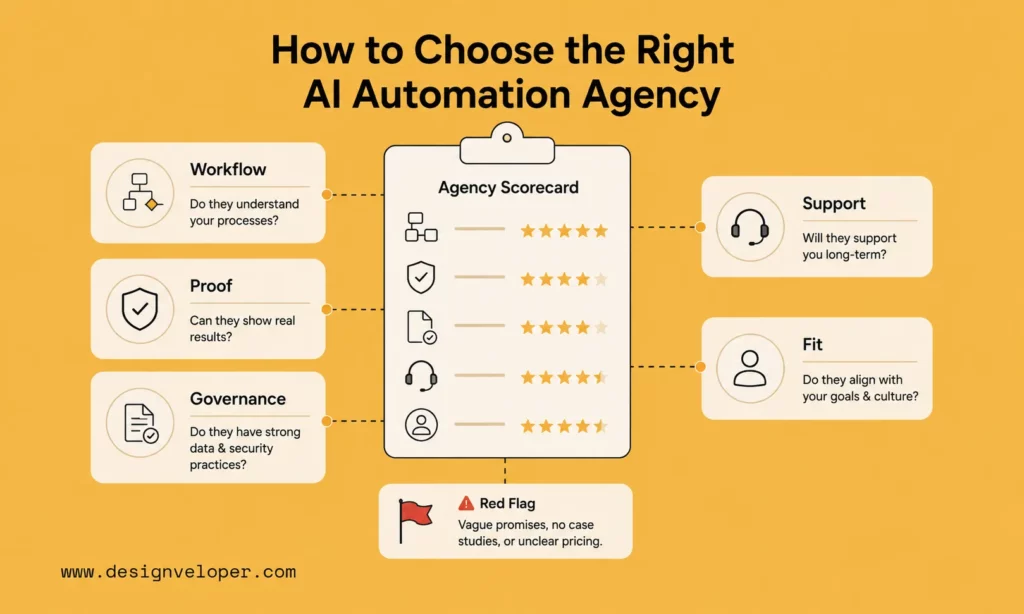
1. Evaluate Workflow Thinking First
The best agency starts with the process. It asks where work starts, what decisions happen, who approves exceptions, and which systems must update. This shows practical maturity.
A weak agency starts with a demo and forces every problem into a chatbot or agent. That can impress during a sales call. It often fails during daily use.
| Evaluation Area | Strong Signal | Red Flag |
|---|---|---|
| Workflow understanding | Starts with bottlenecks, owners, inputs, and outcomes | Starts with tool names only |
| Delivery process | Explains discovery, build, test, launch, and support | Promises fast results without scope clarity |
| Governance | Defines review rules, permissions, logs, and fallbacks | No clear answer on risk or failure handling |
| Integration skill | Understands APIs, data sync, and system ownership | Treats automation as a standalone bot |
| Commercial fit | Matches pricing model to scope and support needs | Sells one package to every buyer |
2. Ask Better First-Call Questions
Good questions reveal whether the agency can deliver beyond a demo. Buyers should ask about process, risk, ownership, and measurable outcomes.
- Which workflow would you automate first, and why?
- Which steps should stay under human review?
- Which tools and systems need to connect?
- What data do you need before build work starts?
- How do you handle failed runs or low-confidence outputs?
- What documentation will our team receive?
- Who owns monitoring after launch?
- Which KPI should improve first?
3. Compare Agency, In-House, and DIY Options
Not every company needs an agency. Some teams can automate internally. Others only need a simple no-code workflow. The right choice depends on urgency, complexity, control, and long-term ownership.
| Delivery Model | Best Fit | Main Benefit | Main Trade-Off |
|---|---|---|---|
| Agency | Teams that need speed, integration skill, and outside delivery support | Faster path to implementation | Requires strong handoff and scope control |
| In-house team | Companies that treat automation as a core capability | More control over long-term systems | Needs hiring, training, and internal capacity |
| DIY no-code | Simple workflows with low risk | Low friction and fast experimentation | Can become hard to govern at scale |
AI Automation Agency Business Model
1. How Agencies Usually Make Money
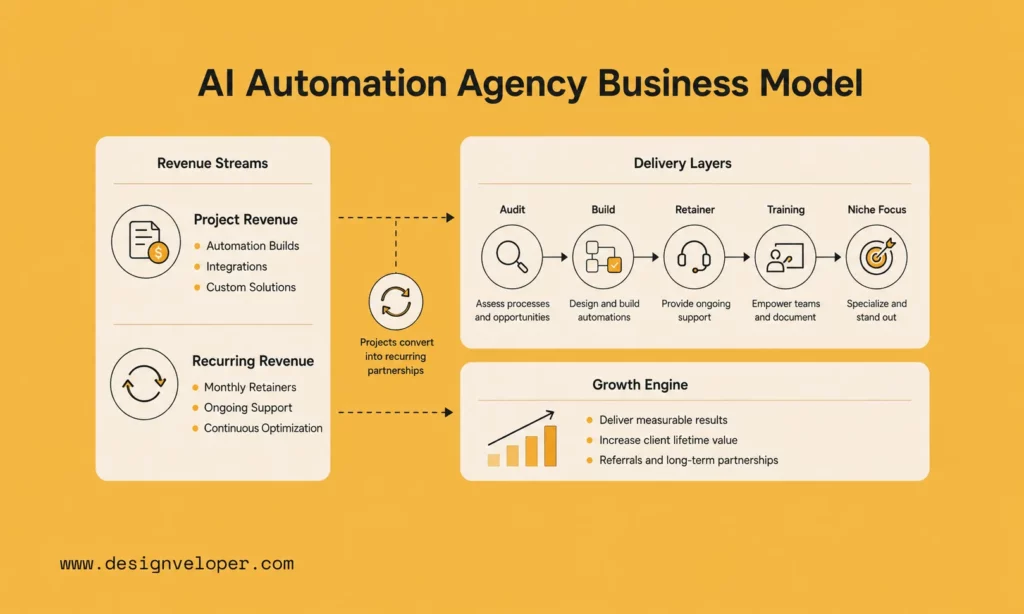
The AI automation agency business model usually combines consulting, implementation, and ongoing support. The agency sells expertise, delivery capacity, and operating reliability.
Some agencies focus on one niche, such as sales automation or customer support. Others act as broader implementation partners. The strongest model often depends on repeatable workflows. A niche agency can build reusable playbooks, templates, integrations, and support routines. That makes delivery faster and quality more stable.
Common revenue streams include:
- Workflow audits and automation strategy
- Fixed-scope AI automation projects
- Custom software and integration work
- AI assistant or agent setup
- Managed automation retainers
- Training and internal enablement
- Governance, monitoring, and improvement support
2. What Makes the Model Sustainable
A sustainable agency does not sell generic AI hype. It sells workflow outcomes. That difference matters because buyers care about fewer manual steps, faster handling, lower error rates, and better visibility.
The model becomes stronger when the agency has clear delivery standards. It should know how to scope work, test outputs, document systems, price support, and define ownership. It should also avoid over-promising autonomy before the client has enough process maturity.
3. How to Start an AI Automation Agency
The keyword “how to start an ai automation agency” has founder intent, so it deserves a brief but clear answer. To start one, choose a narrow workflow niche first. Then learn the tools, build sample automations, document a repeatable delivery process, and sell outcomes instead of vague AI services.
A practical starting path looks like this:
- Pick one market with repeated manual work.
- Choose one workflow that has clear value.
- Build a demo with real inputs and realistic edge cases.
- Create a discovery checklist for client calls.
- Define what the client receives after each phase.
- Set support rules before launch.
- Collect proof from small projects before expanding.
However, founders should not confuse experiments with production. A buyer pays for reliability. That means security, documentation, error handling, and long-term ownership matter as much as the first demo.
Common Mistakes to Avoid
1. Starting With Tools Instead of Processes
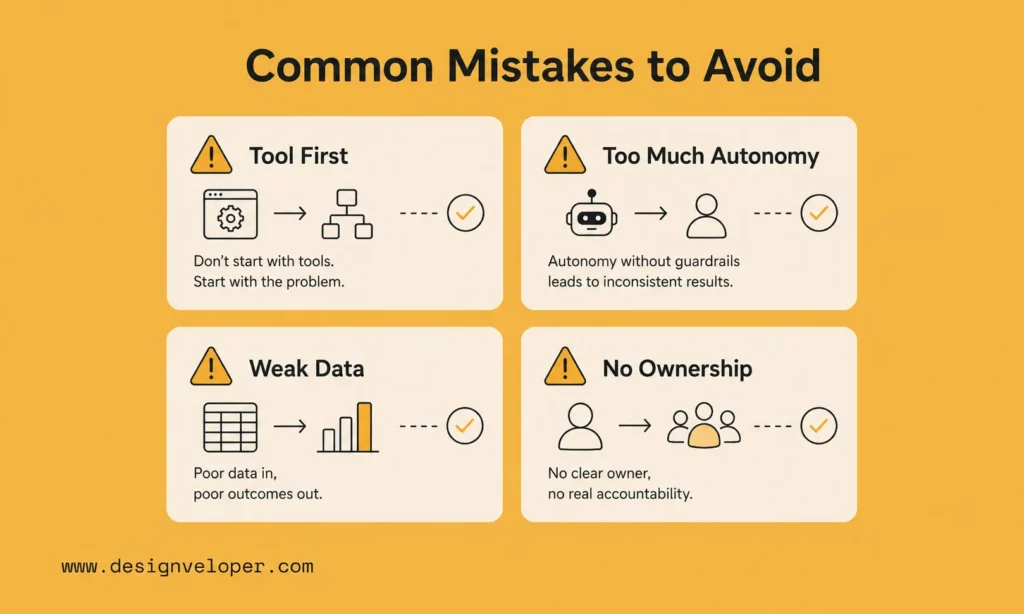
The most common mistake is asking, “Which AI tool should we use?” before asking, “Which workflow should improve?” This creates scattered experiments. It also makes ROI hard to measure.
Start with process pain. Then choose the tool. A small workflow with clear value usually beats a broad AI roadmap with no owner.
2. Giving AI Too Much Autonomy Too Early
AI can assist, recommend, draft, and route. But it should not control sensitive decisions before the business defines guardrails. A safer rollout starts with human review. Then the team can reduce review where the system performs well.
This approach builds trust. It also creates useful feedback for tuning prompts, routing logic, and exception handling.
3. Ignoring Data and Integration Quality
AI automation depends on the systems around it. If CRM data is messy, help desk tags are inconsistent, or knowledge content is outdated, the workflow will suffer.
Good agencies inspect inputs before launch. They also design fallback paths when data is missing. That makes the workflow more resilient.
4. Skipping Post-Launch Ownership
Many automation projects fail after the first version because no one owns improvement. Users change behavior. Tools change fields. Teams add exceptions. Without monitoring, quality drops.
Buyers should decide ownership before signing. The owner may sit inside operations, IT, sales, support, HR, or the agency. The exact team matters less than the clarity of responsibility.
Conclusion
An AI automation agency is right for a business when repeated work slows teams down and the company needs help turning that pain into a reliable system. The best agencies do not sell AI as a trend. They connect workflow design, software integration, AI capability, governance, and support.
The strongest first project is usually narrow. Pick one workflow with clear volume, clear owners, and clear value. Then ask the agency to map the process, define the risks, build a controlled version, and measure the result. This keeps the work practical and avoids AI theater.
Designveloper fits this kind of work as an AI-first software and automation partner. Our team builds custom AI systems, intelligent workflows, web and mobile products, and internal business software around real operations. That approach matters because useful AI automation is not only about prompts. It is about turning business logic into production-ready software that teams can trust, use, and improve.