


AI resume screening is now part of the modern hiring stack. It helps recruiters read, structure, and prioritize resumes faster. It also creates new risks when teams treat a machine score as a hiring decision.
This guide explains what AI resume screening means, how it works, where it helps, where it fails, and what recruiters should look for before using AI resume screening tools. It also explains how candidates can prepare resumes for AI based resume screening without gaming the system.
The pressure is real on both sides. SHRM reported that an estimated 40% to 80% of job applicants use AI to write resumes, cover letters, and interview responses. That makes hiring faster in some ways, but weaker in others. Recruiters now face more polished applications, more repeated language, and more noise at the top of the funnel.
So the right question is not whether artificial intelligence resume screening should replace recruiters. It should not. The right question is how teams can use resume screening AI to narrow the list, improve consistency, and still protect fairness, context, and human judgment.
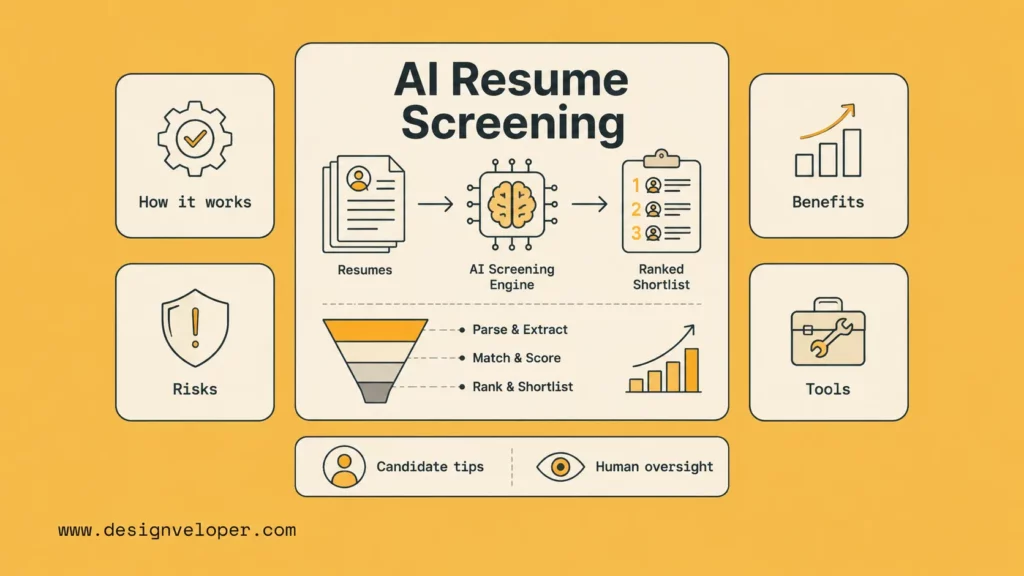
What Is AI Resume Screening?
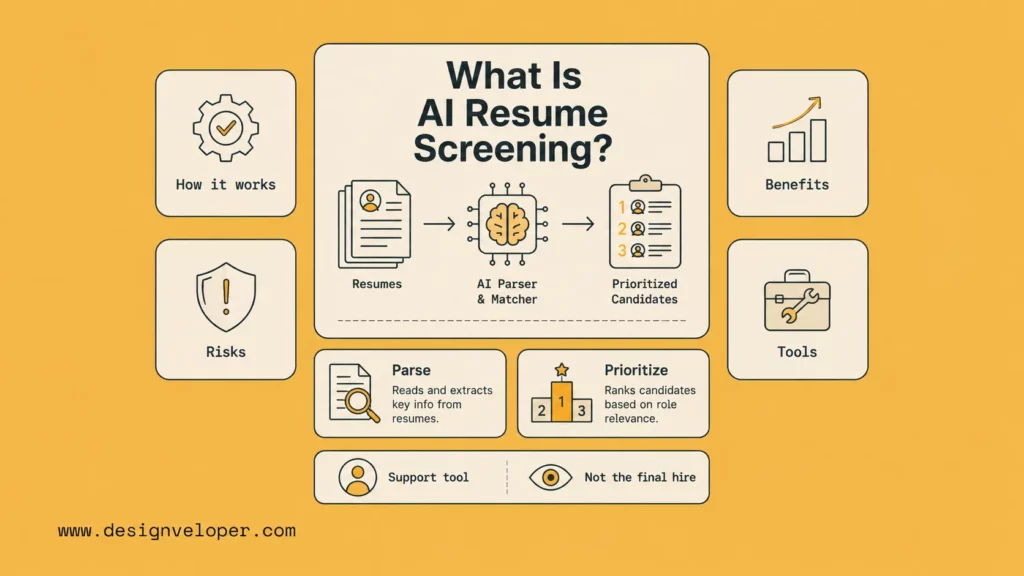
AI resume screening is the use of artificial intelligence to read, extract, compare, and rank candidate resumes during the early stage of hiring. The system turns each resume into structured data. Then it compares that data with job requirements, hiring criteria, and sometimes past hiring patterns.
In simple terms, AI resume screening helps recruiters decide which applications need attention first. It can read skills, job titles, education, certifications, experience, dates, and keywords. More advanced tools can also compare similar skills, detect related experience, and group candidates by likely fit.
AI resume screening is not the same as a basic applicant tracking system. A traditional ATS may store resumes, manage applications, and filter for exact words. Resume screening AI goes further. It may use natural language processing, machine learning, semantic search, ranking logic, or rule-based filtering.
| Area | What AI Resume Screening Does | What It Should Not Do Alone |
|---|---|---|
| Resume parsing | Reads resumes and extracts structured data | Assume every extracted field is correct |
| Candidate matching | Compares skills and experience with role criteria | Judge potential from keywords only |
| Ranking | Prioritizes candidates for recruiter review | Make final hiring decisions |
| Workflow automation | Moves candidates through early funnel steps | Reject edge cases without human review |
This distinction matters. AI resume screening should support a recruiter. It should not become a black box that decides a person’s career path without context.
For employers, the best use case is early funnel triage. For candidates, the main impact is visibility. A resume may still reach a recruiter, but AI may affect when it appears, how it gets grouped, and what evidence the recruiter sees first.
Why Traditional Screening Fails in Modern Hiring
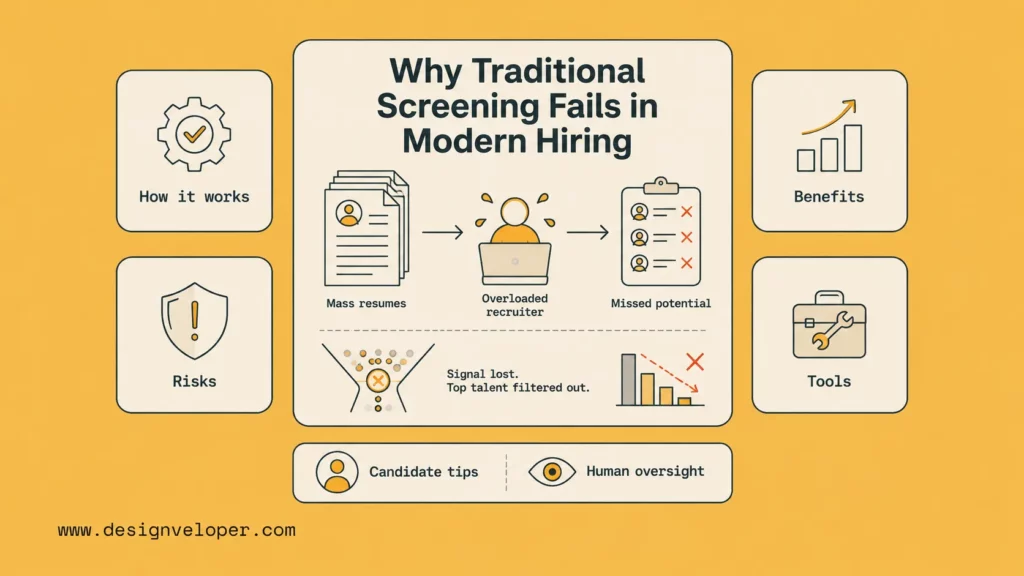
Traditional resume screening fails when application volume grows faster than recruiter capacity. A recruiter can review only so many resumes with full attention. After that point, speed, fatigue, and inconsistent judgment affect the shortlist.
The problem has grown because job seekers now use AI to tailor resumes at scale. A candidate can paste a job description into a tool and produce a resume that mirrors the posting. That resume may look relevant, but it may not prove real fit.
This creates a signal problem. Recruiters see more resumes that use the right words. However, those words may not reflect the right depth of experience. Manual review becomes slower because every resume looks stronger on the surface.
AI also changes recruiter work. LinkedIn’s 2025 recruiting report said talent acquisition professionals already using generative AI reported a 20% reduction in workload on average. That does not mean AI solves hiring. It means recruiters increasingly use AI to handle repetitive tasks so they can spend more time on judgment, candidate relationships, and hiring manager alignment.
| Traditional Screening Problem | Why It Hurts Hiring | How AI Can Help |
|---|---|---|
| Application overload | Strong candidates get buried | AI can group and prioritize applications |
| Keyword mimicry | Weak resumes can look aligned | Semantic matching can look beyond exact words |
| Recruiter fatigue | Review quality drops over time | Automation can handle first-pass sorting |
| Inconsistent criteria | Different reviewers weigh evidence differently | Configured rules can apply a shared baseline |
Still, AI cannot fix poor hiring criteria. If the job description is vague, the screening model will work from vague input. If the team defines “must-have” skills too broadly, the tool may reject good candidates. So the quality of AI resume screening depends on the quality of the hiring process behind it.
Types of AI Used in Resume Screening
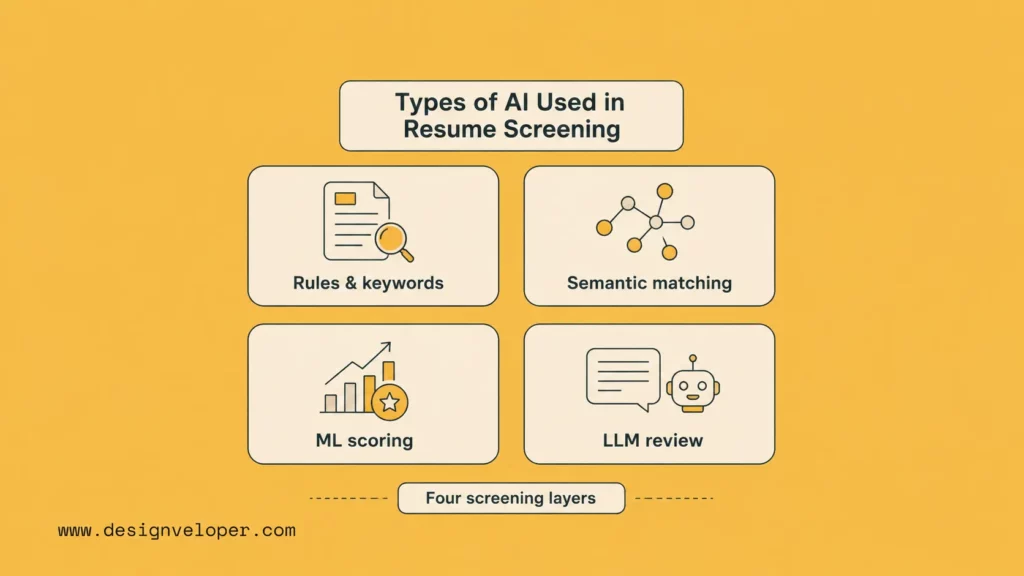
AI resume screening is not one technology. It is a stack of methods. Some tools still rely heavily on rules. Others use semantic search, machine learning, or large language models to interpret context.
The most common systems combine several layers. They parse the resume first. Then they normalize the data. After that, they compare the candidate against the role. Finally, they rank, filter, or route the application.
| Method | What It Reads | Best Fit | Main Risk |
|---|---|---|---|
| Keyword and rule-based filtering | Exact terms, required answers, credentials | Hard requirements | Can reject strong nontraditional profiles |
| Natural language processing | Resume text, sections, entities, phrases | Parsing and information extraction | Can misread complex formatting |
| Semantic matching | Related skills, context, similar experience | Broader fit assessment | Can produce opaque matches |
| Machine learning scoring | Patterns in candidate data and criteria | Ranking large applicant pools | Can inherit bias from past data |
| LLM-assisted review | Summaries, explanations, skill maps | Recruiter-facing insights | Can hallucinate or overstate fit |
Rule-based logic still has a place. It works for non-negotiable requirements, such as a license for a regulated role. However, teams should avoid using rigid filters for soft signals. A candidate may lack one exact phrase and still have the right experience.
Semantic matching can improve that problem. For example, a candidate may write “customer onboarding automation” while the job description says “implementation workflow.” A simple keyword filter may miss the match. A stronger AI system may see the relationship.
LLM-assisted screening adds another layer. It can summarize a resume, explain a match, or create a recruiter note. Yet this layer needs controls. A model can sound confident while missing a key fact. Recruiters should always check source evidence inside the resume.
How AI Resume Screening Works
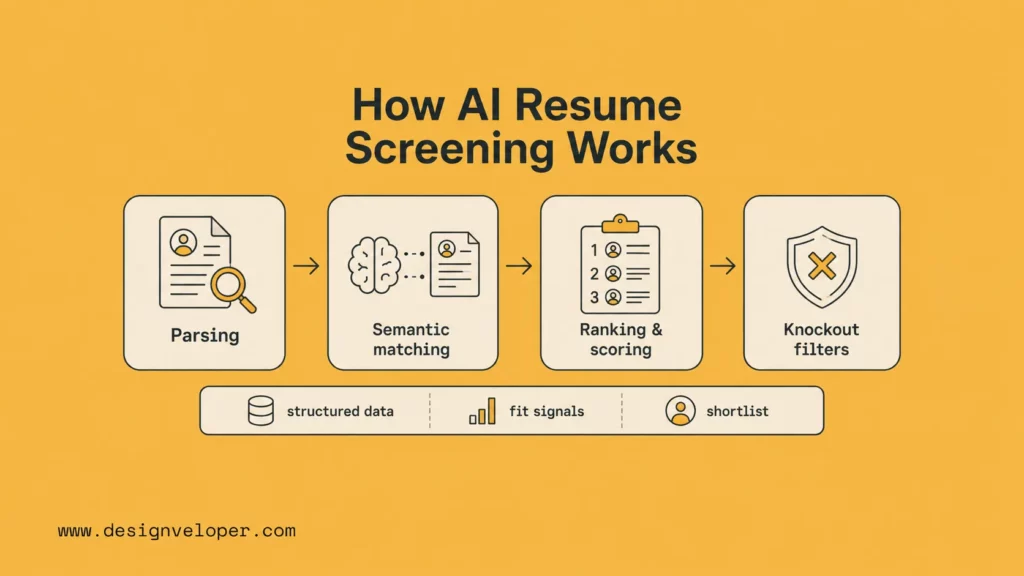
AI resume screening usually follows a clear pipeline. The exact design changes by vendor, but the core workflow stays similar. The tool reads the resume, extracts data, matches it to the job, scores the fit, and sends the result into the recruiter workflow.
Good teams map this pipeline before buying a tool. They ask what data enters the system, what logic the tool applies, what output it creates, and where humans can override it.
1. Parsing And Data Extraction
Parsing is the first step. The system reads the resume file and identifies sections such as work experience, education, skills, certifications, and contact information.
This step sounds simple, but it is critical. If the parser reads dates incorrectly, the scoring layer may misunderstand tenure. If it misses a certification, the candidate may rank lower. If it cannot read a two-column design, it may place the wrong skill under the wrong job.
Parsing also turns messy text into structured fields. For example, it may convert “Senior Backend Engineer at Company X from 2020 to 2024” into job title, employer, start date, end date, and role duration.
Recruiters should test parsing quality before trusting rankings. They should upload resumes with different formats, seniority levels, career gaps, international schools, and nonstandard job titles. Then they should compare the extracted data with the original resume.
2. Semantic Matching
Semantic matching compares meaning, not just words. It looks for related skills, similar responsibilities, and adjacent experience.
This matters because strong candidates do not always use the same language as the job description. A software engineer may write “API performance tuning” instead of “backend optimization.” A product manager may write “customer discovery” instead of “user research.” A recruiter understands those links. A good AI tool should too.
Semantic matching can also reduce keyword stuffing. If the model understands context, candidates gain less from repeating the same job description terms without evidence. The tool can look for where the skill appears, how recently it appears, and whether the candidate used it in a real role.
However, semantic matching needs explainability. Recruiters should know why the tool considers two profiles similar. A match score without reasons does not help much. A better output shows the evidence: matched skills, related experience, missing requirements, and uncertainty.
3. Ranking & Scoring
Ranking places candidates in order of likely fit. Scoring assigns a number, category, or label to each application. Some tools use a fit score. Others use groups such as strong match, possible match, and low match.
Recruiters should treat ranking as prioritization, not truth. A score helps decide where to start. It does not prove who deserves the job.
Good scoring separates hard requirements from preferences. For example, a nursing license may be mandatory. Experience with a specific scheduling tool may be preferred. If the model weighs both equally, the ranking becomes weak.
A useful scoring system also shows trade-offs. It may say that a candidate meets the core technical requirements but lacks industry experience. That is more useful than a single number. It gives recruiters a reason to review the profile with context.
| Scoring Element | Good Practice | Risky Practice |
|---|---|---|
| Mandatory criteria | Use only for true deal-breakers | Use for broad preferences |
| Preferred skills | Weight by importance | Treat every skill equally |
| Experience signals | Review recency, depth, and role context | Count keywords only |
| Score explanations | Show evidence behind the ranking | Hide logic behind a black-box score |
4. Knockout Questions And Automated Filtering
Knockout questions remove candidates who fail defined requirements. Common examples include work authorization, location, license status, language level, or required certification.
This type of automated filtering can help when the requirement is clear and lawful. It can also save recruiter time. However, it becomes dangerous when teams use knockout logic for flexible criteria.
For example, “Do you have five years of experience?” may look simple. But a candidate with four strong years may outperform someone with seven weak years. A rigid filter would remove the stronger profile before a recruiter sees it.
So teams should write knockout questions with care. They should use them only when the answer truly decides eligibility. They should also review rejected candidates during calibration, especially for roles with low applicant quality or unusual career paths.
Key Benefits Of AI Resume Screening For Recruiters
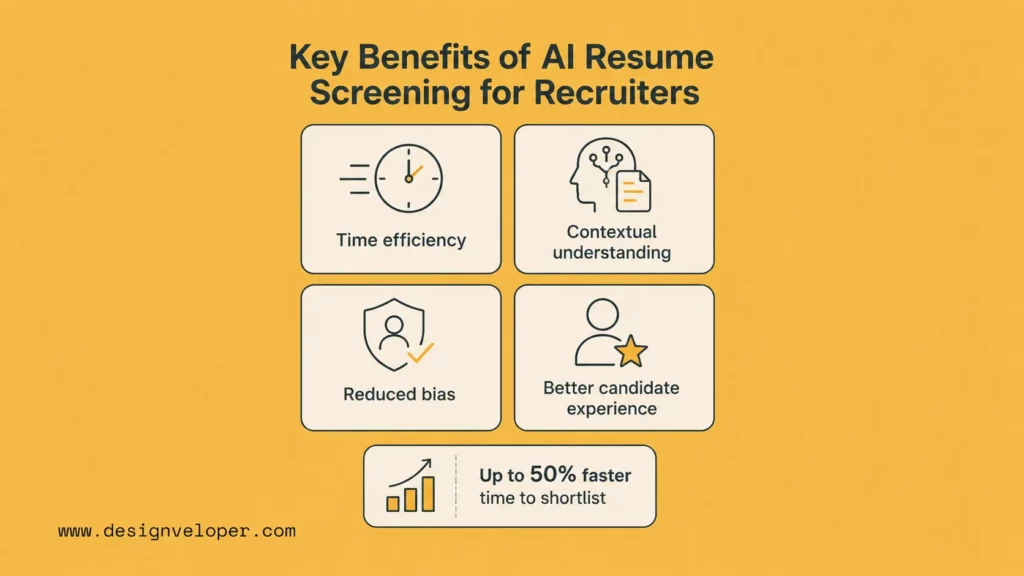
AI resume screening creates value when it improves the early funnel. It should help recruiters move faster, compare candidates more consistently, and focus attention where human judgment matters most.
The clearest benefit is not full automation. It is better prioritization. iCIMS reported that employers using AI in hiring found the most value in candidate screening (55%) and matching (40%), and nearly two-thirds of AI adopters saved over two hours per recruiter weekly. That explains why screening and matching often become the first AI use cases in recruiting.
1. Time Efficiency
Time efficiency is the most practical benefit. Recruiters can reduce the hours spent opening resumes, checking basic criteria, and sorting large applicant pools.
This matters most in high-volume hiring. Retail, customer support, operations, sales, and graduate hiring can attract many similar applications. Manual review in those roles can delay the whole hiring process.
AI resume screening can create a cleaner first pass. It can group candidates by fit, flag missing requirements, and create summaries for recruiters. That gives recruiters more time for phone screens, interview planning, and candidate communication.
Still, speed should not become the only metric. A fast screen that misses good people creates hidden cost. Teams should track both time saved and candidate quality.
2. Contextual Understanding
Contextual understanding is the main upgrade from old keyword filters. A stronger AI system can connect related skills, tools, and responsibilities.
For example, a candidate may not mention “CRM administration,” but may describe Salesforce pipeline cleanup, lead routing, and sales operations reporting. A recruiter can see the connection. A semantic screening tool may also recognize that the work belongs to the same skill family.
This helps recruiters find candidates who use different language. It also helps with career switchers and candidates from adjacent industries. However, it works only when the model explains its reasoning.
Recruiters should ask vendors how their matching logic handles related terms. They should also test real examples. A demo with perfect sample resumes does not prove the tool can handle messy hiring data.
3. Reduced Bias
AI resume screening can reduce some forms of human inconsistency. A configured system can apply the same baseline criteria to every applicant. It can also hide selected information during early review if the workflow supports blind screening.
However, reduced bias is not automatic. AI can repeat bias when teams train or configure it on biased data. It can also create proxy bias. A model may never ask for age, gender, race, or disability. Yet it may still use signals that correlate with protected traits.
That is why governance matters. The EEOC states that AI and other technologies used in employment decisions may violate laws against discrimination when used in employment decisions. Employers cannot assume a vendor tool is fair just because it uses AI.
Recruiters should review model outputs by group, role, source, and stage. They should also check whether the tool creates adverse impact. If the system removes certain groups at higher rates, the team needs to investigate the criteria and workflow.
4. Better Candidate Experience:
AI resume screening can improve candidate experience when it makes the process faster and clearer. Candidates often dislike silence more than rejection. A faster early screen can help teams send updates sooner.
It can also support better routing. A candidate who does not fit one role may fit another. AI can identify adjacent matches if the recruiting system connects open roles, skills, and candidate data.
However, candidates do not always trust AI in hiring. Pew Research Center found that 66% of U.S. adults would not want to apply for a job with an employer that uses AI to help make hiring decisions. That skepticism gives employers a clear message. They need transparency.
Candidate experience improves when employers explain what AI does, what humans still review, and how candidates can request accommodation or reconsideration. A hidden automated filter creates mistrust. A clear process builds confidence.
The Main Risks And Limitations
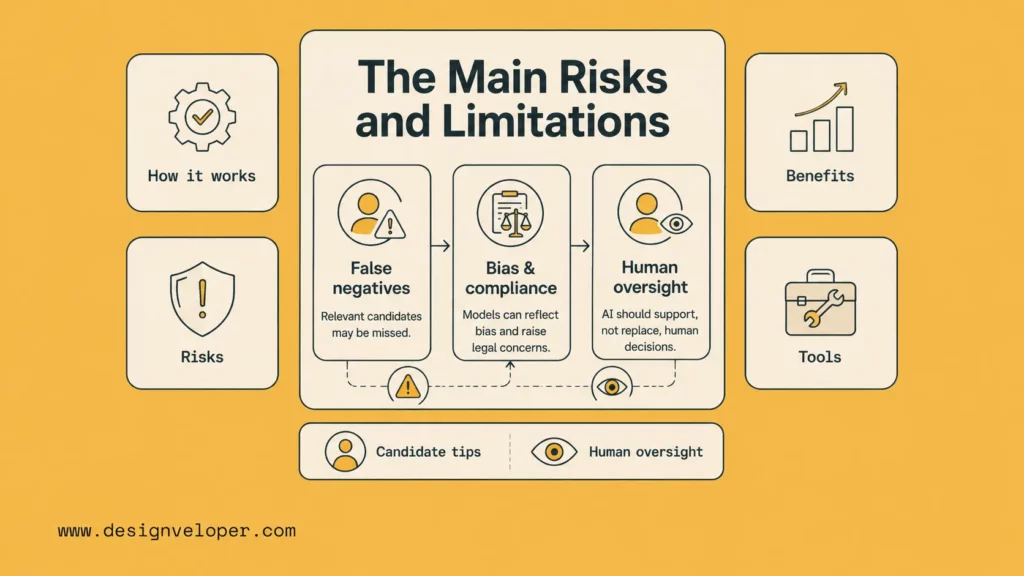
AI resume screening has real limits. It can speed up review, but it can also hide mistakes behind confident scores. The biggest risks come from rigid criteria, biased data, weak explainability, and missing human oversight.
Employers should treat AI based resume screening as an accountable workflow. It affects who gets reviewed, who gets delayed, and who may never reach an interview. That makes governance part of the product, not an optional add-on.
1. False Negatives And Over-Filtering – Explain how strong candidates can be missed when screening logic is too rigid.
A false negative happens when the system screens out a strong candidate. This is one of the most damaging risks because the team may never know what it missed.
False negatives often come from rigid rules. A tool may reject someone who lacks a specific title, even though their work matches the role. It may penalize a career changer who uses different language. It may miss a candidate with strong freelance, military, academic, or international experience.
Over-filtering also happens when recruiters define too many “must-have” requirements. The model then searches for an ideal resume instead of a capable person. In practice, this can shrink the funnel too early.
Teams can reduce false negatives by reviewing a sample of rejected candidates. They should also test the tool with known strong profiles. If the system ranks those profiles poorly, the criteria need adjustment.
2. Bias, Fairness, And Compliance Concerns – Cover training data, explainability, and hiring-governance risks.
Bias can enter AI resume screening through data, design, and deployment. Past hiring data may reflect past bias. Job descriptions may include biased criteria. Recruiters may configure filters that seem neutral but harm certain groups.
Explainability also matters. A recruiter needs to know why a candidate ranked high or low. Without that view, the team cannot defend the process, improve the model, or answer candidate concerns.
Compliance rules are also moving faster. New York City’s Automated Employment Decision Tool rules require employers and employment agencies using covered tools to make sure the required bias audit was done, post a summary of the results, and give required notices. Even companies outside that market can learn from the principle. Automated hiring tools need auditability, notice, and accountability.
Good governance includes several controls:
- Clear criteria for required and preferred qualifications.
- Bias testing before and after launch.
- Candidate notices where required or appropriate.
- Recruiter override with documented reasons.
- Audit logs for score changes and workflow actions.
- Data retention and deletion rules.
- Vendor review for security, privacy, and model behavior.
These controls do not remove all risk. However, they make the system easier to review and improve.
3. Why AI Screening Still Needs Human Oversight – Show why recruiters should review edge cases, exceptions, and final shortlists.
Human oversight remains essential because hiring is contextual. A resume rarely tells the whole story. It may show evidence, but it does not show motivation, growth speed, team fit, communication, or real work quality.
AI can help find patterns. Recruiters still need to judge meaning. They should review edge cases, exceptions, and final shortlists. They should also question scores that look too clean.
For example, a candidate may rank low because they lack one tool. But they may have learned similar tools many times before. Another candidate may rank high because the resume mirrors the job description. But the interview may reveal shallow experience.
Recruiters should also own final decisions. The tool can narrow the list. The hiring team should decide who moves forward. This protects candidates, but it also protects the business from weak automation decisions.
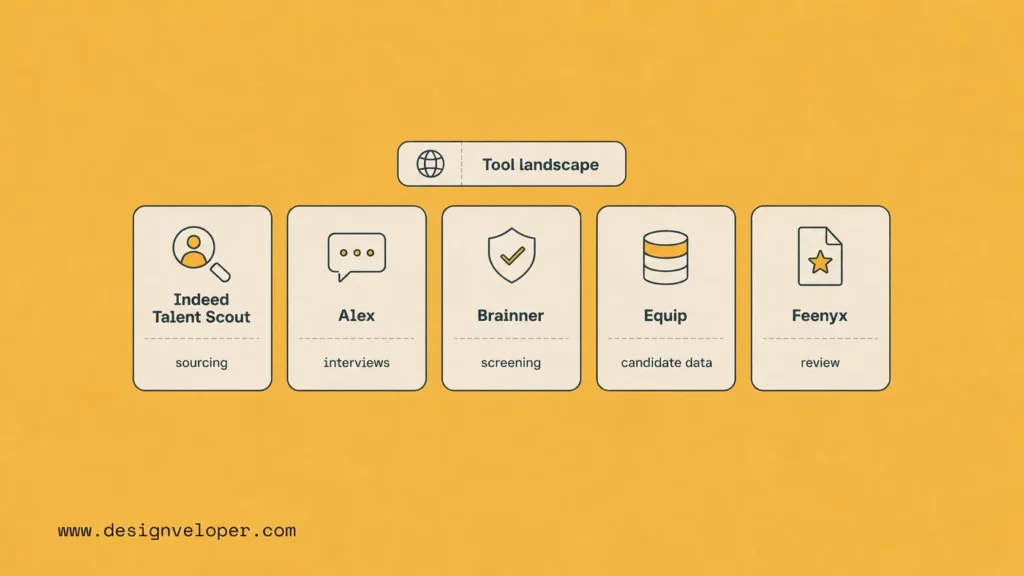
The market for automated resume screening software using AI is mixed. Some products are pure screeners. Others are broader recruiting agents, ATS layers, interview tools, or assessment platforms.
That is why buyers should not compare tools only by AI claims. They should compare fit. A large enterprise may need ATS integration and compliance controls. A startup may need faster first-pass review. A technical hiring team may need skills validation more than resume ranking.
| Tool | Best Fit | Screening Angle | Main Watch-Out |
|---|---|---|---|
| Indeed Talent Scout | Employers already using Indeed | AI sourcing, matching, and outreach support | Not only a resume screener |
| Alex | Teams that want AI screening plus interviews | Resume screening and candidate engagement | Interview automation needs careful oversight |
| Brainner | Teams needing resume screening and fraud protection | Resume ranking, ATS sync, fraud signals | Vendor claims need buyer validation |
| Equip | Teams that need screening, ATS, and assessments | Resume parsing, skill extraction, searchable data | Best when used as part of a wider workflow |
| Feenyx | Teams focused on proof, skills, and fraud signals | Resume review, summaries, skills mapping | Not a simple resume-only filter |
1. Indeed Talent Scout
Indeed Talent Scout is best understood as an AI recruitment agent, not just a resume parser. Indeed describes it as an AI-powered hiring agent designed to help employers engage, find, and hire talent. It supports market insight, candidate discovery, job-post improvement, and outreach workflows.
This makes it useful for employers that already rely on Indeed for sourcing. It can help recruiters move from passive search to active recommendations. It can also support outreach at scale.
The main watch-out is scope. A buyer looking only for resume screening may not need a broader sourcing agent. Teams should check how the tool connects to their ATS, how it explains matches, and how much control recruiters have over recommendations.
2. Alex
Alex focuses on AI recruiting workflows that include screening and interviews. Its positioning centers on instant candidate engagement. Alex says it can conduct live, two-way AI interviews via video, phone, or chat.
This can help teams that lose candidates because they respond too slowly. It can also help with high-volume roles where early qualification calls consume recruiter time.
The risk is that interview automation raises the governance bar. Recruiters should know what questions the AI asks, how it scores responses, and how candidates can request an alternative process. They should also keep humans involved before rejecting candidates based on automated interview output.
3. Brainner
Brainner positions itself as AI resume screening software with fraud protection. Its website says it helps organizations save up to 90% on initial screening tasks. It also emphasizes ATS-connected screening and candidate risk reduction.
This makes Brainner relevant for teams that handle large resume volumes and need structured first-pass review. It may also fit teams worried about identity issues, copied resumes, or low-signal applications.
Buyers should validate the time-saving claim against their own workflow. They should run a pilot with real resumes, compare human and AI shortlists, and review false negatives before making the tool part of the hiring process.
4. Equip
Equip focuses on AI resume screening, candidate data, and assessment workflows. Its resume screening page says it can turn every resume, in any format, into clean, searchable data. This is useful for teams that want cleaner candidate records, not just a ranked list.
Equip may fit recruiting teams that need parsing, skills extraction, plain-language search, and structured shortlisting. It also connects naturally with assessment workflows when resumes alone do not prove ability.
The main watch-out is implementation design. If a team adds screening, assessments, and interviews at once, candidate friction can rise. Teams should decide where each step adds value and where it slows people down.
5. Feenyx
Feenyx presents itself as an AI recruiting co-pilot. It focuses on resume review, hidden-gem discovery, fraud signals, and assessment support. Its AI-powered resume review feature includes bulk resume uploads, instant summaries, skills mapping, and side-by-side candidate comparison.
This can help teams that want more than keyword screening. It can also support hiring managers who need faster context before reviewing candidates.
The main watch-out is role fit. Feenyx may work best when resumes connect to skills evidence and structured evaluation. Buyers should check how it handles nontraditional candidates, what fraud signals it uses, and how recruiters can override the system.
How To Optimize Resumes For AI Screening
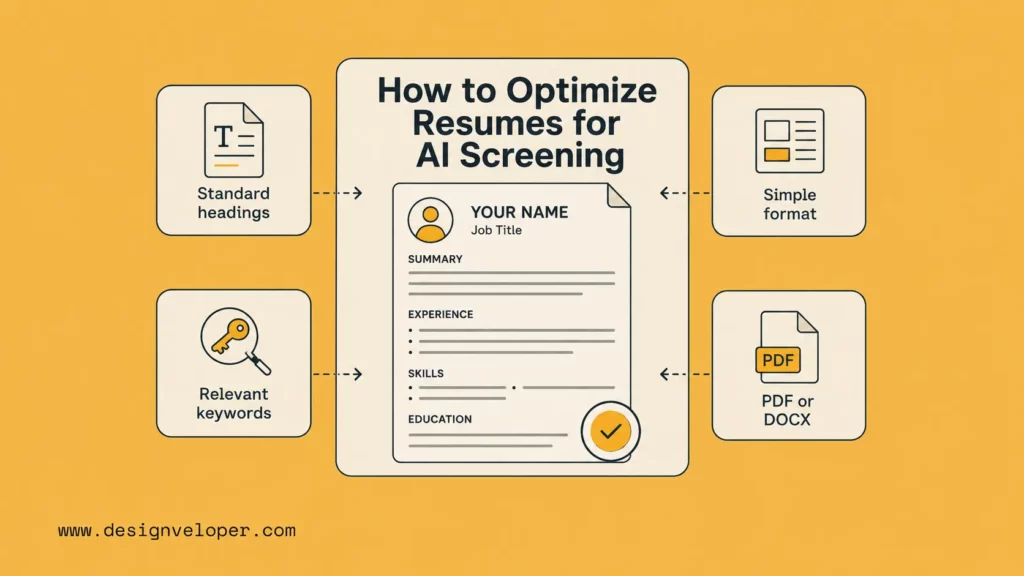
Candidates should optimize for clarity, not tricks. The goal is to help both the AI and the recruiter understand the resume. A resume that passes a screen but fails human review will not help.
This is also the best answer to the common question: should i opt out of ai resume screening? In most cases, candidates should first check whether the employer offers a clear alternative, accommodation path, or human review process. Opting out may make sense for accessibility or fairness concerns. Yet it may also move the candidate outside the normal workflow if the employer has no practical alternative.
A better strategy is to create a clean, honest, machine-readable resume. Indeed advises candidates to use standard section headings like “Professional Summary,” “Work Experience,” and “Skills”. That advice works for ATS systems and AI screeners because clear structure improves parsing.
- Use Standard Headings: Use clear, simple headings like “Work Experience,” “Education,” “Certifications,” and “Skills.” Avoid creative labels such as “My Journey” or “Where I’ve Been.”
- Incorporate Relevant Keywords: Tailor the resume with terms from the job description. Use exact terms only when they honestly describe your experience. Add related terms when they clarify your skill set.
- Keep Formatting Simple: Use a single-column layout. Avoid images, graphics, charts, icons, unusual bullets, and text boxes. These elements can break parsing.
- Choose the Right File Type: Use .docx or PDF as requested by the employer. Make sure the file contains readable text. Do not submit a scanned image of a resume.
Candidates should also write bullets with evidence. A weak bullet says, “Responsible for customer support.” A stronger bullet says, “Resolved customer support tickets for a SaaS product and documented recurring issues for the product team.” The second version gives both AI and recruiters more context.
| Resume Area | Good Example | Weak Example |
|---|---|---|
| Heading | Work Experience | Career Story |
| Skills | Python, SQL, API testing, data validation | Tech-savvy problem solver |
| Experience bullet | Built reporting dashboards for weekly sales operations reviews | Worked on reports |
| File format | Text-based PDF or .docx | Scanned image PDF |
Do not keyword-stuff. It may help with a weak filter, but it can damage credibility later. Recruiters notice when a resume repeats terms without proof. Interviewers also test whether the candidate can explain the work.
Finally, candidates should match the resume to the role. A general resume forces the system and the recruiter to guess. A tailored resume makes the fit easier to see.
AI Screening Should Narrow the List, Not Make the Hire
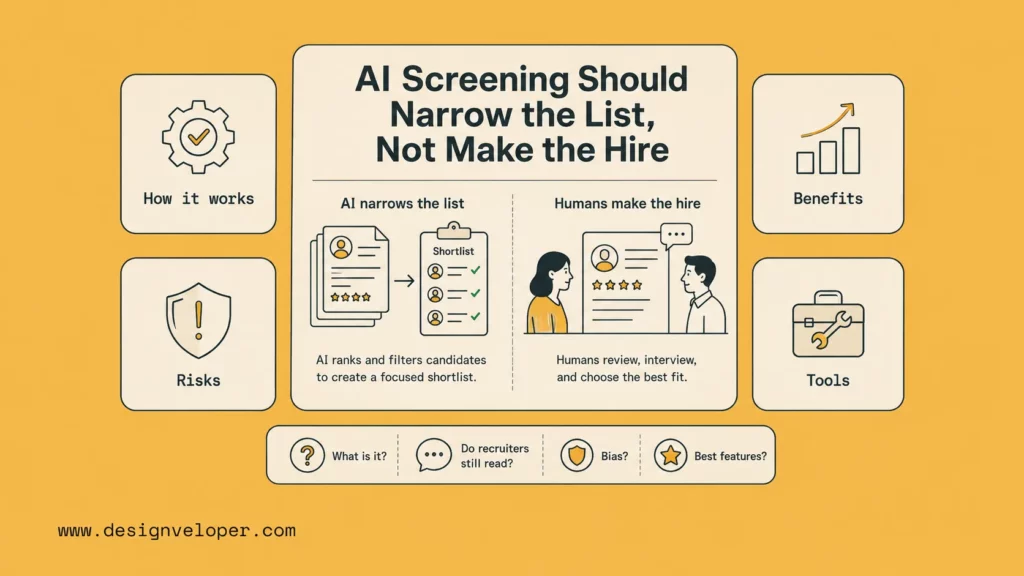
AI screening should narrow the list. It should not make the hire. This principle protects both the employer and the candidate.
Recruiting includes judgment. A resume can show evidence, but it cannot show the full person. It cannot fully measure learning speed, motivation, communication, collaboration, or problem-solving under pressure.
AI resume screening works best when it supports a controlled workflow. The system can parse resumes, flag strong matches, highlight missing information, and create reviewer notes. Then recruiters can review the evidence and decide what happens next.
Strong teams treat AI as one signal. They compare the AI shortlist with recruiter judgment. They review rejected samples. They track who moves forward. They inspect outcomes for bias and drift.
| Implementation Checkpoint | What Strong Teams Do |
|---|---|
| Criteria definition | Separate hard requirements from preferences |
| Validation | Test the system with known strong and weak profiles |
| Human review | Review edge cases and final shortlists |
| Override | Allow recruiters to change decisions and record reasons |
| Bias monitoring | Check whether outcomes harm groups unfairly |
| Integration | Keep ATS notes, status changes, and audit logs aligned |
This approach also helps buyers choose the best ai resume screening software for their context. The best tool is not the one with the most AI features. It is the one that fits the hiring workflow, explains its outputs, supports recruiter control, and creates a record the company can trust.
That matters for business outcomes too. A bad automated filter can quietly remove great candidates. A strong screening workflow can help recruiters spend more time with people who deserve attention.
FAQs About AI Resume Screening
1. What Is AI Resume Screening Called?
AI resume screening may be called resume screening AI, AI based resume screening, automated resume screening software using AI, AI resume parsing, AI candidate matching, or AI recruiting screening. These terms overlap, but they are not always identical.
Resume parsing usually means extracting structured data from a resume. Candidate matching means comparing that data with a job. Screening means using those outputs to prioritize, group, or filter applicants. A complete AI resume screening workflow may include all of these steps.
2. Do Recruiters Still Read Resumes After AI Screening? – Clarify how AI changes prioritization, not full human involvement.
Recruiters should still read resumes after AI screening. AI changes prioritization. It should not remove human involvement from the process.
In a strong workflow, AI helps recruiters decide where to start. It may show top matches, possible matches, missing criteria, and resume summaries. The recruiter then checks the evidence and reviews the candidate in context.
This is especially important for edge cases. Career changers, returners, international candidates, and nontraditional profiles may not rank well in a rigid system. Human review helps protect those candidates from early rejection.
3. Can AI Resume Screening Reduce Hiring Bias? – Explain the conditional answer and why governance matters.
Yes, AI resume screening can reduce some bias if the team designs and monitors it well. It can apply the same baseline criteria to every applicant. It can also support blind review in selected workflows.
However, AI can also increase bias. It may learn from biased historical data and use proxies that create unfair outcomes. Additionally, it may rank candidates based on patterns that no recruiter can explain.
So the answer depends on governance. Employers need bias testing, clear criteria, explainable scoring, human override, and regular audits. Without these controls, AI can make biased screening look more objective than it really is.
4. What Features Matter Most In AI Resume Screening Tools? – Summarize parsing, scoring, controls, integrations, and reporting.
The most important features are parsing accuracy, semantic matching, criteria control, explainable scoring, ATS integration, reporting, audit logs, and recruiter override.
Parsing accuracy matters because bad extraction weakens every later step. Scoring controls matter because recruiters must separate mandatory criteria from preferences. Integrations matter because screening output should fit the real hiring workflow.
Reporting also matters. Recruiters and HR leaders should see funnel movement, score distribution, rejection reasons, override patterns, and possible adverse impact. Without reporting, the team cannot improve the system.
5. How Can Candidates Optimize Resumes For AI Screening? – Cover headings, keywords, formatting, and file type.
Candidates can optimize resumes by using standard headings, clear role-relevant keywords, simple formatting, and the file type requested by the employer.
Use headings such as “Work Experience,” “Education,” and “Skills.” Match important terms from the job description when they honestly apply. Keep the layout clean. Avoid graphics, tables, icons, and scanned files.
Most importantly, write for both AI and humans. AI may help route the resume, but a recruiter still needs to understand the evidence. Clear, specific bullets work better than vague keyword lists.
AI resume screening is useful when it helps recruiters handle high-volume applications with more structure and speed. It becomes risky when teams confuse ranking with judgment. The safest path is clear criteria, strong parsing, explainable scores, recruiter override, and regular review.
For employers, the goal is not to automate hiring away. The goal is to build a better first-pass workflow. For candidates, the goal is not to trick the machine. The goal is to make real qualifications easy to read, easy to parse, and easy to verify.
Conclusion
AI resume screening can make hiring faster, cleaner, and more consistent. But it should never become a black-box hiring decision. The best systems narrow the list, explain the match, flag risks, and keep recruiters in control.
At Designveloper, we see AI resume screening as part of a larger HR automation workflow. A strong solution needs more than parsing and scoring. It needs ATS integration, recruiter dashboards, audit logs, permission controls, data security, and human review paths that fit the company’s real hiring process.
As an AI-first software and automation partner, Designveloper has delivered 100+ projects across 20+ industries with a 100+ person team and 50+ technologies. Our experience in HRM systems, internal assistants, document intelligence, workflow automation, and custom AI software helps us build AI tools that work inside real operations, not just demos.
For hiring teams, the next step is not to automate every decision. It is to design a safer and more useful screening workflow. If your team wants to build or integrate AI resume screening, connect it with your ATS, or add governance controls around HR automation, talk to our team.