


Meta has allocated $13 million in new funding to its independent Oversight Board after mulling the possibility of abandoning the project, according to a Reuters report. The Oversight Board provides an additional checking process for Meta’s policy decisions, enabling users to challenge Meta’s bans and moderation calls via an external group.
Founded in 2020, Meta’s Oversight Board is a collection of independent, external experts who are available to review appeals of content decisions made by Meta’s moderators.
The group is funded by Meta, but the idea is that the board’s decisions remain independent from the company, offering impartial, third-party guidance on Meta’s policies, as well as a means for users to appeal such decisions.
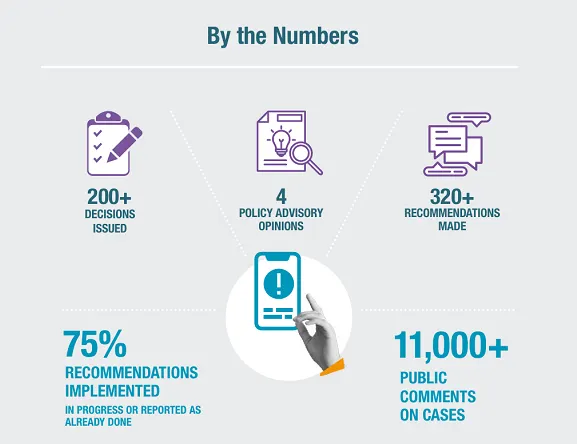
The Oversight Board has made over 300 recommendations to Meta’s policy team over the past five years and Meta has ultimately implemented 75% of them. This underlines the value of the process when it comes to providing additional checks and assurances.
As such, it makes sense for Meta to continue funding the project, with the new allocation set to keep the project running through at least 2028.
This continuation wasn’t a given. As reported by Platformer last month, Meta had been considering pulling funding for the project and abandoning the Oversight Board model.
A combination of changing priorities and shifting perceptions of social platform issues, had Meta considering alternative approaches, including whether it needed an oversight process at all. However, the company has now determined that the project remains a valuable, viable initiative.
As per Oversight Board Chair Paolo Carozza: “Meta has also renewed its commitment to working with the Board by continuing to refer difficult cases and respond to questions about them, consult on broad issues of policy through advisory opinions and publicly respond to our recommendations for change.”
Carozza added that Meta’s commitment is especially valuable right now due to the rise of artificial intelligence, and the way AI is transforming how content is generated, curated and governed.
“[A]s users’ experiences on digital platforms evolve, so too do the risks to freedom of expression and other human rights — risks that become more complex as AI plays a greater role in policy enforcement, and that require greater transparency from companies,” Carozza said.
An interesting side note here is that Meta’s Oversight Board was actually intended to be an example of how external social media moderation could work. It was supposed to be a demonstration of how an independent, government-appointed body should be put in place to govern all social media platforms under the same rules.
That, seemingly, has fallen by the wayside, especially with the Trump Administration seeking to enable more freedom of speech, and stay out of moderation decisions. But the original experiment was intended to show that social platforms more broadly need external rulings on their decisions, in order to ensure fairness in operation.
It seems, instead, that most people have just accepted that what’s on social media is biased and manipulated by algorithmic amplification, one way or another. And while social media now has a huge influence over public perception, it seems, at this stage at least, that the appetite for regulating such is limited to teen users.
Presumably, the impacts of social media are just as significant in all age groups, and there’s plenty of evidence to suggest that, if anything, younger users are actually less susceptible to information manipulation through digital platforms.
Indeed, a study published by Harvard University in 2020 showed that older adults are far more likely to share fake news, while the FBI’s Internet Crime Complaints Center reported that older Americans are disproportionately impacted by scams and fraud.
The balance of data, then, would suggest that some level of overarching regulation could be of benefit.
However, it’s not a topic that seems to have gained traction amongst political groups.