


Meta announced enhanced security measures for the FIFA World Cup 2026, as the company looks to protect fans and players from attacks and abuse related to what’s arguably one of the world’s most passionate sporting events.
As explained by Meta: “In the coming months, soccer fans across the globe will use our apps to connect around the FIFA World Cup 2026. While most will be rooting for their favorite teams and players, unfortunately there may be bad actors who will try to lure people into scams or harass and abuse others — offline and online.”
First, Meta plans to protect users from ticketing and accommodation scams in the app via enhanced monitoring of related activity.
“Global sporting events can lead to an increase in fraud, like ticketing scams, false offers of immigration processing, and misleading accommodations for those looking to travel to matches,” Meta said. “We have dedicated teams monitoring and enforcing against accounts that attempt to target people with these scams and violate our policies.”
Meta is also working with industry partners to disrupt scam networks through the Global Signal Exchange (GSE) and Meta’s Fraud Intelligence Reciprocal Exchange (FIRE).
“Meta collaborated with Visa through the GSE, to proactively disrupt cross-channel fraud,” Meta said. “By providing timely and actionable scam intelligence, Visa’s Scam Disruption team facilitated Meta’s identification and dismantling of a network on Facebook that linked to spoofed websites that mimicked the FIFA World Cup 2026 official branding and promoted fake gambling content.”
Meta also rolled out new in-stream notifications to warn users about potentially fraudulent ticket sellers, and educate them on how to avoid ticketing scams.
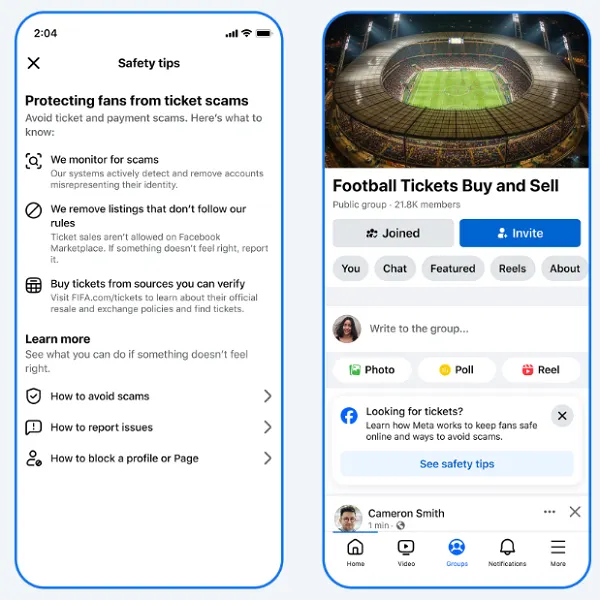
The company is also partnering with Mexico’s Consumer Protection Agency (PROFECO) to launch a creator-led campaign that raises awareness about common scams expected around the tournament, such as fake ticket sales and the impersonation of official FIFA World Cup-related websites.
On the abuse front, Meta also plans to take proactive action in order to address harm, with Instagram DMs being a key focus.
Back in 2021, Instagram unwittingly became the source of various incidents of race-based attacks against players from teams including Manchester United, Chelsea and Liverpool, who were targeted via Instagram messages. As reported by Sky News, team officials condemned the incidents, and called on Meta to do more to protect users from DM abuse. This led to Meta announcing tougher penalties and new options that enabled users to restrict who can send players messages in the app.
Clearly, that incident is front of mind for Meta once again.
“We have clear rules against bullying and harassment, violent threats, and hateful conduct toward both players and fans,” Meta said. “No one should be subject to this kind of abuse, and we remove this content when we find it.”
Meta said that it will use reports from users, along with AI technology, in order to proactively detect content that violates its policies.
“Between October and December 2025, we removed 2.6 million pieces of hateful content on Facebook and Instagram, and found more than 74% of it before anyone reported it to us,” Meta said.
Given the history of Meta’s platforms being used in negative ways around the event, it makes sense for Meta to make this a specific focus, and to implement proactive approaches to combat abuse and deception.
The FIFA World Cup 2026 begins on June 11th.