

Python frameworks help teams build web apps, APIs, dashboards, automation services, and production backends faster by giving developers reusable structure instead of starting every project from scratch. The right framework depends on project scope, team experience, performance needs, security expectations, and how much built-in structure the product requires.
Django is usually the strongest choice for full-stack, database-backed web products. Flask is often best for lightweight applications and flexible services. FastAPI is a strong choice for modern APIs, typed request validation, and backend services. Pyramid fits teams that want a flexible but mature middle ground. Tornado or Sanic can fit asynchronous workloads where long-lived connections or non-blocking I/O matter.
This guide compares the most useful Python web frameworks by type, project fit, learning curve, ecosystem, and production tradeoffs. It is written for teams choosing a framework for a real product, not only for developers comparing syntax examples.
What Is A Python Framework?
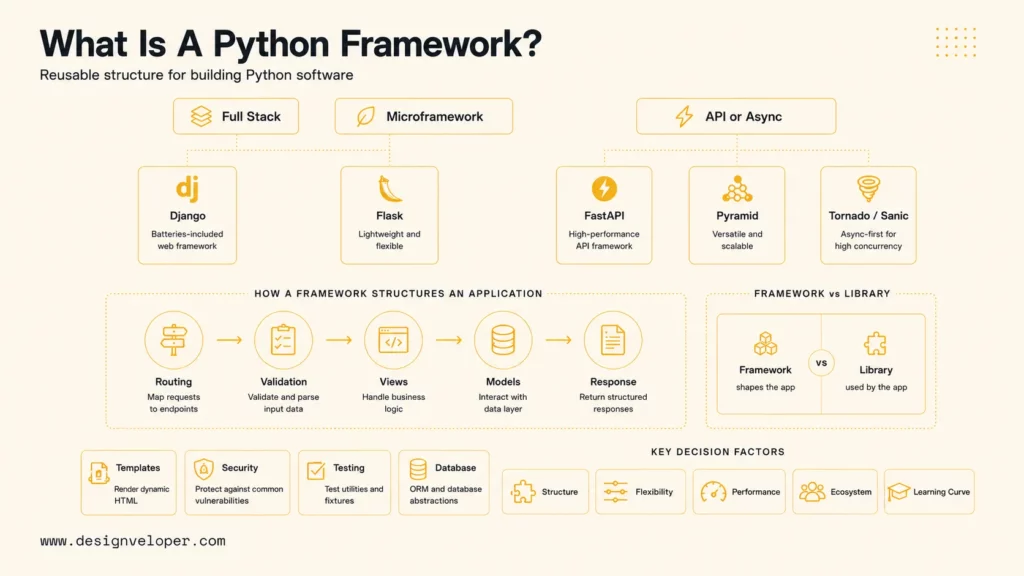
A Python framework is a reusable structure for building software in Python. In web development, a framework usually provides routing, request handling, response formatting, templates, middleware, validation, sessions, security helpers, testing support, and integrations with databases or deployment tools.
The main value of a framework is decision support. A framework gives a team a known way to organize routes, models, views, dependencies, templates, serializers, tests, and deployment settings. That structure reduces repeated work and helps developers collaborate with shared conventions.
Python frameworks vary in how much they provide. A full-stack framework such as Django documentation includes many batteries for database-backed applications, forms, authentication, admin screens, files, templates, and security. A microframework such as Flask documentation keeps the core small and lets teams add extensions as needed.
A framework is different from a library. A library is usually called by the application. A framework usually shapes the application and calls the developer code through routes, handlers, views, lifecycle hooks, or middleware. That inversion of control is why choosing a framework affects architecture for years.
Why Use Python Frameworks?
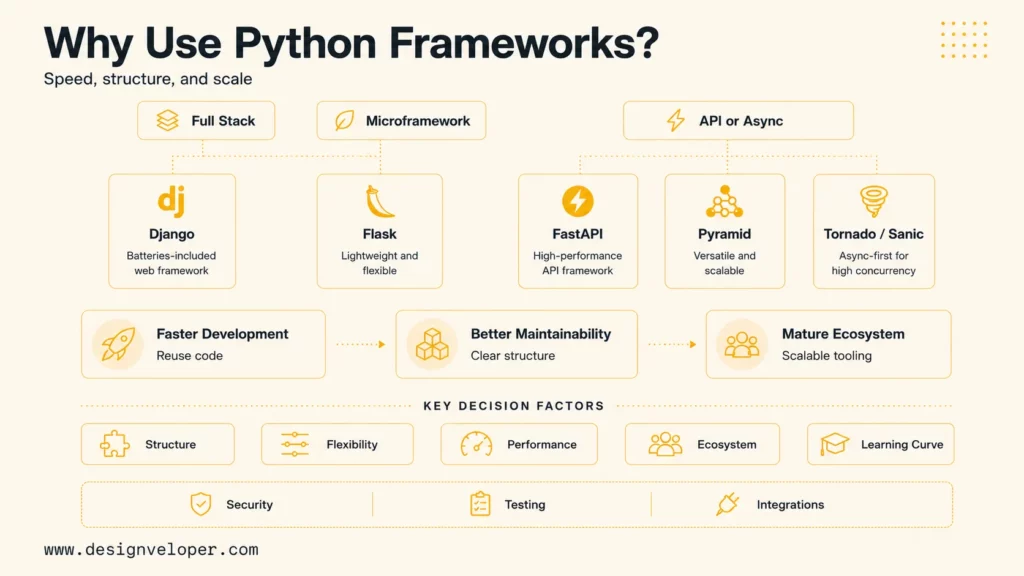
Python frameworks help teams move faster while keeping software easier to maintain. The benefit is not only fewer lines of code. The benefit is that the project gains conventions for structure, security, testing, and integration from the start.
Faster Development And Less Repeated Code
Frameworks reduce repeated code by handling common web application tasks. Routing, request parsing, error responses, templates, sessions, validation, authentication hooks, static files, and test clients do not need to be redesigned for every project.
Fast development matters when a team needs to validate an idea, ship an internal tool, build an API, or iterate on a customer-facing feature. A Django team can use the admin interface and ORM to move quickly on content-heavy or data-backed applications. A FastAPI team can use type hints and automatic OpenAPI docs to move quickly on APIs. A Flask team can keep the starting point small when a service does not need heavy structure.
The speed advantage becomes larger when the framework matches the project. Using Django for a database-heavy admin product can save weeks. Meanwhile, using Django for a tiny webhook endpoint may add unnecessary weight. Using Flask for a small service can be elegant. While using Flask for a large business platform may require more architecture decisions from the team.
Better Project Structure And Maintainability
Frameworks improve maintainability by giving developers familiar places to put application code. Routes, models, schemas, services, templates, tests, settings, and middleware become easier to find when the team follows a framework convention.
Maintainability becomes especially important after the first release. A product may begin as a few endpoints, then gain background jobs, permissions, billing, admin workflows, dashboards, webhooks, integrations, and role-based access. The framework should help the codebase absorb that growth without turning into unrelated scripts.
Good framework structure also improves onboarding. A developer who has used Django before can recognize models, migrations, views, templates, admin, and settings. A developer who has used FastAPI before can recognize routers, dependencies, Pydantic models, OpenAPI docs, and async handlers. Familiar structure lowers review cost.
Easier Scaling With Mature Ecosystems
Framework ecosystems help teams scale by providing extensions, integrations, documentation, examples, and community knowledge. A mature ecosystem can reduce risk when the product needs authentication, database migrations, file uploads, monitoring, background jobs, API documentation, or deployment patterns.
Survey data supports the importance of mainstream choices. The Python Developers Survey 2024 results from the Python Software Foundation and JetBrains collected responses from more than 30,000 developers and shows Django, Flask, Django REST Framework, FastAPI, Starlette, and related tools as important parts of the Python web ecosystem.
Popularity should not be the only selection factor, but popularity affects hiring, documentation, troubleshooting, and long-term maintenance. A niche framework can be excellent for a specific workload, but the team should understand the hiring and support tradeoff before committing.
Types Of Python Frameworks
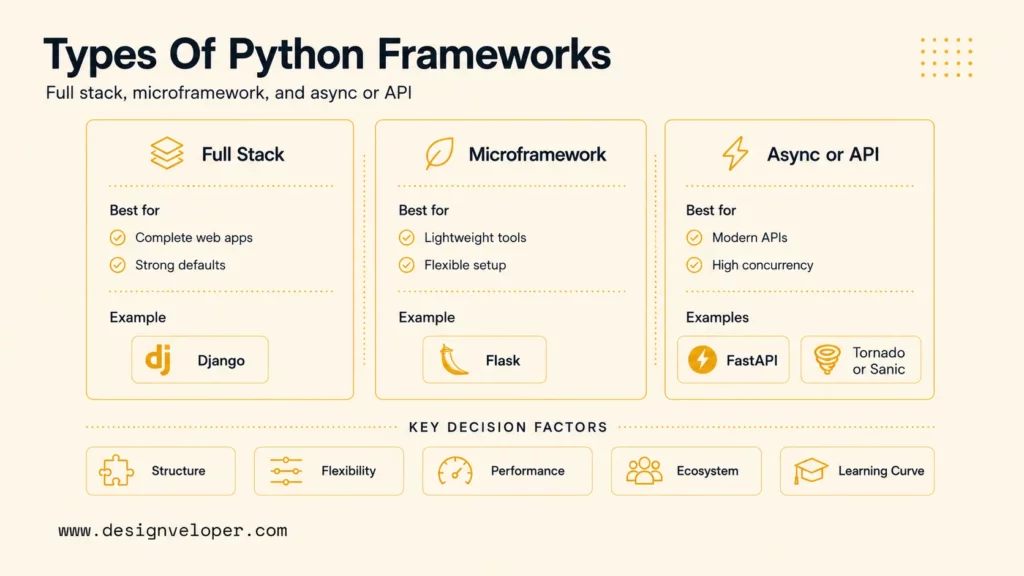
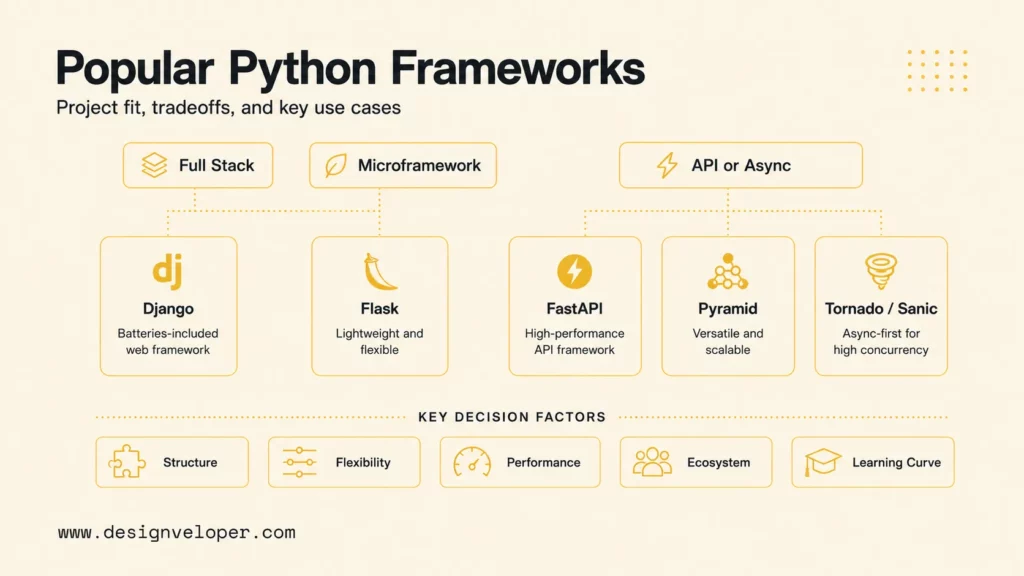
Python frameworks can be grouped by how much structure they provide and what kind of workload they target. The three most useful categories are full-stack frameworks, microframeworks, and asynchronous or API-focused frameworks.
Full-Stack Frameworks
Full-stack frameworks provide a broad set of features for building complete web applications. Django is the clearest example in Python. Django includes an ORM, migrations, admin interface, templates, forms, authentication, security middleware, URL routing, caching support, file handling, and testing tools.
Full-stack frameworks fit products where the team wants strong defaults and fewer architecture choices. Content platforms, marketplaces, admin-heavy systems, learning platforms, customer portals, internal operations systems, and multi-role business applications often benefit from Django-style structure.
The tradeoff is that full-stack frameworks can feel heavy for small services. A product that only needs a few JSON endpoints may not need an ORM, template layer, admin site, and broad application structure.
Microframeworks
Microframeworks provide a small core and let developers choose the rest. Flask is the best-known Python microframework. Flask gives routing, request handling, response helpers, templating support through Jinja, and an extension ecosystem, but it does not force a database layer or project architecture.
Microframeworks fit small applications, internal tools, prototypes, webhooks, integrations, and services where flexibility matters more than built-in structure. Flask is also useful when a team wants to teach web fundamentals because fewer framework decisions are hidden.
The tradeoff is ownership. Flask gives teams freedom, but freedom creates architecture responsibility. A large Flask system needs deliberate choices for project layout, validation, database access, authentication, testing, configuration, and dependency management.
Asynchronous And API Frameworks
Asynchronous and API frameworks focus on backend services, non-blocking I/O, high-concurrency workloads, and machine-readable APIs. FastAPI is the most visible modern API framework in this category. The FastAPI documentation describes FastAPI as a modern, high-performance framework for building APIs with Python based on standard type hints.
Tornado and Sanic are also relevant for async workloads. The Tornado documentation describes Tornado as a Python web framework and asynchronous networking library for long polling, WebSockets, and long-lived connections. The Sanic user guide presents Sanic as an asynchronous Python web framework focused on speed, scalability, and production-ready server behavior.
API and async frameworks fit services that handle many external calls, model inference endpoints, real-time dashboards, streaming responses, webhooks, and integration-heavy backends. They still need careful design because async code can become difficult to debug when timeouts, cancellations, database sessions, and retries are not handled consistently.
Python Frameworks At A Glance
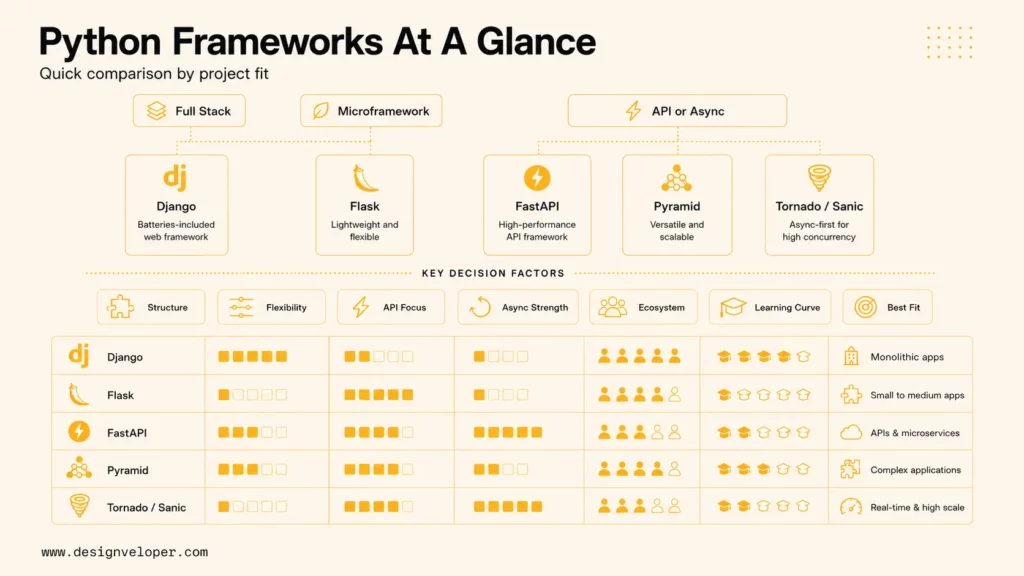
The fastest way to compare Python frameworks is to map each option to the project shape it serves best. The table below is a starting point, not a universal ranking.
| Framework | Type | Best For | Key Strength | Learning Curve |
|---|---|---|---|---|
| Django framework | Full-stack web framework | Database-backed web apps, admin portals, content platforms, business systems. | Batteries-included structure, ORM, admin, auth, security features, large ecosystem. | Medium, because conventions and project structure take time to learn. |
| Flask framework | Microframework | Small apps, prototypes, webhooks, custom services, simple APIs. | Minimal core, flexibility, easy start, extension ecosystem. | Low at first, higher when the application grows. |
| FastAPI framework | API and ASGI framework | Modern APIs, backend services, AI endpoints, typed request validation. | Type hints, Pydantic validation, automatic OpenAPI docs, async support. | Low to medium, depending on typing and async familiarity. |
| Pyramid framework | Flexible web framework | Applications that need more structure than Flask but less opinion than Django. | Flexibility, mature design, ability to grow from small to complex apps. | Medium, because teams choose more architecture pieces themselves. |
| Tornado framework or Sanic framework | Async web framework | Long-lived connections, WebSockets, streaming, high-concurrency I/O workloads. | Non-blocking I/O and async request handling. | Medium to high, because async production behavior requires discipline. |
A practical shortlist is simple. Start with Django for a full product with users, roles, admin workflows, and database models. Start with FastAPI for a JSON API or AI backend. Start with Flask for a small flexible service. Consider Pyramid when the project needs explicit architecture choices. Consider Tornado or Sanic when asynchronous connection handling is central to the product.
Most Popular Python Frameworks
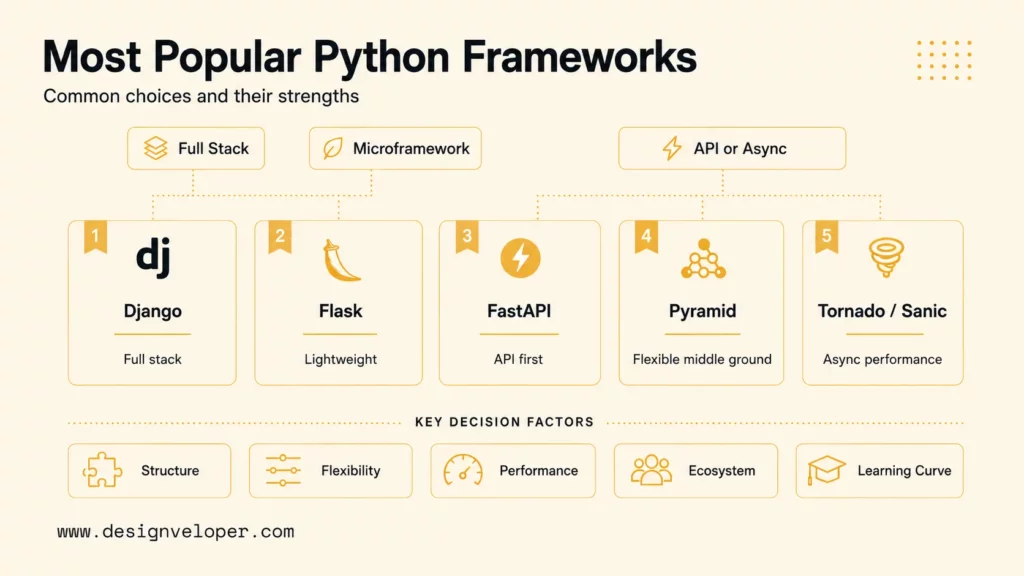
The most popular Python frameworks are popular because they solve repeatable problems with stable documentation, proven patterns, and active ecosystems. Popularity helps, but every framework still has a best-fit project profile.
Django
Django is the strongest general-purpose choice for full-stack web products. It is especially useful when a project needs a database, user authentication, admin interfaces, content management, forms, permissions, and a clear structure from day one.
Django’s biggest advantage is the amount of product infrastructure included by default. The Django documentation covers models, forms, file uploads, security, testing, deployment, and reusable apps. That breadth makes Django valuable for teams that want to spend less time choosing basic building blocks and more time building business features.
Django is not always the smallest or fastest-feeling option for a tiny service. However, Django often becomes more attractive as the product grows. The admin interface, ORM, migrations, and mature ecosystem can save time when the system gains operational workflows and nontechnical admin users.
Flask
Flask is a flexible microframework for teams that want a small core and freedom to choose supporting libraries. Flask works well for prototypes, small apps, webhooks, dashboards, service wrappers, and simple APIs.
Flask’s strength is that it stays close to the developer. A basic route is easy to understand, and the framework does not force a database layer, validation library, folder structure, or authentication system. That makes Flask approachable for beginners and useful for experienced teams building focused services.
The main risk is unplanned growth. A Flask application can become hard to maintain when each developer adds a different extension, folder pattern, validation style, or database abstraction. Larger Flask projects need written conventions for app factories, blueprints, configuration, testing, and dependency boundaries.
FastAPI
FastAPI is a strong choice for modern APIs and backend services. FastAPI uses Python type hints and Pydantic-style validation to turn function signatures into request parsing, validation, serialization, and OpenAPI documentation.
FastAPI is particularly useful for AI systems and integration-heavy products because many AI features are API-first. Model inference endpoints, chatbot backends, RAG services, workflow automation APIs, internal developer tools, and data-service endpoints can benefit from FastAPI’s typed request and response model.
FastAPI’s automatic API documentation is a practical collaboration advantage. Backend developers, frontend developers, QA teams, and external integrators can inspect endpoints through generated OpenAPI docs instead of waiting for a separate documentation pass.
Pyramid
Pyramid is a mature Python web framework for teams that want flexibility without starting from a tiny microframework. The Pyramid web framework documentation describes Pyramid as small, fast, and down-to-earth, with detailed tutorials and API documentation.
Pyramid can fit projects that need custom architecture, long-term maintainability, and careful selection of components. It is less mainstream than Django, Flask, and FastAPI, but it remains relevant for teams that value explicit configuration and flexible design.
The main tradeoff is ecosystem momentum. Pyramid may be a good technical fit, but teams should confirm hiring, community support, extension availability, and internal expertise before choosing it for a long-lived product.
Tornado Or Sanic
Tornado and Sanic fit asynchronous and high-concurrency use cases. Tornado is useful for long polling, WebSockets, and long-lived connections. Sanic is useful when a team wants an async-first framework with a lightweight feel and production server tooling.
Async frameworks are not automatically faster for every application. Async helps most when the application spends time waiting for network I/O, streaming data, external APIs, databases, or many open connections. CPU-heavy work should usually move to workers, queues, native extensions, or separate services so the event loop stays responsive.
Choose Tornado or Sanic when async behavior is central to the product, not because async sounds modern. A normal CRUD application may be easier to build and maintain in Django, Flask, or FastAPI.
Best Python Frameworks For Different Use Cases
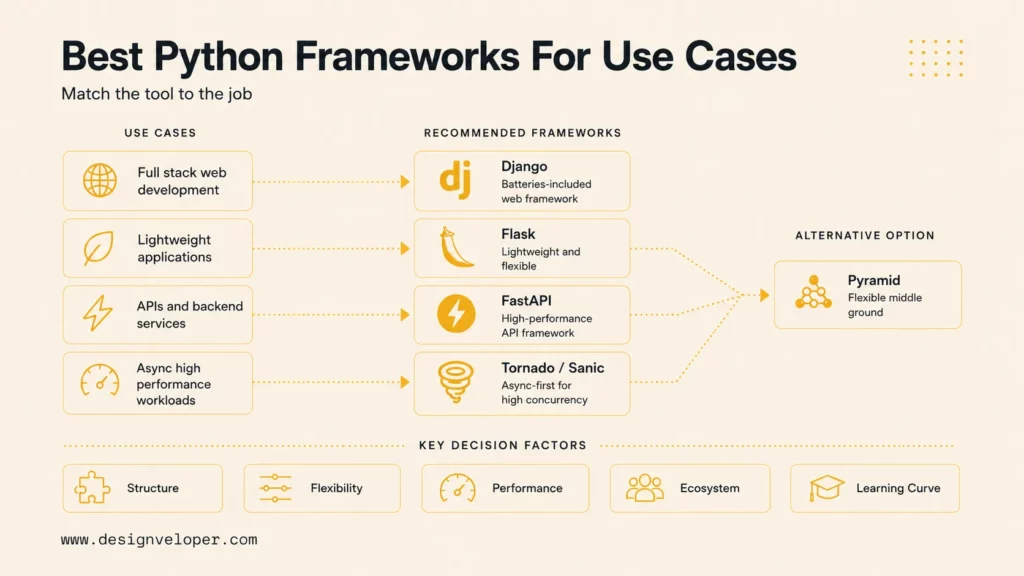
The best Python framework changes with the product use case. Teams should choose by workflow, data model, API shape, concurrency needs, and maintenance plan rather than choosing only by popularity.
For Full-Stack Web Development
Django is usually the best Python framework for full-stack web development. It gives teams a strong structure for models, templates, forms, authentication, admin workflows, and security. That structure is useful for products with user accounts, content management, dashboards, permissions, and back-office operations.
Django is especially strong when the product needs an admin panel early. A team can let internal staff manage users, records, content, orders, bookings, or operational data without building a custom admin interface from scratch.
FastAPI or Flask can still support full-stack products, but they require more choices around templates, admin, forms, authentication, database migrations, and authorization. Those choices can be healthy for experienced teams, but they add decision cost.
For Lightweight Applications
Flask is often the best fit for lightweight applications because it is simple, flexible, and easy to start. A small webhook service, analytics dashboard, internal utility, proof of concept, or integration wrapper may not need Django’s full application structure.
FastAPI is also a good lightweight choice when the application is API-first. If the output is JSON, the inputs need validation, and the frontend or another service consumes the API, FastAPI may be a better starting point than Flask.
The key decision is future size. A lightweight project that will stay small can remain simple. A lightweight project that is likely to become a core product should adopt folder structure, tests, type hints, settings management, and deployment conventions early.
For APIs And Backend Services
FastAPI is usually the best Python framework for modern APIs and backend services. It gives developers typed request models, response models, dependency injection, automatic OpenAPI documentation, async support, and a clean developer experience for JSON-first products.
Django REST Framework is a strong option when the product already uses Django or needs Django’s ORM, authentication, permissions, and admin ecosystem. The Django REST Framework documentation emphasizes extensive documentation and community support, which matters for teams building APIs on top of Django applications.
Flask can also serve APIs well, especially for small services. However, FastAPI often gives API teams more structure out of the box through type hints, validation, and generated documentation.
For Async And High-Performance Workloads
FastAPI, Tornado, and Sanic are the main choices for async and high-performance Python web workloads. FastAPI is the best default when the workload is an API with typed validation. Tornado is useful when long-lived connections, long polling, or WebSockets are central. Sanic is useful for async-first services with a lightweight design.
High performance should be defined before choosing a framework. Some products need lower latency. Some need many concurrent connections. Some need streaming responses. Some need lower cloud cost. Some need better developer velocity, which can be more important than raw request benchmarks.
Teams should also separate framework performance from system performance. Database queries, external APIs, model calls, serialization, caching, deployment configuration, and background workers often dominate real latency. A framework choice helps, but production performance still requires profiling and architecture review.
How To Choose The Right Python Framework
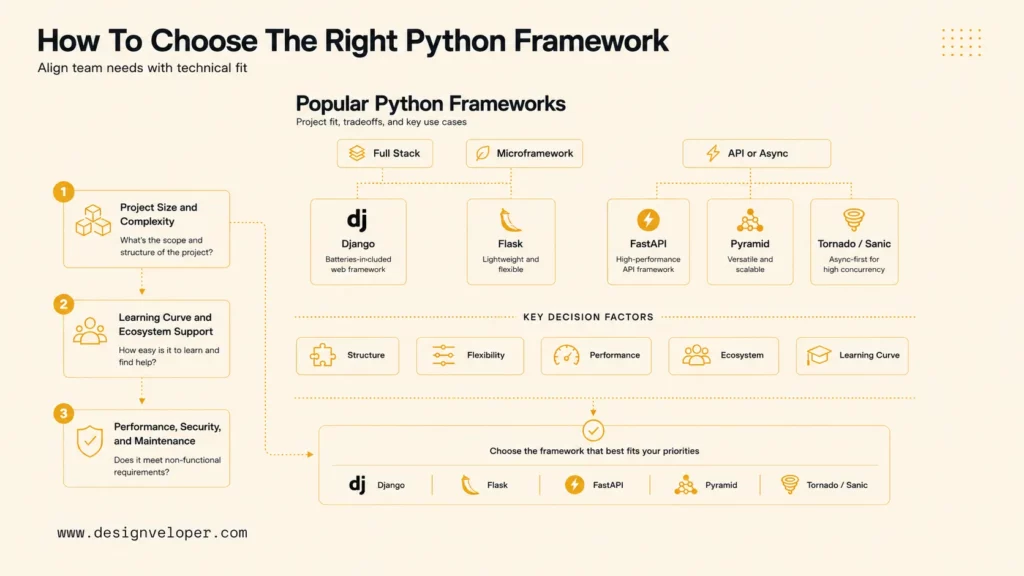
The right framework is the one that fits the project’s complexity, team skills, performance needs, security model, and maintenance expectations. A good decision should reduce future friction, not only make the first sprint pleasant.
Match The Framework To Project Size And Complexity
Project size and complexity should guide the first shortlist. A simple webhook does not need a full-stack framework. A multi-role business platform probably needs stronger structure than a tiny microframework. A real-time collaboration feature may need async support from the start.
| Project signal | Recommended starting point | Reason |
|---|---|---|
| Admin-heavy product with users, roles, and records | Django | Built-in admin, ORM, auth, and conventions reduce setup work. |
| Small service or prototype | Flask | Minimal setup and flexible architecture keep the service lean. |
| Typed API for frontend, mobile, or AI systems | FastAPI | Validation and OpenAPI docs improve API collaboration. |
| Custom architecture with selective components | Pyramid | Flexible structure supports explicit design decisions. |
| Long-lived connections or async I/O | Tornado or Sanic | Async design supports connection-heavy workloads. |
Complexity can change, so the first framework decision should include a growth path. A prototype can start in Flask or FastAPI, but the team should know when it will need stronger project conventions, background jobs, observability, permission design, and deployment automation.
Consider Learning Curve And Ecosystem Support
Learning curve matters because frameworks are maintained by teams, not by isolated developers. A framework that one senior engineer loves may be risky if the rest of the team cannot review, debug, test, or deploy it confidently.
Django has more conventions to learn, but those conventions help larger teams. Flask is easy to start, but teams must learn how to add missing structure. FastAPI is approachable for developers comfortable with type hints, but async behavior and dependency injection need disciplined use. Pyramid, Tornado, and Sanic can be strong choices when the team already understands their architectural style.
Ecosystem support includes documentation, community examples, packages, editor support, deployment guides, security updates, and available developers. Mainstream frameworks make hiring and troubleshooting easier. Less common frameworks may still be right when their technical fit is unusually strong.
Think About Performance, Security, And Maintenance
Performance, security, and maintenance should be evaluated together. A fast framework that the team cannot secure is not a good choice. A secure framework that slows every product change may also be a poor fit. A maintainable framework balances runtime needs with team capability.
Security expectations differ by framework type. Django includes many security features and conventions, but teams must still configure settings correctly. Flask gives flexibility, so teams must add and review security-related extensions and patterns. FastAPI provides validation and documentation advantages, but teams still need authentication, authorization, rate limits, CORS, secret handling, and audit logging.
Maintenance should include Python version upgrades, dependency updates, test coverage, deployment scripts, observability, incident response, and ownership. A framework choice is successful when new developers can understand the project, CI can test it, security teams can review it, and the product can evolve without repeated rewrites.
Making Python Framework Choices Work In Real Projects
Python framework choices work best when they are tied to product scope, team skills, deployment model, and long-term maintenance needs. Popularity is useful evidence, but popularity does not replace architecture judgment.
A practical decision process looks like this:
- Define the workload: Is the product a full-stack web app, API service, async system, dashboard, internal tool, AI backend, or data workflow?
- List product requirements: Identify user roles, admin needs, data models, authentication, integrations, real-time features, and compliance expectations.
- Check team readiness: Confirm whether the team can test, review, deploy, monitor, and maintain the framework.
- Prototype the riskiest workflow: Build the hardest route, form, API, async call, or admin flow before committing.
- Plan production basics: Add CI, linting, tests, settings management, logging, monitoring, dependency updates, and deployment scripts early.
At Designveloper, we treat framework selection as a product engineering decision. Our teams work across web applications, AI-powered services, automation systems, and backend platforms, so we evaluate frameworks by delivery risk, maintainability, integration needs, and post-launch support. Our web application development services and AI development services help teams connect framework choices to real workflows, security needs, testing strategy, and production operations.
The best framework decision is rarely dramatic. It is usually the framework that makes the team faster without hiding important risks. Choose Django when structure and built-in features matter. Flask is for when simplicity and flexibility matter. FastAPI is when typed APIs and backend services matter. And choose Pyramid, Tornado, or Sanic when their specific architecture strengths match the product better than mainstream defaults.
FAQs About Python Frameworks
What Is The Best Python Framework For Beginners?
Flask is often the easiest Python framework for beginners because it has a small core and simple routing model. Django is also beginner-friendly for learners who want to build complete web applications with databases, templates, authentication, and admin features. FastAPI is beginner-friendly for developers learning API development with type hints.
Which Python Framework Is Best For APIs?
FastAPI is usually the best Python framework for modern APIs because it uses type hints, validation, and automatic OpenAPI documentation. Django REST Framework is a strong choice when the API belongs to a Django application. Flask can work well for small APIs when the team wants a minimal core.
What Is The Most Used Python Framework?
Django, Flask, and FastAPI are the most visible Python web frameworks in current developer surveys and industry usage. The best answer depends on the category: Django is strongest for full-stack web applications, Flask remains common for lightweight services, and FastAPI has grown quickly for APIs and backend services.
What Is The Difference Between A Python Framework And A Library?
A Python library is usually a package that application code calls for a specific task. A Python framework gives the application a structure and calls developer code through routes, views, handlers, middleware, or lifecycle hooks. Libraries are building blocks; frameworks shape the building.
Which Python Framework Is Best For Large Projects?
Django is often the best Python framework for large web projects because it provides strong conventions, ORM, migrations, admin, authentication, security features, and a mature ecosystem. FastAPI can also fit large API-first systems when the team designs project structure, authentication, testing, observability, and deployment carefully.