

This is what makes the portal actionable. It’s not just displaying information; it’s connected to a system that can act.
Data plane: keep it simple
The data plane is where your workloads actually run. In most cases, this means one or more Kubernetes clusters. The data plane doesn’t know about your abstractions. It understands Kubernetes primitives such as pods, deployments, services, and ingresses. The control plane’s job is to compile your higher-level concepts into these primitives and apply them.
The data plane does one thing: it runs what the control plane tells it to run. The intelligence lives in the control plane; the execution happens in the data plane.
Where AI fits into the platform
AI is now part of every platform conversation, but the architectural question is where it actually belongs.
The abstractions and control plane you’ve built create the foundation. You have well-defined concepts such as components, endpoints, and dependencies. You have a runtime state aggregated and tied to those concepts. You have a connected view of your system. AI agents can definitely leverage this.
Agents as platform users
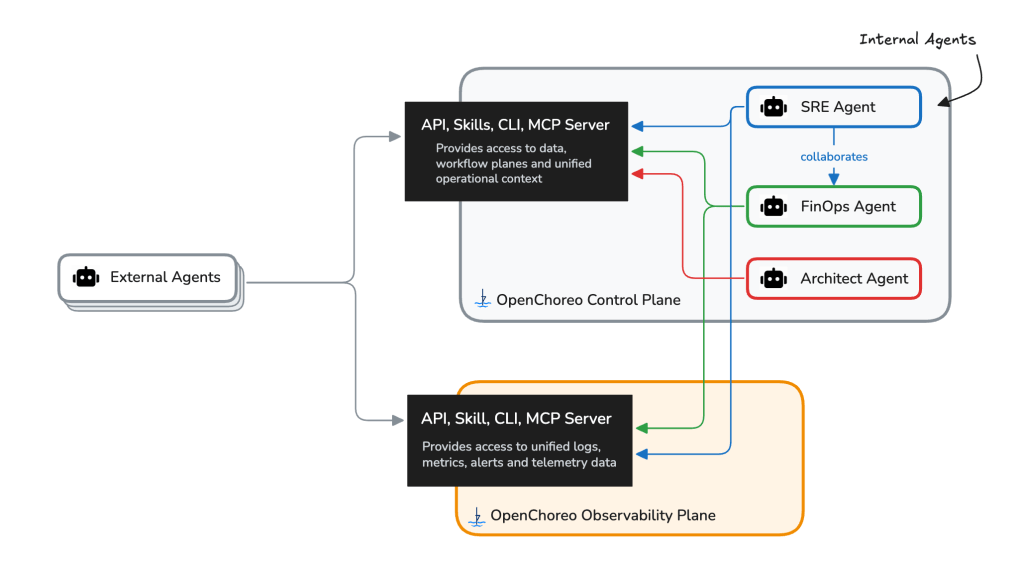
AI agents should be able to interact with your platform as first-class participants. This requires exposing platform capabilities through interfaces that agents can use, such as Model Context Protocol (MCP) servers, APIs with clear semantics, user-friendly CLIs, and skills that map to platform operations.
These capabilities of the platform enable agents to create components, trigger builds and deployments, query environment status, and reason about dependencies. They help you and your developers become more productive.
Agents as platform capabilities
You can also embed agents inside your platform to help your teams’ day-to-day operations. Here are some examples of agents you can develop:
- SRE agents: Analyze logs, metrics, and traces to surface likely root causes. Instead of developers digging through dashboards, the agent correlates signals and suggests where to look.
- FinOps agents: Help teams understand and optimize resource costs across environments and components.
- Architect agents: Assist with system design decisions, such as dependency analysis, capacity planning, and migration impact assessment.
These agents work because they have access to the control plane’s unified view. They see abstractions, runtime state, and observability data in one place, the same connected story developers see in the portal.
The pattern holds. Good abstractions make everything easier, including AI.
OpenChoreo as a reference implementation
OpenChoreo is an open-source developer platform for Kubernetes. It was recently accepted into the CNCF as a sandbox project. OpenChoreo implements the architecture described in this article: developer abstractions backed by a control plane, a Backstage-powered portal, integrated CI/CD and GitOps, and observability wired to your abstractions.
If you’re building this architecture yourself, OpenChoreo is worth studying as a reference, even if you don’t adopt it directly. The project demonstrates how these pieces fit together: how abstractions compile into Kubernetes resources, how runtime state flows back to the portal, and how guardrails are enforced during compilation.
You can use OpenChoreo as a complete platform, or install its Backstage plugins into your existing portal and use just the control plane layer. Either way, the underlying patterns are what matter. The architecture is the idea. OpenChoreo is one way to implement it.
WSO2
A useful mental model: multi-plane architecture
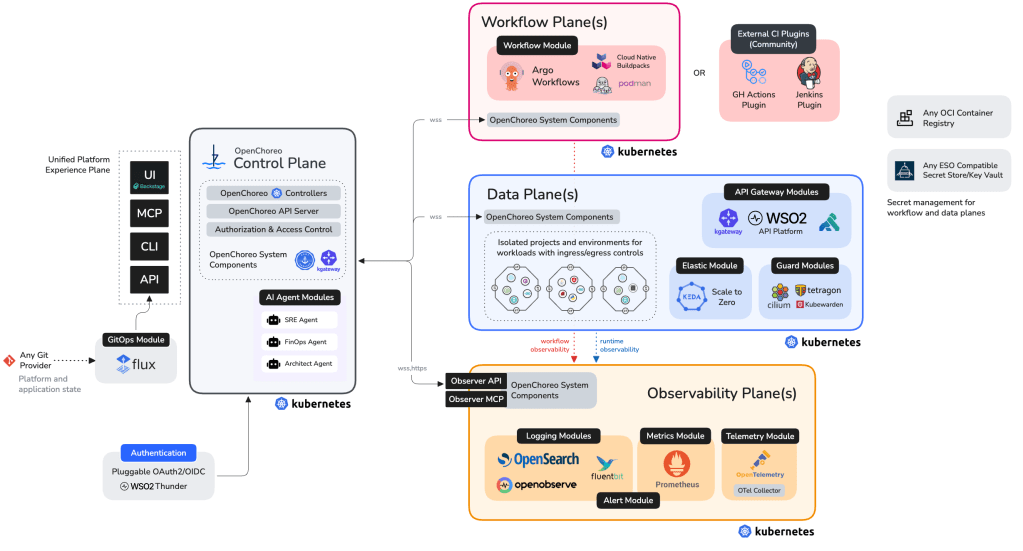
OpenChoreo separates concerns across five planes:
- Experience plane: Where developers, platform engineers, and SREs interact with the platform via the Backstage-powered portal, CLI, GitOps, or AI agents.
- Control plane: The brain that translates high-level abstractions (components, APIs, environments, pipelines) into Kubernetes manifests. Programmable through component types and traits, so you can extend it without forking or writing low-level controllers. Continuously reconciles the runtime state back into those abstractions.
- Data plane: Where workloads run. Enforces the semantics of your abstractions, such as project isolation, traffic policies, and security boundaries. These aren’t just configurations; the platform guarantees them.
- Observability plane: Feeds metrics, logs, and traces back through the same abstractions developers already understand, requiring no translation.
- Workflow plane (optional): Handles builds using Cloud Native Buildpacks and Argo Workflows by default.
These planes work together but remain separate concerns. You can reason about each independently, evolve them at different rates, and deploy them flexibly: a single cluster with namespace isolation for dev/test, fully separated multi-cluster setups for production, or hybrid topologies that colocate planes like Control and CI for cost efficiency.
AI and OpenChoreo
OpenChoreo is being built to treat AI agents as first-class participants. In OpenChoreo 1.0, external agents can interact with the platform via MCP servers, agent skills, or the CLI to generate and edit component configurations, reason about releases and environments, and more. The built-in SRE Agent is a first example of this. It analyzes logs, metrics, and traces from your deployments and uses LLMs to surface likely root causes and actionable insights.
WSO2
From portal to platform
Backstage solved the portal problem. It gave you a unified interface for catalogs, documentation, and golden paths. But a portal isn’t a platform. There’s a gap between what developers see and what’s actually running, and that’s where you get stuck. You fill it with point-to-point integrations, custom plugins, and scripts that become their own maintenance burden.
The pattern that works is portal, control plane, data plane:
- A portal that gives developers ready access to catalogs, documentation, and templates.
- A control plane that compiles platform abstractions, reconciles drift, and aggregates runtime state.
- A data plane that runs workloads and enforces guarantees.
Whether you build this yourself or you adopt something like OpenChoreo, the architecture matters more than the tools. Get the layers right, and new capabilities slot in cleanly. Get them wrong, and every feature request becomes a project.
Backstage gives you the front door. The real platform begins behind it.
—
New Tech Forum provides a venue for technology leaders—including vendors and other outside contributors—to explore and discuss emerging enterprise technology in unprecedented depth and breadth. The selection is subjective, based on our pick of the technologies we believe to be important and of greatest interest to InfoWorld readers. InfoWorld does not accept marketing collateral for publication and reserves the right to edit all contributed content. Send all inquiries to doug_dineley@foundryco.com.