

Many beginners often get confused when learning about software development methodologies. Especially, Agile and Scrum alone are already messy. So, if you wish to untangle the differences between Agile vs Waterfall vs Scrum vs Kanban, you’ve come to the right place.
In this article, we’ll detail what each approach actually means (without the jargon overload), how they differ, and when to use them. Keep reading, and this article will help you choose the right method for your project.
What is Agile?
First, we’ll learn what Agile means. Agile is a mindset built around the idea that software or any other products shouldn’t be developed in one long, rigid sequence.
Instead, Agile teams break work into smaller, yet manageable pieces which are implemented and tested within a single iteration. That way, they don’t spend months building something only to realize that it’s not what users actually need.
Agile started with the Agile Manifesto. This document emphasizes flexibility, collaboration, and responding to change over following a fixed plan. In practice, different teams interpret Agile differently, hence implementing Agile practices in different ways as well.
How Agile Works
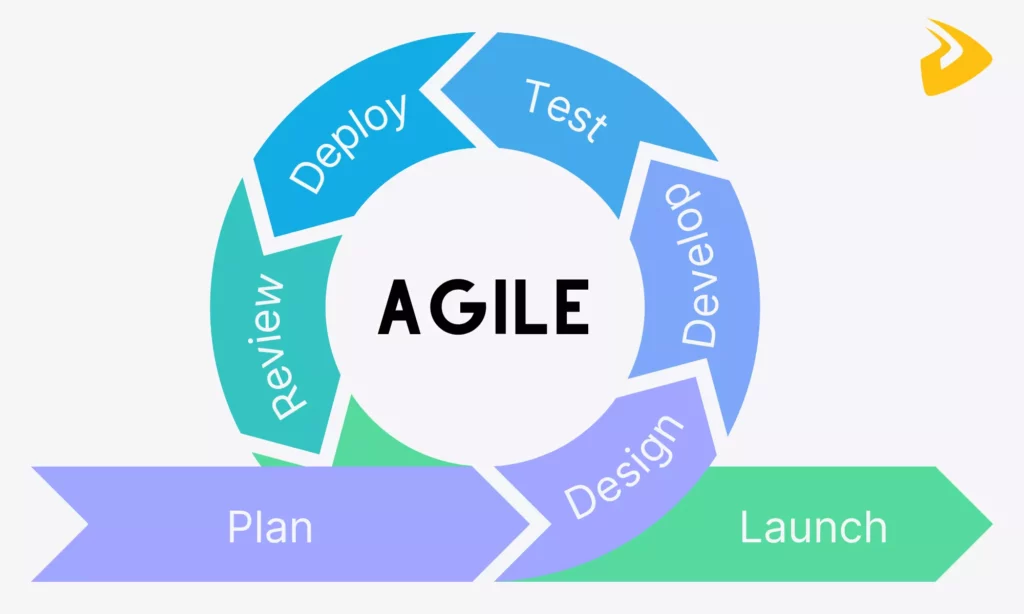
Agile works in short cycles (often called iterations or sprints) where teams plan, build, test, and review small chunks of work. In other words, they deliver incrementally instead of delivering everything at the end. Through feedback loops and various iterations, teams can adjust their workflow and improve products continuously.
A typical Agile process might start with a backlog, which is a prioritized list of features or tasks. Accordingly, the team picks a few items to work on during a short cycle (usually 2-4 weeks). During that time, they design, develop, and test those features. At the end, they review what’s been built and gather feedback from stakeholders or actual users.
For example, imagine building a mobile app. Instead of developing the entire app over six months, an Agile team might release a basic login feature first, then add user profiles, then messaging, and each is delivered in separate cycles. If users complain early on that the login process is confusing, the team can fix it right away, instead of discovering the issue months later.
Advantages of Agile
More and more organizations and transforming to the Agile methodology for flexibility and fast responses to changes. This leads to a rise in Agile transformation services, with an estimated value of $141 billion by 2032.
Agile isn’t just popular for no reason. It offers some real, practical benefits as follows:
- Flexibility to adapt to change: For projects where requirements evolve frequently, Agile helps teams to pivot when needed. It does so by allowing teams to build, test, and deliver software increments that are prioritized in the backlog.
- Faster delivery of value: Teams and stakeholders can see working features early and regularly instead of waiting months. This trait makes Agile very helpful when teams want to experiment with new ideas or develop MVP (Minimum Viable Products).
- Better collaboration: Agile inherently encourages frequent communication and shared responsibilities between developers, stakeholders, and users. This keeps everyone more aligned.
- Early risk detection: Incremental delivery also helps teams spot issues sooner because Agile testing happens continuously, not just at the end.
- Improved product quality: Through ongoing feedback loops, teams can refine the product over time, rather than relying on one big final review.
- Higher customer satisfaction: Since users are involved throughout, the final product is more likely to meet their actual needs. Further, incremental development helps teams check how real users react to released software parts. Using feedback and insights, they can improve software to increase customer satisfaction.
What Makes Agile Unique
There are many factors making Agile unique. Let’s take a look:
- Its attitude toward uncertainty: Traditional approaches try to predict everything upfront. But Agile handles uncertain requirements and market shifts by allowing you deliver software increments that meet current demands. Agile doesn’t teach you to fight against uncertainty, but how to live with it.
- Its emphasis on people over processes: Agile doesn’t ignore structure, but it prioritizes collaboration, communication, and team autonomy. It accordingly encourages teams to self-organize, make decisions, and continuously improve how they work.
- Agile thrives on constant feedback. Whether the feedback is from users, stakeholders, or within the team itself, that loop helps teams to make small, continuous adjustments based on evidence rather than guesswork.
What is Waterfall?
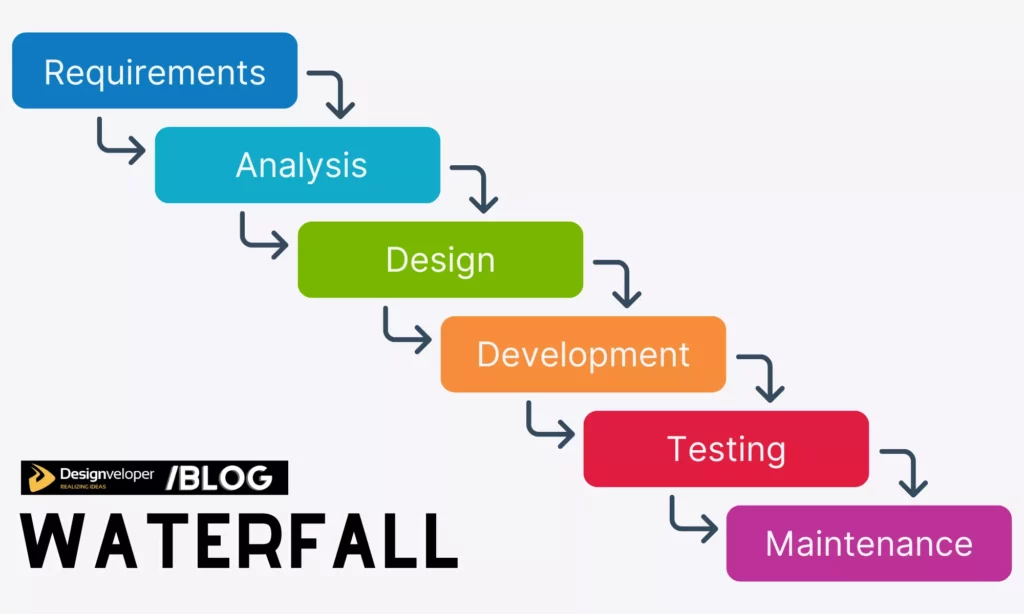
Waterfall is one of the oldest approaches to project management. It follows a linear, step-by-step process where each phase must be completed before the next one begins. Unlike Agile, steps in Waterfall aren’t overlapped. Teams have to finish one stage, then move on.
Traditionally, Waterfall is used in environments where requirements are clear from the start and unlikely to change much. You accordingly plan everything upfront, from scope and timeline to budget, and then execute according to that plan. Once you move forward, going back isn’t easy and costs a lot of effort, time, and money.
How Waterfall Works
Waterfall works by moving through a series of fixed stages: requirements, design, implementation, testing, deployment, and maintenance. Each phase has its own deliverables, and you don’t proceed until the current one is fully completed and approved.
Let’s say a company is building a payroll system. In the Waterfall model, they would first spend a significant amount of time gathering and documenting all unlikely-to-change requirements, including every feature, rule, and edge case. Once that’s locked in, the team moves to design, creating detailed system architecture and specifications. Only after that do developers start coding.
Testing comes much later, often near the end of the project. That means if a major issue is discovered, like a misunderstanding of requirements, it can be costly and time-consuming to fix. It’s because you might need to go all the way back to earlier stages.
So, in practice, Waterfall works best when everything is predictable. If the scope shifts midway, things can get complicated, and the Waterfall process will become a nightmare.
Advantages of Waterfall
Despite its rigidity, Waterfall still has its place. The following benefits show why it’s preferred in certain industries and situations:
- Clear structure and documentation: Every Waterfall phase is well-defined, with detailed documentation. This makes it easier to track progress and onboard new team members.
- Easy to manage and understand: The linear flow makes it simple to follow, even for teams with less experience in complex methodologies.
- Predictable timeline and budget: Since everything is planned upfront, Waterfall teams can easily estimate costs and deadlines.
- Well-suited for stable projects: Projects with fixed requirements (like government systems or compliance-heavy applications) benefit from Waterfall’s structured approach.
- Strong accountability: Each phase has clear deliverables and approvals. This helps ensure responsibility at every step.
What Makes Waterfall Unique
Waterfall is unique in certain projects and situations because of its following traits:
- Its commitment to upfront planning: Unlike Agile, which embraces change, Waterfall tries to minimize it from the very beginning. The idea is simple: if you plan everything carefully enough, execution should be smooth and predictable.
- Its strict sequence: In Waterfall, you don’t need to revisit earlier phases unless necessary. This creates discipline in the process, where teams must clarify all the requirements early and bring them throughout the process to the end.
- A strong emphasis on documentation: Every requirement, design decision, and test case is recorded in detail. That might feel excessive in fast-moving projects, but in Waterfall projects where heavy documentation is prioritized, it’s actually a huge advantage.
What is Scrum?
Scrum is a framework used to implement Agile principles. People often mix them up but there’s still some difference between Scrum and Agile.
Agile is more like a philosophy or mindset, while Scrum gives you a concrete way (we mean “a framework”) to actually implement the Agile philosophy. Further, Scrum comes with defined roles, events, and artifacts. This helps Agile adopters, especially beginners, easily adopt the Agile mindset.
Having said that, Scrum doesn’t cover everything, typically a complete instruction to build software. It just tells you things about roles (e.g., Product Owner, Scrum Master, etc.), events to run (e.g., daily stand-ups or retrospectives), and how to organize work (e.g., sprint goals or backlog). This “just enough structure” trait allows Scrum adopters to be more flexible in adapting it to their context without being confined within a rigid framework.
How Scrum Works
Scrum focuses short, time-boxed iterations called sprints, usually lasting 1-4 weeks. At the start of each sprint, the team picks a set of tasks from a prioritized backlog; this phase is called sprint planning. These tasks should be small enough to complete within the sprint.
A typical Scrum team is often organized around the three main roles:
- Product Owner who manages the backlog and priorities
- Scrum Master who facilitates the process and removes obstacles
- Development Team who actually designs, builds, and tests the software.
Each role has clear responsibilities, though in practice, there can be some overlap.
During the sprint, the team meets daily for a quick check-in (often called the daily stand-up) to discuss progress and blockers. At the end of the sprint, they hold a sprint review to demo what’s been built, followed by a retrospective to reflect on what went well and what didn’t.
Let’s say a team is building an eCommerce site. After breaking down the large work and picking the most critical features to build first, they decide to implement the shopping cart feature within a single sprint that lasts two weeks. By the end of the sprint, they have a working version – even if it’s basic – that can be reviewed during the review session and improved in the next sprint.
Advantages of Scrum
Scrum is widely adopted because it brings structure to Agile without making things overly rigid. Below are the most visible benefits of Scrum:
- Clear roles and responsibilities: In Scrum teams, everyone knows what they’re accountable for. This reduces confusion and unnecessary overlap as well as guides people on what they must do to deliver value.
- Frequent delivery of usable features: Each sprint delivers a working increment. This allows stakeholders to see progress regularly.
- Strong focus on priorities: During sprint planning, Scrum teams create and prioritize the product backlog. This ensures teams are always working on the most valuable tasks first.
- Continuous improvement: Through retrospective sessions, teams can reflect and adjust their workflow after every sprint.
- Better transparency: Daily stand-ups and sprint reviews keep everyone aligned and informed about the progress.
- Adaptability within structure: While Scrum has rules, it still allows flexibility in how teams execute their work.
What Makes Scrum Unique
Although Scrum is built around the core Agile philosophy, it still contains different traits that set it apart:
- Its balance between structure and flexibility: Unlike broader Agile approaches, Scrum gives you a defined system, including specific roles, events, and artifacts. But it still leaves room for teams to figure out how they want to work within that system.
- Its rhythm: The sprint cycle creates a steady, almost predictable cadence: plan, build, review, reflect, repeat. This rhythm keeps teams focused while also responding promptly to changes to adjust direction.
- Emphasis on accountability at both the individual and team levels: Scrum encourages teams to deliver a potentially shippable software increment at the end of each sprint. This pushes teams to create real value instead of just a working feature.
- Retrospective: Scrum doesn’t just allow teams and stakeholders to see how software increments actually work in practice, then adapt the product backlog. It also helps teams reflect on their effort by inspecting and improving how they work.
What is Kanban?
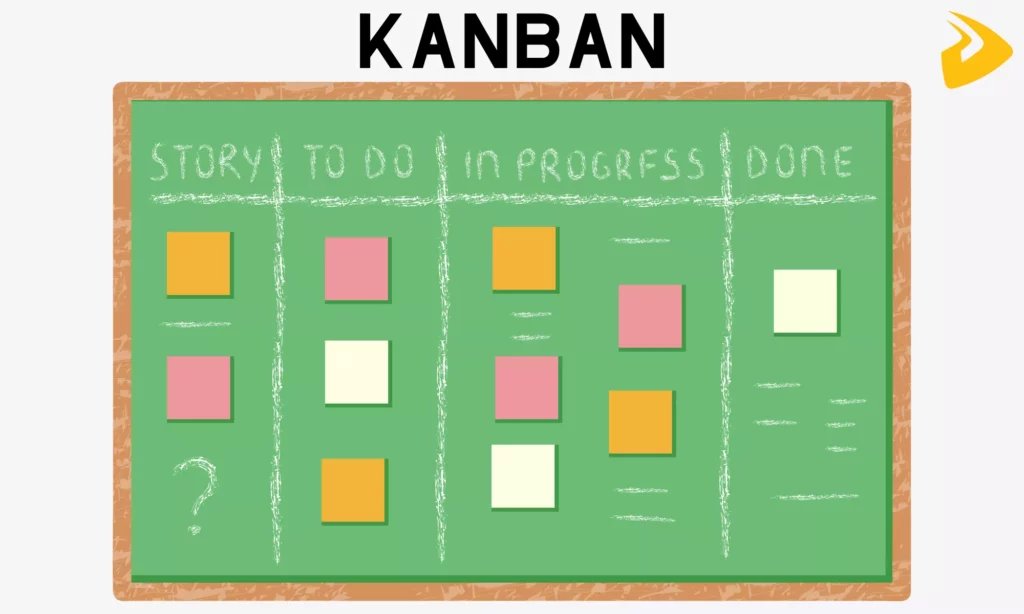
Kanban is a visual workflow management method that helps teams track work as it moves through different stages. Simply speaking, it focuses on making work visible and limiting how much is in progress at any given time.
Kanban often appears in the form of a board with columns like “To Do,” “In Progress,” and “Done.”
Kanban doesn’t rely on fixed iterations or sprints like Scrum. Instead, Kanban focuses on continuous delivery. This means tasks are completed and released whenever they’re ready, not at the end of a time-boxed cycle.
How Kanban Works
Kanban works by visualizing tasks on a board and moving them through predefined stages when work progresses. Each task is represented by a card, and each column represents a step in the workflow. When team members pick up tasks, they move the cards across the board, typically from left to right. There are no fixed deadlines or sprints in Kanban.
One key concept in Kanban is limiting Work In Progress (WIP). This means you can only have a certain number of tasks in a given stage at once. For example, if the “In Progress” column has a limit of 3 tasks, the team can’t start a fourth until one of the existing tasks moves forward. This forces focus and reduces bottlenecks.
Imagine a content team managing blog production. A task might move from “Ideas” → “Writing” → “Editing” → “Published.” If too many articles pile up in “Editing,” it’s a clear signal that something’s slowing things down. For example, maybe the editor is overloaded or the process is getting stuck.
Advantages of Kanban
Many teams, including Designveloper, adopt Kanban for its simplicity and flexibility. Below are the most visible benefits of this approach:
- Highly visual workflow: The Kanban board helps teams easily observe what’s happening, who’s working on what, and where things might be stuck.
- Continuous delivery: Tasks can be completed and released anytime, without being limited by deadlines or sprints.
- Improved focus through WIP limits: By limiting ongoing work, teams avoid multitasking overload and finish tasks faster.
- Flexibility and adaptability: Teams can add new tasks at any time without disrupting the overall workflow.
- Quick detection of bottlenecks: Visually tracking progress helps teams identify blockages quickly, hence addressing them early.
- Minimal setup and overhead: Kanban doesn’t require strict roles or events. So teams can adopt it quickly.
What Makes Kanban Unique
Kanban becomes outstanding among project management methods for its unique traits as follows:
- Emphasis on flow: While other approaches focus on deadlines or iterations, Kanban targets to optimize how tasks move through the system.
- Flexibility: Kanban doesn’t require roles, fixed timelines, or mandatory meetings but focuses more on work progress. Therefore, teams can use Kanban while flexibly organizing their team and workflows around the core Kanban principle.
- Visual work management: By visualizing every task and delay, teams can make their workflows more transparent. If something’s stuck, everyone can see it without waiting for status reports at the end of each iteration.
- Emphasis on limiting work instead of maximizing it: Doing more at once doesn’t mean you can get more work done well. Following that thinking, Kanban encourages teams to do less at a time, but finish more in a more sustainable way.
Agile Vs. Waterfall Vs. Scrum Vs. Kanban: Quick Comparison
So, you’ve learned what Agile, Waterfall, Scrum, and Kanban actually mean, plus how they work, outstanding features, and benefits. Now, let’s compare these approaches side by side in different aspects to see how they differ from each other:
| Aspect | Agile | Waterfall | Scrum | Kanban |
| Approach | Iterative & adaptive. Mainly supports teams in working in response to changes. | Linear or sequential. One phase only happens based on the final deliverable of the previous phase. | Iterative & structured with well-defined roles. Encourage teams to deliver product increments within sprints (typically 1-4 weeks). | Iterative & continuous. Mainly focus on workflow management rather than fixed deadlines and roles. |
| Flexibility | High, adapts to change easily | Very low, changes are difficult | Moderate to high within sprints | High, changes anytime |
| Workflow | Iterative and incremental | Sequential, step-by-step | Iterative in time-boxed sprints | Continuous flow |
| Roles | Not strictly defined | Clearly defined by phase | Defined (Scrum Master, Product Owner, Team) | No fixed roles |
| Structure | Loose, adaptable | Rigid and structured | Structured but flexible | Minimal structure, mainly visual boards |
| Delivery | Incremental releases | One final delivery | Increment per sprint | Continuous delivery |
| Best for | Dynamic, evolving projects where requirements regularly evolve | Stable, predictable projects with fully known requirements | Teams needing structure within Agile | Teams prioritizing flexibility and continuous flow (normally operational support, maintenance, or marketing teams) |
Which Project Management Methodology Should You Use?

With all the differences above, each project management approach shines in different situations. So the choice of approach depends on factors like project size, team structure, flexibility needs, and even the industry you’re working in. There’s no one-size-fits-all option here. Keep reading to see when to use which:
Based on Project Size
Project size can decide on quite many things, from planning and communication to how much structure you actually need.
- For small projects: Agile or Kanban
Smaller teams can move quickly, communicate informally, and adjust without heavy processes slowing them down. Agile or Kanban works best in this case. Particularly, Kanban is a great choice when tasks are ongoing and loosely defined, like content production or minor product updates. Agile (or Scrum) can also fit, though Scrum might be over-structured for very small teams.
- For medium-sized projects: Scrum
Scrum fits those projects. Accordingly, you get enough structure (roles, sprints, planning) to keep things organized, but still maintain flexibility.
- For large-scale projects (especially those with fixed requirements): Waterfall
Waterfall makes sense here. When you’re dealing with complex systems, multiple stakeholders, and strict deadlines, having everything planned upfront reduces uncertainty.
Having said that, many large organizations now use hybrid approaches (a mix of Waterfall planning and Agile execution) or homegrown approaches to meet their specific needs. Besides, they can adopt scaled Agile or Scrum to manage various Agile/Scrum teams under a single project.
Based on Team Structure
How your team is organized also decides on your choice between Agile, Waterfall, Scrum, and Kanban.
- For a cross-functional, self-managed team: Agile or Scrum
Agile or Scrum allows those teams to collaborate closely, make quick decisions, and adapt without needing constant top-down direction. Scrum, in particular, thrives here because its roles and ceremonies support a certain level of team autonomy.
- For a more hierarchical or siloed team: Waterfall
Waterfall fits those teams because its linear methodology fits top-down decision-making and rigid organizational structures. Accordingly, different departments (like design, development, and testing) can work in clearly defined phases, handing work off from one to another.
- For a less formal or constantly changing team: Kanban
Kanban is often a safe choice in this case because it doesn’t require fixed roles or strict ceremonies. This trait allows it to flexibly handle part-time contributors or evolving responsibilities and let people jump in where needed.
Based on Flexibility Needs
Does flexibility matter in your project? The answer partially helps you decide on the right methodology to adopt among Agile, Scrum, Waterfall, and Kanban.
- High flexibility: Agile, Scrum, Kanban
If your project requires high flexibility, choose Agile, Scrum, or Kanban. Why?
Agile embraces change. Scrum, although adding some structure, is still designed to manage that change within sprints. Meanwhile, Kanban allows continuous adjustments without waiting for a sprint to end. If priorities change weekly (or even daily), Kanban might be a better option.
- Moderate flexibility: Scrum
Scrum works well for projects with moderately changing requirements, because it balances planning and adaptability. You can’t change things mid-sprint easily, but you can adjust at the start of the next one.
- Low flexibility: Waterfall
If your project doesn’t have hard-to-change and fixed requirements, choose Waterfall. Its sequential methodology allows your team to avoid unnecessary overhead for iteration planning.
Based on Industry Or Use Case
Some industries “prefer” certain methodologies to others due to domain-specific requirements.
In these industries, we see requirements often evolve, user feedback matters, and fast time-to-market is required. So, iterative and adaptive approaches are the best choices to help teams adapt to those requirements. Among those approaches, Scrum is common for product teams, while Kanban is often used for maintenance, support, or continuous delivery environments.
- Construction, manufacturing, or infrastructure projects: Waterfall
Unlike software development where user demands change due to outdated versions or bugs, these physical industries often have clear upfront requirements about building a foundation or a metal part. Therefore, they prioritize detailed planning and sequencing, which Waterfall supports most.
- Regulated industries (like healthcare, finance, or government): Mixed or homegrown approaches
Organizations in these industries often adopt hybrid or homegrown approaches. For example, they may use Waterfall to provide the documentation and control for compliance, while Agile methods are used in development phases to stay responsive.
- Creative or content-driven teams (like marketing, design, or media): Kanban
In these domains, work is continuous, priorities shift, and rigid timelines aren’t always necessary. So, a visual workflow is enough, while Agile approaches like Scrum may sound overwhelming and unnecessary.
How Designveloper Helps Build Effective Software Using Agile
Choosing the right methodology is important. But having a team that actually knows how to apply it in real-world projects is a different story. So, if you plan to build an entire software product or improve an existing one, why not partner with Designveloper, a leading software and app development company in Vietnam?
At Designveloper, our teams often use Agile approaches like Scrum and Kanban for software and app development. The process typically starts with Business Analysts (BAs) working closely with clients to gather requirements and shape a clear list of essential features. From there, the team organizes work using Scrum and Kanban. But instead of following these frameworks too strictly, Designveloper adapts them to fit each project’s context.
This flexibility helps us launch faster while maintaining high quality, especially in MVP (Minimum Viable Product) development. Rather than trying to build everything at once, we prioritize core features, release early, and then iterate based on feedback.
Along with Agile approaches, we also focus on open and proactive communication to avoid misunderstandings, especially in cross-border projects. Whether through email or video calls, we keep clients regularly updated on progress, changes, and potential issues. Behind the scenes, we use Agile project management tools like Jira and Trello to track tasks, spot bottlenecks, and keep everything moving smoothly.
With this approach, Designveloper has successfully delivered over 100 projects across industries—from SaaS platforms to mobile apps and websites. Some notable names include ODC, Lumin PDF, Swell & Switchboard, Walrus Education, and Chloe Ting Hub.
Whether you plan to build software from scratch or improve an existing one, it might be worth reaching out to us!
FAQs About Agile Vs. Waterfall Vs. Scrum Vs. Kanban
Is Scrum Part Of Agile?
Yes, you can say Scrum is part of Agile. More particularly, it’s a framework that implements Agile principles in a structured way – or in other words, provides a structure around the Agile philosophy. While Agile itself is more like a mindset, Scrum gives teams a clear structure of roles, events, and workflows to follow.
With that understanding, you can say all Scrum teams are working around Agile principles. But not all Agile teams use Scrum because they can adopt other frameworks like Kanban or Lean.
Is Kanban Part Of Agile?
Not actually. Kanban wasn’t originally part of Agile, as Toyota developed it to support the Lean methodology in the Toyota Production System. Although Lean and Agile originally served different purposes (manufacturing and software development, respectively), they’re now often blended in different project types across industries.
For that reason, Kanban itself is widely used within Agile environments today. Many Agile teams align Kanban’s core idea with Agile values (e.g., continuous delivery and flexibility) to deliver the best outcomes.
Why Is Kanban Not Agile?
Strictly speaking, Kanban isn’t Agile because it wasn’t created from the Agile Manifesto or its original frameworks. It has roots in Lean methodology in the Toyota Production System. Further, it doesn’t involve Agile things like iterations. So, calling it “not Agile” is technically correct.
But Kanban’s core idea still supports many Agile principles. It encourages adaptability, continuous delivery, and workflow transparency. That’s why many Agile teams still adopt Kanban for part of their workflows, and many documents also suggest this approach as part of Agile.
When Should I Use Scrum Vs. Kanban?
The answer depends on how your team works and how much structure you need.
Normally, teams use Scrum if:
- They want clear roles, routines, and time-boxed planning
- Members benefit from regular check-ins and defined goals
- They’re building products in stages and need a steady rhythm
Teams also use Kanban when:
- Their work is continuous and less predictable
- They prefer flexibility over fixed schedules
- They want to focus on improving workflow and reducing bottlenecks
Can You Combine Kanban And Scrum?
Yes, and many teams actually adopt the Scrumban approach in practice. This hybrid approach combines the structured elements of Scrum (like sprint planning and roles) with Kanban’s visual workflow and flexibility.
For example, a team might still work in sprints but use a Kanban board with WIP limits to manage tasks more efficiently. This hybrid approach can reduce some of Scrum’s rigidity while keeping enough structure to stay organized.