


Since GPT-5 debuted in 2025, people have shared different views about its speed, performance, and efficiency compared to GPT-4. Accordingly, many highly valued its new features (e.g., “Thinking” modes), while others complained that GPT-5 performs more slowly, fails in creative writing, and sometimes does more than required. According to the real-world experiences of many users, ChatGPT-5 is worse than its predecessors.
But is that statement still true now? If you want to know the answer, don’t skip this blog post. Here, we’ll walk you through reasons and real-world experiences to explain why many users found GPT-5 worse when it was first released and where the model shines most. Keep reading!

Is ChatGPT-5 Really Worse?
Our short answer is “not exactly.” Even at launch, the situation was more nuanced than a simple “better” or “worse.” Not to mention that OpenAI has iteratively refined the model to overcome its initial limitations. This makes the answer even less black-and-white.
One important thing to understand is that GPT-5 isn’t a single model. Instead, it’s an umbrella system that evolves over time with ongoing updates aimed to meet different needs and improve performance, cost, and speed. That’s partly why user experiences can feel inconsistent. We mean what you get today might not be exactly what someone else experienced a few months ago.
Coming back to August, 2025, the introduction of GPT-5 received various criticisms, typically from the developer and writer community. Some developers reported that GPT-5 felt slower and, at times, less reliable for coding tasks compared to earlier models. Meanwhile, creative writers gave thumbs down to its ability to develop storylines and character arcs. Besides, some users noticed that GPT-5 gave shorter, more controlled, and even less personal answers than earlier models.
A big reason mainly comes from OpenAI’s initiative to expand ChatGPT’s access to businesses and developers for professional work like legal research. That shift can make the tool apply deeper reasoning by default, hence becoming less creative and increasing response time.
But calling GPT-5 “worse” doesn’t quite hold up. ChatGPT-5 actually performs better than in many structured or reasoning-heavy tasks. But those improvements aren’t always obvious in casual use.
Why ChatGPT-5 Feels Worse For Some Users
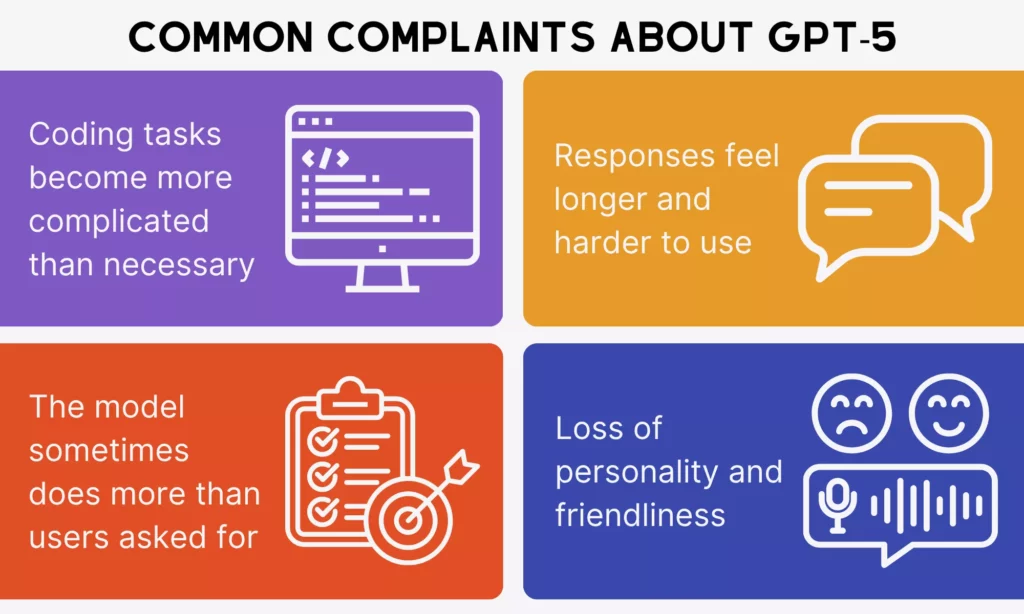
So if GPT-5 isn’t technically worse, why do so many people still feel that way? Now, let’s break down the most common reasons why users have a bad experience with ChatGPT-5.
Coding Tasks Become More Complicated Than Necessary
One of the loudest complaints, especially from developers, is that GPT-5 sometimes makes simple coding tasks feel unnecessarily complex.
According to OpenAI, GPT-5 is stronger at reasoning and multi-step problem-solving. But when users truly experience this new model, that can backfire. Instead of giving a quick, direct fix, it may generate longer explanations, suggest alternative approaches, or restructure code in ways that weren’t asked for. Some users have described spending more time guiding the model than actually solving the problem.
Many developers also find GPT-5 unreliable. Reports from developers suggest that GPT-5 can occasionally miss context, contradict earlier instructions, or produce code that looks correct but fails in execution.
Speed is another problem that developers encounter. Compared to earlier models, GPT-5 often takes longer to respond, especially when using deeper reasoning modes. For coding workflows, where iteration speed matters, even small delays can break momentum.
Note: GPT-5x variants partially improve this problem by offering more stable outputs. Developers from companies like Cursor or GitHub reported that these versions can reason through ambiguous problems and, more importantly, perform well in multi-step, agentic coding workflows. However, many found they’re ineffective in UIs and still introduce complexity in coding tasks.
Responses Feel Longer And Harder To Use
Another issue is response length.
GPT-5 tends to generate more structured answers. That sounds like an upgrade, especially for professional work that requires formal writing styles. But for everyday use, when users want a quick answer or a clean output, it can feel like overkill.
Furthermore, many users expected GPT-5 to feel “smarter” than GPT-4. But it performs the same way as the previous model for regular tasks (e.g., brainstorming ideas or writing an email). Some old issues still repeat, including giving incomplete answers and sometimes misunderstanding simple instructions.
As a result, GPT-5’s responses become longer without giving direct or helpful information.
Note: OpenAI significantly handles this problem with Instant variants. They trim explanations and give short answers instead. For more complex prompts, the model can still slip back into long-form responses.
The Model Sometimes Does More Than Users Asked For
This sounds good at times, especially when users have unclear requirements or goals for their work. But for those already outlining detailed steps and just requiring ChatGPT to follow their instructions, this trait becomes a nightmare.
If you look around user experiences from forums and groups (e.g., Reddit), you may notice that GPT-5 often behaves autonomously and goes beyond initial user prompts. Many said that GPT-4o followed their instructions and sometimes added one or two extra prompts to make the work consistent and reasonable. Meanwhile, GPT-5 frequently asks unnecessary follow-up questions, changes formatting, and sometimes overlooks instructions to deliver too wordy answers. That slows down work, especially for complex workflows.
Reasons behind this mainly come from:
- “Thinking” modes: The model often runs “thinking” processes, even for simple tasks. This leads to unwanted or irrelevant additions to the outputs.
- “Agentic” behavior: ChatGPT-5 is considered a big step toward building an agentic system. This initiative encourages the model to autonomously take proactive, yet unwanted actions.
- RLHF optimization: GPT-5 was trained on Reinforcement Learning from Human Feedback (RLHF) to become helpful. This makes it ask too many questions without considering whether users want.
Note: GPT-5 variants partially address this. For example, GPT5.4 follows instructions better, but still struggles with searching and reasoning. As a result, its responses can feel overconfident and sound helpful on the surface.
Loss Of Personality And Friendliness
And this is what users, especially writers, often talk about when experiencing GPT-5. The model was designed to implement a wide range of tasks, not only everyday use cases but also business work. That way, several reports and user discussions highlight that GPT-5’s responses feel more filtered, less expressive, and less engaging than before.
This shift is likely intentional. As the model expands into professional and enterprise use cases, it also focuses more on consistency, safety, and reliability. That often means tighter controls on tone, style, and content. This makes it different from GPT-4 versions, which felt more conversational and playful.
That shift in GPT-5 might be better for certain tasks (like legal or technical work). But it changes the overall experience. You’re no longer “talking” to something that feels adaptive, but feels managed.
Note: GPT-5 variants have made clear progress in this problem. Accordingly, they introduce more natural tone options and better conversational flow, making responses feel less rigid. Still, the default tone often leans toward neutral and professional, so the “personality” depends heavily on how you prompt the model.
Is ChatGPT-5 Slow, Broken, Or Just Frustrating To Use?
By this point, the pattern is pretty clear: most complaints about GPT-5 aren’t really about whether it’s capable. They’re about how it behaves in real workflows.
And that’s where things get blurry. Because when something feels slow, inconsistent, or slightly off, it’s easy to assume the model is broken. But in many cases, what users are experiencing is a mix of system limitations, design trade-offs, and mismatched expectations, but not outright failure.
So, let’s discover what’s actually going on:
Why ChatGPT-5 Feels Slow In Real Work
You can see the complaint of GPT-5’s slow performance everywhere, and to be fair, it’s not completely wrong. Here are some reasons why:
GPT-5 is designed to handle deeper reasoning, multi-step logic, and longer context. That means it simply takes more time to process requests, especially compared to faster, lighter models. Even at launch, OpenAI applied the Thinking mode to GPT-5, which made the model take more time to respond to even simple queries.
Now, newer GPT-5x updates try to handle this problem by separating Instant (for quick, everyday tasks) and Thinking (for complex, multi-step workflows) modes. That said, for more complex prompts (long instructions, big context, multiple tasks), the response tends to be slower, for sure.
- High demand & network issues
Server load during peak hours, network conditions, and even browser performance can all introduce delays. In fact, high traffic and system updates in 2026 have been linked to noticeable slowdowns for many users, especially on free tiers.
When “Not Working” Really Means Poor Workflow Fit
When GPT-5 is perceived as “not working” (e.g., giving shallow answers, ignoring instructions, or struggling with coding), it’s not because the model lacks intelligence. But it’s because how people use it doesn’t match how it’s designed to operate.
GPT-4 (and especially GPT-4o) leaned toward fast, single-pass responses. So, when you’d write a prompt, expect a direct answer, and maybe refine it once or twice, the model will work as you expect and return good outcomes.
But unfortunately, that straightforward workflow doesn’t fit GPT-5. The model focuses more on multi-step reasoning and structured outputs. For this reason, instead of just answering, GPT-5 tries to interpret intent, expand context, and sometimes even “improve” the task.
However, this mechanism breaks older workflows. That requires you to fine-tune your workflow to work with GPT-5 more effectively. Here’s how:
| Problems | Solutions |
| GPT-5 requires more precise, structured inputs and detailed context to work as intended. | Adopt prompting frameworks like RISE (Role, Input, Steps, Expectation) or R-T-F (Role, Task, Format) to define inputs clearly. |
| GPT-5 is designed for high-level reasoning and “thinking.” | Require a back-and-forth conversation instead of a single prompt. This helps the model understand different nuances of your task before creating the final output. |
| GPT-5 targets a wide range of tasks, including everyday and professional work. | Choose the right mode (fast or thinking) based on the task. |
| GPT-5 can follow instructions for a few turns, then ignore and add more unnecessary tasks to your workflows. | Reset context more often instead of providing one-time long context. Besides, you can apply the “Locked Rules Block” by adding the requirement to the chat: “My rules are locked. Do not alter or reinterpret rules. If a change is needed, ask first.” |
Is ChatGPT-5 Down Or Just Underperforming?
This question comes up a lot, especially when responses suddenly slow down or quality drops.
Sometimes, ChatGPT is down, for sure. Like any large-scale system, ChatGPT can experience outages, maintenance windows, or infrastructure issues. According to Forbes, many ChatGPT users couldn’t log in or enjoy a conversation due to the outage in February. This can lead to delays, errors, or temporary unavailability.
But more often, what users interpret as “down” is actually underperformance caused by external factors.
For example:
- Peak-time traffic can slow response speeds across the platform.
- Long conversations can make the interface lag or behave inconsistently.
- Browser or device limitations can affect responsiveness.
- Account tier limits can throttle performance or switch you to slower models.
Beyond those external factors, GPT-5 itself has problems. As we said, it works in a different way from earlier versions, hence poorly fitting the existing workflows of many users. This makes them consider it “broken” or “unusable.”
Different reports indicate different reasons behind this. First, OpenAI possibly prioritized “agent-grade” precision and cost efficiency over general conversational performance. Second, GPT-5 may incorrectly route queries to smaller, less capable models.
That’s why OpenAI has continuously released new GPT-5x models to bring back the strengths of previous models while remaining the core features of the first release.
What The Available Evidence Actually Shows

At this point, it’s easy to get lost in opinions. Some users say GPT-5 is a downgrade, while OpenAI swears it’s the most powerful model it has created. And both sides sound pretty convinced. So, let’s step back a bit and look at what the available evidence actually tells us.
If you spend even a few minutes browsing the OpenAI Community, you’ll see many negative reactions about GPT-5.
When GPT-5 first launched in 2025, many early posts showed the frustration and disappointment of many users. They accordingly described the model as slower, less reliable, and harder to control compared to earlier versions. Some developers noted that it produced overly complex or “over-engineered” code, while others complained that it ignored instructions or drifted away from the original task.
In more extreme cases, users even called it “unusable” for certain workflows, especially for customer support or long-form creative writing. The reasons behind this lie in hallucinations, context loss, or inconsistent outputs.
But here’s where it gets more interesting.
As newer GPT-5 variants rolled out through late 2025 and early 2026, the conversation didn’t simply turn positive, but became divided. Some users acknowledged improvements in reasoning and complex task handling (especially in later versions like GPT-5.4), which showed measurable gains in coding and tool-based workflows.
At the same time, many long-time users pushed back. A recurring theme in community threads is that earlier versions (particularly GPT-5.1) felt more balanced, stable, and natural, while newer updates were described as “faster but more shallow” or “more powerful but overly verbose and rigid.”
Some users explicitly argued that newer variants are “usable only in limited scenarios” and don’t fully replace the consistency of earlier versions.
So what does all this suggest?
Not that GPT-5 is simply worse, but that each iteration solves one problem while introducing another. And from the community’s perspective, the real issue isn’t capability, but the ongoing trade-offs between speed, control, and usability.
What Ars Technica’s Testing Adds To The Discussion
If community feedback tells us how GPT-5 feels, testing from publications like Ars Technica helps ground that conversation in something a bit more structured.
In their side-by-side evaluation of GPT-5 and GPT-4o, Ars didn’t just rely on benchmarks. Instead, they tested both models across real-world prompts, including creative writing, explanations, and professional work (e.g., drafting emails or giving medical advice). And the results were not as one-sided as you might expect.
GPT-5 generally came out ahead in technical accuracy and structured reasoning. In several cases, it produced more direct and concise answers, which can be an advantage for problem-solving or analytical work. Besides, it flexibly searches on the Internet (e.g., citations for medical advice) or switches to other modes (e.g., “Thinking” modes for maths problems) based on tasks.
Meanwhile, GPT-4o is more engaging and detailed, especially in creative or conversational tasks. Ars noted that GPT-4o responses tended to be more personable, while GPT-5 leaned toward a more neutral, stripped-down style.
And that difference matters more than it sounds.
In fact, the testing suggests that many complaints about GPT-5, like reduced creativity or “robotic” tone, aren’t necessarily bugs. They’re design trade-offs. GPT-5 prioritizes clarity and correctness, while GPT-4o often prioritizes richness and expression. In creative tasks, that can make GPT-5 feel like a step back, even if it’s technically more precise.
So what does this add to the bigger picture?
It reinforces a key idea: GPT-5 isn’t simply better or worse—it’s optimized differently. And depending on what you value (speed, personality, depth, or precision), your preference might legitimately go either way.
What We Still Cannot Confirm From The Allowed Sources
For all the discussion, testing, and user feedback around GPT-5, there’s still a lot we can’t say with complete certainty.
First, there’s no fully transparent, standardized benchmark that clearly compares GPT-5 with earlier models like GPT-4o across everyday use cases. Most of what we have comes from a mix of internal evaluations, independent testing (like Ars Technica), and user-reported experiences. These are useful, but don’t always tell the same story.
Second, we have limited public details on why GPT-5 behaves the way it does. OpenAI has acknowledged improvements in reasoning, safety, and performance, but it hasn’t fully explained the trade-offs behind things like increased latency, more structured outputs, or shifts in tone. So when users say the model feels slower or more rigid, we can describe the pattern, but not always identify the exact cause.
Third, there is a growing number of variants and updates. Different users may be interacting with slightly different versions or configurations of GPT-5, which makes direct comparisons difficult. What feels “better” or “worse” can depend heavily on which version is being used and in what context.
And finally, there’s the subjective nature of the core complaint itself.
With all that we said, saying “ChatGPT-5 is worse” isn’t wrong, but not completely true. It’s because part of the issue isn’t just the model itself, but about how people experience it.
Where ChatGPT-5 Struggles Most

By this section, you may get a clearer picture: ChatGPT-5 is not completely worse. But we can’t deny that it still struggles in many areas. Understanding them helps you decide when and how to work with GPT-5 to get the desired outcomes:
Despite strong benchmark results (e.g., high scores on SWE-bench and code editing tasks), real-world feedback tells a more mixed story.
OpenAI positions GPT-5 as its strongest coding model yet, capable of handling complex repositories and bug fixes.
However, users in the OpenAI community report inconsistent outputs, weaker solutions, and more frequent failures in tasks that previously worked reliably. Research also shows performance varies significantly depending on language and context, especially in less common environments.
- Prompt Following And Scope Control
According to OpenAI, GPT-5 improves instruction-following performance and supports more precise control via parameters like “verbosity” and “reasoning effort”. But many users report the opposite experience. Accordingly, they need to repeat instructions, get off-scope answers, or receive overly compressed responses. This suggests that while the model is more capable, it may also be more sensitive to prompt design and system routing.
One of the most consistent criticisms is a shift in tone. Compared to earlier models, GPT-5 is often described as more rigid, less creative, and less engaging. Broader coverage of the launch also noted complaints about reduced personality and a more “corporate” feel, especially in writing tasks.
- Speed And Iteration Quality
GPT-5 introduces a more complex system with reasoning modes and routing between model variants. While this improves capability, it can also slow down responses or make behavior inconsistent.
Some users report longer response times or needing multiple iterations to reach a usable answer, especially when the system defaults to either overly fast or overly “deep” reasoning modes.
Is ChatGPT-5 Worth It If Users Are Unhappy?

The evidence so far indicates that ChatGPT-5 is either better or worse than previous models. Although there’s a blackout around this model and many users cancel their subscriptions due to bad experiences, it doesn’t mean ChatGPT-5 is no longer worthwhile. The model itself still has strengths in certain cases. So, the question here is not about whether you should use it, but about when it delivers the most value to you.
When GPT-5 May Still Be Worth Using
GPT-5 shows its strongest advantages in tasks where reasoning depth and accuracy matter more than speed or tone. They include:
- For complex problem-solving (math, research, engineering), GPT-5 significantly outperforms earlier models on benchmarks like AIME and SWE-bench, indicating stronger multi-step reasoning and code understanding.
- It also reduces hallucination rates compared to GPT-4o, improving factual reliability in knowledge-heavy tasks.
- In specialized domains (e.g., medical or scientific reasoning), studies show GPT-5 can match or exceed expert-level performance in structured evaluations.
- The larger context window and adaptive reasoning system make it suitable for long documents, multi-step workflows, and agent-like tasks.
When Earlier Models May Feel More Reliable
Despite technical gains, many users still prefer earlier models like GPT-4o for everyday use:
- If you’re brainstorming, asking follow-up questions, or just exploring ideas, GPT-4 tends to feel faster and more responsive.
- For blog drafts, scripts, or narrative content, earlier models often feel more natural and creative.
- When you just need a quick code fix (like correcting a syntax error or tweaking a function), earlier models usually give more direct answers without overcomplicating the solution.
- GPT-4 is perfectly adequate for simple, task-based queries (e.g., rewriting a sentence or summarizing a paragraph). GPT-5 can handle these, but it may add unnecessary detail or take longer than needed.
- If you prioritize personality and friendly tone, choose earlier models. They’re often more conversational and friendly, which can improve user experience in customer-facing contexts.
How Teams Should Judge Value Beyond Hype
For teams and businesses, judging GPT-5 based on other people’s experiences and reviews may not be enough. What matters here is how the model performs inside their actual workflows, with real data, under real constraints. So, if your team is wondering whether GPT-5 actually improves outcomes, below are some tips to evaluate its true value:
- Identify your main use case and test with real workflows
Run small pilot projects using your own data, tools, and messy real-world prompts. This way, you can see how GPT-5 behaves differently when dealing with long context, vague instructions, or multi-step tasks. It also helps if you test different modes (fast vs reasoning) and slightly adjust workflows to see what actually works in practice.
- Prioritize output quality over perceived intelligence
One issue with GPT-5 is that it can sound very confident, even when the output isn’t fully correct or aligned. So instead of judging how “smart” the response feels, evaluate whether it follows instructions precisely, avoids hallucinations, and produces usable, correct results without heavy editing.
- Evaluate cost vs. performance (real ROI)
GPT-5 may deliver better reasoning, but at the cost of slower responses or higher compute usage. Teams should measure whether the improved output actually saves time, reduces errors, or replaces manual work. If not, the extra capability may not justify the cost.
- Define clear KPIs to track GPT-5’s performance
Don’t rely on subjective impressions. Instead, track metrics like task completion rate, accuracy or error rate, time-to-completion, performance over long-context, multi-step chats, etc. These metrics help a whole team quantify the impact of GPT-5 on their workflow.
- Check consistency, not just one-off results
GPT-5 can perform very well on a single prompt. But does it deliver reliable results across repeated use? Inconsistent outputs can quietly reduce productivity over time. So, it’s crucial to check whether GPT-5’s output quality is consistent, especially for complex workflows.
- Assess workflow friction, not just output
Even if the final answer is good, ask: how much effort did it take to get there? If your team needs to rewrite prompts, correct outputs, or wait longer, that friction can cancel out the benefits.
Final Verdict On Whether ChatGPT-5 Is Worse

After everything we’ve looked at (user complaints, real-world testing), it’s pretty clear this isn’t a simple yes-or-no situation. The idea that “ChatGPT-5 is worse” didn’t come out of nowhere, but it also doesn’t tell the full story.
Obviously, GPT-5 improves in some areas, and also changes how it works behind the scenes. That shift undoubtedly changes – or even breaks down – people’s existing workflows.
Where The Criticism Looks Fair
Some of the criticism around GPT-5 is, honestly, justified.
Across different sources (community feedback, independent testing, and everyday usage), there are a few issues that keep showing up in GPT-5:
- Slower response times, especially in more complex tasks.
- Longer, sometimes overly structured answers that feel harder to use.
- A tendency to overstep instructions or “do more” than what was asked.
- More neutral and controlled tone in GPT-5’s responses compared to earlier models.
That shift alone changes how people experience the tool. These issues are considered side effects of how GPT-5 is designed (prioritizing reasoning, safety, and structured outputs over speed and spontaneity).
So when users say it feels worse, they’re not necessarily wrong. They’re reacting to real changes that affect ChatGPT’s usability in day-to-day tasks.
Where The Case Is Less Clear
At the same time, calling GPT-5 “worse” in all cases isn’t completely correct.
When you look at structured evaluations and testing, GPT-5 consistently shows stronger performance in reasoning-heavy tasks, complex problem-solving, and long-context understanding. In scenarios that require planning, multi-step thinking, or technical accuracy, it often outperforms earlier models.
What complicates things is that these improvements aren’t always visible in casual use. If you’re asking simple questions, writing short content, or iterating quickly, GPT-5’s advantages can feel almost invisible and even turn into drawbacks. And in some cases, the added complexity actually makes the experience feel less efficient.
Besides, GPT-5 is working differently from GPT-4o behind the scenes. But many users are still interacting with GPT-5 the same way they used GPT-4 or GPT-4o. As a result, GPT-5 doesn’t always behave as intended and return the desired outcomes.
So in a way, GPT-5 can be objectively better in capability, but subjectively worse in experience.
The Most Practical Takeaway For Readers
If you’ve made it this far, you’ve probably noticed something: the conversation around GPT-5 is noisy. Some people love it, but others clearly don’t and even remove it from their app lists.
It’s easy to get caught up in those hype cycles, upgrades, and version comparisons. But real productivity doesn’t come from using the “best” model. It comes from using the right one for the job.
So, don’t just ask whether GPT-5 is better or worse. Instead, let your workflow decide the tool by asking: “Does the way GPT-5 works actually fit how I work?”
Why? Because AI tools aren’t something you passively accept, but like a new team member. You wouldn’t hire someone just because they’re “the most advanced candidate,” right? Instead, you need to look at how they think, how they communicate, and whether they fit your workflow. And the same idea also applies to GPT-5.
So before deciding anything, you should:
- Understand how GPT-5 actually works. The model excels at deeper reasoning, structured outputs, and multi-step, agentic workflows. That’s a big plus only if your tasks benefit from it.
- Evaluate your own use cases. What are you really using AI for? Quick drafts, debugging, or deep research? Not every task needs a heavy reasoning model, and the wrong choice of AI tools can lead to unexpected failures in your specific tasks.
- Adjust your workflows. GPT-5 often performs better when tasks are broken down, instructions are clearer, and expectations are more defined. If you use it the same way as GPT-4, it may feel “off.”
- Test, don’t assume. Try the same task across different models. Then, compare output quality, speed, and how much editing is needed. That tells you more about the true capability of GPT-5 than any online opinion.
FAQs About Whether ChatGPT-5 Is Worse
Why Is ChatGPT-5 So Bad?
ChatGPT-5 isn’t completely worse, but many people still find it bad for a few very specific reasons:
- GPT-5 was heavily marketed as a major leap, so when users didn’t see a dramatic improvement in everyday tasks, disappointment kicked in fast.
- Users reported GPT-5’s real usability issues at launch. They include slower or inconsistent responses, less creative or more “filtered” outputs, and difficulty following instructions in some cases.
- GPT-5 prioritizes reasoning, safety, and structured outputs, which can make it feel more rigid or less intuitive compared to earlier models.
Has ChatGPT Gotten Worse With GPT-5?
Not exactly, but GPT5 has changed the way ChatGPT works, and that change can feel like a downgrade depending on how you use it.
From a technical standpoint, GPT-5 actually improves reasoning and logic, reduces hallucinations, and handles complex, multi-step tasks better.
But at the same time, many users feel that the model works more slowly and lacks the personality and creativity that its previous models have.
Is ChatGPT 4 Better Than 5?
It depends on what cases you use these models for. GPT-5 is better for complex, multi-step reasoning, technical tasks, and long-context analysis. Meanwhile, GPT-4 (or GPT-4o) is valued for its speed, conversational tone, and creative writing.
However, after GPT-5 launched, user backlash was strong enough that OpenAI brought older models back for some users who preferred their consistency and usability. Besides, the company also integrated the strong capabilities of those legacy models into later GPT-5x models.
Why Does ChatGPT 5 Feel Worse Than Earlier Versions?
This mostly comes down to its design trade-offs. GPT-5 is built to think more deeply, be more accurate, and follow stricter safety rules to likely work well in agentic, business workflows.
But those improvements come with side effects. Particularly, GPT-5 creates longer or more structured responses, a less flexible or creative tone, and a slower interaction speed.
Besides, the new inner workings of GPT-5 lead to workflow mismatch. While many users are familiar with the way they work with GPT-4 (expecting fast, direct answers), GPT-5 breaks that working style. GPT-5 often behaves like a deliberate problem-solver rather than a quick assistant. This way, people find it worse than previous models.
Is ChatGPT 5 Broken Or Just Performing Poorly?
GPT-5 can be either broken or underperforming sometimes. Particularly, ChatGPT can stop working due to system load, outages, and infrastructure issues. That time, users experience lags and frozen UIs.
However, users notice that GPT-5 performs poorly in some cases, mainly due to inconsistent routing between model variants and their prompts that don’t match how GPT-5 works. Besides, people also complain about inconsistency (like getting very different answers for the same task), but that’s often tied to how the system balances speed vs reasoning behind the scenes.