


If you’re planning to implement the DevOps process, learning about how it works isn’t enough. Discovering the DevOps best practices is also crucial to help build a high-performing team that streamlines deployment workflows, reduces risks, and maintains quality.
So, don’t skip our top 10 DevOps practices in this article if you want to adopt DevOps effectively. But first, let’s take a quick look at what DevOps means and why it’s important to modern software teams.
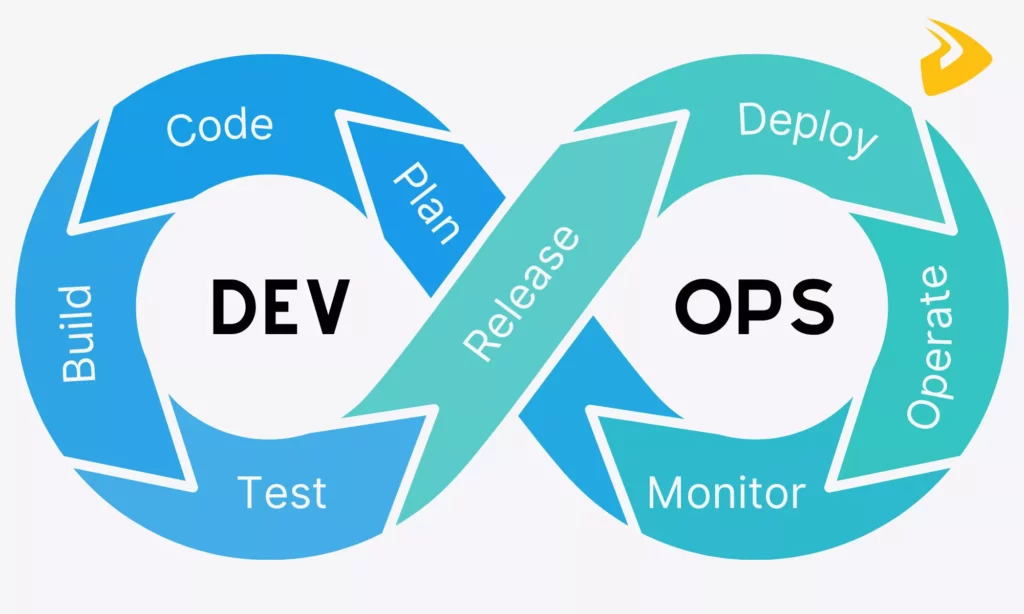
What Is DevOps?
DevOps is a working approach that brings development and operations teams closer together. Unlike traditional approaches that let those teams work separately in different phases, DevOps encourages the operations team to work alongside the development team.
In reality, both collaborate into a continuous loop throughout the entire software lifecycle: build, test, release, monitor, and repeat. Teams rely on practices like continuous integration and continuous delivery (CI/CD), automated testing, and infrastructure as code. Their goal is to automate and streamline the release process, reduce human errors, and accelerate deployments without compromising quality.
For example, imagine a team pushing a new feature. In a traditional setup, developers finish coding and pass it to operations, who then deploy it. This traditional process may take days or weeks to complete, coming with the risk of costly rework if the code contains bugs or doesn’t meet security and performance requirements.
But with DevOps, the operations team doesn’t need to wait until the code is done. They get involved right from the planning stage and define the infrastructure to ensure consistent environments from development to production. At the same time, after developers write the code, it’s continuously merged into a central repository, where automated tests check for issues right away. This way, building and validating the feature are implemented side by side, helping teams to spot issues immediately.
Importance of DevOps

The DevOps market is projected to reach $18.77 billion in 2026, and it’s expected to keep growing at a CAGR of 25.8% from 2026 to 2030. Those numbers reflect a shift in how modern software teams operate. More companies are realizing that speed without reliability doesn’t scale, and reliability without speed doesn’t cut it either. So, they adopt DevOps to achieve both speed and reliability.
When looking deeply into DevOps, you’ll soon realize several key reasons why DevOps matters that much:
- Faster time to market: DevOps enables teams to release updates more frequently while maintaining quality.
- Improved collaboration: It breaks down silos between teams. Developers and operations, accordingly, work side by side toward shared goals instead of separately. In reality, this reduces miscommunication and costly rework.
- Higher software quality: Continuous testing and monitoring alongside development help detect issues early. Of course, this doesn’t help teams avoid bugs entirely, but identify and fix them before they grow into serious problems.
- Greater system reliability: With automation and consistent environments, teams can ensure that what works in testing will also work well in production. This then makes deployments more predictable and reliable.
- Scalability and flexibility: DevOps practices, especially Infrastructure as Code (IaC), allow teams to scale systems up or down as needed more easily, without starting from scratch each time.
- Better customer experience: Faster and more frequent updates also mean more stable apps and fixes. That makes end-users happier.
Core DevOps Practices
DevOps works around various core practices that guide teams on how to implement DevOps in the right way that fits their core needs. Below are some practices you may adopt when working with DevOps:
- Continuous Integration (CI): Developers frequently integrate code into a shared repository, where automated builds and tests run right away. This helps catch issues early before they pile up into something harder to fix later.
- Continuous Delivery and Deployment (CD): DevOps teams use tools to automatically prepare code changes for release and even deploy them directly to production. It reduces manual steps and lets teams make multiple releases safely in a day.
- Infrastructure as Code (IaC): Teams use code to define infrastructure instead of setting it up manually. This makes environments consistent and repeatable from development to production.
- Monitoring, Logging, and Observability: Teams track system performance, logs, and behavior in real time using tools. Those tools don’t just detect failures, but explain why they happen.
- Microservices: Applications are broken into smaller, independent services. This allows teams to update or scale parts of a system without affecting everything else. However, this can result in complexity if not managed well.
- Shift-Left Security and Testing: Testing and security checks happen earlier in the development process, not just at the end.
- Version Control: Through version control systems (typically Git), teams can track how code and infrastructure change. So, when things go wrong, teams can easily roll back to previous versions to find the root causes or let systems work more reliably.
- Collaboration, Automation, and Continuous Feedback: DevOps encourages shared responsibility, automated workflows, and fast feedback loops. Without these, the other practices tend to lose their impact.
Top 10 DevOps Best Practices For High-Performing Teams
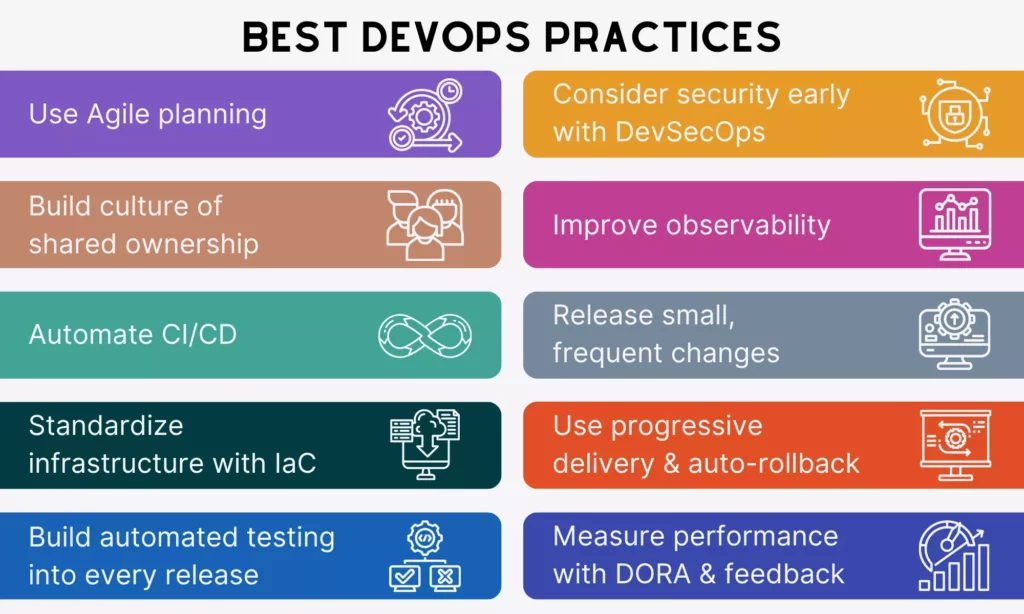
The core practices above act as the foundation for those who want to adopt the DevOps process. But to implement it effectively in practice, teams must turn those core ideas into something specific and suitable to their projects and working style. Below are the best practices to consider to build a high-performing DevOps team:
1. Use Agile Planning To Support Continuous Delivery
Agile inherently supports continuous delivery, as it allows for incremental, iterative development to release software parts faster. That core philosophy fits well with the core idea of DevOps. So, many modern teams blend Agile planning with their DevOps pipelines to implement predictable releases and enable stable delivery.
So, how can teams use Agile planning to support continuous delivery? Let’s see:
- Break work into deployable increments. Teams break down large features into smaller pieces that they can build, test, and deploy independently over iterations.
- Align sprint cycles with release cadence. If you plan to release daily, your sprint planning should reflect that instead of considering deployments as separate events.
- Prioritize work flexibly through backlog grooming (refinement). Teams can adjust priorities based on feedback, rather than sticking rigidly to long-term plans. This way, teams can flexibly focus on the most crucial tasks and avoid last-minute confusion.
- Integrate DevOps tasks into the backlog. DevOps tasks (e.g., improving the pipeline or updating infrastructure) shouldn’t be treated as side work. But they should stay in the backlog so that everyone can have a clearer view of how the DevOps process works as well.
2. Build A Culture Of Shared Ownership And Collaboration
DevOps encourages development and operations teams to work side by side. But only letting both teams work at the same time and sit in the same meeting doesn’t make that collaboration effective. The DevOps process still fails if they work on separate responsibilities and goals. That’s why building a culture where people share ownership and are responsible for the same outcome is a must.
Below are some key ways to build such a culture effectively:
- Encourage cross-functional teams. It’s crucial to build a product-based team that lets developers, operators, and even QA engineers work together towards the same goal. Everyone in the team shares responsibility and uses tools like Terraform or Ansible to manage infrastructure collaboratively, hence fostering shared expertise.
- Create shared metrics. Teams use KPIs (e.g., deployment frequency and change failure rate) to measure shared outcomes instead of individual tasks. They can use shared tools like Jira or Slack to have the same visibility over project goals, progress, and bottlenecks.
- Run joint retrospectives. Accordingly, developers and operations review incidents together, not in isolation. This reduces misunderstandings and promotes shared expertise.
- Build a blameless culture and the “You Build It, You Run It” mindset. Everyone should be encouraged to join earlier in the development lifecycle to understand the system and collaborate well with other experts. They also need a safe environment to feel comfortable discussing mistakes and fixing the system when incidents occur. For this reason, teams can avoid blaming individuals.
3. Automate Continuous Integration And Continuous Delivery

Automation is the backbone of DevOps. And Continuous Integration/Continuous Delivery (CI/CD) is one of the best practices that many teams often adopt to make that automation actually work in real projects.
Accordingly, CI/CD is about merging code into a shared repository where the code is automatically built and tested (CI), then deploying that code to production (CD). By automating CI/CD, teams ensure that code moves smoothly from development to production with minimal human intervention.
To automate CI/CD effectively, teams should:
- Start small, then expand pipelines. Teams should begin with a simple pipeline that includes automated build and unit tests to check how it works. Once the pipeline works reliably, teams can add more stages like integration tests, security checks, and deployments.
- Use version control for everything. Teams should use version control systems to store all application code, i definitions, pipeline configurations, and environment settings. This builds a single reliable source to trace, audit, or roll back changes when something fails.
- Implement deployment automation coupled with smart strategies. Reduce manual deployment steps using tools like GitHub Actions or Jenkins. Further, adopt smart deployment techniques (e.g., blue-green deployments or feature flags) to release changes safely, control impact, and allow for instant rollbacks.
- Implement automatic rollbacks. Set up automated systems to identify failed deployments (e.g., via error thresholds or health checks) and revert immediately to a stable version. This reduces downtime and avoids last-minute fixes.
- Use deployable artifacts and containerization to build once and deploy everywhere. Teams should package applications into consistent artifacts (e.g., JAR files or Docker images) to ensure what works in development behaves the same way in production.
4. Standardize Infrastructure With Infrastructure As Code
This DevOps best practice involves using machine-readable definition files to automatically provision and manage IT resources. This reduces manual work in configuring environments, hence making setups consistent and aligned with organizational standards.
So, how can teams use IaC to keep infrastructure consistent effectively?
- Use declarative configuration tools. Tools like Terraform, CloudFormation, and OpenTofu help teams define the desired end-state of infrastructure clearly. Instead of manually configuring resources, teams specify what the system should look like, and the tools handle the rest.
- Modularize infrastructure code. Teams should break down complex infrastructure into smaller, reusable modules (e.g., templates for servers or databases). This ensures consistency, reduces duplication, and saves time for building infrastructure.
- Use version control for infrastructure code. Like application code, all IaC code should be stored in version control systems like Git to track changes, enable peer reviews, and allow for immediate rollbacks when something breaks.
- Integrate automated testing and validation. Teams can use tools like Checkov or tflint to scan infrastructure code for security risks and misconfigurations. Additionally, enforce organizational or regulatory standards with tools like Open Policy Agent to prevent non-compliant configurations from being deployed.
- Monitor IaC regularly. Teams should integrate monitoring and observability tools into their IaC to see whether actual infrastructure deviates from the defined state and take corrective action.
5. Build Automated Testing Into Every Release

In DevOps, speed without quality can quickly turn into production issues that teams struggle to fix later. So, instead of considering testing as an afterthought, integrating automated tests into every release is encouraged among DevOps teams. This best practice ensures that every code change is validated early and consistently, helping teams detect bugs before they reach users while still maintaining fast delivery cycles.
Below is how teams can build automated testing into every release effectively:
- Implement multiple testing layers. Teams should adopt a layered testing approach, including unit tests, integration tests, and end-to-end tests. Accordingly, unit tests validate small pieces of code quickly, while integration and end-to-end tests ensure that different components work together as expected.
- Run tests automatically in CI/CD pipelines. Testing should be fully integrated into CI/CD workflows by letting every code commit or pull request trigger automated tests without manual intervention. This creates fast feedback loops and helps teams detect issues almost immediately.
- Prioritize fast and reliable tests. Teams should optimize tests to increase trust in the testing process and speed up deployments accordingly.
- Continuously review and refactor tests. Test suites shouldn’t be static. Instead, teams need to update, remove, or refactor tests to keep them relevant and effective for evolving applications.
- Shift testing earlier in the development process. Instead of treating testing as a final step, teams should integrate it from the beginning. Particularly, developers can write tests alongside code, which helps identify issues sooner and reduces rework later on.
6. Shift Security Left With DevSecOps
In traditional workflows, security often comes right before release. This makes fixing issues To avoid that, DevOps teams should adopt DevSecOps, an approach encouraging them to integrate security earlier in the development lifecycle. This way, teams can identify vulnerabilities sooner, reduce risks, and avoid unexpected surprises that delay deployments in the last minutes.
Here’s how teams can implement DevSecOps effectively:
- Integrate security into CI/CD pipelines. Teams should embed security checks (e.g., SAST, SCA, DAST, or dependency scanning) directly into CI/CD workflows. This ensures vulnerabilities are detected automatically with every code change.
- Automate security testing. Teams can use tools to continuously scan for misconfigurations, exposed secrets, or known vulnerabilities. Automation helps maintain consistent security checks without slowing down development.
- Educate developers on secure coding practices. Keeping code secure isn’t a job of only security specialists, but it extends to developers. Accordingly, developers should understand common security risks and how to avoid them when writing code.
- Use policy-as-code for enforcement. Define security and compliance rules in code and enforce them automatically during builds and deployments.
7. Improve Observability Across Every Layer

In DevOps, it’s not enough to know that something broke. But you need to understand why to avoid repeating the same mistakes and enhance testing and deployment processes. That’s where you need monitoring and observability tools to gain deeper insights into application behavior and respond to issues more effectively.
So, how can teams improve observability? Let’s take a look at some practical ways as follows:
- Collect metrics, logs, and traces. Metrics give a high-level view of system health and detect anomalies quickly. Logs explain what actually happened at a specific moment, while traces show how a request flows across services and help teams identify where delays or failures occur in distributed systems. Together, these data sources give teams a complete picture of system performance.
- Centralize monitoring tools. Unified platforms like Datadog or Grafana collect and visualize data from different services, environments, and infrastructure layers. These platforms can be integrated into CI/CD pipelines to automatically track the performance of new releases.
- Set up meaningful alerts. Instead of triggering alerts for every minor issue, teams should define thresholds that indicate real problems.
- Continuously refine observability practices. As systems evolve, teams should update dashboards, alerts, and tracing strategies to stay relevant.
8. Use Progressive Delivery With Auto-Rollback
Progressive delivery is a DevOps approach where teams release changes gradually by starting with a small group of users and then expanding the rollout if everything works reliably. This way, teams can validate performance and control impacts in real time. In case something goes wrong and teams need quick recovery, automated rollback can help releases revert to their stable versions almost immediately.
To implement progressive delivery and auto-rollback effectively, teams should:
- Automate the rollback process. Teams should embed automated rollback scripts directly into CI/CD pipelines so that systems can revert automatically when failures are detected.
- Implement deployment strategies like canary or blue-green. These techniques support teams in releasing updates to a small group of users first, observing system behavior, then gradually expanding the rollout. This limits the blast radius if something fails.
- Define rollback conditions clearly. Teams should set specific thresholds (e.g., error rate spikes or latency increases) to trigger automatic rollback. Without clear conditions, teams may react too slowly or overreact to minor issues.
- Monitor system health during rollout. Continuously tracking metrics like error rates or response times is essential to determine whether a rollout should proceed or be reversed.
9. Release Smaller Changes More Frequently

One of the best DevOps practices is to encourage teams to release smaller, more frequent updates instead of large, irregular changes. It’s because smaller changes are easier to test, debug, and deploy, reducing the impact if failures occur.
To release updates more frequently while maintaining quality, teams should:
- Break features into smaller increments. Teams should break down large features into smaller pieces that they can build, test, and release because they take less time and effort.
- Automate as many deployment steps as possible. Instead of manually building, testing, and releasing small increments, teams should use tools like Jenkins or GitHub Actions to automate and speed up the delivery cycle.
- Use secure release strategies. These techniques allow teams to deploy changes frequently without affecting users. Some common strategies include feature flags (decoupling deployment from release), canary releases (deploying changes to a small group of users or servers first), and blue-green deployment (building two identical production environments).
10. Measure Performance With DORA Metrics And Continuous Feedback
In DevOps, moving fast is important, but moving fast without knowing what’s working can be risky. So, teams need a way to measure both speed and stability. Otherwise, it’s hard to improve their DevOps pipeline and make it perform as intended. That’s where many teams combine DORA metrics with continuous feedback to get a clearer, data-backed view of how their delivery process is actually performing.
So, what do DORA metrics measure?
| Speed | Stability |
| – Deployment Frequency (DF): Measures how often teams release successful code to production. A higher frequency usually indicates faster delivery and smaller, more manageable changes. – Lead Time for Changes (MLTC): Tracks how long it takes for a code change to go from commit to production. Accordingly, shorter lead times suggest more efficient development and deployment pipelines. |
– Change Failure Rate (CFR): Shows the percentage of deployments that result in failures (e.g., bugs, outages). This helps teams understand the reliability of their releases. – Time to Restore (MTTR): Measures how quickly teams can recover from failures. Particularly, faster recovery times indicate stronger incident response and system resilience. |
Together, Deployment Frequency and Lead Time reflect how quickly teams deliver value, while Change Failure Rate and Time to Restore reveal how stable and reliable that delivery is. Therefore, looking at these metrics as a whole helps teams avoid optimizing for speed at the expense of quality or the other way around.
To make these metrics more meaningful, teams should combine them with continuous feedback loops. This includes input from monitoring tools, user feedback, and internal retrospectives. Metrics show what is happening, while feedback helps explain why.
Below are several practical ways to combine these two factors to make more informed decisions and refine DevOps practices efficiently:
- Review DORA metrics regularly alongside incident reports and user feedback
- Use dashboards to track trends and identify bottlenecks over time
- Adjust workflows based on both data and real-world feedback
- Encourage cross-team discussions to align improvements with actual system performance
How To Implement DevOps Successfully

To implement DevOps successfully without getting stuck, below are several tips for beginners in this realm:
- Start with one high-impact workflow
Instead of transforming the entire system, teams should focus on a single workflow that requires DevOps practices most (for example, deployments are slow, or testing delays releases). By improving just that one area, teams can see quick wins, check how their DevOps pipelines truly work, and then scale.
- Remove bottlenecks before scaling automation
Automation can speed things up, but it can also scale existing problems if teams aren’t careful. For instance, automating a slow or unstable testing process just makes it fail faster. Teams should first identify bottlenecks (like manual approvals or flaky tests) and resolve them before adding automation layers. Otherwise, the system becomes more complex without actually improving performance.
- Standardize environments across development, test, and production
One of the most common issues in software delivery is inconsistency between environments. This means something works in development but fails in production. By standardizing environments using tools like containers or infrastructure as code, teams can ensure consistency across the pipeline. This also reduces unexpected errors and makes deployments more predictable.
- Improve continuously through measurement and feedback
There’s no perfect DevOps pipeline. Some DevOps practices may work this time, but fail to deliver the desired outcome that time. So, through measurement and feedback, teams know whether their DevOps pipelines work as planned, where they get stuck, and what to improve.
Conclusion
Understanding DevOps and adopting DevOps tools aren’t enough to help you implement this approach efficiently in real projects. It requires your adoption of the best DevOps practices, from Agile planning and a culture of shared ownership to CI/CD automation, infrastructure as code, automated testing, security, and observability.
Of course, knowing these practices is one thing, applying them effectively is another. That’s where you need to work with an experienced partner in this approach to make a significant difference. And Designveloper is willing to help you with that.
Designveloper is a leading software and app development company in Vietnam. We combine DevOps and Agile approaches to deliver projects in smaller, manageable increments. By leveraging automation pipelines, our teams accelerate testing and releases while still maintaining quality.
This combination allows Designveloper to deliver SaaS platforms, websites, and mobile apps within predefined timelines and budgets. Following DevOps and Agile principles, our teams emphasize open communication and close collaboration to avoid misunderstandings and keep workflows running smoothly. That approach has earned us positive feedback across platforms like Clutch, TechReviewer, and GoodFirms.
If you’re curious how this works in practice, it’s worth exploring our successful projects like Lumin, Song Nhi, and Swell & Switchboard. And if you’re planning to adopt DevOps in software development, contact us!