


5G is reshaping how people use phones, connect devices, and consume digital services. For product teams and engineers, it does not just mean “faster internet.” It changes how apps are designed, tested, deployed, and monetized. In this context, 5G app development has become all-important.
This guide explains what 5G technology is, how it changes mobile app architecture, which new experiences it enables, and what challenges teams should plan for. It closes with practical FAQs that product owners and developers ask when planning for 5G-ready roadmaps.
What Is 5G Technology?
1. 5G Definition
The 5G is the abbreviation of the fifth-generation mobile network technology. It is the successor of 4G LTE and it presents a new radio standard (5G NR) and a more flexible core network. They provide enhanced throughput, reduced latency and better performance consistency when used together across a large number of device types.
Standards bodies such as the ITU and 3GPP define 5G capabilities in detail. For example, the 5G standard targets peak data rates of 20 Gbit/s downlink and 10 Gbit/s uplink under ideal conditions. Real-world speeds are lower but still dramatically higher than 4G.
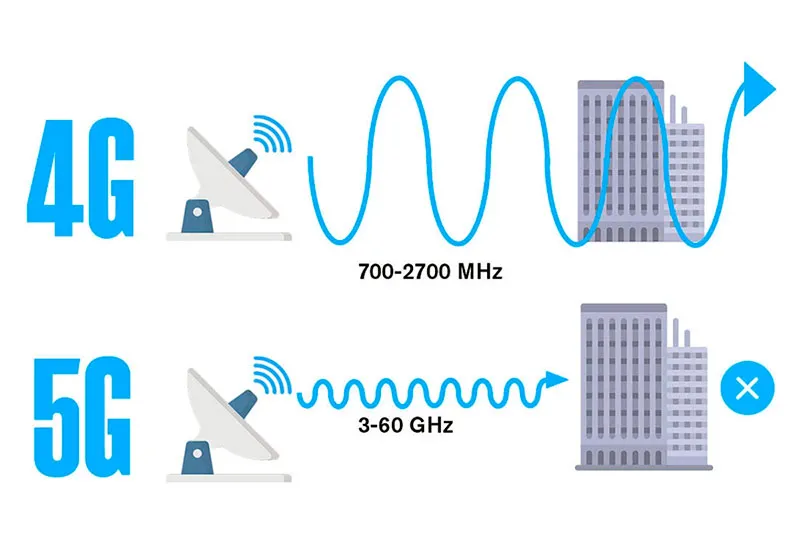
The 5G technology also has other spectrum layers, low-band spectrum, which covers wide area, middle spectrum, which balances speed and distance, and high-band (millimeter wave) spectrum, which has high throughput in dense regions. Radio details are not required of the app team, but they should know that user experience will be different depending on band, device, and location.
2. Key Technical Improvements vs 4G
First, 5G improves speed. With an average of 5G downloads of hundreds of megabits per second in most live networks, and a typical 4G speed around tens of megabits per second, many benchmarks can be set. This is a loophole that enables apps to transfer lightweight media to more powerful formats, including 4K video, volumetric content, and high-quality game materials.
Second, 5G reduces latency. Ultra-Reliable Low Latency Communication (URLLC) profiles aim for less than a millisecond of delay with very high reliability, as shown in research that targets a 0.5 ms latency with reliability higher than 99.99%. Lower latency enables instant feedback in real-time use cases like remote control, industrial automation, and multi-player gaming.
Third, 5G enhances density and capacity. Several input, several output (MIMO) antennas, beamforming, and more efficient use of spectrum enable networks to support much larger numbers of users in a single cell. This is essential in stadiums, transport hubs and smart-city settings where conventional networks tend to falter.
3. Why 5G Matters for Mobile Apps
5G alters the expectations of the users of the mobile applications. Individuals begin to view a phone as an access point to cloud computing capabilities, real-time teamwork, and experiences, and not as a standalone item. They also require apps to not take long to open and play media without buffering.
To the developers, 5G opens various important shifts. The heavy workloads are transferred to the edge or cloud. Applications are able to coordinate huge data records among users and places more or less in real time. The interactions that teams can create and do not seem possible or annoying with 4G would include multi-angle live video or real-time digital twins.
Concisely, 5G is not a network upgrade. It is a new standard redefining the architecture of apps, features, and product strategy of any serious mobile business.
How 5G Impact Mobile App Development
1. Faster Data Transfer Enables High-Performance Apps
High throughput allows apps to move more data per second between devices and back-end services. This affects almost every category of application, from streaming media to enterprise tools.
A regulator study shows that downloading a small 2 MB file can take 0.3 seconds on 5G compared with 0.7 seconds on 4G. That difference may feel small on its own, but the impact compounds when apps fetch many assets, images, and API calls at once.
With higher throughput, teams can:
- Stream high-resolution video or 3D assets without aggressive compression.
- Sync large data sets for offline-first apps faster at launch.
- Send richer telemetry from devices to back-end analytics systems.
In practice, this means mobile apps can deliver desktop-class experiences without forcing users to wait.
2. Low Latency Enables Real-Time Features
Latency is the duration that elapses between the user action and the visible response. In 4G networks, interactions involving real-time can be noticeably slow, such as in multiplayer games or live collaboration tools.
The low-latency profiles of 5G enable the developers to develop features that presuppose nearly instant reactions. Such applications are cloud-rendered game frames, shared whiteboards with live cursors, and live event AR overlays.
For 5G app development, latency improvements influence technical choices. Teams can use UDP based game networking, WebRTC data channels or low latency streaming protocols. They can also bring more logic nearer to the users to ensure that round-trip delay is not very large.
3. Higher Device Connectivity Boosts IoT App Development
5G networks support massive device density per cell. This matters for Internet of Things (IoT) platforms that connect sensors, wearables, vehicles, and industrial equipment in the same area.
Industry forecasts suggest the global IoT market will reach 38.7 billion connections by 2030. Much of this growth depends on 5G capabilities like massive machine-type communication, which prioritize energy efficiency and scalability.
For app developers, this means:
- Mobile apps can act as control hubs for hundreds of nearby devices.
- Real-time dashboards can display data streams from factories, fleets, or buildings.
- Developers must design APIs and data models that handle high-frequency sensor updates.
IoT-focused 5G app development often combines mobile clients, cloud services, and edge gateways to meet performance and cost constraints.
4. Improved Network Reliability Enhances User Experience
5G also brings about features meant to achieve reliability, such as network slicing and quality-of-service controls. Dedicated slices can be assigned to operators with assurance of performance to certain applications or industry.
In applications where reliability is paramount (remote operations, telemedicine, etc.), this reliability is of greater significance than raw speed. Payment applications, medical records, or industrial controls can use more stringent SLAs when they are deployed on slices that are allocated to enterprise or mission-critical traffic.
Concerning UX, increased reliability would reduce timeouts, jitter in live calls, and unpredictable behavior in varying locations. There is still strong offline/retry logic required by developers, but the day 0 experience is smoother.
5. Greater Bandwidth Brings High-Quality Media Streaming
The 5G bandwidth is directly helpful to media-rich apps. Increased bitrate budgets allow services to provide 4K or even 8K video, spatial audio and multi-angle streams to mobile subscribers.
As an example, a sports application can enable the audience to alternate camera angles, zoom in on players, and more. A music application would be able to provide lossless audio streams without being too concerned with buffering.
Media pipeline developers are forced to change their media pipelines. That adds adaptive bitrate streaming support that supports 5G tuning, codecs that are sensitive to power consumption and prefetch techniques that can make the most of idle bandwidth without fully depleting batteries.
6. 5G + Edge Computing Enables Faster Processing
Edge computing and 5G are closely related. This is achieved by operators and cloud providers deploying compute resources at metro or local point of presence near users. The workloads of AI inference, video encoding, or physics simulation can be offloaded to these nodes through apps.
This architecture minimizes latency and does not keep devices running at the fullest capacity. Processing edge-streamed scene understanding can be provided to a mobile AR application in place of all models executing on-device. Thousands of assets can be tracked with minimal delay by a logistics app, processing outputs to aggregate and compute insights through edge services.
For 5G app development, this means teams must design distributed architectures from the start. They determine what workloads will be stored on-device, which will be transferred to adjacent edge zones, and which will be executed in central clouds. Visibility and coordination emerge as essential competencies as opposed to an afterthought.
New Type of Application Features Enabled by 5G
1. Augmented and Virtual Reality (AR/VR – XR)
The 5G makes it feasible to transmit high-quality visuals and sensor data between the headsets, phones, and edge servers, as the bandwidth and latency of the experiences are minimal to avoid motion sickness and lags.
In the case of mobile, developers can create AR navigation, live event overlays and collaborative design tools in which multiple users interact with the same 3D scene. Spatial mapping and intensive rendering is offloaded to edge servers by headsets or phones, which transmit compressed frames or scene updates.
This model also saves hardware expenses at the client-side. This is because devices do not require the best GPUs to provide high-quality XR experiences.
2. Cloud Gaming and High-Fidelity Mobile Games
The frames were streamed to end devices by cloud gaming streams based on the information in the data centers. Throughput and latency are two factors that determine performance and which are better with 5G networks.
Games studios are able to develop titles which are identical in codebase, that they operate on consoles, personal computers and mobile devices, which are the thin clients. Multiplayer games that involve competition will have lower input lag and frames that are delivered smoothly.
In business terms, cloud gaming, enabled by 5G, allows developers to enter a new market where users have midrange devices, yet demand the high-end experience. Then console economics could be reflected in subscription models and in-game purchases.
3. 360-Degree and Multi-Angle Live Streaming
Live streaming is no longer a one-camera system, but multi-angle and 360-degree feeds are available, which can be produced and consumed at high uplink and downlink rates provided by 5G.
A concert, a sports event or a conference can attract numerous feeds of the camera and uplink them in near real time at the venue. The viewers can select the angle they want to see, switch between viewpoints or see picture-in-picture feeds of players, speakers, or performers.
Streaming architectures need to be developed that will accommodate numerous concurrent feeds, coordinate timelines and offer seamless transitions and latencies barely noticeable.
4. Enterprise-Quality Video Communication
Video calls are the new normal and quality remains erratic on 4G, particularly in busy places. 5G enables mobile-first enterprise-quality video and audio.
The collaboration apps designed by teams can include such features as multi-party HD video, live transcription, screen sharing, and real-time whiteboarding on phones and tablets. The high-quality reliable streams are directly applicable to sales, field service and telehealth workflows.
Network slicing would be able to set aside capacity to the enterprise UCaaS providers and guarantee predictable performance even in the event of a large public gathering or peak hours.
5. IoT and Smart Device Applications
Smart buildings, cities, and homes are based on the principle of constant communication between thousands of devices. 5G has massive connectivity and can allow apps to coordinate sensors, actuators, and gateways on a large scale.
An example is that a building management application can be used to monitor energy consumption, occupancy and safety systems throughout all floors in real time. Smart agricultural solutions can be used to connect soil sensors, drones, and irrigation controllers across expansive regions.
In such a case, the human interface to complicated back-end systems is frequently the mobile app. Developers need to develop intuitive dashboards, alerts and control flows, but the underlying connectivity should be robust and secure.
6. Autonomous Systems & Vehicle Connectivity Apps
Connected and autonomous vehicles are based on real-time data exchange between them and infrastructure, cloud services, and other cars. 5G assists in this case both with low latency and high reliability.
Dancer and fleet management along with passenger mobile applications can display real-time traffic, safety notices, and car diagnostics. In more sophisticated applications, applications can plan platooning, intelligent parking or electric vehicle charging based on 5G infrastructure along roadsides.
The developers in this field have to consider safety as a fundamental need. It implies a high level of care of failover, data integrity, and safe communication between vehicles, applications, and back-end systems.
7. Telemedicine and Remote Healthcare Apps
One of the most promising 5G areas is healthcare. Remote care models are supported by high-quality video, low latency, and stable connections.
Telemedicine applications have the potential to provide high-quality video calls, distance diagnostics with the help of connected medical devices, and immediate exchange of imaging or test findings. The 5G can be used to serve mobile workstations, asset tracking, and AR-guided procedures in hospitals.
Of particular concern in this field is regulation, privacy, and security. Strong encryption, access control and audit trails should be implemented in collaboration with clinical stakeholders.
8. Other Emerging 5G-Enabled Experiences
In addition to the apparent industries, 5G allows numerous niche yet useful applications. Some of them are smart factories featuring mobile robots, digital twins of infrastructure in real-time, and immersive education platforms where lessons in AR are accompanied by live interaction.
Most of these applications are based on a combination of edge computing, network slicing and device-to-device communication. The maturation of ecosystems will unlock new applications of sensors, AI, and 5G connectivity into products that were previously challenging to utilize.
The trick to product leaders is to monitor where latency, bandwidth and density open a step-change in user value, and to build apps based on those leverage points.
Challenges of 5G App Development
5G opens many doors, but it also introduces new constraints and risks. Teams should plan for the following challenges when designing and launching 5G-ready apps:
- Coverage fragmentation: 5G availability still varies by country, city, and even neighborhood. Apps must gracefully degrade to 4G or Wi-Fi without breaking key flows.
- Device fragmentation: Not all phones support all 5G bands or features. Developers must test across chipsets, modems, and OS versions, especially for XR or low-latency functions.
- Complex testing environments: Simulating real 5G conditions, including handovers, slices, and edge locations, is harder than testing a simple 4G or Wi-Fi setup.
- Higher back-end load: Faster networks encourage more usage and bigger payloads. Back-end systems, databases, and analytics pipelines must scale accordingly.
- Security and privacy risks: More connected devices and data streams increase attack surfaces. Teams must harden authentication, encryption, API security, and data governance.
- Cost of infrastructure: Leveraging edge computing, dedicated slices, or private 5G networks may require new commercial agreements and higher infrastructure spend.
- Power consumption on devices: High-band 5G and continuous data transfer can drain batteries faster. Developers should optimize polling, streaming, and background tasks.
- Regulatory and compliance constraints: Telecom, data protection, and sector-specific rules can limit certain 5G use cases, especially in healthcare, finance, or public safety.
- Skill gaps in teams: Many organizations lack experience with distributed architectures, real-time protocols, or telecom integrations. Training and hiring plans are essential.
Addressing these challenges requires coordination between product, engineering, DevOps, security, and network partners from the earliest design phases.
FAQs About 5G App Development
1. How does 5G improve mobile apps?
The speed, latency, and reliability are the primary aspects of 5G that enhance mobile apps. The increased speed of data transfer minimizes loading time and enables richer content including high-resolution video and intricate 3D content. Reduced latency enables real-time communication such as gaming, collaboration and remote control to feel responsive.
Better reliability and capacity also minimize congestion in busy places, therefore, apps are more predictable at the most popular times or at big events. All of these are combined to enable teams to create features that were impractical on 4G, such as live AR overlays and cloud-rendered experiences.
2. What new apps can be built with 5G?
Many verticals have new apps enabled by 5G. These can be XR collaboration, multi-angle event streaming and industrial IoT dashboards with real-time control and telemedicine suites with video and connected devices.
Consumer applications based on edge AI can also be developed by developers, like real-time language translation overlays, customized content feeds rendered in the cloud, or city-scale AR games. The usual trend is that 5G allows applications to transfer more data, more frequently, with lower latencies and thus imagination is not as limited by network restrictions.
3. Does 5G improve mobile gaming?
It is true, 5G affects mobile games. Reduced latency enhances responsiveness in competitive titles, lessening the time between the player input and action on the screen. Increased throughput enables cloud gaming, in which case, servers render frames and send them to phones, and enables quicker download of large game assets.
Players will have an easier time finding a match, reduced disconnections in crowded regions, and improved voice quality chat. Nevertheless, developers must continue to provide high-quality netcode, fair matchmaking and cheat prevention to provide a fantastic overall experience.
4. Do all phones support 5G apps?
No, not all devices support 5G. To work with 5G bands a phone must have a compatible modem, antenna design and network certification. Older or less expensive devices can only work with 4G or selected 5G bands and with a limited set of features.
To developers, it is that 5G functionality must be optional additions and not a hard requirement. The apps need to identify network potentials and gracefully degrade with alternative experiences in case of only 4G or Wi-Fi.
5. Will 5G replace Wi-Fi?
Wi-Fi is not going to be completely supplanted by 5G. Rather, they will co-exist and complement one another. Wi-Fi is still effective in indoor applications, local networks, and those applications where the organization has direct control over the infrastructure, including offices, homes, and campuses.
5G offers wider mobility over a larger area, outdoor, and controlled quality-of-service over numerous places. There are also enterprises that will switch to a 5G private network rather than Wi-Fi or both, but the majority will continue to switch between the two networks in their everyday lives.
6. What is needed to build a 5G-enabled app?
To develop a 5G-driven application, it is essential that the teams have a clear product objective that can be practically enhanced with the help of 5G (low latency, high throughput, etc.). They should then come up with an architecture that is adaptable to various network conditions and can integrate with edge resources or cloud resources where required.
Practically, developers should have access to test devices, 5G network coverage (public or lab) and observability tools to gauge performance. They also need to cooperate with operators or cloud providers in case they intend to deploy network slicing, edge platforms or private 5G deployments.
Lastly, they have to remember about security, privacy and scalability in the teams. An effective 5G application must also be resistant to failure, have a high-quality design, and be capable of functionality even when the connection is reverted to the older systems.
The role of 5G is a strong enabler, and it is not the features of the network that create value, but rather how intelligently teams incorporate it into actual workflows.
Conclusion
As global 5G coverage expands toward 60 percent by the end of 2025, mobile apps must evolve to match new expectations for speed, reliability, and immersion. Average 5G download performance also reaches about 230 Mbps, while 4G still sits far lower. At the same time, 5G subscriptions are forecast to climb to 6.3 billion by the end of 2030, which means almost every modern app team must treat 5G as a default, not a niche. .
As real-time experiences, edge-powered workflows, and immersive applications become the new standard, businesses must rethink how their mobile ecosystems operate. This is where we at Designveloper step in. With more than 12 years of experience and over 100 successful software and mobile app projects delivered worldwide, we help teams adopt 5g app development practices with confidence and clarity.
Our engineers have built complex systems across telecommunications, IoT, healthcare, and enterprise operations—ranging from large-scale platforms like LuminPDF to customized mobile ecosystems for global clients. This experience allows us to design architectures that fully leverage 5G capabilities such as low latency, massive connectivity, and edge integration. Whether you need a cloud gaming prototype, an IoT monitoring app, a real-time communication platform, or an enterprise-grade mobility solution, we can build and optimize it for next-generation networks.