


You know, with millions of apps already out there, launching a new mobile app and getting noticed is, quite frankly, a beast of a challenge. You could have the most elegant code and a killer user interface. But if you haven’t actually figured out who needs your solution and why they should choose you over literally everyone else, well, your app is basically just an expensive hobby. This is exactly why mobile app research isn’t just a checkbox activity, but a must.
But slowing down just a bit. Taking the time to truly understand the user’s psyche and the market is not that easy. So, we’re here, telling you how to perform effective market research for your mobile app.
But first, why don’t you take a little time learning what it is?

What Is Mobile App Market Research?
The name tells exactly what it is. It’s all about systematically collecting and analyzing data about the mobile app market related to your specific situation.
For example, if you want to build a stress reduction app for young office workers, you have to learn about their pain points, needs, and habits. Further, you need to discover similar apps, particularly about what makes them successful or fail, and even market trends shaping the growth of this app type (like AI integration to suggest personalized practices).
That’s what we call “doing thorough market research on mobile apps.”
Explore more:
Why Market Research Is Important Before Building a Mobile App
You may wonder, “Why do I mind doing all this research?” It’s all due to validation and de-risking.
Just imagine you cook a dish, and you think everyone will love it because it tastes good. But surprisingly, no one touches the dish after the first spoonful. Some find it unsuitable, and others are allergic to some ingredients. So, even when your cooking skills are excellent, many still abandon your food. That’s why you need to “do a small research” and see if the food suits people’s taste.
The same applies to all products around the world, including mobile apps. You have to sell what others need, not what you excel at.
According to Statista, there will be 181 million apps downloaded in 2026. But how can you ensure your app is viable enough to be downloaded? That’s why you have to validate your mobile app idea, no matter how good you think it is.
Building an app is not simple and cheap, even when you count on AI’s assistance for vibe coding. So, if you don’t want to throw money out the window, you need to research the current market to understand what target users truly want.
For example, before market research, you may think the core features of your stress reduction app must be guided meditations or breathing exercises. But upon research, you may learn that your target audience may demand mood tracking and quick, short tips they can use during work breaks to release stress immediately.
You see, by doing mobile app research, you may find the unique value proposition (UVP) that makes people willing to subscribe to your app. It also helps you understand your competitors better and make data-driven decisions about features. This will minimize the risk of wasting resources.
Type of Mobile App Market Research
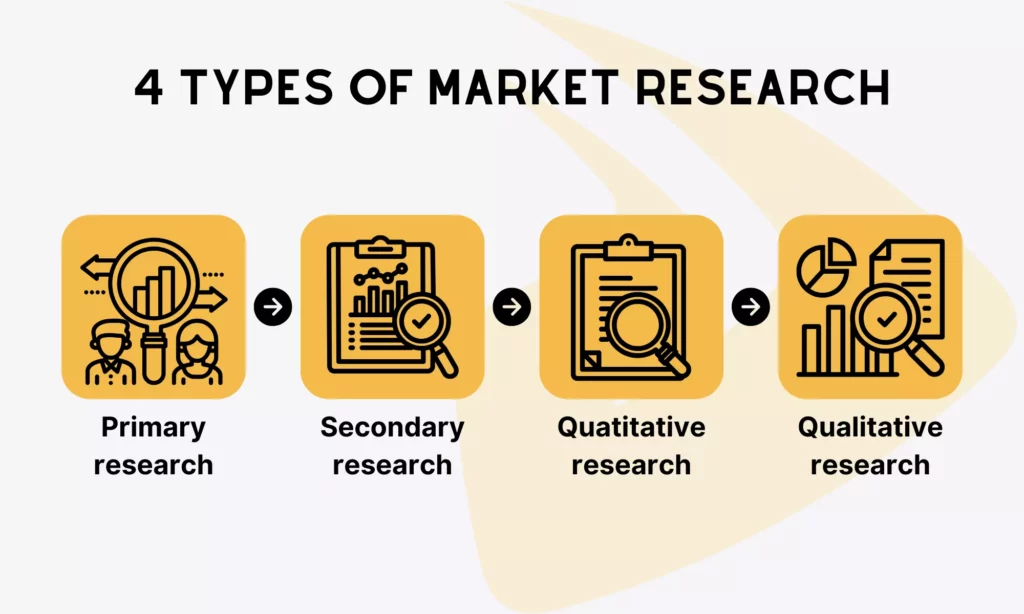
There are four ways you can collect and analyze market data. Choose the one or blend the right ones in alignment with your ultimate purpose:
1. Primary Research
Primary research refers to collecting data directly from a target source. Particularly, you conduct surveys, in-depth interviews, and focus groups to get data specific to your goals from target users. This type of market research allows you to get the most relevant and accurate information from the right people. But it’s definitely time-consuming and expensive.
As we said, some methods you may adopt to perform primary research are:
- Surveys: Collect quantitative data. You can use platforms like SurveyMonkey or Google Forms to build quick surveys.
- In-depth interviews: Gather qualitative data. You can talk with a small, carefully chosen group of potential users, albeit online or in person. What you acquire from them is not just “yes” or “no,” but also their specific needs, motivations, and pain points.
- Focus groups: You have a small group of prospects to discuss app concepts, early prototypes, and marketing messages. People in focus groups can give you different viewpoints that in-depth interviews may miss. But be careful: if a strong personality dominates, the conversation will become biased and generate helpless ideas.
2. Secondary Research
Secondary research means reusing data that others have already gathered and published. This method is cheaper and faster, yet it may contain irrelevant or even outdated information for your project.
Let’s see some reputable sources for doing secondary research:
- Industry reports: You can get reliable, high-level data from Statista, McKinsey, Sensor Tower, and other consulting firms. They produce reports yearly or periodically to discuss industry growth and trends.
- App Statistics: Look at the publicly available data on top apps in your category, and you’ll find out their revenue models and top-rated features. Besides, through real user reviews, you can know exactly what they love or hate most about the apps. This helps you spark an idea to develop an app over your potential competitors.
- Academic Literature: University papers and journals are also incredible sources to learn about consumer psychology, tech adoption behavior, and specific market shifts.
3. Qualitative Research
As the name states, qualitative research is about gathering non-numerical data that details reasons and feelings behind statistics.
Through this research type, you can get crucial insights from the pain points of your target users. In other words, you don’t just know what problem they’re encountering, but also the reasons why and the whole story behind them.
Further, you can implement qualitative research by observing people’s behavior towards a competitor’s app or your early-stage prototyping (often through A/B testing and user testing sessions). Performing this behavior-based analysis, you can capture significant insights that may not be revealed in words.
4. Quantitative Research
Unlike qualitative research, quantitative research focuses on numerical data, coming from surveys, industry reports, or academic research.
From this type of research, you can know the market size of your target app, plus potential users, search volumes for similar apps, and other crucial statistics. This helps you determine whether your app is worth the investment and feasible in both the present and the future.
What Is The Final Purpose of Conducting Mobile App Market Research?
Well, after all the surveys, interviews, or any research methods you have done, what is the ultimate goal of doing research on the mobile app market? Why do we have to be serious about this process before truly coding the app? Here are several benefits (and also reasons) behind this process:
- Determine whether there is real demand for the app idea. Sometimes you think your idea is good enough and definitely attracts the target audience’s attention. But market research may splash cold water on your face, saying that, “Your concept is not feasible enough for people to put money on.”
- Pinpoint the target audience most likely to use the app. Doing mobile app research, you may discover who is most likely to use your app to address their existing pain points. This allows you to customize features, a visual design, and other things for those target users.
- Supply data-driven proof of the app’s potential value to investors or stakeholders. Money matters. When you’re seeking funding, whether from external investors or internal stakeholders, research provides real data as proof of concept.
- Identify the essential features the app must include to be practical and competitive. You have to know what your Minimum Viable Product (MVP) actually needs, not just what you want it to have. By analyzing competitor gaps and listening to pain points, the research indicates critical features that make your app better.
- Gain insight into existing competitors and understand the market landscape. Mobile app research helps you conduct a proper SWOT analysis on your direct rivals. When understanding the competitive landscape, you’ll find a truly unique value proposition (UVP) to set your app apart from others.
How to Do Market Research for a Mobile App
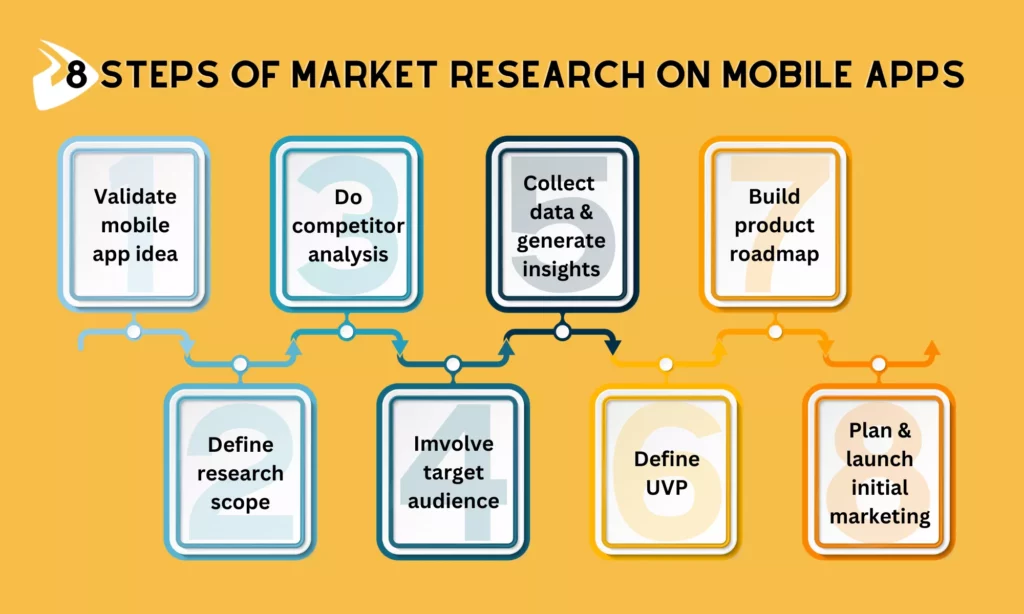
Well, you understand the importance of mobile app market research, plus its four different methods. Now, you may wonder how to do market research effectively for your potential mobile app. This section will help you with that by offering the eight solid steps as follows:
Step 1: Mobile App Idea Validation
First off, you have to test whether your mobile app idea is feasible. To do so, you must:
- Identify if there is any real, strong demand related to your concept in the market. Ask yourself: Is the problem serious enough for target users to require a solution? How do similar apps in the market solve the problem, and what can your app do to beat others?
- Consider how big your potential market is. This market can be divided into the following three levels:
Total Addressable Market (TAM): In this market, everyone can use your app. Take the example of our stress reduction app above. TAM here may refer to all people around the world experiencing stress or all internet users enjoying mental wellness apps.
Serviceable Available Market (SAM): As a portion of TAM, SAM is the niche you can actually target. For example, SAM can serve English-speaking young workers who want to reduce stress at work.
Serviceable Obtainable Market (SOM): As a part of SAM, SOM can truly capture the attention of target users in a specific timeframe. For instance, SOM can be a market for English-speaking office workers aged 22-35 in the US who already use productivity apps and follow wellness influencers.
In the early stages, you can validate your app ideas in SAM and SOM. But if their size is too small, you need to move to TAM.
- Prioritize which features are really crucial and which ones your target users may pay for.
- Identify the right strategy to make money (monetize your app). Should your app go with ads, in-app purchases (IAP), free versions, or subscription? A pro tip for this case is that you should research existing apps with similar features. This helps you find the most viable monetization model for your potential app.
Step 2: Define Research Scope
You can’t research everything. Instead, you should set the scope for initial mobile app research to keep your research in check and budget-friendly. Below are several considerations that help define the research scope:
- Geographic location: Which national market or context do you prioritize studying first? If you live in Phoenix, Arizona, and find a huge demand there, target the research in that region first. It’s because an app meets a burning demand in Phoenix may not perform effectively in different cultures, like Sydney. That’s why you need to narrow down your first launch market and do initial research there first.
- Demographic segmentation: You should narrow down the research scope based on basic characteristics, like age, gender, and income.
- Psychographic segmentation: This helps you dive deep into the lifestyle of your target audience and how they behave towards technology.
Further reading:
Step 3: Do Competitor Analysis
Analyzing your competitors is a must to understand what they do best and worst. Then, you can identify opportunities to fill the gaps in their existing mobile apps.
Here’s what you need to do:
- Identify competitors: Your rivals can be direct (aka similar apps solving exact problems you do) or indirect (aka alternatives users might consider using). For example, if you intend to build a finance app, your indirect competitors are Excel or Google Sheets, while direct ones are similar fintech apps.
- Analyze SWOT: Narrow down 3 to 5 competitors and perform a simple SWOT analysis. Answer the following questions to discover the four factors below:
- Strength: What are they great at? (e.g., an easy-to-navigate interface)
- Weakness: What do their users often complain about? (e.g., unsuitable AI suggestions)
- Opportunity: What trends can you adopt? (e.g., GenAI integration)
- Challenge: What threats can you encounter? (e.g., high expenses)
- Analyze App Store Evaluation (ASO): By analyzing reviews from real users on the App Store or Google Play, you can get key insights into what people are most interested in or disappointed about. Further, you should analyze the keywords, description, and screenshots of your competitors to see what search terms they’re ranking for and how they introduce their apps.
Step 4: Target Audience Deep Dive
Now, involve the target audience in your market research to learn about their mobile behaviors and willingness to pay (WTP).
To do so, you should build 3 to 5 detailed user personas (or fictional profiles representing your target user group). These profiles cover goals, key pain points, and specific use cases for your potential app. Give them names and jobs to make the process more realistic.
Then, conduct rigorous research on their mobile behavior by answering these questions:
- Which devices are they mainly using (iOS/Android)? (This impacts development priorities.)
- When and for how long are they using mobile apps in your domain? (This indicates when your app should send notifications to users so that they don’t feel annoyed.)
Next, evaluate their willingness to pay (WTP) for premium features through interviews and surveys. This helps you identify what you should charge real users.
Step 5: Collect Data and Generate Insights

Considering all the mentioned factors above, from Steps 1 to 4, you’ll execute data collection using different mobile app research, like Primary and Secondary.
Don’t just stop at collecting, but try to interpret the data. Accordingly, you should:
- Analyze market gaps to identify where current solutions are failing to meet user demands. These gaps are your golden opportunity to jump into the market.
- Compare your potential app’s feature set and subscription models against your competitors. This helps identify where your apps differ.
- Find and rank major risks, including technical risks (“Can we build it?”), market risks (“Will users need it?”), and legal risks (“Can we operate it?”). Try to clarify and be honest about what can leave your project off track.
Step 6: Define Your Unique Value Proposition (UVP)
If you did Step 5 right, your UVP should almost write itself. So, what is UVP? This is the unique value that your app offers to stay different from others. It’s a unique, compelling reason why users must download your app instead of the rivals’.
Step 7: Build a Product Roadmap
Many people consider mobile app research as the crucial blueprint for mobile app development. With research findings, you’ll have enough solid information to build an effective MVP (Minimum Viable Product). This earliest, simplest version of your potential app contains the core set of features that align with your real user needs.
Based on user feedback and further research to keep up with market shifts, you can devise expansion plans to outline the next core features that keep your app meeting user demands all the time.
Step 8: Plan the Initial Marketing & Launch Strategy
Your team can feed research findings directly into the initial marketing strategy, backed up with solid data instead of doing guesswork.
Accordingly, you can plan a detailed ASO strategy that uses keyword research from Step 3 to pick high-intent, low-competition keywords for your app’s title and descriptions. This helps your app reach the right users on the App Store or Google Play.
Meanwhile, you can use User Personas from Step 4 to identify the most favorite communication channels (social, paid search, forums) of your target users. Therefore, if your audience mainly hangs out on LinkedIn, don’t waste time marketing your app on TikTok.
Conclusion
Market research on mobile apps isn’t just for big companies, but also for startups and SMEs! With this guide, you’ve unlocked the secrets to conducting effective market research for your mobile app project. Follow our detailed steps and start researching the most essential information for your build.
Mobile app research is your superpower – use it to create something amazing. Remember, Designveloper is always here to help your app dreams take flight! See our portfolio or contact our team to get a detailed consultation!