

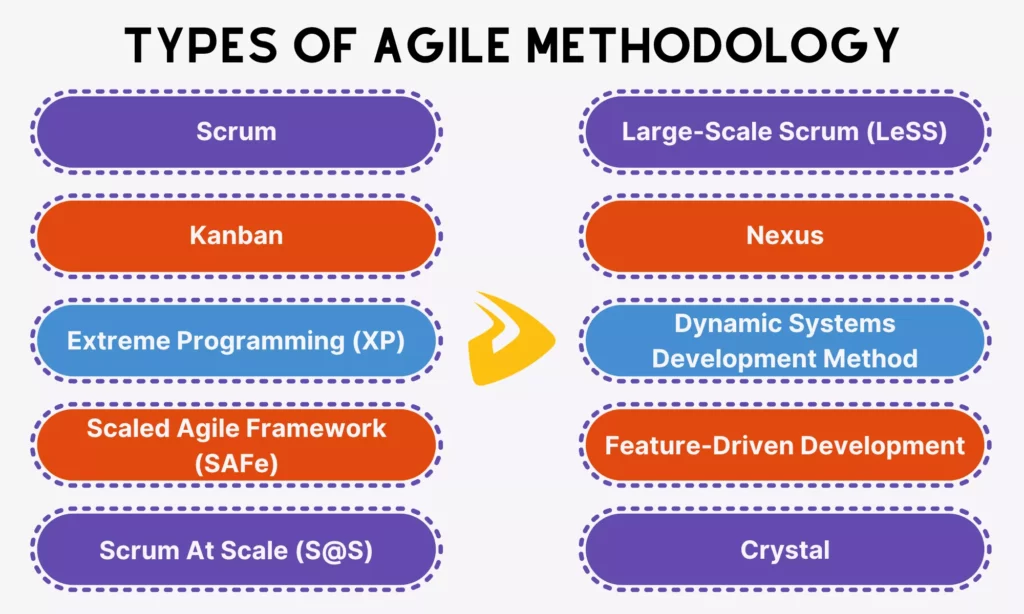
Agile has been around for a while now, becoming a popular project management approach among software teams. Along with its growth is an increase in types of Agile methodology, including Scrum, Kanban, Extreme Programming (XP), and many more. Each comes with different pros and cons, serving different use cases.
So what is the best Agile methodology for your team? In this article, we’ll guide you through the top common Agile approaches, breaking down how they work in real-world scenarios and how they differ. This helps you choose what makes sense for your team’s size, goals, and way of working.
What Is Agile Methodology?
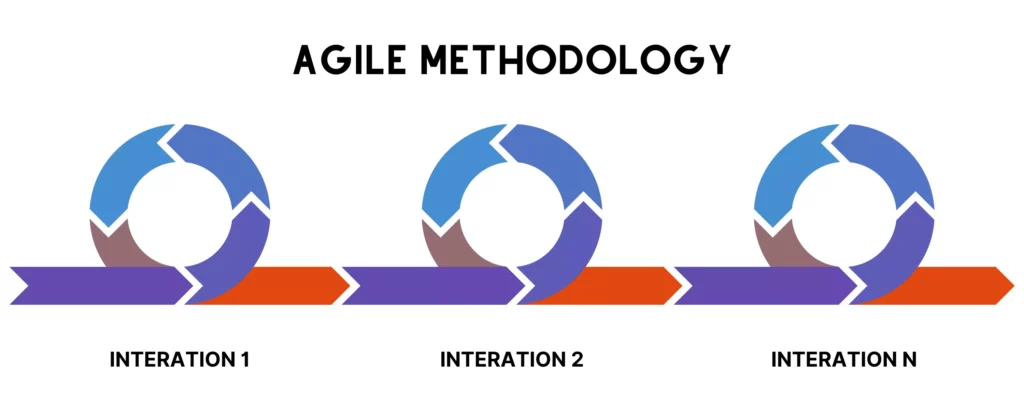
Agile itself is a philosophy and mindset that encourages teams to build products through small, continuous improvements instead of a full release. Accordingly, various Agile methodologies are designed around this philosophy.
Despite differences, all these approaches allow teams to break work into smaller chunks, test ideas early, gather feedback, then adjust and repeat. Besides, teams don’t need to plan everything upfront and be locked in fixed plans. Instead, they can deliver value faster over short cycles, communicate frequently, and share responsibilities. This way, teams can flexibly respond to changes in customer demands and business goals while ensuring high quality and fast deliveries.
For that reason, many teams, especially in software development, choose Agile. According to the 18th State of Agile Report, 41% of surveyed organizations have increased their investment in Agile. On top of that, Agile transformation services in enterprises are projected to grow at a CAGR of 16.1% from 2026 to 2034, dominated by frameworks like Scrum, Kanban, Scrumban, and Scrum/XP.
Why There Are Different Types Of Agile Methodologies
So, why are there so many Agile methodologies out there? If Agile is supposed to simplify the way teams work, shouldn’t there just be one standard approach to avoid complexity? Keep reading, and this section will explain why.
Why Teams Need Different Agile Development Methods
In reality, teams aren’t built the same way, hence facing different constraints and goals. A five-person startup trying to ship an MVP quickly operates very differently from a 200-person enterprise team managing legacy systems. Their priorities, risks, and even communication styles don’t quite match. And Agile is never meant to be one-size-fits-all.
So, different frameworks emerged to solve different kinds of problems.
For example, a small, fast-moving team might prefer something lightweight like Kanban without being restricted by strict roles or sprint deadlines. Meanwhile, teams that need more structure (especially those working with stakeholders or deadlines) often choose Scrum, due to its defined roles and time-boxed sprints.
Beyond work, other factors like team culture, experience level, and leadership style require different Agile approaches. Some teams grow with strict routines, but others find them restrictive. So, there isn’t just one type of team, there isn’t just one Agile methodology.
How Agile Methodologies Support Different Workflows
Different teams work differently. And Agile methodologies tend to align with specific workflows. Let’s see some common use cases as follows:
- Continuous delivery workflows: Kanban
Teams that release updates frequently often use Kanban. Why? Because its visual board and work-in-progress limits help maintain a steady flow without the interruptions of sprint planning.
- Iterative workflows: Scrum
Scrum fits this workflow better because it allows work to be delivered in fixed cycles. The structure of sprints, reviews, and retrospectives gives teams a predictable rhythm to deliver software iteratively.
- Engineering-heavy workflows: Extreme Programming (XP)
This Agile methodology is designed to support highly engineering-driven teams that prioritize code quality and rapid feedback. Practices like pair programming and test-driven development are the backbone of this approach.
- Scaling workflows: SAFe, Nexus, or Scrum at Scale
When you scale things up, these frameworks help coordinate multiple teams working on the same product.
10 Common Types Of Agile Methodology
If you’re finding some ways to penetrate the Agile world, you should first identify which Agile framework best suits your company. In this section, Designveloper will focus on several most prevalent types of agile methodology that all project managers should know. These lightweight approaches work around the Agile Manifesto, hence showing some similarities. However, they have various features.
1. Scrum
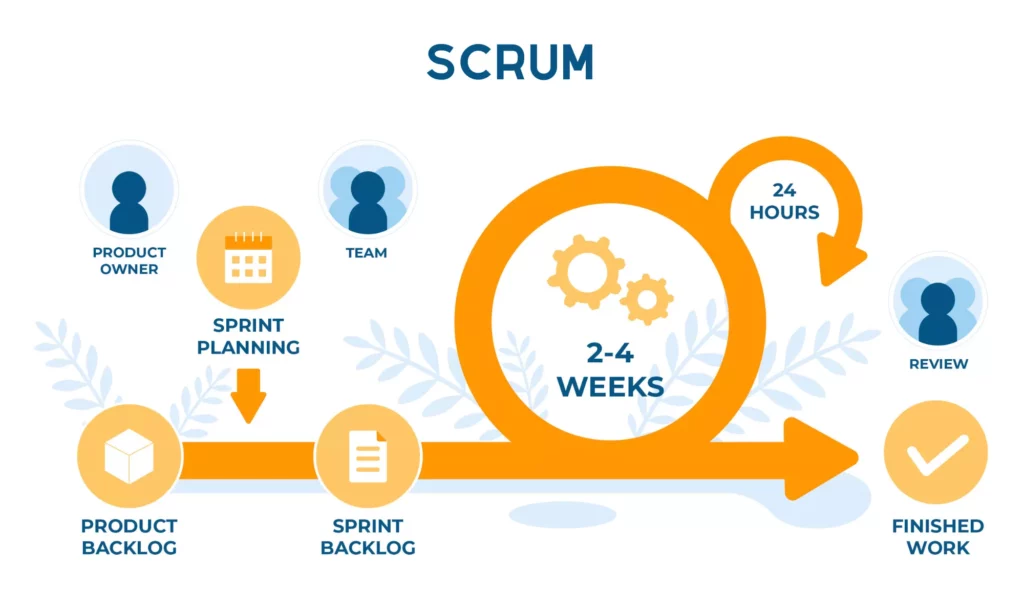
Scrum is the most widely recognized Agile framework. It focuses on a small, self-organizing team delivering a specific set of tasks in short, time-boxed iterations called sprints (usually 2–4 weeks). The approach involves various events (e.g., Sprint Planning, Daily Scrum, Sprint Review, and Sprint Retrospective) to keep workflows organized.
How it works:
Scrum teams often consist of clearly defined roles: Product Owner (prioritizing work), Scrum Master (coaching teams on Scrum), and developers. Teams often start by planning their sprint, breaking work into manageable pieces, and meeting daily for quick check-ins (stand-ups). At the end of each sprint, they review what’s been done and reflect on what could be improved in the next sprint.
Best for:
- Complex or uncertain projects where project requirements are unclear and rapidly changing.
- Environments that support small, self-organizing teams in working together to deliver value.
- When early and continuous stakeholder feedback is important for project success.
- When teams need to build, test, and deliver features or functional products quickly, typically minimum viable products (MVPs).
| Pros | Cons |
| – Provides a clearer view of what teams are working on, what’s blocked, and what’s coming next. – Encourages regular feedback, which helps teams adjust quickly. |
– Scaling Scrum across large, complex organizations is challenging. – Scrum requires a mature, experienced team of different experts who understand Scrum well and are capable of managing their work collaboratively. |
2. Kanban
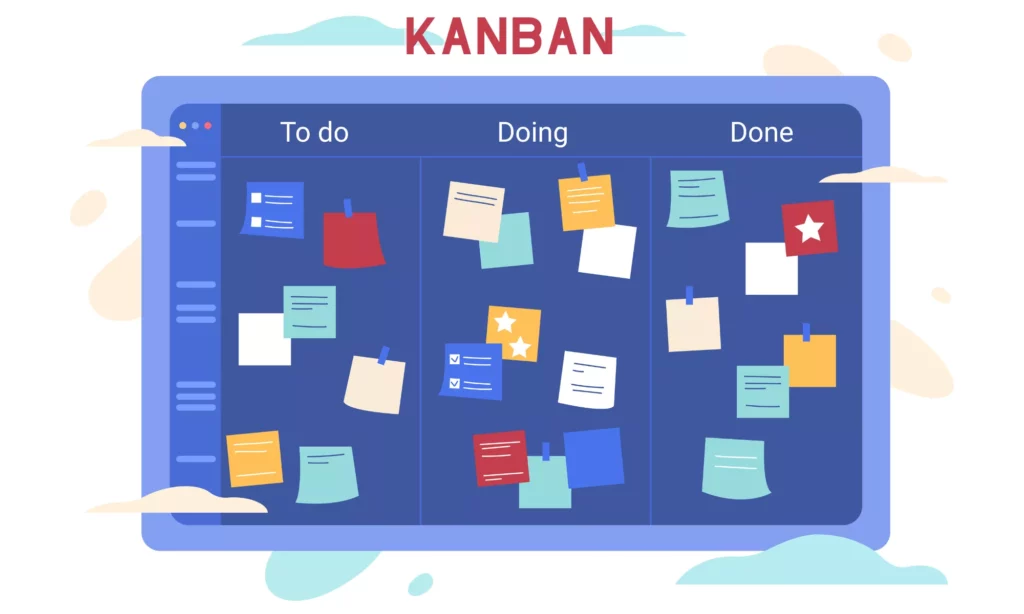
Kanban is a visual workflow management method that focuses on continuous delivery rather than fixed iterations. This approach uses a Kanban board to represent tasks when they move through different stages of work (e.g., To Do, In Progress, Done). One key component of Kanban is limiting work in progress (WIP), which helps teams avoid overload and maintain a steady flow of tasks.
Kanban originated from Toyota’s “just-in-time” production in the 1940s. Although Kanban isn’t technically considered an Agile methodology, it’s increasingly adopted in software development. It shares many similarities with the Agile philosophy itself, so many people still quietly see it as an Agile approach.
How it works:
Teams visualize their workflow on a board and pull tasks as capacity allows, instead of committing to a predefined batch of work. They then monitor progress continuously, identify bottlenecks, and adjust as needed.
Best for:
- Teams handling ongoing or unpredictable workloads (e.g., maintenance, support).
- Environments where priorities shift frequently and require flexibility.
- Teams that prefer a continuous delivery model over sprint-based planning.
- Situations where improving workflow efficiency and reducing bottlenecks are a priority.
| Pros | Cons |
| – Provides clear visibility into workflow and task status. – Helps teams identify and reduce bottlenecks effectively. |
– Lacks structured timelines, which can make planning harder. – May lead to unclear priorities without strong discipline. |
3. Extreme Programming (XP)
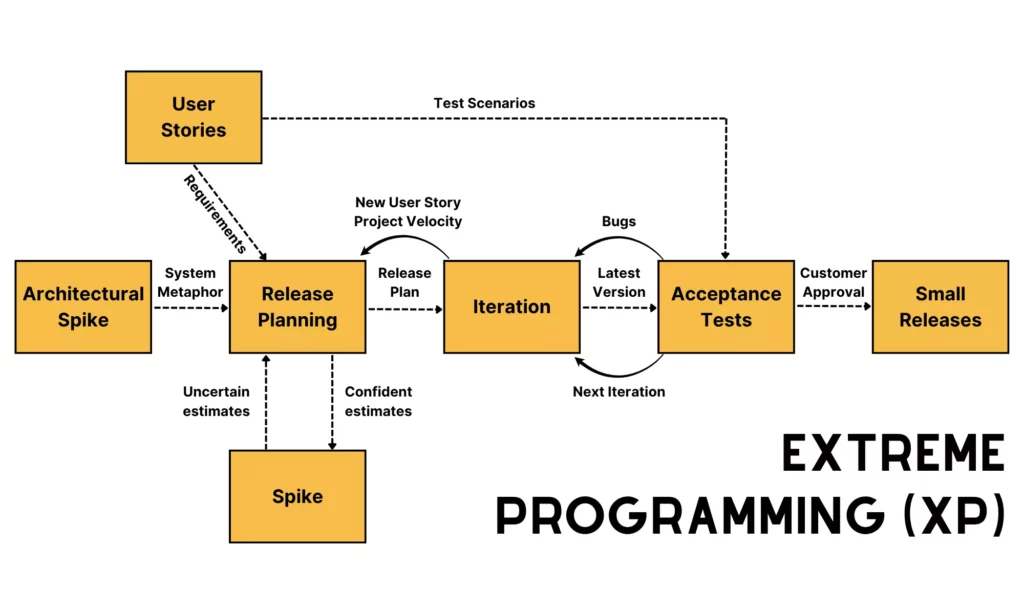
Extreme Programming (XP) is an Agile methodology that focuses heavily on engineering practices and code quality. It emphasizes frequent releases, continuous feedback, and technical excellence through practices like pair programming, test-driven development (TDD), and continuous integration.
How it works:
XP teams work in short cycles, similar to Scrum, but with a stronger focus on how code is written and tested. Besides, developers often work in pairs, write tests before code, and integrate changes frequently to catch issues early. XP also encourages constant communication and tight feedback loops to deliver functional products quickly.
Best for:
- Teams prioritizing high code quality and feeling comfortable with disciplined engineering practices like TDD and pair programming.
- Projects with rapidly changing requirements that need frequent releases.
- Environments where reducing technical debt is critical.
| Pros | Cons |
| – Improves code quality and reduces defects over time. – Enables teams to flexibly respond to changing requirements. – Encourages strong collaboration and continuous feedback. |
– Requires significant discipline and experience to implement effectively. – Practices like pair programming may not suit all teams or cultures, especially in remote work environments. |
4. Scaled Agile Framework (SAFe)
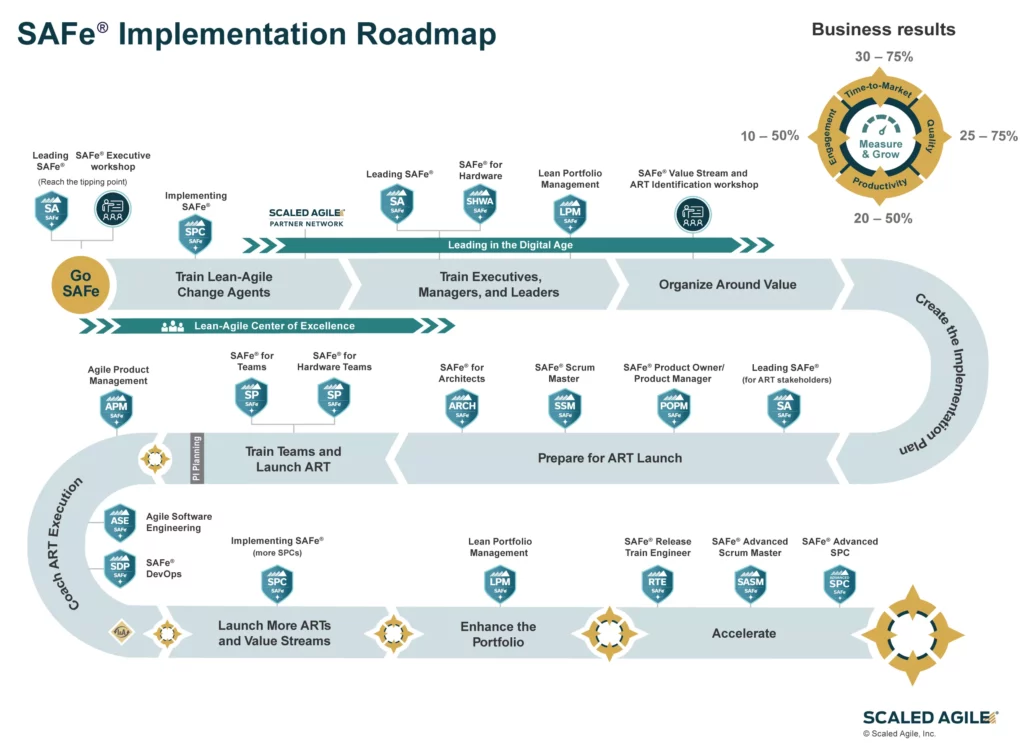
Scaled Agile Framework (SAFe) is designed to help large organizations apply Lean-Agile practices across multiple teams. More particularly, it combines Agile principles with structured layers of planning, coordination, and governance to align many teams working on complex systems.
Digital.ai found that most organizations (44%) are now adopting SAFe for scaling Agile. Accordingly, its structured framework helps handle the challenges of scaling through some key components:
- Agile Release Trains (ARTs): Teams of Agile teams (typically 50-125 people), including key roles like Release Train Engineer (RTE) or Product Manager.
- Agile Teams: Cross-functional teams in ARTs using Scrum or Kanban to deliver products incrementally.
- Program Increment (PI) Planning: A planning session lasting every 8-12 weeks to help all ART teams identify goals and dependencies.
- Lean Portfolio Management (LPM): Helps enterprises apply Lean thinking to manage their product portfolio, as well as identify and prioritize high-value initiatives.
- Continuous Delivery Pipeline: Includes practices like Continuous Exploration, Integration, and Deployment to release high-quality products more frequently.
How it works:
SAFe organizes teams into larger groups called Agile Release Trains (ARTs), which work together toward shared objectives. In PI Planning, these teams plan together to identify the shared goals, dependencies, and timelines for the next 8-12 weeks.
During that time, individual teams work using Agile practices like Scrum or Kanban under the constant coordination of the RTE or Product Manager. These roles also hold regular sync meetings to manage dependencies and risks.
Best for: Large enterprises that need to scale Agile and manage complex, interdependent products across many teams.
| Pros | Cons |
| – Provides a clear structure for scaling Agile across large organizations. – Aligns business goals with development efforts effectively. |
– Can be complex and heavy to implement. – May reduce flexibility compared to lighter Agile methods. |
5. Scrum At Scale (S@S)
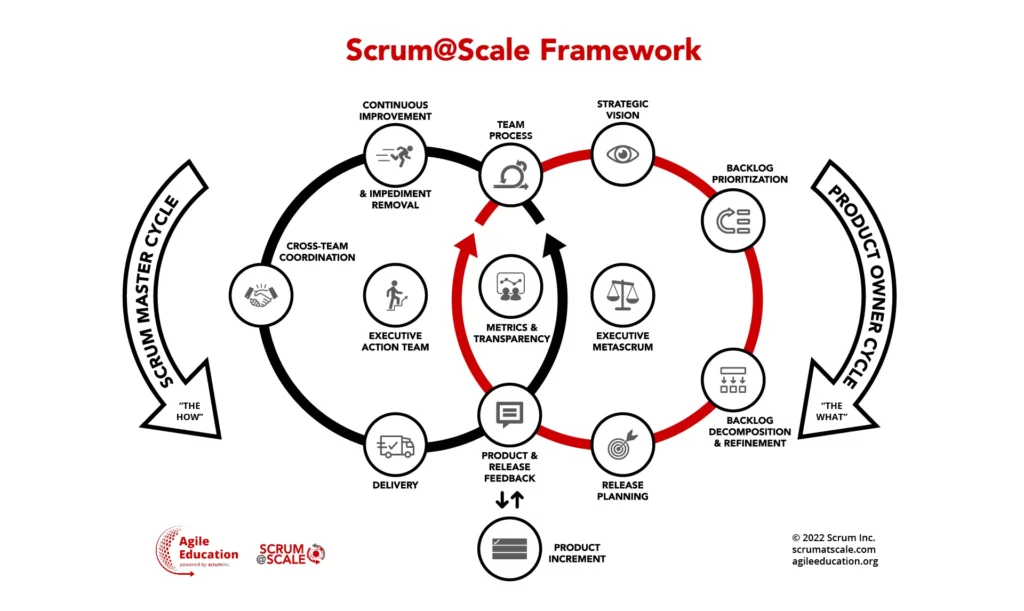
Scrum At Scale extends the core principles of Scrum to support numerous teams working on the same product. With standard Scrum practices and a scaled structure, this approach allows organizations to coordinate complex projects while maintaining agility.
At its core, Scrum At Scale is built based on the following key ideas:
- Building the Scrum of Scrums (SoS), a larger team that coordinates work across small, modular teams (ideally 3-9 members).
- Introducing just enough structure with a few necessary layers to keep teams agile across complex, interdependent projects.
- Focusing on a two-cycle framework: one for scaling execution (Scrum Master Cycle) and the other for aligning product vision (Product Owner Cycle).
How it works:
In practice, teams still run standard Scrum activities at the team level, from planning sprints and holding daily stand-ups to delivering increments. But instead of operating in silos, they’re connected through the Scrum of Scrums, where representatives from each team meet regularly to discuss dependencies, blockers, and progress.
At a higher level, the Product Owner Cycle ensures that all teams are aligned on priorities through a shared backlog and coordinated planning. Meanwhile, the Scrum Master Cycle focuses on improving how work gets delivered across teams. When issues go beyond what teams can solve themselves, the Executive Action Team steps in to remove those larger organizational impediments.
Best for:
- Organizations already using Scrum and looking to scale it.
- Products developed by multiple teams working in parallel.
- Teams needing structured coordination without adopting heavier frameworks like SAFe.
| Pros | Cons |
| – Builds on familiar Scrum practices, making adoption easier. – Supports coordination across multiple teams without excessive complexity. |
– Coordination across teams can become challenging as scale increases. – If not implemented effectively, adding layers like the Product Owner Cycle can slow down deliveries, especially for teams with little Scrum experience |
6. Large-Scale Scrum (LeSS)
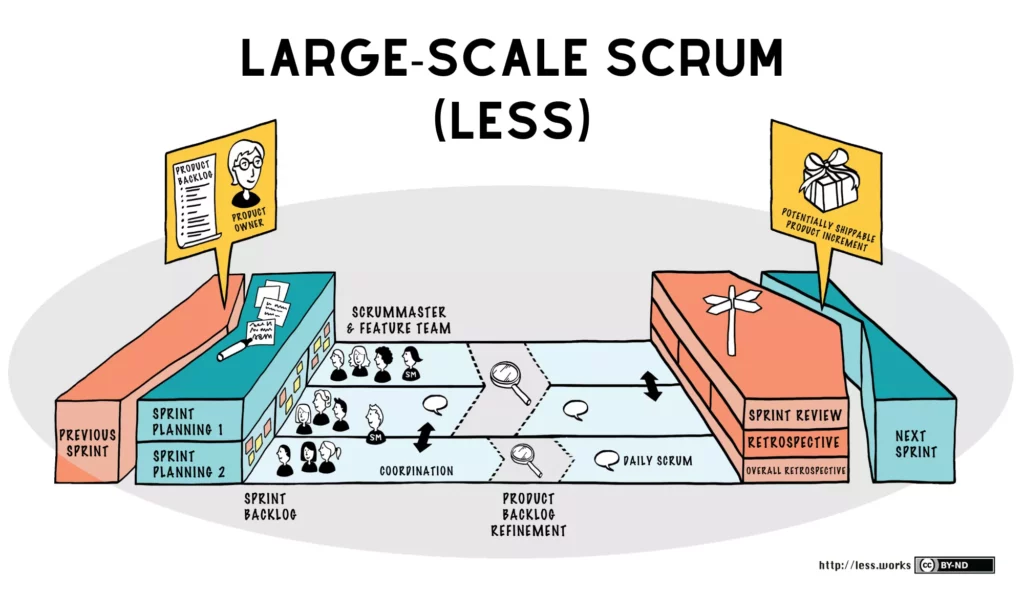
Large-Scale Scrum (LeSS) is another type of scaling Agile methodology. LeSS sticks closely to core Scrum principles and scales them with less structure and fewer roles in comparison with S@S. This means even with multiple Scrum teams involved, LeSS still maintains one Product Owner, one shared product backlog, and one deliverable increment at the end of every sprint.
There are two types of LeSS configurations:
- Basic LeSS (2-8 teams, 10-50 members): Ideal for those new to scaling Scrum.
- LeSS Huge (8+ teams, 50+ members): Works best for those familiar with Scrum and ready for scale. This structure adds roles like Area Product Owners (who manage product backlogs for certain areas within the larger product).
How it works:
In LeSS, several Scrum teams work on the same product using a single backlog managed by one Product Owner. During Sprint Planning, teams both align on overall priorities and break down work at the team level. Then, all teams work under the same sprint schedule.
During the sprint, teams collaborate closely, not just within their own group but across teams when needed. There’s no heavy coordination layer, so communication tends to be more direct; we mean developers talk to developers, so teams can handle dependencies in real time. At the end of the sprint, all teams contribute to a single, integrated product increment, which they also review.
Best for:
- Organizations that want to scale Scrum without adding heavy frameworks.
- Teams working on a single product with shared goals.
- Environments that value simplicity and minimal process overhead.
| Pros | Cons |
| – Keeps scaling simple by staying close to standard Scrum without adding too many layers. – Encourages strong alignment through a single backlog and shared goals. |
– Requires high discipline and experience to avoid chaos. – Limited guidance compared to more structured scaling frameworks. |
7. Nexus
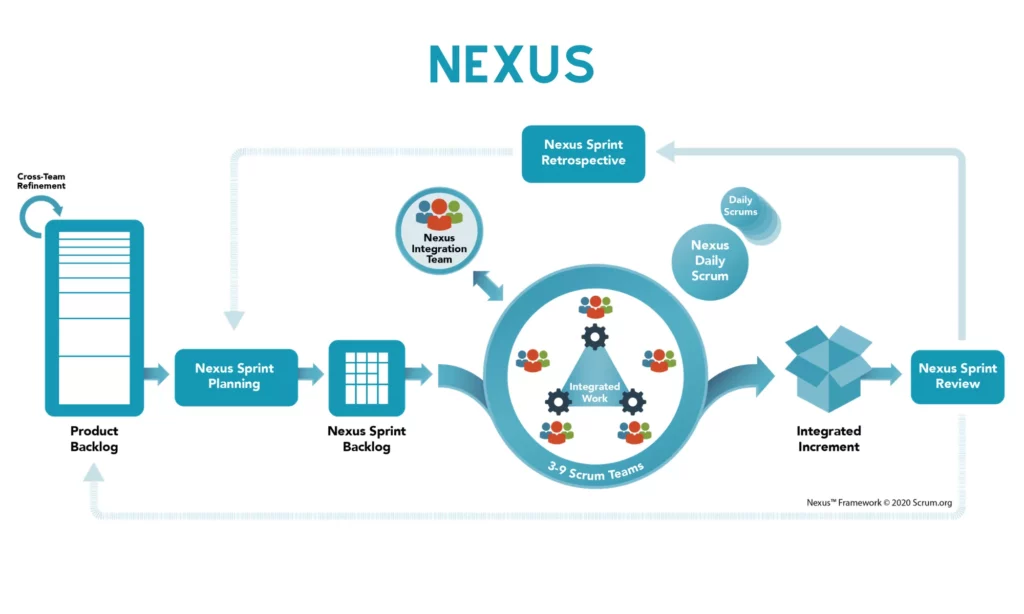
Nexus is another Scrum-based scaling framework, focusing on scaling Scrum practices across 3-9 teams to work on the same product.
Compared with LeSS, it’s a bit more structured, organizing a Nexus Integration Team to minimize dependencies, handle cross-team issues, and ensure a “Done” integrated increment at the end of every sprint. Like standard Scrum, the Nexus Integration Team also covers a Product Owner, Scrum Master, and other necessary roles.
How it works:
Nexus allows 3-9 Scrum teams to work together on one product, sharing a common Product Backlog. It introduces a Nexus Integration Team to manage integration and handle cross-team issues.
Meanwhile, teams still run their own Scrum processes. But they also participate in shared events like Nexus Sprint Planning, Daily Nexus meetings (focused on dependencies), and integrated Sprint Reviews to synchronize work and review outcomes together.
Best for:
- Organizations scaling Scrum across a moderate number of teams.
- Products requiring frequent, smooth integration of work from multiple teams.
- Teams struggling with cross-team dependencies and coordination.
- Environments that want more structure than LeSS but less than SAFe.
| Pros | Cons |
| – Handles dependencies continuously to ensure a consistent “Done” product increment. – Adds just enough structure to manage dependencies effectively. |
– Nexus is limited for 3-9 Scrum teams, making it unsuitable for larger-scale projects. – Depending on a single PO can cause a bottleneck if the person can’t manage many teams effectively. |
8. Dynamic Systems Development Method (DSDM)
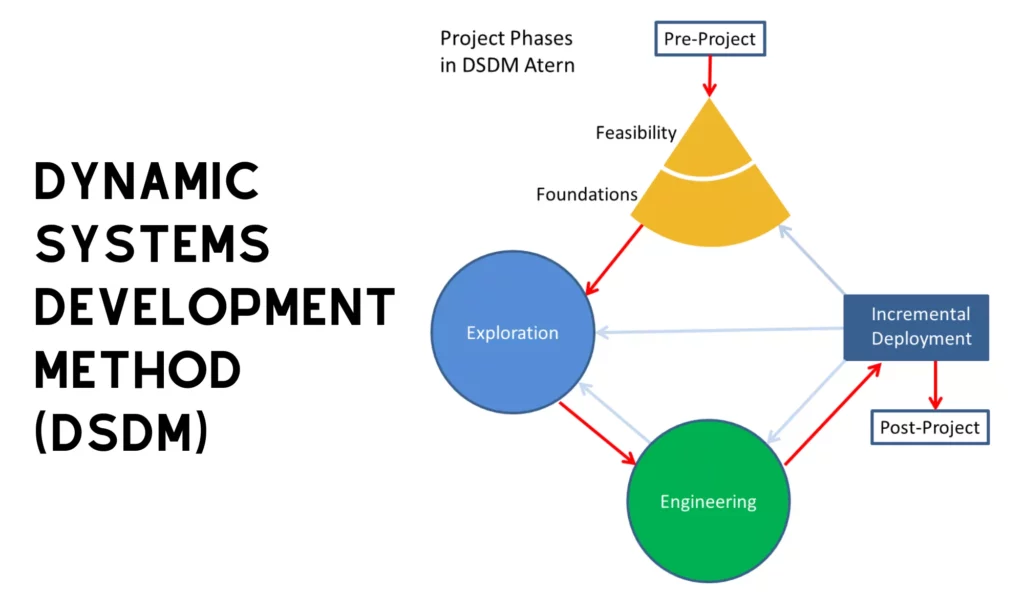
Dynamic Systems Development Method (DSDM) is one of the earlier Agile approaches, and it leans a bit more toward structure compared to newer frameworks. It focuses on delivering business value quickly while maintaining strong governance, making it somewhat appealing for organizations that need both agility and control.
How it works:
DSDM follows a structured lifecycle that includes phases like feasibility, foundation, development, and deployment. Like newer Agile methodologies, it uses timeboxing (similar to sprints) to break projects down into fixed-budget and fixed-time chunks (typically 2-6 weeks). Besides, it involves users actively throughout the process and emphasizes iterative development.
Best for:
- Large-scale organizations requiring governance and documentation alongside Agile practices.
- Projects with fixed deadlines but flexible scope.
| Pros | Cons |
| – Balances Agile flexibility with structured governance. – Excels at meeting strict deadlines and tight budgets. |
– Be more rigid compared to lighter Agile methods. – Requires commitment from business stakeholders throughout the process. |
9. Feature-Driven Development (FDD)
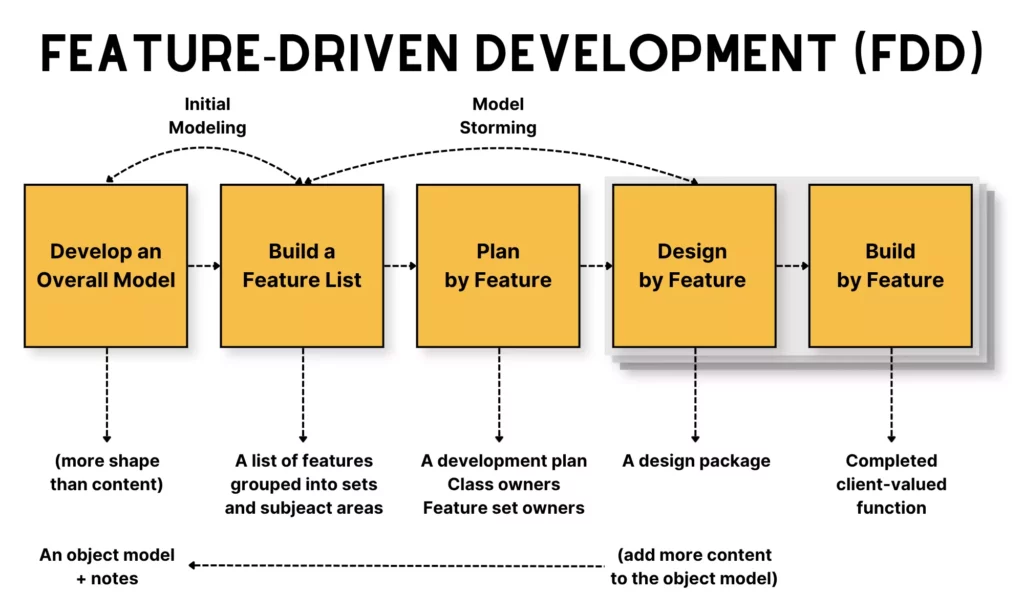
Feature-Driven Development (FDD) is an Agile approach centered around designing and building features in iterative cycles (typically two weeks or less). Unlike other types of Agile methodologies, FDD is highly structured and emphasizes domain modeling, documentation, and reporting.
How it works:
FDD follows an iterative process. It starts by developing an overall, high-level model (class diagram) that maps the entities, relationships, and behaviors of a business domain. This model provides a roadmap for developers to define the software architecture. Then, the project is broken down into small, client-centric features that teams can develop in two weeks or less.
After that, small, temporary teams are formed to plan, design, and build specific features. Besides, specific developers are also assigned to take ownership of individual code classes to improve code quality.
Best for:
- Complex, large-scale software projects with well-defined requirements (like financial or enterprise software).
- Teams that prefer structured planning and documentation.
- Environments where tracking progress by features is important.
| Pros | Cons |
| – Provides clear structure and predictable progress tracking. – Focuses on delivering client-valued features consistently. |
– Less flexible when requirements change frequently. – Upfront modeling can slow down initial progress. |
10. Crystal
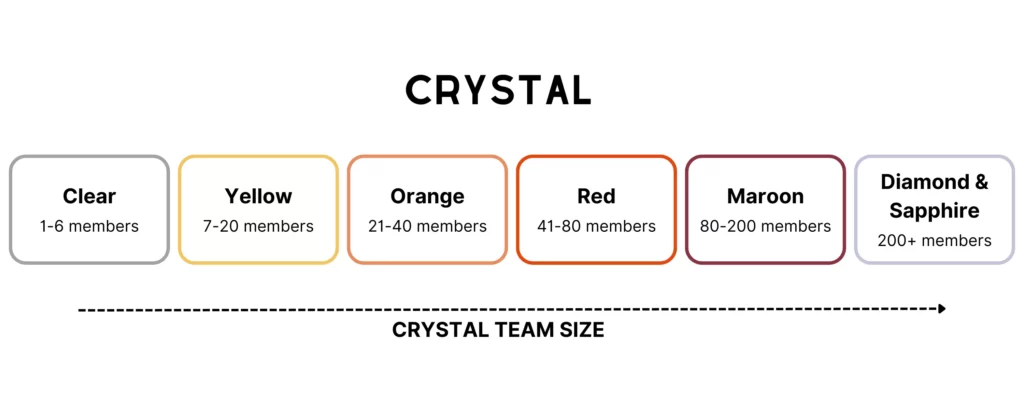
Crystal is actually a family of Agile methodologies rather than a single framework. Accordingly, different “colors” of Crystal (like Crystal Clear or Crystal Orange) are designed for different team sizes and project criticality. Despite differences, all Crystal approaches value people, communication, and adaptability over strict processes.
How it works:
Crystal doesn’t define a fixed set of roles or ceremonies. Instead, teams choose practices that fit their context, focusing on frequent delivery, close communication, and continuous improvement. Besides, the method evolves based on team needs and system complexity:
- Crystal Clear (1-6 members): Best for small teams working on low-criticality projects. It prioritizes close collaboration, minimal processes, and fixed budgets.
- Crystal Yellow (7-20 members): Suitable for slightly larger teams that still want flexibility but may need a bit more coordination.
- Crystal Orange (21-40 members): Introduces more structure and defined roles. It’s often used in mid-sized projects where communication becomes harder to manage organically.
- Crystal Red (41-80 members): Designed for larger teams with higher project complexity. It requires more formal communication and coordination practices.
- Crystal Maroon (80-200 members): Used in large-scale environments where projects demand stronger control and documentation.
- Crystal Diamond (200+ members): Applied in very large, mission-critical systems (e.g., safety-critical projects) where failure is not an option.
Best for:
- Small to mid-sized teams that value flexibility and autonomy.
- Organizations open to adapting processes rather than following strict frameworks.
- Teams having experience in defining their own working methods.
| Pros | Cons |
| – Highly flexible and adaptable to different team contexts. – Strong focus on people and communication. |
– Lacks clear structure, which can confuse less experienced teams. – Harder to standardize across larger organizations. |
Agile Methodology Comparison For Different Team Types

There’s no single “best” Agile methodology that works for everyone. The right choice depends heavily on your team’s size, goals, and how you actually work day to day. Some teams need speed and flexibility, while others need structure and coordination. Now, let’s learn about which Agile workflows fit which team.
Best Agile Methods For Small Teams And Startups
Small teams and startups usually operate with tight deadlines, limited resources, and constantly shifting priorities. They don’t have time for heavy processes or too many meetings. What they need is speed, clarity, and just enough structure to stay aligned without slowing things down.
So, here are some Agile methods that may work well for them:
This approach is great for fast-moving environments with unpredictable workloads. It comes with no strict roles or sprint commitments, hence keeping small teams and maybe startups more flexible in managing projects. Additionally, Kanban helps teams visualize work and avoid overload.
Scrum may sound a bit structured for small teams and startups. But in fact, it still proves useful when teams need a defined structure to avoid working blindly. Accordingly, short sprints help teams deliver MVPs quickly, and regular feedback loops allow teams to adjust product direction early.
In case small teams and startups want some structure but not too much, combining Scrum’s planning with Kanban’s flexibility is a good idea.
This framework is designed specifically for very small teams (1-6 people). It accordingly enables direct communication and minimal process overhead. Therefore, it fits teams that don’t require too formal communication and too many meetings.
Best Agile Methods For Software Teams
Software teams, especially those building complex systems, need more than just speed. Accordingly, they need code quality, maintainability, and a way to handle changing requirements without breaking everything. So their Agile approach often leans a bit more technical.
In that case, some strong options for software teams include:
Many software teams adopt Scrum, as it provides a clear structure for managing feature development. More particularly, they break large work down into smaller and more manageable tasks, so that they can complete them incrementally over sprints.
This framework is very useful for highly engineering-driven teams. Its engineering practices, like TDD (Test-Driven Development) and pair programming, help software teams maintain high code quality and reduce technical debt. This type of Agile methodology also works well when teams want to deal with frequent changes.
Many software teams can use Kanban to handle bug fixes, maintenance, or DevOps tasks. By keeping workflow visible and manageable, Kanban can support teams in continuous delivery.
- Feature-Driven Development (FDD)
This approach provides software teams with a more structured approach to large-scale software projects. Accordingly, it helps them organize work around delivering small, client-valued features and track progress clearly across development cycles.
In reality, many software development teams combine different types of Agile methodologies to fit working styles and deliver the best outcomes.
For example, at Designveloper, we adopt Scrum and Kanban to break down large projects into smaller tasks and define which ones need prioritizing and what should be achieved in each sprint. Besides, we also use engineering techniques like Pair Programming to tap into multiple perspectives. Together, all these approaches support our teams in building the most robust solutions and improving overall software quality.
Best Agile Methods For Enterprise Teams
Enterprise teams operate on a completely different scale. Normally, large organizations require a reliable way to manage multiple teams, shared systems, and cross-department dependencies effectively. Besides, they emphasize constant coordination and seamless alignment with business goals.
That’s why they often need more structured (and even scaling) Agile frameworks:
- Scaled Agile Framework (SAFe)
This Agile methodology is designed for large organizations with complex systems. It helps enterprise teams align development work with business strategy through structured planning.
Further, it provides visibility across multiple teams and levels.
For enterprises demanding to scale Scrum principles across many teams, this Agile approach is an ideal choice. It adds coordination layers to manage more teams more effectively while maintaining flexibility.
LeSS is best suited in case enterprises want to scale Scrum practices but try to minimize additional roles and processes. It helps teams stay aligned under a single product vision and encourages strong collaboration across them.
This Agile approach suits enterprise teams that want to scale Scrum for a moderate number of teams (typically 3-9). Accordingly, it supports them in managing dependencies effectively and ensures a single, cohesive product increment each sprint.
Common Mistakes When Choosing Agile Methodologies

Choosing an Agile methodology is not easy in reality. Sometimes, you think one certain approach aligns with your team’s working styles and visions. But when adopting it in real projects, issues arise.
The reason is not because Agile “doesn’t work,” but because it’s applied in the wrong way or in the wrong context. And here are a few common mistakes that many teams often make when choosing Agile methodologies for their teams:
Assuming Scrum Works For Every Team
Scrum is almost too popular, to the point where some teams treat it as the default Agile solution. This approach, of course, works well in many cases. But it doesn’t fit every team.
Scrum comes with structure: defined roles, fixed sprint cycles, and regular events. For some teams, that’s helpful. But for others, especially those dealing with fixed requirements to unpredictable workloads (e.g., help desk), Scrum can be restrictive. That time, you might see teams struggling to fit urgent tasks into sprint boundaries or attending meetings that don’t quite add value.
How to avoid it
To avoid this mistake, look at how your team actually works first. If your workflow is more continuous than iterative, something like Kanban (or even a hybrid like Scrumban) might be a better fit.
Choosing A Scaled Framework Too Early
Scaling frameworks like SAFe or Scrum At Scale can look appealing, especially for growing organizations. They promise alignment, visibility, and better coordination across teams. But jumping into them too early can create more problems than they solve.
The issue here is, these frameworks assume a certain level of Agile maturity. If individual teams are still figuring out basic practices (like backlog management or sprint execution), adding layers of coordination can be overwhelming. Besides, scaled frameworks come with more meetings and more processes, which are unnecessary for inexperienced teams and even lead to worse outcomes.
How to avoid it:
Focus on getting Agile right at the team level first. Accordingly, you need to make sure teams are comfortable with core practices before scaling. Sometimes, staying simple a bit longer actually saves time in the long run.
Ignoring Team Culture And Workflow
This one’s subtle, but it matters a lot. Teams have their own habits, communication styles, and ways of solving problems. If you ignore all these factors and force an unsuitable Agile methodology on top of that, teams may resist adoption and may not achieve the desired outcomes. For example, a highly collaborative team might succeed with Scrum, but a more independent team could find it too rigid.
How to avoid it:
Don’t adopt Agile methodologies blindly, but treat them as something you adapt. Along with that mindset, you need to look at how your team communicates, how decisions are made, how work flows, and even where the team is getting stuck. The answers help you identify which methodology fits those patterns and supports your team the best, rather than trying to reshape the team overnight.
Treating Agile As One Fixed Method
Ironically, one of the biggest misunderstandings about Agile is treating it as not Agile. Some teams pick a framework and follow it rigidly, as if it’s a fixed system that shouldn’t be changed. But that makes them fail to fit Agile methodologies to their workflows and even team culture.
Agile is natively flexible. Meanwhile, frameworks like Scrum or Kanban just offer structures or somehow defined ways to enter the Agile world more easily, but don’t force teams to stick to them too strictly. If you do so, you fail to understand the core philosophy of Agile: being flexible.
How to avoid it:
Adopt the Agile mindset instead of following frameworks rigidly. Accordingly, you can adjust events, tweak workflows, combine practices, and refine how your team works over time to achieve the best results.
FAQs About Types Of Agile Methodology
What Are The Different Types Of Agile Methodologies?
There are many types of Agile methodology, and teams can adapt them to different contexts. Some of the most common ones include Scrum, Kanban, Extreme Programming (XP), Scaled Agile Framework (SAFe), Scrum At Scale, Large-Scale Scrum (LeSS), Nexus, Dynamic Systems Development Method (DSDM), Feature-Driven Development (FDD), and Crystal.
Despite differences, each of these takes the core Agile principles, like iterative delivery, collaboration, and flexibility.
Which Agile Methodology Is Best For Software Development Teams?
There’s no single “best” option, but there are a few methodologies that suit software teams better. They include:
- Scrum: Helps teams organize work into manageable sprints and maintain a steady delivery flow.
- Extreme Programming (XP): Goes deeper into engineering practices like test-driven development and pair programming, making it great for teams focusing on code quality and long-term maintainability.
- Kanban: Helps teams handle ongoing work like bug fixes or DevOps tasks, where priorities can change quickly.
- Feature-Driven Development (FDD): Supports software teams in creating small, client-value features, making it suitable for large-scale, complex projects.
Can Teams Use More Than One Agile Methodology?
Yes. And in real-world projects, teams often blend practices and principles from different Agile methodologies.
The reason is that no single framework covers everything perfectly. So, teams need to combine methods to respond flexibly to different needs at different stages. For example, a team might use Scrum for sprint planning and reviews, but adopt Kanban practices to manage daily workflow.
Can Agile Methodologies Be Used In Software Testing?
Yes, absolutely. In fact, many teams adopt Agile methodologies to streamline their software testing process, reduce human errors, and detect issues early.
Accordingly, Agile testing isn’t a separate phase that happens at the end. It’s integrated throughout the development process. Or in other words, testers work alongside developers, validating features continuously rather than waiting for a “finished” product.
Some methodologies, like Extreme Programming (XP), place a particularly strong emphasis on testing through practices like test-driven development (TDD). But even in Scrum or Kanban, testing plays a key role in ensuring each increment is functional and ready for release.