


Teams keep asking what is agentic ai because automation now goes beyond chat. Modern systems can plan, use tools, and complete tasks with less hand-holding. That shift changes how products work, how workflows run, and how businesses scale.
This guide explains the agentic AI definition in plain terms. It also breaks down how agentic systems work, what an agentic AI architecture looks like, and where the biggest benefits and limits show up in real deployments.

What Is Agentic AI?

Agentic AI is an autonomous system that acts independently to achieve specific, high-level goals with minimal human oversight. It does not just respond to prompts. Instead, it plans steps, selects actions, uses tools, and checks outcomes until it reaches the goal. That is the core agentic AI meaning in practice.
This agentic AI definition matters because the system can operate across time and context. It can also coordinate multiple actions, such as searching, writing, calling APIs, updating records, and routing work. You still control the boundaries. Yet the system controls the next move inside those boundaries.
Why Agentic AI Matters in the AI Evolution
Key Characteristics of Agentic AI System

- Autonomy: The AI can pursue goals with minimal human oversight, performing tasks beyond exactly what was instructed. It doesn’t constantly ask for guidance.
- Reasoning: It applies contextual decision-making to choose solutions on its own. The agent analyzes data and context to figure out its next steps actively.
- Adaptable Planning: When conditions change, the AI adjusts its plan of action accordingly. It can alter its approach on the fly if something unexpected happens.
- Context Understanding: Agentic AI has a strong grasp of context (e.g. understanding natural language or data) so it can understand instructions and environments.
- Action-Oriented: Crucially, an AI agent doesn’t just analyze – it takes action. It carries out tasks and delivers results whenever it is capable, without waiting for explicit orders.
Thanks to advances in AI techniques, these capabilities are now possible. Modern agentic systems often combine powerful large language models, machine learning, and reinforcement learning to learn from experience and improve their decision-making.
This blend of technologies allows the AI agent to learn the best ways to achieve its goals through trial and error, much like a human would. Importantly, agentic AI can break down big goals into smaller subtasks and delegate them to specialized tools or models as needed.
By orchestrating multiple components in this way, the AI agent can handle complex, multi-step processes end-to-end. For example, if given an overarching objective, an agentic AI might split it into sub-tasks (data gathering, analysis, steps, etc.) and handle each one with the appropriate method – all without a person mapping it out beforehand.
How Does Agentic AI Work?
1. Perception
The system first builds a working view of the situation. It reads the user goal, gathers context, and pulls relevant data. It may query internal knowledge bases, browse approved sources, or fetch customer records. This step reduces guesswork later.
Perception also includes constraints. The system identifies policies, deadlines, budgets, and quality rules. Then it keeps those constraints active through the run.
2. Reasoning
The system turns the goal into an executable plan. It selects a strategy, breaks work into steps, and assigns each step to a method or tool. It also decides what “done” means, so it can stop at the right time.
Good reasoning uses checks. The system anticipates failure modes, such as missing data or unclear intent. Then it adds validation steps before taking risky actions.
3. Acting
The system executes the plan through actions. Actions can include tool calls, API requests, database updates, or message drafting. Each action has inputs, outputs, and expected effects.
Acting should respect permissions. Many teams adopt read-only access first. Then they add write access with approvals for sensitive operations, such as deleting records or sending emails.
4. Learning (Observe and Reflect)
The system observes outcomes after each action. It checks whether results match the plan. If results drift, it adjusts the next step.
Learning also happens at the workflow level. Teams review traces, add tests, refine prompts, and tune retrieval. That is how agentic systems become stable in production.
Agentic AI Architecture Diagram
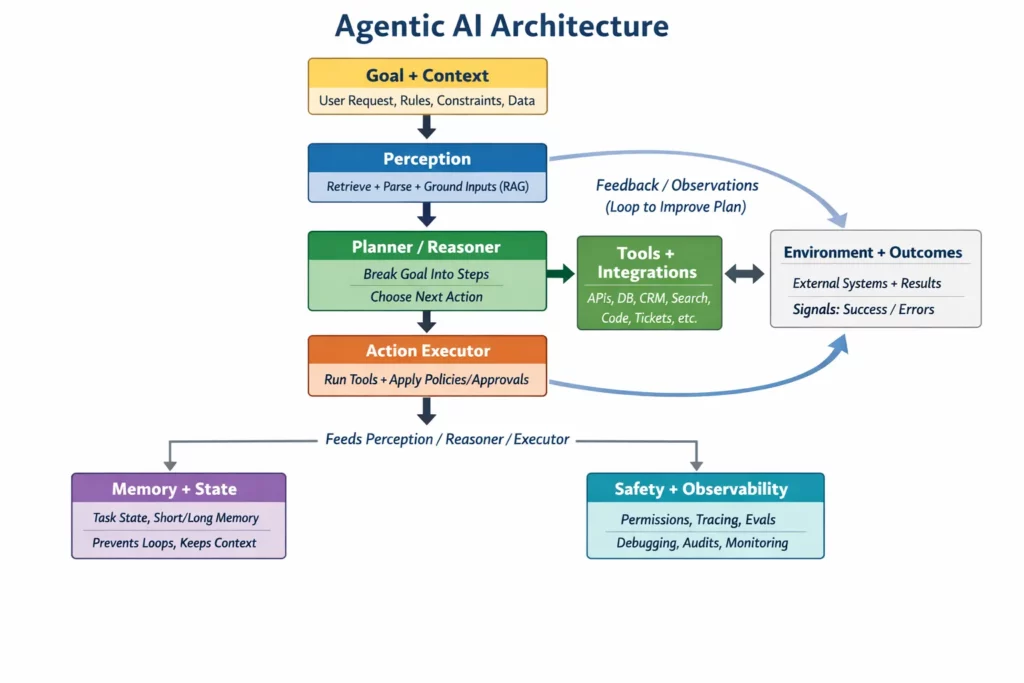
Diagram overview: a goal enters the system, perception gathers context, reasoning builds a plan, and actions run through tools under safety controls. This is a simple agentic AI architecture diagram for quick orientation.
This architecture highlights the core loop: perceive, reason, act, then observe. Most production teams add two extra layers. They add policy gates for safety. They also add observability so they can trace failures and improve reliability.
Different Between Agentic AI vs AI Agent vs Generative AI vs Traditional AI
| Category | Agentic AI | AI Agent | Generative AI | Traditional AI |
|---|---|---|---|---|
| Main purpose | Achieve goals through multi-step autonomy | Complete a bounded task with tools | Create content (text, images, code) | Predict or classify using fixed models |
| Control flow | System decides next steps | Agent follows a task policy or script | User drives each prompt-response turn | Predefined pipeline and rules |
| Tool use | Core capability with permissions | Often supported, usually narrower | Optional, not always included | Usually limited to data inputs |
| Memory | Stateful, can persist task context | May store short-term task state | Often session-limited memory | Minimal or no memory |
| Best fit | Workflow automation and orchestration | Single workflow steps or narrow processes | Drafting, ideation, summarization | Fraud detection, forecasting, routing |
| Primary risk | Unsafe actions at scale without guardrails | Overreach beyond scope | Hallucinated content | Bias and data drift |
Think of “AI agent” as a building block. Then think of agentic AI as a broader approach that strings many agent capabilities into a goal-seeking loop. Generative AI often powers the language layer in both. Traditional AI still matters for prediction and detection, and agentic systems can call it as a tool.
Benefits of Using Agentic AI
- End-to-end task automation. Agentic workflows can run tasks from start to finish. They can handle handoffs, retries, and validation steps. That is why many teams use agentic AI for operations and support.
- Reduced human intervention. Humans stop acting like routers for every step. Instead, they approve key actions and review outcomes. This approach also improves consistency across teams.
- Scalability across workflows. Once you design a safe loop, you can reuse it. You can also apply the same loop across departments by swapping tools and policies.
- Faster decision-making. The system can collect data, compare options, and propose a decision quickly. McKinsey also reports rising interest, and 62% of survey respondents say their organizations are at least experimenting with AI agents, which shows how widely teams now evaluate this speed advantage.
Limitations of Agentic AI
- Alignment and control. Agentic systems can optimize the wrong target if you define goals loosely. You need clear objectives, constraints, and stop conditions.
- Hallucination risks. Agents may invent facts and still act on them. Tool grounding helps, but you still need validation, citations, and structured checks.
- Security and permission management. Tool access increases impact. You must design least-privilege permissions and add approval flows for sensitive actions.
- Observability and debugging. Multi-step behavior can fail in non-obvious ways. You need traces, logs, and evaluations to spot where the plan went wrong.
- Cost and infrastructure complexity. Agents can trigger many model calls and tool calls. That can raise latency and spend. You can reduce this with caching, better planning, and tighter stopping rules.
Agentic AI Use Cases
- Customer support automation. Triage tickets, fetch account context, propose fixes, and escalate with a full trace.
- Sales ops and CRM hygiene. Enrich leads, draft follow-ups, update records, and schedule next steps with approvals.
- IT service management. Diagnose issues, run safe scripts, and document resolutions.
- Finance ops. Reconcile transactions, flag anomalies, and prepare variance explanations for review.
- Procurement. Compare vendors, draft RFQs, and route approvals based on policy.
- Software delivery. Generate code changes, run tests, open pull requests, and summarize diffs.
- Research and analysis. Gather sources, synthesize findings, and produce structured briefs for decision makers.
- Compliance support. Map evidence to controls, draft audit responses, and track remediation tasks.
The Future of Agentic AI

Agentic AI updates now focus on reliability, not only capability. Teams want agents that act safely, stay on task, and explain what they did. That demand pushes three trends at once.
First, agents move into products. This shift happens when apps embed agentic flows instead of adding chat as a layer. You will see more “do it for me” buttons that run workflows and return outcomes.
Second, standards and ecosystems mature. Agentic AI frameworks increasingly converge on shared ideas. They standardize tool interfaces, state handling, and trace formats. That makes it easier to swap models and tools without rewriting the system.
Third, market pressure accelerates investment. Forecasts now assume sustained growth. Fortune Business Insights projects the agentic AI market could reach USD 139.19 billion by 2034, which explains why vendors race to ship agentic AI architecture patterns that enterprises can govern.
Survey data also shows rapid experimentation and deployment. LangChain’s State of AI Agents report says 51% of respondents are using agents in production today, which suggests many teams already moved past demos and into real workflows.
At the same time, teams still learn what “good” looks like. Operational best practices now spread through community playbooks, internal platform teams, and tooling for traces and evaluation. LangChain’s later survey also gathered 1,340 responses, which points to a fast-growing discipline around agent engineering and production hardening.
FAQs about Agentic AI
1. Is ChatGPT Agentic AI?
ChatGPT can support agentic behavior, but it depends on how you use it. If you only chat and get text, you use a generative interface. If you connect tools, give it permissions, and let it plan and act, you move toward agentic AI. Many modern “agent” experiences wrap a chat UI around an action loop, so the experience can feel agentic even when strict autonomy stays limited.
2. Is Agentic AI Safe?
Agentic AI can be safe when you design it for safety. You should start with least privilege. You should also add approval gates for risky actions. Then you need monitoring, traces, and tests. Safety is not a single feature. It is a system property that comes from architecture, policy, and operations.
3. Are Agentic AI vs Autonomous AI the Same?
They overlap, but teams often use them differently. “Autonomous AI” is a broad label for systems that operate with less human input. “Agentic AI” usually implies a goal-seeking loop with planning, tool use, and iterative execution. In practice, many people treat agentic AI as a concrete form of autonomy built around agents.
4. Does Agentic AI Replace Human Workers?
Agentic AI changes tasks before it changes jobs. It can remove repetitive coordination work, like copying data between tools or drafting standard responses. However, humans still set goals, define success, and handle exceptions. Most teams get the best results when they pair human judgment with agentic execution.
5. Is Agentic AI Suitable for SMEs?
Yes, SMEs can benefit because they run lean teams. Agentic AI can automate admin-heavy workflows and reduce backlog. Still, SMEs should start with narrow, high-value processes. They should also choose simple controls, such as human approvals for write actions and clear audit logs. That approach keeps risk low while benefits grow.
Agentic AI makes AI useful beyond conversation. It turns models into goal-driven systems that can plan, act, and improve with feedback. When you pair strong guardrails with a clear architecture, you can automate real workflows and keep control. That is the practical answer to what is agentic ai, and it is why so many teams now build toward agentic systems instead of chat-only assistants.
Conclusion
Agentic AI delivers the most value when you treat it like a production system, not a demo. You need clear goals, safe tool access, and strong observability. When those pieces align, agentic workflows can plan, act, and self-correct while your team keeps control.
At Designveloper, we build agentic solutions as part of real products. We are founded in 2013, and we operate as a Vietnam-based web and software development company with cross-functional delivery. Our team spans product discovery, UI/UX, web and mobile engineering, QA automation, DevOps, and AI engineering for RAG, tool orchestration, and evaluation.
You also need proof that your partner ships reliably. That is why we highlight our 4.9/5.0 rating on Clutch and our company scale of 51–200 employees, which supports long-term delivery and support.
If you want to move from “what is agentic ai” to a working system, we can help you plan the architecture, connect tools safely, and harden the workflow for production. Explore our AI development services and browse our project portfolio to see how we turn complex workflows into software your team can run with confidence.


