


It’s a new day for TikTok in the U.S., under its new U.S. ownership, and already TikTok users are complaining about reliability issues, questionable post performance and, most concerningly, potential censorship.
How much of that is true, and how much is imagined based on the broader context, is impossible to say, but the new U.S. TikTok will certainly be under scrutiny in the coming months, as American users look for cracks in the app’s revised TikTok operating structure in the nation.
To recap, late last week, TikTok finally came to terms on a new deal that would allow it to remain in the U.S., via a joint venture partnership with a group of Trump-approved U.S. businesses, who will now, in effect, control the local version of the app.
That should mean minimal change, because TikTok will still operate under the same algorithm, and that’s driven such massive success for the app, that it would be a significant risk for the new ownership group to mess with it too much. But there are, of course, concerns that this new group, led by Oracle, could look to re-align TikTok’s algorithms around the Trump Administration’s preferences, which could significantly change the in-app experience.
Again, to reiterate, there’s no definitive evidence that anything like this is happening, but TikTok users are already reported instances of what they’re perceiving as censorship around some issues since the switch (including restricted searches for “Minneapolis,” among other potential issues).
There’s also the updated privacy policy, which has spooked some users.
On Friday, TikTok users were greeted with a pop-up prompt that alerted them to the change.
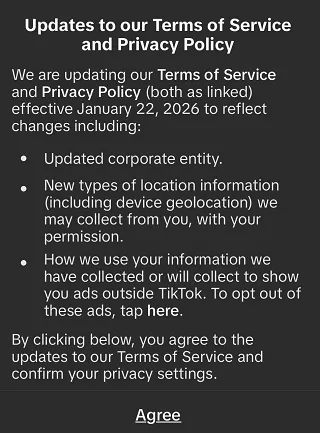
Under “TikTok USDS Joint Venture LLC,” TikTok users in the U.S. will now have to agree to a new privacy policy, which some have suggested significantly alters the data that TikTok can collect.
But it doesn’t, not really.
The three main changes of note, based on analysis of the old and new privacy policy documents, are:
- TikTok US can now collect more precise location data if you have location services switched on. The previous version of TikTok disabled this element to better align with U.S. regulations and privacy concerns.
- TikTok US can now track your interactions with AI tools in the app, including “prompts, questions, files and any other types of information that you submit.” This is fairly standard legal wording for AI features, but it wasn’t included in TikTok’s previous rules.
- TikTok US can now utilize your on-platform data for off-platform advertising, in order to expand its ad targeting offerings to third-party partners.
None of these are radical changes, which are going alter the way that TikTok gathers and uses your data, and are fairly standard provisos for most social media apps. But there are some changes, which you’re agreeing to when you choose to use the app.
I guess, the bigger question now is whether the Trump Administration will look to lean on TikTok’s new management in order to alter its algorithms to favor Republican talking points.
Trump has previously noted that he would make TikTok “100% MAGA” if he could, while there have long been suggestions that the Chinese government censors certain content within the app, in order to better align with a pro-CCP agenda.
There’s been no definitive evidence of this, though cybersecurity officials have maintained their alarm about the app, which is what led to the initial calls for TikTok to be banned in the U.S.
But essentially, we don’t know if and how TikTok could be used for political manipulation, nor do we know exactly how much algorithm control the new TikTok U.S. entity will have to enact such, if it so chooses.
In TikTok’s announcement of the deal, it noted that:
“The [US] Joint Venture will retrain, test, and update the content recommendation algorithm on U.S. user data. The content recommendation algorithm will be secured in Oracle’s U.S. cloud environment.”
So the new group will have some input here, but with each individual user having a totally different experience in the app, it’s very hard to measure if and how people might be seeing certain things, or not, based on any such tweaking.
So are TikTok’s American users in for a vastly different experience now that the app has changed hands? Again, I would think not, given the risk to the business, but there is a chance, based on the wording of these new agreements, that TikTok’s American audiences are going to experience at least a slightly different weighting in some aspects.
That will lead to accusations of suppression, and some may be correct. But it will take some time to establish such as fact.