


The loudest conversations about AI and jobs focus on what disappears. Inside IT, the more immediate problem is what quietly multiplies. As AI capabilities spread across the stack, they splinter work into new, poorly defined skill demands: prompt engineering here, orchestration there and model evaluation somewhere in between. None of it aligns neatly with existing roles, reporting lines, or hiring frameworks.
The result is an accumulation of invisible labor. Critical, unscoped work is absorbed by already stretched teams, bypassing formal ownership and eluding traditional workforce planning. For CIOs, the risk isn’t just a skills gap. It’s an operating model that can no longer see, measure or manage the work required to run AI at scale.
While AI implementations differ from organization to organization, their impact on IT work is near universal.
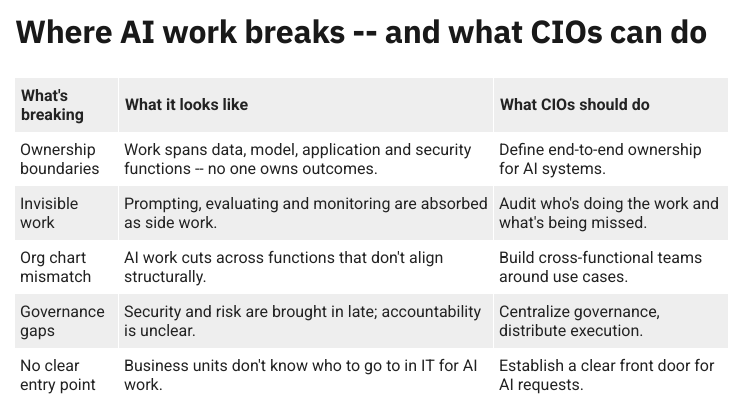
“AI systems break the ownership boundaries,” said Sridhar Rao Muthineni, engineering manager at PwC.
A model’s behavior spans training data, prompts, infrastructure, validation, governance and its user interface, Muthieni explained, so “when something goes wrong — say, a customer-facing model hallucinates financial advice — no single traditional owner can be held accountable because every layer contributed.”
Diagnosing the problem: AI is not just another layer in the tech stack
The situation — while understandable — results in a whopping hole in IT in terms of accountability, responsibility and a clear chain of authority for AI implementations that, by definition, are continuously evolving.
“AI isn’t a deployment. It’s a living system. It drifts, it breaks in subtle ways, it requires continuous human judgment. Executives can’t see the skills gap because the work is invisible,” said Bud Caddell, CEO of NOBL, a consultancy.
Every department in an organization is struggling to use AI, and more than a few are unsure to whom in IT they should turn to help them succeed. For example, according to a recent Coupa report, 85% of the 600 CFOs surveyed identified AI as central to their strategy, yet 92% worry about their ability to implement it — an increase from 66% last year.
The clearest signal of organizational drift typically starts at the leadership level, where ownership of AI capability development is undefined, which leads to initiatives without a governing authority. So departments don’t just lack skills, they lack a clear front door into IT for AI work. The result is that AI is no longer a centralized function. It is everywhere and nowhere, dissolving clear escalation paths and leaving business units guessing which team owns outcomes.
At the heart of the problem, of course, is AI’s disruption of how business has always been done.
Legacy IT roles were built for deterministic systems where the code did what you told it to do, Masud said. AI breaks that model, requiring new roles, updated adjacent roles and a shift in mindset among those “who still think this is just another layer in the stack,” he said.
Caddell diagnosed the problem as follows: “The org chart maps responsibilities to technical layers, but AI doesn’t respect those boundaries.” In practice, the data team doesn’t understand the model, the app team doesn’t understand the data, security gets looped in last — and nobody owns the outcome. “That’s not a job description problem. That’s a work process problem,” Caddell said.
The CIO conundrum
Even studying the AI ownership issue in search of a fix introduces additional complexity.
“Yes, it is partly a process problem and partly a job description problem, but more than anything it is an operating model problem,” said Zack Tisch, partner of portfolio services at Pivot Point Consulting, a healthcare IT consulting company.
AI work is often added as side work to existing IT teams, “creating bottlenecks, hidden capacity issues and confusion about who owns risk versus who owns outcomes,” Tisch said.
The organization-wide confusion leads to a CIO conundrum: how to manage the situation so it works at every level and for every department. The first step may be to reframe the problem.
“The problem isn’t that AI doesn’t fit the org chart. The problem is that the org chart doesn’t fit AI,” said Paul McDonagh-Smith, senior lecturer at the MIT Sloan School of Management and former senior advisor at NASA Goddard Space Flight Center.
“Traditional organizational structures were built for a world of silos — discrete functions with defined boundaries, clear handoffs and hierarchies designed to control the flow of information upward and decisions downward. Today, we are trying to navigate a world of flows with a map drawn for a world of walls,” McDonagh-Smith said.
Steps CIOs can take
Certainly, a rethink is in order — and perhaps a full-blown reorganization of work, where, according to McDonagh-Smith, the focus shifts from hierarchies to how intelligence flows across the team.
How this translates into real-world IT operations, however, remains unclear.
“Leading CIOs are starting to treat this as an operational discipline, not just a technology deployment,” said Tony Grout, chief product and technology officer at M-Files, a document management system provider. That means centralizing governance while enabling distributed execution, he said, often through emerging functions like AI operations, model governance councils or cross-functional AI teams.
“They’re also investing in standardized frameworks for evaluation, monitoring and data readiness, so teams aren’t reinventing the wheel with every use case. The goal is to reduce fragmentation by creating shared guardrails and visibility, while still allowing innovation at the edges,” Grout added.
Creating a new org chart for AI may be in order, if only to clarify how work gets done across the business.
“The strongest CIOs are defining shared standards for governance, evaluation and security, then building cross-functional teams around high-value use cases,” said Atif Khan, CTO of Alkira, an AI-native network IaaS. This often takes the form of a hub-and-spoke model, with a central team setting policy and architecture and domain teams executing.
Regardless of how individual companies approach this problem, the fundamental gap between the question and the answer remains.
“Mapping AI work onto existing roles hides the gaps rather than closing them. Start with an audit of where AI is running, who’s doing the work and what’s being left undone,” said Mark Friend, director at Classroom365, which provides IT support for schools across the UK.
Most CIOs find the audit eye-opening, Friend said, adding that the practical next step is to create a small cross-functional AI operations function — not a new department, but a focused group with clear ownership of governance, prompt management and output evaluation.
“In the schools we support, the biggest gains come where someone has been given a formal AI lead role with actual ring-fenced time, not a side project. That single point of ownership makes a bigger difference than any tool purchase we’ve seen,” Friend said.