


If you’re working with ChatGPT, you may wonder which large language models behind it (e.g., GPT-5.4 or GPT-4o) can help you achieve the best outcomes. Released by OpenAI at the end of 2022, ChatGPT has become the most common AI chatbot that creates human-like responses based on user prompts. However, different ChatGPT models fit different workflows and tasks. So, this guide will explain what each model does well and guide you to choose the best one for your specific cases.
What Is A ChatGPT Model?
A ChatGPT model is the underlying large language model (LLM) developed by OpenAI to help the chatbot understand user input and generate relevant responses. These models are trained on massive text datasets and use a technique called Reinforcement Learning from Human Feedback (RLHF) to improve accuracy and clarity over time.
At a technical level, ChatGPT models are built on Transformers (a type of neural network architecture) to predict the most likely next word (or sequence of words) based on the context of your prompt. This allows the chatbot to handle a wide range of tasks, from answering questions and writing content to coding and analyzing data.
ChatGPT Models Explained
OpenAI develops multiple models for ChatGPT, each optimized for different purposes. Understanding how these models work helps you choose the right one for your needs and use it more effectively. Now, let’s dive into them:
GPT-5 Models

Released in August 2025, GPT-5 is OpenAI’s latest and most advanced ChatGPT model. It’s designed as a unified system that uses a real-time router to assign tasks intelligently between standard, mini, and multi-phase “thinking” modes based on query complexity. The model has a wide range of capabilities to perform various tasks, including business and professional work.
From a technical view, GPT-5 uses a large-scale Transformer with advanced RLHF and extended “thinking” processes to improve reasoning accuracy. The model is like OpenAI’s answer to the era of agentic AI, where chatbots can make some autonomous decisions.
Key features and improvements:
- A unified system that can smartly route tasks between fast models (for answering most questions) and deep reasoning models (for complex problems)
- Native multimodal support (text, image, audio, video)
- Larger context window of up to 400K tokens
- Provides 45-80% fewer hallucination errors in responses.
- Stronger reasoning and multi-step problem-solving compared to previous models
- Support for tool usage and agent-like workflows
Model variants: Since the launch, OpenAI has released various GPT-5x updates from 5.1 to 5.4 (the latest). They can be categorized into the following types:
- Core GPT-5 models (for general purposes): GPT-5 (Standard), GPT-5 Pro (for deeper reasoning), GPT-5 Mini (for cost-efficiency and speed), and GPT-5 Nano (the most lightweight version for simple API and basic tasks)
- Specialized variants (Codex & Codex Spark) specifically for software engineering, agentic coding, and cybersecurity auditing.
Limitations:
- Still hallucinates and produces unreliable responses, especially in edge or highly novel cases
- Slightly slower for simple tasks compared to lighter models
API pricing: From $0.05/$0.4 to $30/$180 per 1M tokens
Best for: Multi-step, agentic tasks and professional workflows (like research, software development, and data analysis)
GPT-4.1 Models
OpenAI released GPT-4.1 models on April 14, 2025. These ChatGPT models focus on coding accuracy, instruction-following, and long-context understanding. Now, users can access GPT-4.1 models through the OpenAI API or the OpenAI Developer Playground.
Key features and improvements:
- Improves coding accuracy and structured task handling
- Focuses on dialogue style prompts
- Supports up to 1M tokens of context, allowing GPT-4.1 to process long documents or complex codebases
- Retains GPT-4o’s strong multilingual and analytic abilities, but ensures higher accuracy
- Performs faster than GPT-4o on equal prompt length
Model variants:
- GPT-4.1: Considered a smart non-reasoning model that excels at tool calling and instruction following
- Mini: Optimized for balanced load
- Nano: Designed for short, cost-efficient tasks
Limitations:
- Less advanced reasoning compared to GPT-5 or O-series models
- Still requires careful prompting for complex tasks
API pricing: From $0.1/$0.4 to $2/$8 per 1M tokens
Best for: Structured tasks that require large context, high performance, or strict instruction following at an affordable cost.
GPT-4o Models

OpenAI officially released GPT-4o (short for “omni”) on May 13, 2024 as a multimodal model to replace earlier GPT-4/Turbo models. GPT-4o can process text, images, audio, and even video inputs (by analyzing sampled frames) and output text, audio, or images.
It’s optimized for low latency and can respond in near real time. This makes it suitable for chat interfaces, voice assistants, and interactive applications. While it performs well across general tasks, it’s s typically less powerful than newer models like GPT-5 in deep reasoning scenarios.
Key features and improvements:
- Native multimodal support (for text, image, audio, and even video inputs)
- Very low latency and high speed, even in live conversations (thanks to heavy engineering optimization)
- Context window of up to 128K tokens, four times larger than the 32K window of GPT-4
- Provides intelligence on par with GPT-4 Turbo in text and code performance while being 50% cheaper per token
- High accuracy in visual reasoning tests and audio tasks across many languages
Model variants:
- GPT-4o (Main): The high-intelligence flagship model for complex tasks
- Mini: A fast, affordable small model for high-volume tasks and applications that prioritize speed and cost efficiency.
Limitations:
- Less advanced reasoning compared to GPT-5 and O-series models
- Still remains GPT-4’s general limitations (hallucinations, biases), while adding new issues from audio/visuals (e.g., failing on very abstract images or poor-quality audio)
- Despite strong multimodal capabilities, GPT-4o fails if users combine different modalities in a prompt.
API pricing: From $0.15/$0.6 to $2.5/$10 per 1M tokens
Best for: General-purpose tasks and interactive chat experiences where latency is a priority. This makes it ideal for real-time chatbots, vision tasks, and multilingual chats.
O-Series Models

The O-series models are designed specifically for complex reasoning and problem-solving tasks. This series started with OpenAI o1 (Sept 2024 preview) and expanded to o3, o3-mini, and o4-mini (early 2025).
They also use the Transformer architecture as traditional GPT models. But while GPTs aim for general purposes, O-models are trained on iterative RLHF to reason step-by-step before generating answers. Besides, they are taught with all of ChatGPT’s tools (web, memory, code interpreter, etc.) and learn when to use them, but at the cost of higher latency.
Key features and improvements:
- Chain-of-thought reasoning to improve accuracy and reduce hallucinations
- Supports tool calling, including searching websites and executing Python code for data analysis
- Allows users to adjust reasoning parameters (low, medium, high) to balance speed and reasoning based on tasks
- Strong performance in math, coding, and logic-heavy tasks
- Context window of up to 200K tokens
Model variants: The o-model family includes the following key models:
- o1/o3 (Flagship): Flagship models for advanced, high-reasoning tasks, especially on STEM topics
- o3-mini/o4-mini: Fast, cost-effective models in complex, multi-step tasks
- o3-pro: Focuses on running multiple reasoning threads and choosing the best path forward
Limitations:
- Higher latency (slower responses than GPT models)
- Less optimized for casual conversation or simple tasks
API pricing: From $1.1/$4.4 to $150/$600 per 1M tokens
Best for: Tasks that require deep analysis or multi-step reasoning, such as solving complex math problems or handling multi-file coding tasks. O-models can act as agents that autonomously use web and Python tools for several tasks (e.g., searching through research or code libraries to get answers).
Older Models And Legacy Options

Looking back at the past, we easily see other legacy models that supported ChatGPT over time. Some of them include:
OpenAI released GPT-4 on March 14, 2023 and positioned it as a large multimodal model that supported text and images. The model has a smaller context window (8K to 32K tokens) than newer options and excels at general reasoning, cross-domain knowledge, and creative content.
However, it could hallucinate, although its factual errors were considered nearly 40% lower than GPT-3.5. Besides, even with careful prompting, the model could still deliver disallowed content. Now, you can still access GPT-4 (Main) and GPT-4 Turbo through the OpenAI API or the OpenAI Developer Playground.
Released in November 2022, GPT-3.5 is the backbone of the original ChatGPT. It uses deep learning to generate human-like text for different tasks, like answering questions, summarizing text, and writing code. OpenAI then introduced GPT-3.5 Turbo as a cheaper, faster version optimized for chat. This version had a context window of up to 16K tokens and was fine-tuned for general chatbots, code generation, and moderate-complexity writing.
Note: OpenAI developed other large language models like GPT-3 (2020), GPT-2 (2019), and GPT-1 (2018), but they’re not ChatGPT models. At that time, GPT-3 was OpenAI’s first commercial product accessed through the OpenAI API and fine-tuned to power over 300 apps (including InstructGPT, the technical predecessor of ChatGPT). Meanwhile, GPT-2 and GPT-1 were open-source, transformer-based models trained to understand and create human-like text.
Key Differences Between ChatGPT Models
Below is a comparison table that helps you review the key differences between ChatGPT models:
| Models | GPT-5 | GPT-4.1 | GPT-4o | O-Series | GPT-4 | GPT-3.5 |
| Key features | – Unified system – Lower hallucinations – Agentic workflow & deep reasoning support |
– Improves coding accuracy & structured task handling – Focuses on dialogue style prompts |
– Improves text & code performance – High accuracy in multimodal and non-English tasks |
– Trained for step-by-step reasoning – Excels at STEM tasks |
Excels at general reasoning, cross-domain knowledge, and creative content. | Backbone of the first ChatGPT release |
| Release Data | Aug 2025 | Apr 2025 | May 2024 | Late 2024 – early 2025 | Mar 2023 | Nov 2022 |
| Context Window (tokens) | 1M | 1M | 128K | 200K | 8K – 32K | 4K – 16K |
| Multimodal? | Yes (text/vision/audio) | Yes (text & images) | Yes (text/vision/audio/video) | Yes (text & images) | Yes (text & image in preview) | No |
| Latency | Moderate | Moderate | Very low | High | Moderate | Low |
| Typical Use Cases | Multi-step, agentic tasks and professional workflows | Structured tasks at an affordable cost | General-purpose tasks and real-time applications | Complex math/coding/logic tasks, multi-step workflows | General chat, writing, some vision tasks | General chatbots, simple coding, search |
| Cost Tier(per 1M) | ~ $1.25/$10 | ~$2/$8 | ~$2.5/$10 | ~$2/$8 | ~$30/$60 | ~ $0.5/$1.5 |
How To Choose The Best ChatGPT Model For You

The best ChatGPT model doesn’t always mean the most advanced one. Our comparison between different models at least clarifies one fact: Each model is trained, tuned, and optimized differently. Therefore, they work best in different cases.
That’s why choosing the wrong model can lead to ineffective workflows and undesired outcomes. Below are three ways you should consider when choosing the right model:
Choose Based On Speed, Reasoning, Or Cost
First, you need to consider trade-offs between speed, reasoning, and cost to decide which ChatGPT model fits your needs:
- If you care about speed, choose models like GPT-4o or lighter variants (Mini/Nano). They respond quickly and work well for everyday tasks like chatting, drafting emails, or answering simple questions. But this means they can miss subtle details in more complex prompts.
- If you prioritize reasoning, choose GPT-5 or the O-series models. These models are designed to handle multi-step problems, deeper analysis, and structured thinking. This definitely translates to slower performance. But these models can become more reliable when tasks get complicated.
- If you’re in budget constraints or require high-volume use at an affordable cost, then choose cost-efficient models (Mini/Nano). They’re cheaper and faster. However, you may not access the full power of standard ChatGPT models.
Choose Based On Coding, Writing, Research, Or Visual Work
Another way to choose a model is by looking at what you actually want to get done.
- In coding & development, choose GPT-5, o-series, or GPT-4.1 depending on task complexity. For example, GPT-5.4 is designed to support agentic software engineering, making it a better option if you want an agent that supports autonomous code repair or debugging tasks. Meanwhile, GPT-4.1 assists with daily, high-speed coding work.
- In writing, choose GPT-5, GPT-4o, and GPT-4.1 depending on what type of writing you prefer. Accordingly, GPT-5 is best for high-quality, structured writing (with reliable citations), while GPT-4.1 supports technical or structured content that requires strict formatting and instruction following. For creative writing and brainstorming with natural tones, use GPT-4o.
- In research, choose GPT-5, o-series, GPT-4.1, and GPT-4o. Each ChatGPT model serves different research purposes. For instance, GPT-4o works well for fast, surface-level research, while GPT-4.1 helps with large-scale research across huge amounts of text. Besides, O-models and GPT-5 enable deep research with citations and multi-step reasoning.
- In visual work, choose GPT-4o and GPT-5. These models have strong multimodal capabilities, allowing you to input visuals for deep analysis or create high-quality visuals directly in chats.
Choose Based On Access, Limits, And Availability
You can also consider the right ChatGPT model based on its access, usage limits, and availability.
If you’re a regular user and choose a free tier, there’s unfortunately no choice to switch between ChatGPT models. Accordingly, your free account will be automatically updated with new GPT versions. At the time of this writing, a free plan is using GPT-5.3 Instant (with a context window of 27K tokens) and GPT-5 Thinking Mini (for deep reasoning).
If you choose Plus or higher plans, you can switch between different options, from the latest GPT-5x to legacy options. Besides, you can access a wider range of ChatGPT models through the OpenAI API or developer environments.
Best ChatGPT Models By Use Case
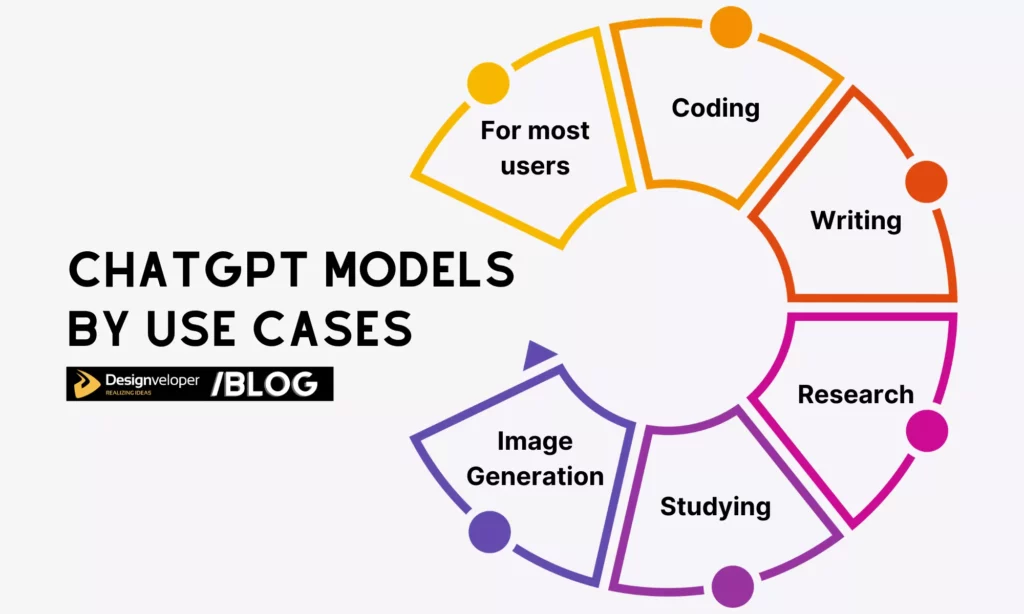
If you’re looking for the best ChatGPT models by use case, don’t skip this section. Here, we’ll detail which ChatGPT model you should consider for most use cases, coding, writing, research, studying, and image generation.
Best ChatGPT Model For Most Users
Recommended model: GPT-4o (for most use cases) / GPT-5 (for high availability)
According to most user experiences, GPT-4o is generally the best choice over time. Here’s why:
- It balances flagship-level intelligence with significantly fast response times and high emotional intelligence (through its engaging and warm tone).
- GPT-4o delivers enough accurate answers for most tasks, from answering questions and drafting content to coding.
- The model is powerful enough to handle moderate reasoning and multimodal inputs (text, images, audio).
In reality, most people don’t need the full power of advanced reasoning models. So, they consider GPT-4o the most practical default for their needs.
However, if you ask which ChatGPT model is available for most users, we would say GPT-5. Albeit powerful, GPT-4o was retired from the free tier and can only be accessed via the OpenAI API or Plus and higher plans. Meanwhile, all users of both free and paid plans access GPT-5, typically GPT-5.3 Instant and GPT-5 Thinking Mini, in their ChatGPT interfaces.
Accordingly, GPT-5.3 Instant is a fast and powerful workhorse for everyday work and learning. It’s a clearly improved version of the initial GPT-5 in info-seeking questions, how-tos, technical writing, and translation, while offering a warmer, more conversational tone. Besides, if your tasks require deeper reasoning, GPT-5 will intelligently route them to GPT-5 Thinking Mini (or full reasoning variants if you’re on a paid plan) for better results.
Best ChatGPT Model For Coding
Recommended model: GPT-5 (for agentic coding) / O-series (for complex debugging & architectural decisions) / GPT-4.1 (for handling massive codebases)
With GPT-5, OpenAI shifts to an autonomous agent that can support agentic software development. Not all GPT-5 models excel at coding work. So if you’re finding specific variants in this category, you should consider:
- GPT-5.4: Best for agentic, multi-step, and complex workflows. It’s improved coding and computer-use capabilities, coupled with its tool use, to handle long-running tasks and reason through complex or vague problems. Besides code generation, it can test what it’s building to ensure code quality.
- GPT-5.3 Codex: Designed as the most capable agentic coding model. It combines frontier coding performance with the reasoning capabilities of GPT-5.2 to boost coding work 25% faster.
- GPT-5.3 Codex Spark: Supports real-time collaboration on coding at a high speed of 1K+ tokens per second. The model is accordingly suitable for rapid prototyping, targeted edits, and hands-on iteration.
Meanwhile, the O-series (particularly o3) provides structured step-by-step reasoning to break down problems. This way, they can handle complex architectural decisions, debug multi-file projects, and find difficult bugs. But the trade-off is that these reasoning models run more slowly than lighter models.
GPT-4.1 is worthwhile for one specific coding scenario: massive codebases. With a large context window, the ChatGPT model proves extremely useful in handling extremely large inputs (maybe entire repositories).
Best ChatGPT Model For Writing
Recommended model: GPT-4o (for creative & professional writing) / GPT-5 (for well-structured writing)
GPT-4o is the best choice if you need a creative option with personality. Its engaging, conversational tone makes it suitable for social media copy, storytelling, and emotional writing.
Besides, it strikes a balance between speed, capability, and cost, making it adequate for every writing task, like Q&A, casual content, summarization, brainstorming, and quick drafts. If you don’t need highly structured formats for professional tasks (e.g., writing emails), just using GPT-4o is enough.
If you plan to write a detailed and well-structured content (like reports or long-form articles), choose GPT-5. This ChatGPT model reduces hallucinations in responses. Additionally, it comes with Deep Research, Web Search, and Thinking modes to improve writing with cited information and multi-step reasoning.
For fast and everyday tasks (e.g., general writing), you should choose GPT-5’s Instant variants. Meanwhile, Thinking versions are better suited for long-form and high-stakes content (e.g., whitepapers, detailed reports, and legal documents), as they have better industry-specific knowledge.
Best ChatGPT Model For Research
Recommended model: O-Series (for high-accuracy scientific & analytical research) / GPT-5 (with Deep Research)
For scientific research assistance, the O-models, especially o3 and o3-pro, are better options because their methodical approach is ideal for precise and careful research. Accordingly, they can analyze experimental data, cross-check logic in proofs, and generate or critique hypotheses with a very keen eye.
Besides, the chain-of-thought “System 2” thinking allows the O-models to “think” to verify logic before giving the final responses. This makes it ideal for mathematical proofs and scientific data analysis.
GPT-5 with Deep Research allows most users to perform web-connected structured research effectively. This feature extracts factual information from reliable sources like Google Scholar, PubMed, and proprietary databases for serious research work.
In case your research involves massive documents, access GPT-4.1 or GPT-5.4 via the API. Those ChatGPT models offer up to 1M tokens to handle entire codebases, full legal corpora, and other long documents in a single session.
Best ChatGPT Model For Studying
Recommended model: GPT-4o (for interactive & beginners) / GPT-5 (with Study Mode for deeper learning) / O-Series (for STEM-heavy subjects)
GPT-4o comes with a friendly and engaging tone, making it suitable for interactive tutoring. Besides, this characteristic of the model helps explain things from different angles, hence allowing learners to grasp new concepts more easily.
If you require deeper explanations and expert-level support for long-term projects or theses, GPT-5 is the best choice. The model accordingly excels at using analogies and layered explanations to guide learners from simple to more complex ideas. Besides, its Study Mode teaches you how to reason through problems instead of giving direct answers, while its Quizzes allow you to self-review your knowledge.
Besides, the O-models are more suitable for STEM students working on proofs, math competitions, or scientific reasoning. Accordingly, o3 and o3-pro explain difficult concepts like quantum physics or advanced mathematics step by step.
Best ChatGPT Model For Image Generation
Recommended model: GPT Image 1.5
OpenAI now introduces a specialized GPT model for image generation to replace the old DALL-E solution. That’s GPT Image 1.5, which evolves from GPT Image 1 and becomes the primary image model in the ChatGPT interface and via the OpenAI API. Built directly into the GPT-5 architecture, the model follows your instructions more reliably and enables faster generation (up to four times).
How Do You Use A ChatGPT Model In N8N?
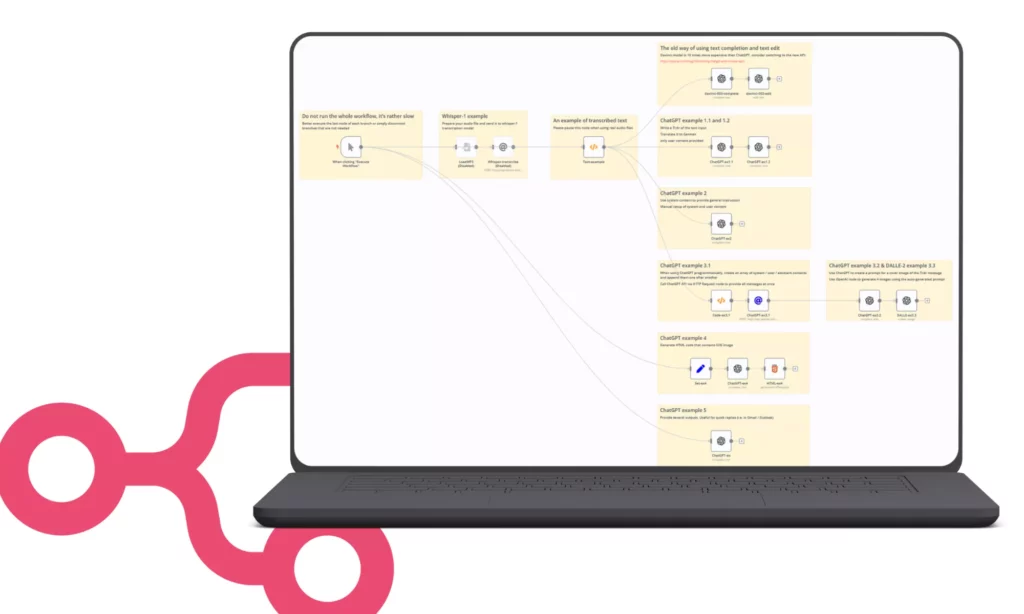
N8n is a visual workflow automation platform that lets you connect apps, APIs, and AI models through a node-based canvas without deep coding. When you add a ChatGPT model into an n8n workflow, it’s like you’re giving the workflow a brain to automate tasks on any data flowing through it.
To set up ChatGPT in your n8n workflow, you need to authorize n8n to communicate with OpenAI by:
- Going to n8n
- Clicking the “Credentials” tab
- Clicking “New credential”
- Choosing “OpenAI API”
- Pasting your OpenAI API key into the required field.
Once that credential is saved, every OpenAI node in your canvas can use it automatically. From there, you add a chat model by clicking the “+” button underneath the Chat Model connection on the AI Agent node. Then, the search dialog will appear, filtered on “Language Models.” When you add the OpenAI Chat Model to your AI Agent in n8n, a settings panel appears and allows you to choose exactly which ChatGPT model powers that node.
But before this setup, you may want to know how to choose the right model for n8n.
How To Choose The Right Model For N8N
Choosing the right ChatGPT model for n8n is important because this decides whether your workflows can run automatically and at scale. Below are several key steps to pick the most suitable one:
Before selecting a model, ask: What is this workflow actually doing?
For simple automation tasks like summarizing content or sending emails, lightweight models (e.g., GPT-5.4-Mini and GPT-5.4-Nano) are the right call. Meanwhile, chatbots and customer support workflows may require conversational, fast models like GPT-5.3 Instant.
- Choose between speed, cost, and intelligence
Considering which factor matters most to your main tasks helps you narrow down the choice. For example, if your workflow prioritizes speed (e.g., real-time chat triggers), GPT-5.3 Instant or GPT-5.4-Mini is the best choice. But for accuracy-critical tasks (e.g., financial modeling), pick reasoning models (e.g., O-Series or GPT-5.4 Thinking).
- Consider API capabilities
Not all models behave the same way inside n8n’s OpenAI node, and this catches many builders off guard. The OpenAI node in n8n connects through one of two APIs: the Chat Completions API (the standard endpoint) or the Responses API (the newer recommended interface for agent-based workflows).
Some of the more advanced capabilities (particularly those used by reasoning models and deep research modes) only work through the Responses API. For a simple linear workflow where one node passes text to ChatGPT and gets a response back, the Chat Completions API is sufficient. So, matching the right API capabilities to your workflow truly matters.
N8n supports a range of built-in tools that AI Agent nodes can call during a workflow (e.g., web search, file search, and code execution). But not all models can use tools effectively. If your n8n workflow requires reliable tool calling to complete its job, consider whether the ChatGPT model supports that well.
When To Use Faster Models In N8N Workflows
Faster models, such as GPT-5.3 Instant, GPT-5.4-Mini, and GPT-5.4-Nano, are the frequent choice if your n8n workflow prioritizes speed, cost efficiency, and high-volume workloads. More particularly, below are several main cases when you should adopt fast models in n8n workflows:
- Your workflow runs frequently
If your workflow triggers every few minutes (e.g., handling large batches of data on a schedule), it’s better to choose faster models. Otherwise, latency and cost can multiply at scale if you adopt reasoning models instead.
- Tasks are simple or repetitive
Common automation tasks, like tagging incoming emails by topic or urgency, require no deep reasoning, but just pattern recognition. Deploying a reasoning model for these tasks is like using a supercomputer to sort a spreadsheet. That’s why just fast models are enough to handle repetitive and simple tasks.
- Real-time response matters
Fast models work well when your workflow prioritizes real-time responses (say, for chatbots, customer support automations, or live notifications), which significantly impact user experience. Unlike reasoning models (like o3) that can take 20-60 seconds to “think” through a complex problem, fast models provide near-instant responses. This keeps interactions natural and fluid.
- You’re optimizing for cost
In production workflows, SaaS automations, and high-scale integrations, cost is a real operational concern. Fast models are much cheaper per API call than their reasoning counterparts, and that gap compounds dramatically as volume grows.
- You don’t need perfect outputs
Most automation tasks don’t require a flawless answer. Instead, they require a good-enough answer delivered reliably and quickly. Therefore, if your workflow can tolerate minor inaccuracies, less detailed responses, or outputs that a human will review before acting on anyway, a fast model is sufficient.
When To Use Reasoning Models In N8N Workflows
N8n workflows still require reasoning models (e.g., o3, o3-pro, and GPT-5.4 Thinking) to handle tasks that cannot be solved by pattern-matching alone or require high accuracy. Despite being slow and more expensive, they’re the best choice in the following use cases:
- Tasks require multi-step problem-solving
If your n8n workflow requires a sequence of actions to handle a complex problem, using reasoning models is better than fast options. Accordingly, those reasoning models excel at reasoning step-by-step to complete tasks and significantly reduce errors.
- Tasks require high accuracy
In some n8n workflows (e.g., handling financial data or flagging compliance issues), the outputs need to be precise to trigger business-critical actions, and any mistakes can bring serious consequences. At that time, reasoning models are more suitable. Despite taking more time to respond precisely, these models can reason carefully and check their own logic before delivering an answer.
- Your workflow runs on complex or multi-source data
Does your workflow process large documents with nuanced information, combine inputs from multiple sources (such as API data alongside user submissions), or work with dense technical content? For those complex tasks, a reasoning model produces better outputs.
- You want to build agentic workflows
Agent-style n8n workflows often use tools (like web search, file search, or external APIs) and plan a sequence of actions. Therefore, they require a reasoning model that can reliably decide which tool to use, when to use it, and how to interpret what comes back.
Common N8N Use Cases For ChatGPT Models
ChatGPT models are often used as part of automated n8n workflows to handle repetitive tasks. Below are some common use cases:
- Email processing and auto-response
ChatGPT models often help with automated email workflows. For tagging and simple summarization, these n8n workflows often involve fast models to handle those tasks cheaply and at volume. Meanwhile, more advanced models prove helpful if the email requires nuanced understanding or actual replies require nuanced judgment (e.g., handling objections, matching tone, or applying policy).
ChatGPT models are often used in the n8n platform to build AI-powered support agents that connect to chat platforms, CRMs, or help desks. These customer support agents can answer FAQs, route tickets to the right team, or score leads when new contacts enter.
Many teams also set up ChatGPT models in n8n to automatically generate content. Some common examples include creating email responses from support tickets, generating blog drafts from outlines, writing social media copy from blog posts, etc. A content pipeline in n8n often chains several nodes to implement a sequence of actions.
- Data extraction and structuring
Rather than manually parsing through raw documents or unstructured API responses, you can feed that data directly into an OpenAI node. Then, your AI agent powered by ChatGPT models can extract exactly what you need in a clean, usable format. Because n8n handles the data routing between nodes, you can chain extraction directly into possibly next actions, like updating a record or sending a notification.
- Multi-agent orchestration
Many teams also build n8n workflows where many AI Agent nodes collaborate. Accordingly, the superior tool-calling and reasoning capabilities of models like GPT-5 make multi-agent systems more viable. They help orchestrate teams of specialized agents instead of building a single, versatile AI system.
Which ChatGPT Model Should You Use?
There’s no “best” or “worst” ChatGPT model. The right option is what fits your workflow and delivers real value. Below are the top ChatGPT models that shine for different types of users.
Best Choice For Most Users
Recommended model: GPT-4o (for most use cases) / GPT-5x (for high availability)
For most people, GPT-4o is the best overall choice because it’s designed as a general-purpose, multimodal model that can balance speed, capability, and cost effectively. It assists with everyday tasks, from writing and summarizing to brainstorming ideas, coding, and even working with images. If you’re unsure which model to use, GPT-4o is usually the safest and most efficient option.
However, if you evaluate the best ChatGPT model based on its availability, GPT-5x (typically GPT-5.3 Instant and GPT-5 Thinking Mini) is accessible for all people (both free and paid tiers). Accordingly, GPT-5.3 Instant is fast enough for casual chat, smart enough for how-to guides, translation, and info-seeking questions, and warm enough to feel conversational. Besides, when tasks become more complex and require deeper reasoning, the chatbot routes Instant queries to Thinking to reason through the problems.
Best Choice For Developers
Recommended model: GPT-5x
Developers have different coding needs, which require different ChatGPT models to handle. GPT-5x models are designed for comprehensive software engineering, especially for broad reasoning and back-end logic. For example, lighter versions (e.g., Instant or Mini) support low-latency and repetitive coding tasks. Meanwhile, GPT-5.4 and GPT-5.3 Codex excel at agentic tasks where the AI can work autonomously to detect issues, write patches, and run tests.
Best Choice For Creators And Visual Work
Recommended model: GPT-5x / GPT-4o (for writing + visuals)
For creators or any users working with multimedia, both GPT-4o and GPT-5x are the best options to generate both text content and visual outputs.
Of which, GPT-4o is designed for fast, interactive workflows, making it ideal and sufficient for creative content like brainstorming ideas or generating social media copy. GPT-5.3 Instant also supports that with its anti-cringe tuning and warmer conversational tone. Besides, the model follows stylistic instructions reliably enough for brand-specific content work.
Both models integrate with GPT Image 1.5 to create and refine high-quality images.
Best Choice Based On Budget And Workflow
Choosing the right ChatGPT model based on cost is not about picking the cheapest option. Instead, you need to match the model’s capability level to specific tasks to get the best ROI. Below are some of the best ChatGPT models based on your budget and workflow:
- Lightweight models (like GPT-5.4-Mini and GPT-5.4-Nano)
These are the right options for high-volume automation, simple repetitive tasks (e.g., tagging or data extraction), and cost-sensitive workflows. Those light variants handle tasks with low latency, making them a strong fit if you need to complete well-defined and repetitive tasks fast but at lower costs.
- Mid-tier models (typically GPT-5.3 Instant)
These models offer the best balance for most real-world use cases. They offer solid performance across writing, summarization, classification, and general Q&A without the cost overhead of a full reasoning model. For the majority of professional workflows that don’t involve deeply complex logic or high-stakes decisions, GPT-5.3 Instant delivers more than enough capability at a reasonable cost.
- Advanced models (GPT-5.4 Thinking, GPT-5.4 Pro, and the O-series)
These models work best for complex, multi-step workflows and high-stakes tasks where accuracy matters. Some common tasks include legal analysis, financial modeling, scientific reasoning, and agentic workflows. But in turn, those models cost you more than the above options. You can access advanced GPT-5x by subscribing Plus and higher plans or via the OpenAI API, while the O-series models are only accessed through APIs.
FAQs About The Best ChatGPT Models
Is ChatGPT 5 The Best Model?
The answer depends on what you need it for. OpenAI positions GPT-5 as the most capable model family it has released. But according to user experience, GPT-5’s initial release was worse than GPT-4o. That’s why OpenAI has continued releasing variants (GPT-5.1, 5.2, 5.3, 5.4) with Instant, Thinking, and Mini versions tuned for different needs and budgets.
GPT-5 is capable across a wide range of tasks, but its architecture is optimized for agentic, multi-step work. So, if your use case is primarily casual conversation or simple everyday tasks, a lighter model like GPT-5.3 Instant will serve you at a lower cost.
Is GPT-4.5 Better Than 4o?
It depends on which aspects you care about. GPT-4.5 is considered better than GPT-4o in depth and reasoning quality. It accordingly performs more consistently in long, structured outputs, handles complex prompts better, and improves accuracy in nuanced tasks.
But when it comes to speed, conversational tone, and multimodal use, GPT-4o still wins. The model accordingly offers much faster responses, supports multimodal inputs, and works better in real-time interactions.
In short, GPT-4.5 shines in detailed analysis and research, while GPT-4o works better for everyday use cases. That’s why people prefer GPT-4o.
What Model Does ChatGPT Use?
As of April 2026, GPT-5.3 Instant is now the default for all logged-in ChatGPT users. It’s a fast and powerful model for everyday work and learning, with clear improvements in info-seeking questions, how-tos, technical writing, and translation, while retaining a warmer, more conversational tone.
On paid tiers, users can manually switch to GPT-5.4 Thinking for deeper reasoning tasks, or GPT-5.4 Pro for maximum performance. Older models, including GPT-4o, GPT-4.1, o4-mini, and the original GPT-5 Instant and Thinking, were retired from ChatGPT on February 13, 2026. However, API access to these models remains unchanged for developers with existing integrations.
Conclusion
Choosing the best ChatGPT model really depends on your specific needs. But if you’re just getting started or using the free tier, you should stick with the latest model from OpenAI (GPT-5). So you don’t have to overthink your choice too early.
If you need expert help to build an AI agent based on ChatGPT models, Designveloper is willing to help. Over 13 years of operations, Designveloper positions itself as an AI-first software and automation partner. Our work spans production-ready AI systems, intelligent workflows, and web, mobile, and even voice-enabled products.
We help software and operational teams turn AI potential into something they can actually use day to day. With that commitment, our AI solutions help companies reduce manual work, improve efficiency, and scale faster. For example, Designveloper has built an internal AI assistant for HR management using Mattermost. The tool automates booking, leave requests, approvals, and policy lookups to turn repetitive internal processes into smooth, self-service workflows.
Are you thinking about building something more tailored? Talk to our team to see how Designveloper can help turn your ideas into practical, scalable solutions!