


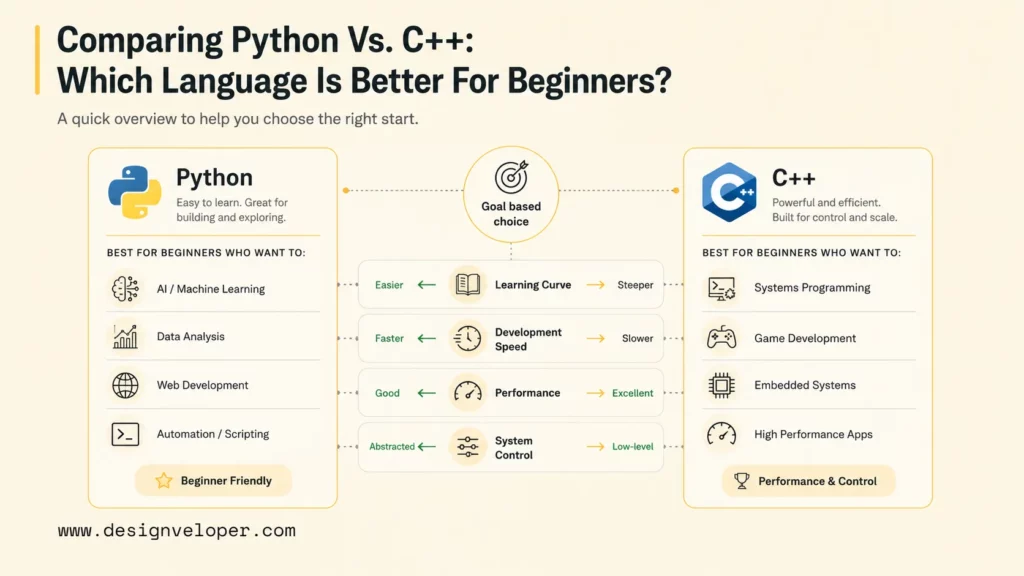
Python vs C++ is a beginner decision between faster learning and deeper computer control. Python is usually better for beginners who want readable syntax, fast progress, automation, data work, AI, web development, or general programming confidence. C++ is better for beginners who specifically want systems programming, game engines, embedded software, graphics, performance engineering, or a deeper understanding of memory and hardware.
The best first language depends on the learner’s goal. A student who wants to build useful projects quickly will usually feel more productive with Python. A student who wants to understand low-level performance, memory ownership, compilation, and resource control may benefit from learning C++ earlier.
This guide compares Python and C++ by learning curve, syntax, development speed, execution speed, memory management, typing, ecosystem, use cases, future relevance, and real project fit.
Overview Of Python And C++
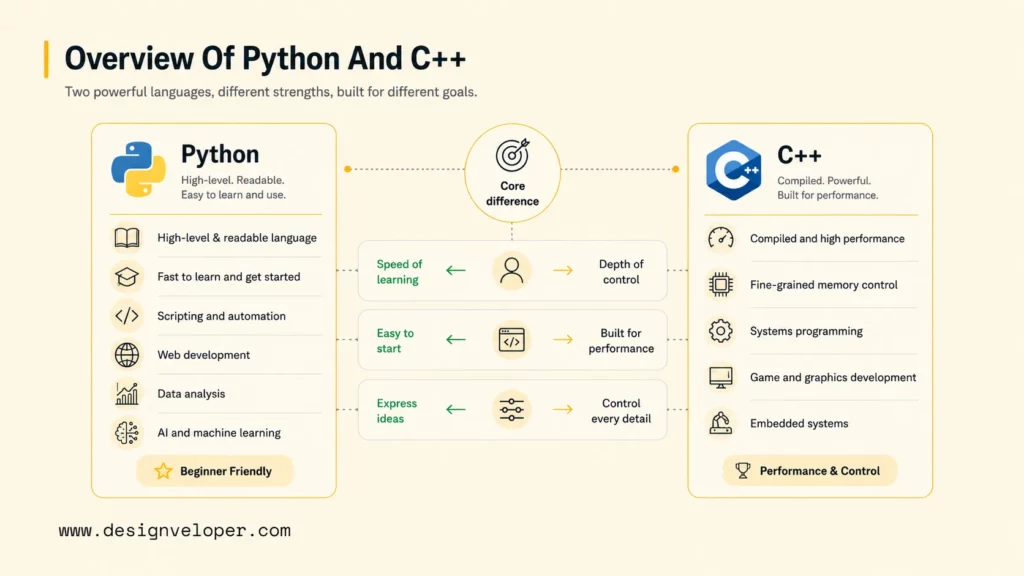
Python is a high-level, interpreted programming language known for readability and broad use across automation, data science, AI, backend development, scripting, education, and internal tooling. The official Python tutorial describes Python as easy to learn, powerful, and supported by high-level data structures and a simple approach to object-oriented programming.
C++ is a compiled, general-purpose programming language used for systems software, game engines, embedded systems, graphics, high-performance services, finance infrastructure, and resource-critical applications. The ISO C++ language standard specifies the requirements for C++ implementations, and the language remains central where performance and control matter.
The two languages differ in philosophy. Python hides many low-level details so developers can express ideas quickly. C++ exposes more control over types, memory, object lifetime, compilation, and performance. That control can produce extremely efficient software, but it also asks more from the beginner.
For beginners, the question is not which language is more “serious.†Both languages are serious. The real question is which language gives the learner the right feedback loop for the projects they want to build.
Comparing Python And C++ Based On Key Criteria
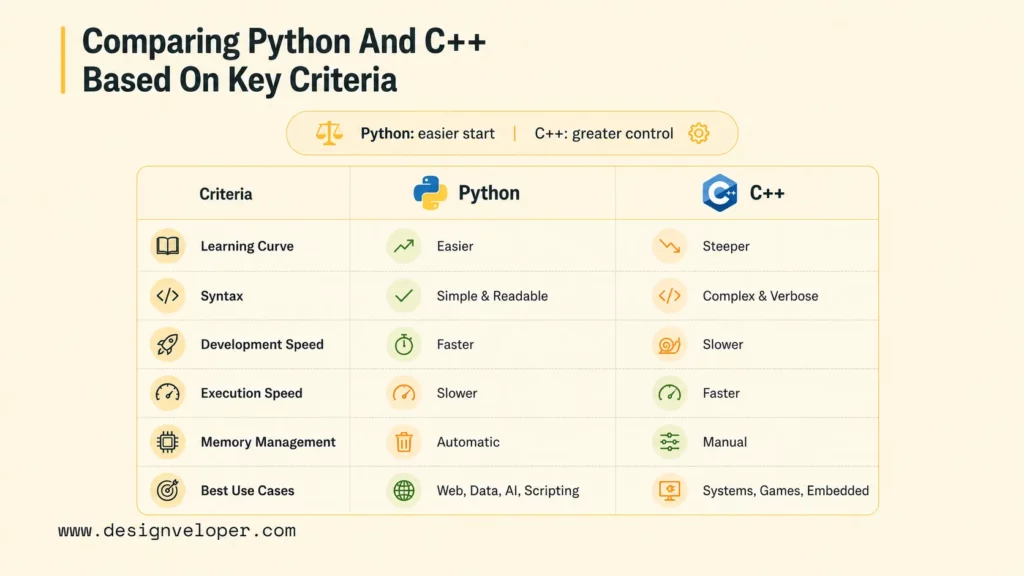
Python and C++ are easier to compare when the decision is broken into practical criteria. A beginner should look at how fast the language can be learned, how readable the syntax is, how quickly projects can be built, how fast the code runs, and how much responsibility the programmer has for memory and system behavior.
| Criterion | Python | C++ |
|---|---|---|
| Learning Curve | Gentler for most beginners because syntax is close to plain English and setup can be simple. | Steeper because learners face compilation, headers, types, memory, references, templates, and build tools. |
| Syntax | Concise and readable, with indentation as part of structure. | More verbose and symbol-heavy, with explicit declarations and braces. |
| Development Speed | Fast for scripts, prototypes, web APIs, data tasks, and automation. | Slower at first because compile steps and stricter decisions happen earlier. |
| Execution Speed | Usually slower for CPU-bound code, though optimized libraries can be very fast. | Usually much faster for CPU-bound and resource-critical workloads. |
| Memory Management | Automatic memory management reduces beginner overhead. | More direct control over allocation, object lifetime, ownership, and resource handling. |
| Typing | Dynamically typed by default, with optional type hints for larger projects. | Statically typed, with many type errors caught at compile time. |
| Best Use Cases | AI, data science, automation, scripting, web apps, internal tools, education, rapid product development. | Game engines, systems programming, embedded software, graphics, high-performance services, real-time applications. |
The short version is direct: Python is easier to start, while C++ teaches more about how computers run software. Python helps beginners build confidence quickly. C++ helps beginners build a deeper mental model of performance and resource control.
Python Vs. C++ For Developer Experience
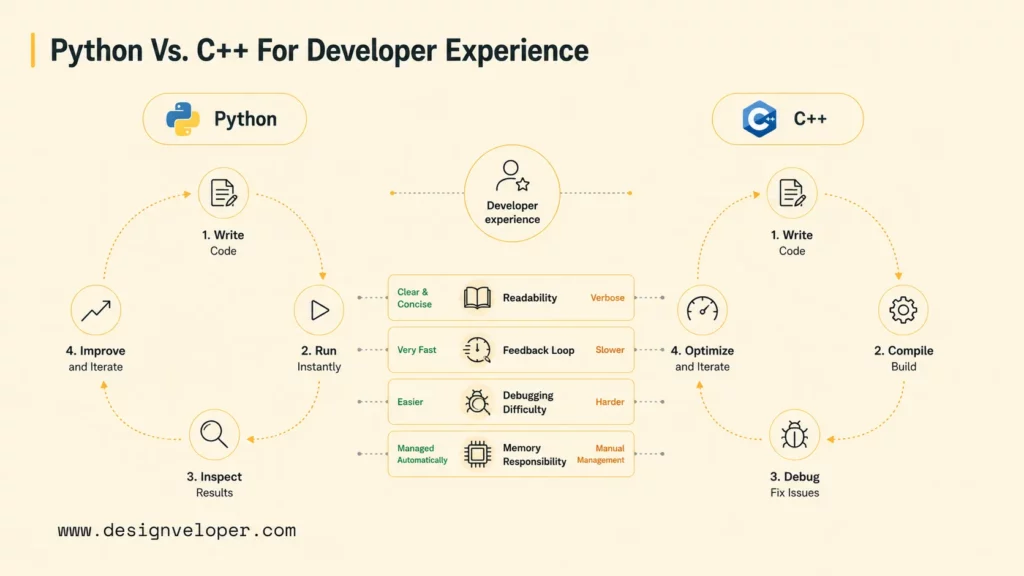
Developer experience is where beginners feel the biggest difference. Python usually gives faster early wins. C++ usually gives stronger control but more friction before the first useful result.
Readability And Speed Of Development
Python is easier to read for many beginners because the language uses fewer symbols and less ceremony. A Python function can look close to pseudocode, which lets learners focus on variables, loops, functions, data structures, and problem solving before learning complex build systems.
Python also has a fast feedback loop. A beginner can write a few lines, run the file, inspect the result, and adjust the code. That loop is useful for learning because mistakes become visible quickly and do not always require understanding a compiler message first.
C++ development can feel slower at the beginning because code must compile, types must match, headers and source files may need coordination, and error messages can be dense. The slower feedback loop is not a weakness in professional C++ development; it is part of how C++ catches many problems before runtime. For a beginner, though, the extra concepts can delay the first useful project.
Complexity, Debugging, And Memory Responsibility
C++ gives developers more responsibility for memory, object lifetimes, references, pointers, copy behavior, and resource management. Modern C++ offers safer tools such as smart pointers, containers, RAII patterns, and standard library abstractions, but beginners still need to learn why memory mistakes happen and how to avoid them.
Python manages memory automatically, so beginners rarely need to think about allocation and deallocation directly. That lets beginners focus on logic and data flow. The tradeoff is that Python hides details that matter for high-performance systems, embedded devices, and memory-sensitive software.
Debugging also feels different. Python errors often happen at runtime and can be read from a traceback. C++ errors may happen at compile time, link time, or runtime. C++ runtime bugs can include undefined behavior, memory corruption, dangling references, or data races, which are harder for beginners to diagnose.
The beginner takeaway is practical. Learn Python first if the goal is to build confidence and complete projects. Learn C++ early if the goal is to understand memory, compilation, and performance deeply.
Tooling, Libraries, And Ecosystem Support
Python has a large ecosystem for web development, AI, data science, automation, testing, DevOps, finance, education, and scientific computing. The Stack Overflow 2025 Developer Survey overview reports that Python adoption grew by 7 percentage points from 2024 to 2025, connecting that growth to AI, data science, and backend development.
C++ has a strong ecosystem in areas where performance and platform control matter. C++ is also deeply embedded in game engines, native desktop applications, operating systems, compilers, robotics, financial systems, graphics, simulation, and hardware-adjacent engineering. Furthermore, C++ tooling often includes compilers, linkers, build systems, package managers, sanitizers, profilers, debuggers, and static analysis tools.
For beginners, Python tooling usually feels more approachable. A beginner can install Python, write a script, use pip, and run tests with fewer moving parts. C++ tooling is powerful, but the combination of compiler, linker, build configuration, include paths, libraries, and platform differences can feel intimidating.
When Python Makes More Sense
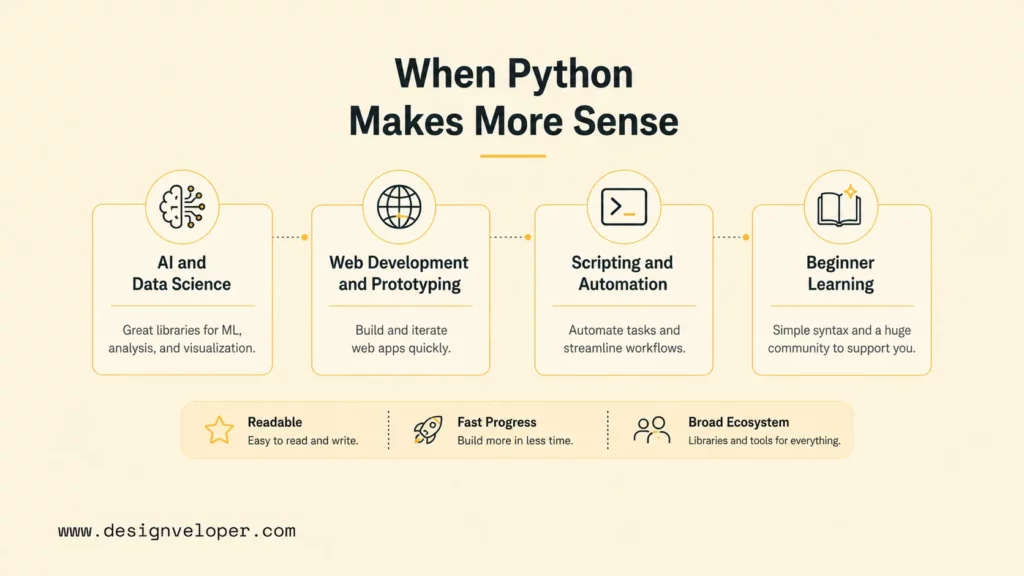
Python makes more sense when the beginner wants faster progress, readable code, broad accessibility, and many project paths. Python is especially practical when the first goal is to build something useful rather than master low-level computer architecture.
AI, Data Science, And Automation
Python is the default beginner-friendly language for AI, data science, analytics, notebooks, and automation. Libraries such as NumPy, pandas, scikit-learn, PyTorch, TensorFlow, Jupyter, FastAPI, and LangChain make Python useful across experimentation and production workflows.
Python works well in AI because many complex operations are handled by optimized libraries written in C, C++, CUDA, Rust, or other lower-level languages. The beginner writes Python code, but the heavy numerical work often runs inside optimized native implementations.
Automation is another strong Python fit. A beginner can automate file renaming, spreadsheet cleanup, API calls, report generation, email workflows, data extraction, or repetitive operations with relatively little code. Those early wins help learners see programming as a practical skill.
Web Development And Rapid Prototyping
Python makes sense for web development and rapid prototyping when a team wants to validate product behavior quickly. Frameworks such as Django, Flask, and FastAPI help developers build admin portals, APIs, dashboards, and backend services without writing every component from scratch.
Python is especially useful when the product requirements are still changing. A team can adjust data models, API routes, background jobs, and business rules quickly. That flexibility is valuable in startups, internal tools, proof-of-concept builds, and AI product experiments.
C++ can build networked applications, but it is rarely the fastest path for typical web products. The extra control that C++ provides is usually unnecessary for CRUD applications, dashboards, content systems, or internal tools.
General-Purpose Scripting And Internal Tools
Python is strong for general-purpose scripting because it is readable, cross-platform, and supported by a large standard library. Beginners can use Python to glue together files, APIs, databases, command-line tools, and cloud services.
Internal tools are often more valuable when they are built quickly and maintained easily. A finance team may need a report generator. A QA team may need a test-data script. An operations team may need a small dashboard. Python is usually a better fit than C++ for those tasks because development speed and readability matter more than raw execution speed.
Python also helps beginners practice core programming concepts in real contexts: conditionals, loops, functions, dictionaries, files, HTTP requests, JSON, databases, and tests. Those concepts transfer to other languages later.
When C++ Makes More Sense
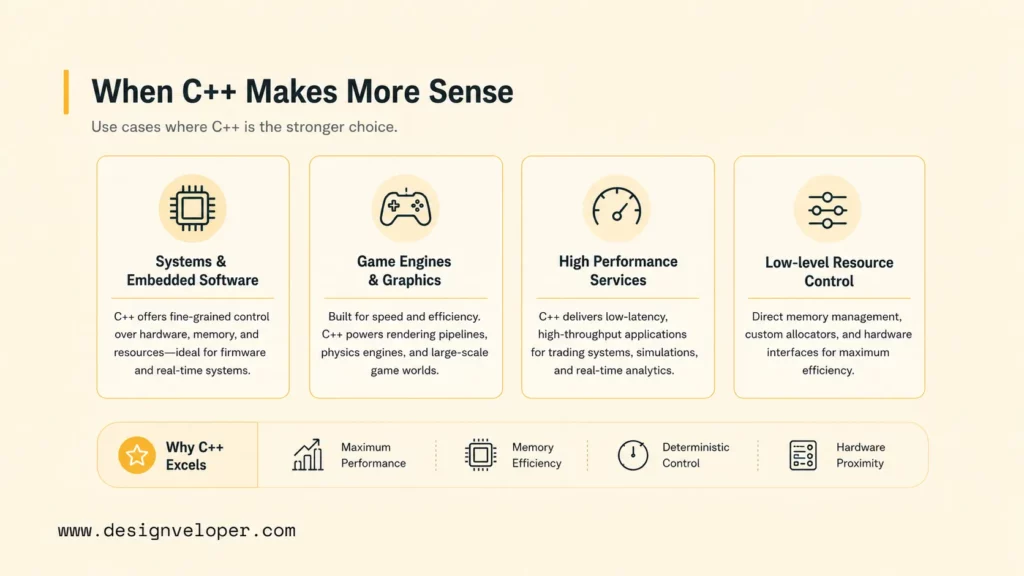
C++ makes more sense when the beginner’s target field requires performance, resource control, hardware awareness, or real-time behavior. C++ is harder to start, but it gives learners access to domains where Python is not enough by itself.
Systems Programming And Embedded Software
C++ is a strong choice for systems programming and embedded software because developers can control memory layout, object lifetime, compilation targets, and resource usage. Operating-system components, device software, robotics, firmware-adjacent applications, and hardware interfaces often need that level of control.
Embedded systems may run with limited memory, limited CPU, strict power budgets, and direct hardware interaction. Python can be useful for testing, tooling, and automation around embedded development, but C++ is often closer to the final runtime when constraints are tight.
Beginners who want to work in robotics, electronics, automotive systems, industrial devices, or operating systems should consider learning C++ after or alongside core programming basics.
Game Engines, Graphics, And Real-Time Applications
C++ is central to many game engines, graphics engines, and real-time applications because those systems need predictable performance and direct control over resources. Frame rates, latency, memory allocation, rendering pipelines, physics, and asset streaming can all be performance-sensitive.
Python still appears in game and graphics workflows, often as a scripting, tooling, pipeline, or automation language. Artists and technical directors may use Python to automate asset processing or control tools. However, the performance-critical engine layer is often C++.
A beginner interested in game development can start with Python for programming fundamentals or simple games, then move to C++ when engine programming, real-time performance, or Unreal Engine development becomes the goal.
High-Performance Services And Resource-Critical Software
C++ makes sense for high-performance services when latency, throughput, memory use, or infrastructure cost is a core product requirement. Finance systems, search engines, databases, video processing, telecommunications, simulation, and trading infrastructure often use C++ because small performance differences matter at scale.
Python can still coordinate those systems. A team might use Python for orchestration, testing, monitoring, scripts, data analysis, or API layers while C++ handles the performance-critical core. That division is common because it combines Python’s speed of development with C++ performance.
The decision should be based on measurement. A service does not need C++ just because performance is mentioned. A team should profile the workload, identify bottlenecks, and decide whether the complexity of C++ is justified.
Can Python And C++ Work Well Together?
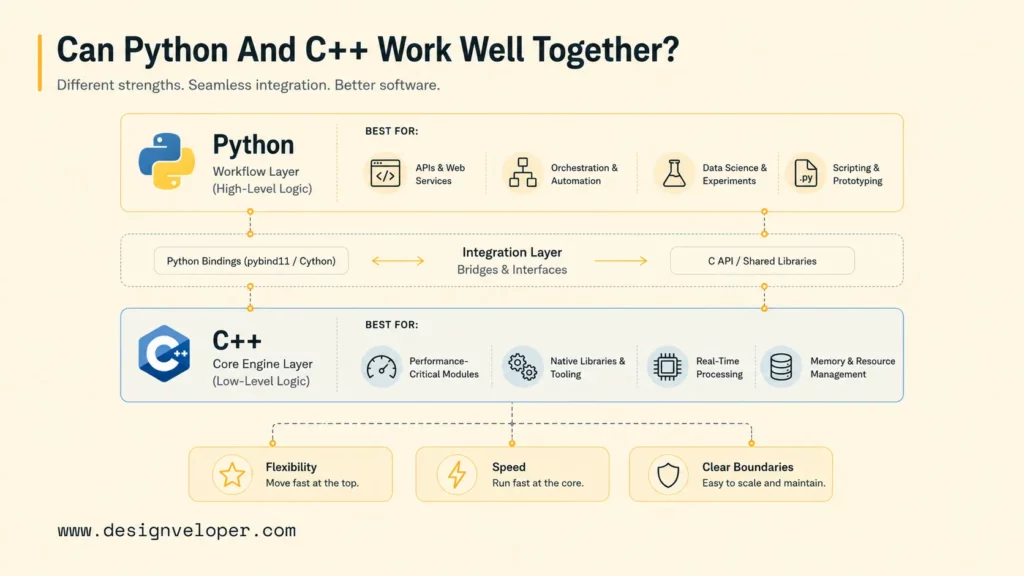
Python and C++ can work very well together when a project needs both flexibility and speed. Python can provide the scripting, orchestration, data workflow, or user-facing layer, while C++ provides performance-critical components that need lower-level control.
The Python/C API reference manual documents the API used by C and C++ programmers who want to write extension modules or embed Python. The Python extending and embedding guide explains the general approach for extending the Python interpreter with C or C++ and embedding Python inside larger applications.
Common integration patterns include:
- Python calling C++ extensions: Python code calls a compiled module for performance-heavy work such as image processing, simulation, parsing, or numerical computation.
- C++ embedding Python: A C++ application embeds Python so users can script behavior, configure workflows, or extend the product.
- Separate services: Python and C++ run as separate services connected by HTTP, gRPC, message queues, or shared data storage.
- Hybrid AI systems: Python handles model orchestration while C++ powers optimized inference, vector search, hardware integration, or real-time processing.
The best integration boundary is small and stable. If a C++ module exposes a clear function with simple inputs and outputs, Python can call it safely. If the boundary mixes business logic, memory ownership, exceptions, and unclear data formats, the hybrid system becomes difficult to debug.
When Should You Choose Python And When Should You Choose C++?
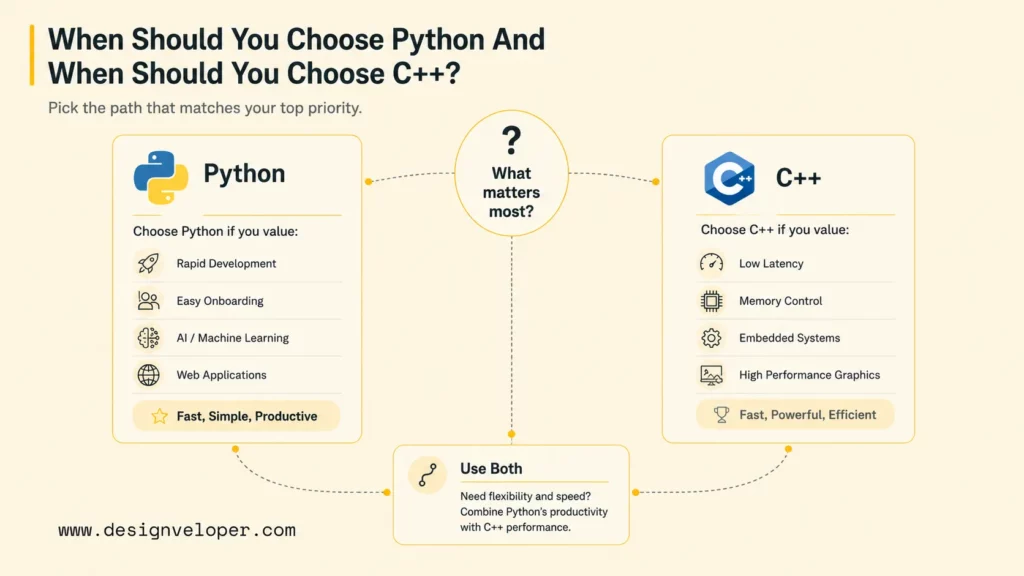
Choose Python when development speed, readability, accessibility, and ecosystem breadth matter most. Choose C++ when performance, control, efficiency, and platform-level behavior matter most. Combine both when the product has one layer that changes often and another layer that must run fast.
Choose Python For Faster Development And Broader Accessibility
Choose Python when the team needs to ship quickly, teach beginners, automate work, analyze data, build AI features, create APIs, or prototype product ideas. Python is usually the safer beginner choice when the learner does not yet know which field they want to enter.
Python is also the better default for cross-functional teams. Product managers, analysts, QA engineers, data scientists, and backend developers can often read Python more easily than C++. That readability helps collaboration on internal tools and AI workflows.
Python is not always slow in practice. Many Python applications spend most of their time waiting on databases, networks, APIs, files, or optimized libraries. If Python is fast enough for the user experience and easier to maintain, Python may be the better engineering choice.
Choose C++ For Performance, Control, And Efficiency
Choose C++ when the software must control memory, manage resources carefully, run close to hardware, meet strict latency targets, or operate under tight CPU and memory limits. C++ is also the better choice when the target ecosystem expects C++, such as many game engines, embedded systems, and native performance libraries.
C++ gives teams tools for predictable performance, but the language also requires stronger engineering discipline. Code reviews, tests, sanitizers, static analysis, profilers, and build-system knowledge matter more because small mistakes can create serious runtime problems.
C++ is not the best beginner default for every learner, but it is an excellent language for beginners who want to understand how software interacts with machines at a lower level.
Combine Both When Your Project Needs Flexibility And Speed
Combine Python and C++ when one language alone would force a bad tradeoff. A machine learning product may use Python for notebooks, feature pipelines, APIs, and experiments while C++ handles a latency-sensitive inference runtime. A desktop engineering tool may use C++ for the core engine and Python for scripting.
A good hybrid plan starts with profiling and clear ownership. The team should identify which part truly needs C++ and keep the interface narrow. Python should own flexible workflow logic. C++ should own stable performance-critical logic.
For beginners, learning Python first and C++ later is a common path. Python builds confidence and project momentum. C++ then deepens understanding of memory, performance, compilation, and systems design.
The Future Of Python And C++
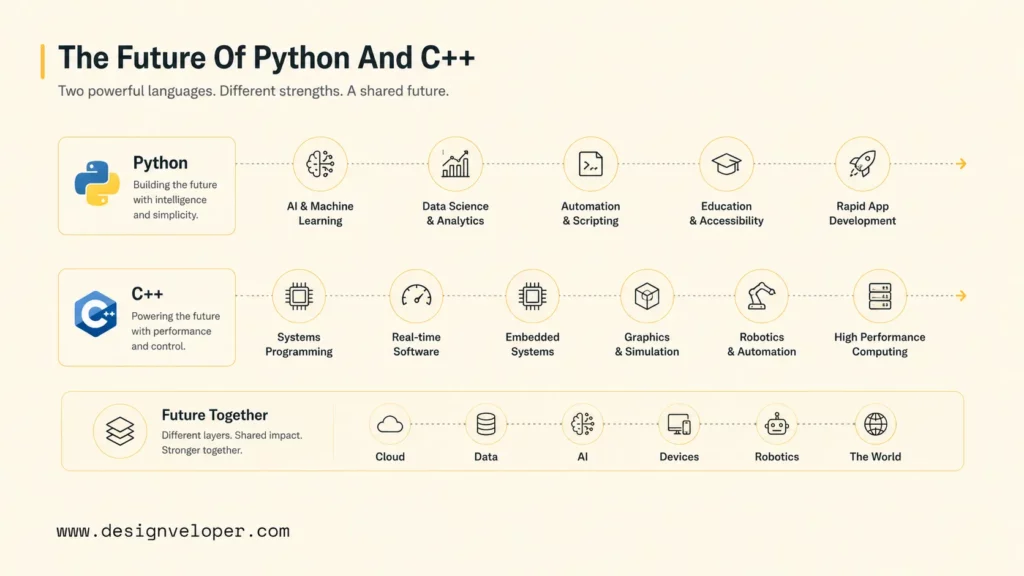
Python is likely to remain strong in AI, data, automation, education, scripting, backend services, and rapid application development. Its ecosystem keeps expanding because the language is approachable and widely used by software engineers, analysts, researchers, educators, and product teams.
C++ will remain critical in systems programming, games, real-time applications, embedded software, high-performance computing, graphics, robotics, and performance-heavy engineering. C++ continues to evolve through ISO standardization, compiler improvements, tooling, and modern language practices.
The future is not one language replacing the other. For many teams, the future is a layered stack. Python handles high-level application logic and experimentation. C++ handles native performance, hardware-adjacent code, and resource-critical components. The combination lets teams move quickly while keeping performance options open.
Beginners should take the same lesson. Python and C++ are not enemies. Python can be the first language that teaches problem solving. C++ can be the second language that teaches performance and systems thinking. The order should match the learner’s goals.
Choosing The Right Language For Real Projects
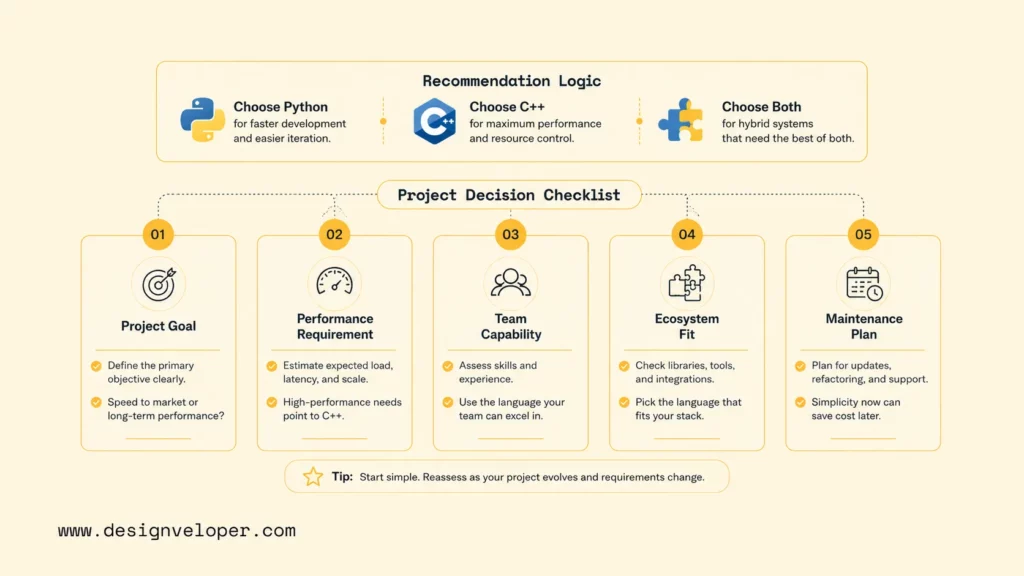
The better language for a real project depends on product goals, team strengths, performance requirements, and long-term maintenance. Popularity and benchmark results are useful signals, but they do not replace the actual project constraints.
Use this decision checklist before choosing:
- Project goal: Is the goal learning, automation, AI, web development, game programming, embedded software, or high-performance engineering?
- Performance requirement: Does the user experience require native speed, predictable latency, or low memory usage?
- Team capability: Can the team review, debug, test, deploy, and maintain the chosen language confidently?
- Ecosystem fit: Does the project depend on Python AI/data libraries, C++ game engines, embedded SDKs, or native libraries?
- Maintenance plan: Will future developers understand the code, build process, dependency model, and testing strategy?
At Designveloper, we treat language choice as an engineering and product decision. We help teams choose stacks based on workflow, architecture, integration needs, release risk, testing, monitoring, and post-launch support. Our web application development services and AI development services often involve choosing the right level of abstraction for the product rather than chasing a single language label.
Choose Python when the project needs speed of delivery and broad accessibility. Choose C++ when the project needs performance and control. And choose both when the product needs a flexible workflow layer and a performance-critical engine underneath.
FAQs About Python Vs. C++
Is C++ Faster Than Python?
C++ is usually faster than Python for CPU-bound workloads because C++ is compiled to native code and gives developers more control over memory and performance. Python can still be fast enough for many applications, especially when it uses optimized native libraries or spends most time waiting on I/O.
Is Python Easier To Learn Than C++?
Python is usually easier to learn than C++ because Python syntax is shorter, setup is simpler, and beginners do not need to manage memory directly. C++ is harder at first because learners must understand compilation, types, headers, memory, references, and object lifetime.
Should I Learn Python Or C++ First?
Most beginners should learn Python first if they want a gentle start, fast projects, automation, AI, data science, web development, or general programming confidence. Beginners should learn C++ first when their main goal is game engines, embedded systems, systems programming, robotics, or performance-critical software.
Is Python Better For AI Than C++?
Python is usually better for AI application development because the AI and data science ecosystem is broad, beginner-friendly, and heavily documented. C++ is still important for optimized inference, real-time systems, hardware integration, and performance-critical AI components.
Can Python And C++ Be Used In The Same Project?
Python and C++ can be used in the same project. Python can handle orchestration, scripts, APIs, data workflows, and experimentation, while C++ handles performance-critical modules, native libraries, game engines, embedded code, or real-time processing. The integration should have a clear and tested boundary.