


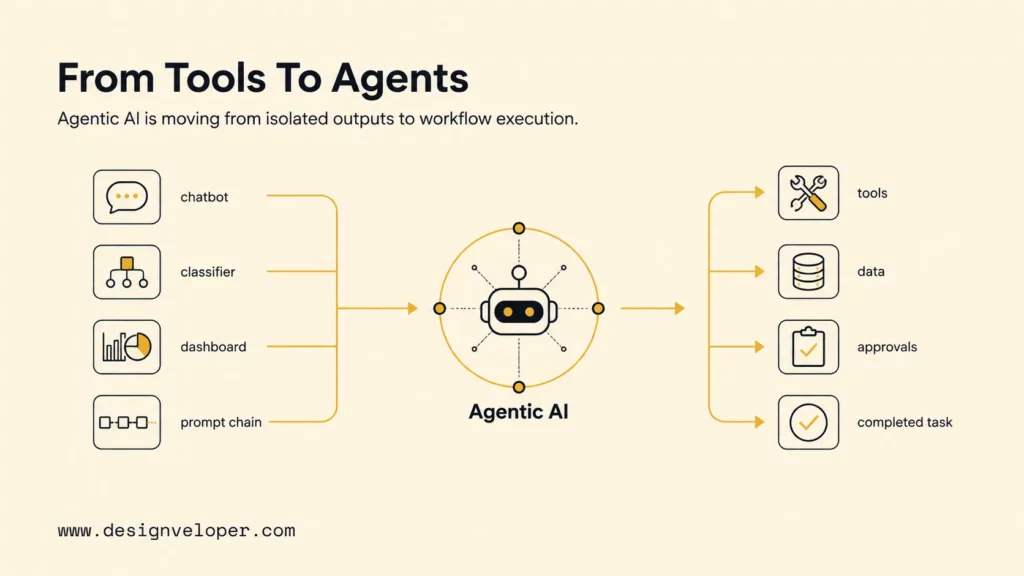
AI replacing AI means older static AI tools are being replaced or absorbed by agentic AI systems that can plan, call tools, use business data, complete multi-step workflows, and learn from feedback. The shift is not only about newer models beating older models. The bigger change is that AI is moving from isolated prediction or content generation into workflow execution, where agents can coordinate tasks that earlier AI tools left for humans.
The phrase ai replacing ai can sound like a prediction about machines replacing machines, but the business reality is more specific. Agentic AI is beginning to replace earlier chatbots, narrow classifiers, single-purpose copilots, brittle robotic process automation, static dashboards, and manual prompt chains when a newer system completes more of the work with better oversight. Gartner predicted that 40 percent of enterprise applications will include task-specific AI agents by the end of 2026, up from less than 5 percent in 2025, according to the Gartner 2025 AI agents forecast.
That momentum does not make replacement automatic. Agentic systems add cost, security risk, evaluation complexity, and governance needs. The best business question is not whether agentic AI is newer. The best question is whether the newer system improves workflow completion, reliability, cost, user experience, and human control compared with the AI layer it would replace.
What AI Replacing AI Means?
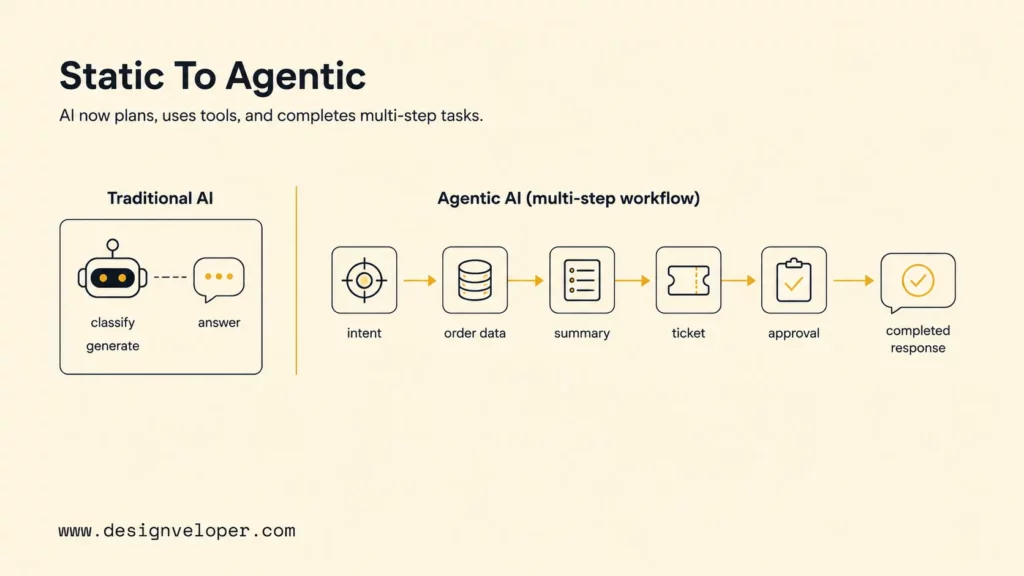
AI replacing AI means the role of artificial intelligence is changing from static assistance to adaptive execution. Earlier AI tools often answered a question, classified an item, generated copy, or predicted a score. Agentic AI systems add planning, tool use, memory, retrieval, orchestration, and feedback loops so the system can move work across steps instead of stopping at one output.
The difference is easiest to see in a support workflow. A traditional AI chatbot may answer a customer question from a knowledge base. An agentic support system can identify intent, check order data, summarize the conversation, update a ticket, recommend a refund path, ask for human approval, and write the final response. The agentic layer may still use older models underneath, but the workflow wrapper replaces the older experience because the new system finishes more of the job.
OpenAI describes agents as systems that can use tools and take actions through the OpenAI Agents guide, while Anthropic documents tool use patterns in the Anthropic tool use documentation. Those product-level shifts matter because they show a move from model-only interfaces to systems that can act inside applications. The replacement target is often not the model itself; the replacement target is the old operating pattern around the model.
A useful definition for business leaders is this: agentic AI replaces earlier AI when the new system can perform the same task with deeper context, more steps, better integration, stronger evaluation, and clearer governance. If the new system only looks smarter in a demo, the older AI layer may still be safer and cheaper to keep.
How Agentic AI Is Replacing Earlier AI Systems
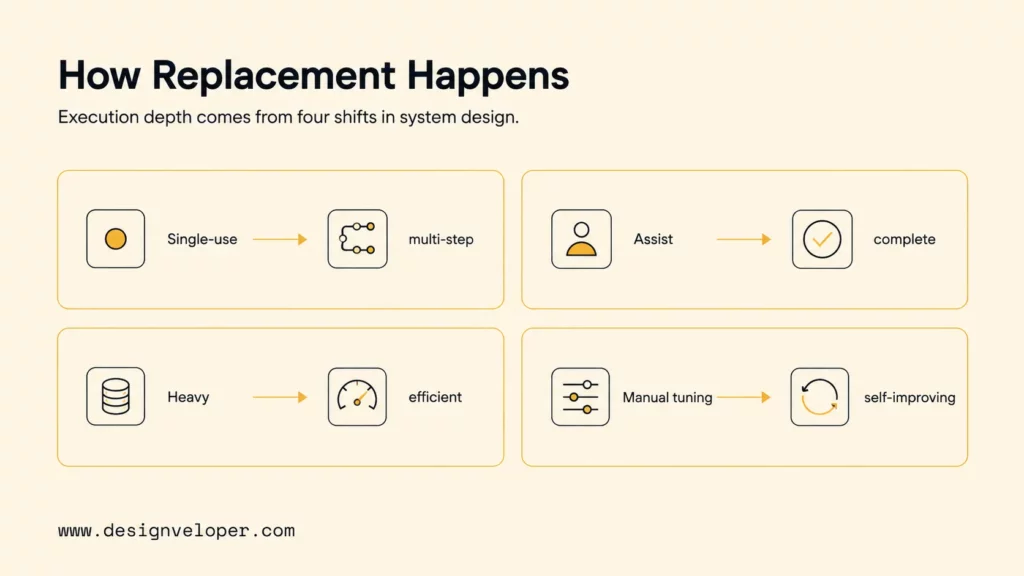
Agentic AI is replacing earlier systems by adding execution depth. Earlier AI usually produced an answer that a person had to interpret and apply. Agentic AI can turn that answer into a workflow step, then use tools, data, checks, and approvals to move toward completion.
McKinsey describes agentic AI as a new operating layer for complex workflows in articles on McKinsey agentic AI at scale guidance and McKinsey agentic AI infrastructure. That framing is useful because the replacement is architectural. Businesses are not only buying a better chatbot; they are rethinking how software, data, permissions, and human review work together.
From Single-Purpose Tools To Multi-Step Execution
Single-purpose AI tools usually perform one bounded task. A model classifies a support ticket. A chatbot answers a question. A recommender suggests a product. A document model extracts fields. Agentic AI connects several of those actions into a sequence that can be monitored and improved.
A multi-step agent might read a complaint, find the customer’s order, compare refund rules, draft a resolution, open a ticket, and ask a manager to approve the refund. The agent has not replaced every system involved. The agent has replaced the old pattern where separate AI outputs were copied between systems by humans.
That shift is why the architecture matters. A workflow agent needs connectors, permissions, state, error handling, audit logs, and rollback paths. Teams should replace single-purpose AI only when the agent can show repeatable success across the whole sequence, not only a good answer at step one.
From Assistance To Autonomous Workflow Completion
Earlier AI assistants helped a person do work faster. Agentic AI aims to complete more of the work under supervision. The distinction is important. Assistance improves productivity for a human operator. Workflow completion changes who or what owns the task until an exception, risk threshold, or approval point appears.
Enterprise vendors are pushing this shift through products such as Microsoft 365 Copilot agents overview, Salesforce Agentforce, and Amazon Bedrock Agents documentation. Those products are different in scope, but the shared pattern is clear: AI agents are being placed closer to CRM, productivity, cloud, and enterprise application workflows.
Businesses should define autonomy levels before replacing an older assistant. A low-risk agent may draft content or summarize notes. A medium-risk agent may update a CRM record after validation. A high-risk agent may affect pricing, refunds, contracts, security settings, or compliance workflows, which means human approval and auditability become mandatory.
From Heavy Legacy Models To Smaller And More Efficient Systems
Agentic AI can also replace earlier AI by changing how intelligence is distributed. A heavy model that tries to answer every question alone may be replaced by a workflow that uses a smaller model, retrieval, rules, tool calls, and validation checks. The result can be cheaper and easier to control when the task is well designed.
McKinsey’s article on McKinsey agentic AI infrastructure points to infrastructure challenges around scale, cost, and reliability for agentic systems. That warning matters because agents can become expensive if every step calls a large model. Efficient agent design often routes simple tasks to deterministic code or smaller models, then reserves stronger models for reasoning-heavy steps.
The practical replacement test is total workflow cost. A newer agent is not better if it uses more compute, creates more latency, and still needs the same manual review. A newer agent is better when it completes more work per dollar while improving or preserving quality.
From Manual Optimization To Self-Improving AI Layers
Earlier AI systems often depended on manual tuning. Teams reviewed errors, adjusted prompts, retrained models, updated rules, and wrote new scripts. Agentic AI introduces feedback loops that can evaluate outputs, trigger tests, route failures, and recommend improvements. The system becomes a managed learning layer rather than a static model endpoint.
Self-improving does not mean unsupervised self-changing in production. A mature feedback layer separates observation from automatic deployment. The agent can collect failed cases, label patterns, suggest prompt changes, compare model outputs, and run evaluation suites. Humans or controlled CI/CD pipelines should approve changes that affect production behavior.
The NIST AI Risk Management Framework is useful here because trustworthy AI requires governance across design, development, use, and evaluation. An agent that improves itself without traceability can create new risk faster than the business can understand it. A safer agent improves through logged feedback, test cases, model comparison, and human-controlled release steps.
Where AI Replacing AI Is Already Happening
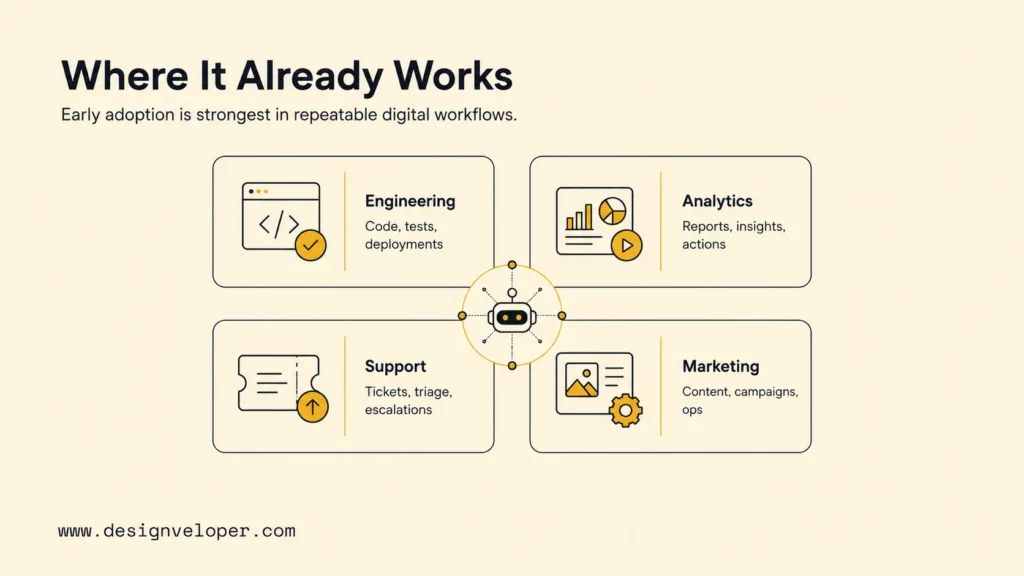
AI replacing AI is already happening where older AI tools created useful outputs but did not finish the workflow. The most visible areas are software engineering, data analysis, customer support, marketing, and content operations. These areas have repeatable tasks, many digital systems, measurable outcomes, and enough text or code context for agents to act.
The pattern is not equal across every industry. Highly regulated workflows need slower adoption, stronger approval gates, and better audit trails. Low-risk internal workflows can move faster, especially when humans review the final result.
Software Development And Engineering Workflows
Software development is one of the clearest examples of AI replacing earlier AI. Early coding assistants suggested lines or explained snippets. Newer agentic systems can inspect repositories, plan changes, edit files, run tests, read logs, and open pull requests. The developer moves from typing every line to reviewing intent, design, correctness, and risk.
The Stack Overflow Developer Survey 2025 shows that developers are already using AI heavily, while trust and verification remain major concerns. That combination explains why agentic engineering workflows need tests, code review, security checks, and rollback paths. AI can replace older autocomplete-style assistance only when the workflow includes verification.
A practical engineering agent should have scoped permissions, a clear task brief, access to relevant code and logs, test commands, style rules, and a human review gate before merge. Without those controls, an agent may create more debugging work than it saves.
Data Analysis And Business Intelligence
Data analysis is shifting from static dashboards to question-driven and action-driven workflows. Earlier AI layers summarized charts or generated SQL. Agentic BI systems can inspect semantic layers, query governed data, explain metric changes, create a narrative, and trigger follow-up tasks for analysts or business owners.
Agentic BI does not remove the need for dashboards. Dashboards remain useful for shared monitoring and executive alignment. Agentic AI replaces weaker AI layers when a user needs an investigation, a causal hypothesis, a data quality check, or a recommended next action rather than another static chart.
The key blocker is data readiness. Agents cannot fix inconsistent definitions, missing lineage, weak access controls, or unreliable source systems by magic. Businesses should strengthen semantic layers, permissions, quality checks, and analyst review before letting agents act on operational metrics.
Customer Support And Service Automation
Customer support is moving from FAQ chatbots to agents that can resolve cases. Earlier AI support tools often answered common questions, summarized tickets, or routed requests. Agentic systems can retrieve customer context, perform account actions, schedule appointments, draft responses, and escalate sensitive cases.
This replacement makes sense when the workflow is narrow and measurable. Order status, appointment changes, password reset guidance, warranty checks, and ticket summaries are better candidates than complex complaints, legal issues, or emotionally sensitive cases. The safest support agents know when to stop and transfer to a person.
Designveloper’s AI development services work is relevant because support automation must connect models to real business systems, not only a chat window. We usually review intents, knowledge sources, CRM or ticketing integration, escalation rules, transcript logging, and post-launch evaluation before recommending an agentic support workflow.
Marketing, Creative Work, And Digital Twin Content
Marketing teams are moving from generative copy tools to agentic workflow systems that can analyze audiences, draft variants, apply brand rules, prepare campaigns, localize content, and route materials for approval. McKinsey’s agentic marketing workflows article describes a process for rebuilding marketing workflows around agentic AI, which is a stronger shift than simply generating more content.
Creative AI replacement is most useful when the agent reduces coordination work. A content agent can turn a campaign brief into a channel plan, generate drafts, check claims, adapt copy for regions, and prepare review packets. A digital twin content workflow can reuse approved brand, product, or audience data to keep outputs consistent.
The risk is brand drift and unsupported claims. Marketing agents need source rules, brand guidelines, approval steps, legal checks, and a clear distinction between draft content and publishable content. The replacement works when the new workflow improves quality control, not only output volume.
What Changes Inside Teams And Businesses
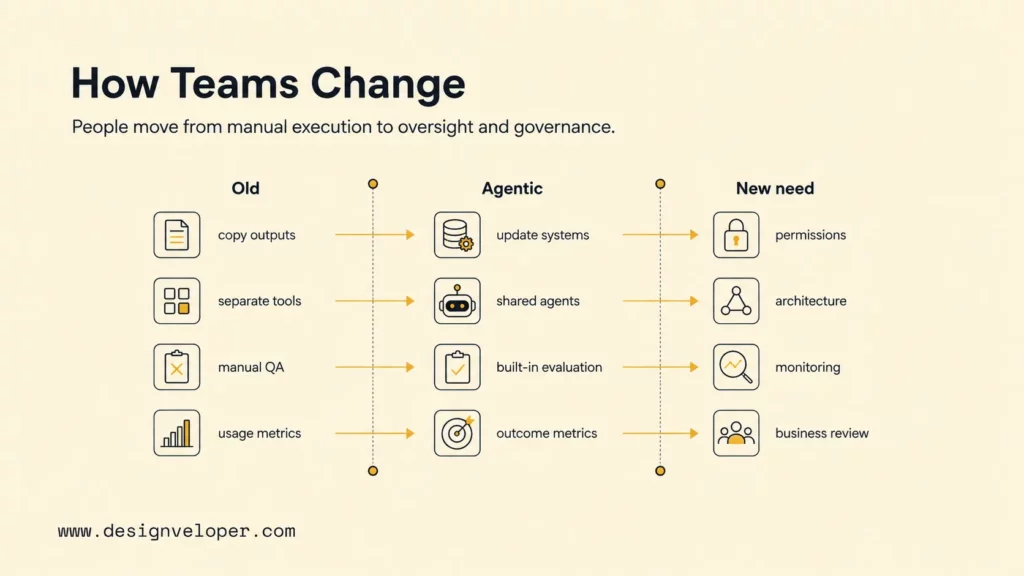
Agentic AI changes business roles by moving people from execution to oversight. Human teams still define strategy, approve risk, interpret exceptions, and own outcomes. The work changes because people manage systems of agents rather than a loose collection of isolated AI tools.
The clearest internal changes are operational. Teams need agent owners, workflow maps, permission models, evaluation datasets, incident playbooks, cost monitoring, and governance reviews. A business that treats agents like normal SaaS features may miss how much autonomy, identity, and data access the agent actually has.
Older AI layers become harder to justify when newer systems complete more of the workflow. A summarizer that only creates notes may be replaced by an agent that summarizes notes, extracts action items, updates the CRM, schedules follow-up, and flags unresolved risks. The human role becomes review, exception handling, and improvement.
| Old operating model | Agentic operating model | New management need |
|---|---|---|
| People copy AI outputs into systems. | Agents call tools and update systems under rules. | Permissions, audit logs, and approval gates. |
| Each team buys a separate AI tool. | Teams share governed agents across workflows. | Architecture, cost control, and reusable integrations. |
| Quality is checked manually after the fact. | Evaluation and validation run inside the workflow. | Test cases, monitoring, and escalation policies. |
| AI adoption is measured by usage. | Agent adoption is measured by completed outcomes. | Workflow metrics and business impact reviews. |
McKinsey’s enterprise architecture for the agentic era makes a similar point at the enterprise architecture level: agentic workflows can be added incrementally or through broader transformation, but each deployment must be integrated carefully to avoid new technical debt.
What Businesses Should Evaluate Before Replacing Older AI
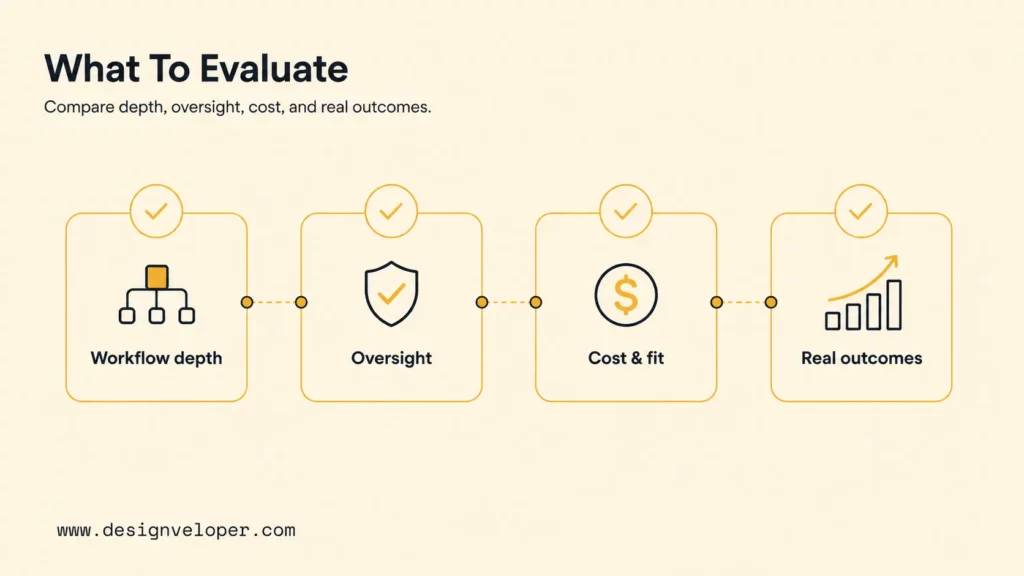
Businesses should replace older AI only after comparing workflow depth, reliability, cost, infrastructure fit, and business outcomes. A newer agent should not win because it feels more advanced. A newer agent should win because it finishes the right work with better governance and measurable value.
A useful replacement review has four questions: Can the agent complete the full workflow? Can the organization supervise the agent? Can the infrastructure support the cost and latency? And can the business prove that the replacement improves an outcome that matters?
Workflow Depth And Execution Quality
Workflow depth measures how much of the real process the new system can complete. A shallow agent that only adds a planning prompt to an old chatbot may not justify replacement. A deeper agent can read context, select tools, execute steps, validate outputs, and hand off exceptions.
Execution quality should be tested with real cases. Businesses should create evaluation sets that include normal cases, edge cases, missing data, ambiguous instructions, policy conflicts, and sensitive scenarios. The agent should pass clear acceptance criteria before replacing an older AI workflow.
Reliability, Oversight, And Governance
Reliability is the deciding factor for agentic AI. An older tool that does one task consistently may be safer than a newer agent that completes five tasks unpredictably. The NIST AI RMF 1.0 publication gives organizations a risk framework for managing AI systems across design, development, deployment, and evaluation.
Oversight should be designed into the workflow. High-risk actions need human approval. Medium-risk actions need validation and audit logs. Low-risk actions still need monitoring and rollback. Governance should also define who owns failures when the agent acts across departments.
Cost, Speed, And Infrastructure Fit
Agentic systems can be more expensive than older AI because one workflow may include several model calls, retrieval steps, tool calls, validation loops, and retries. Cost should be measured at the workflow level, not only by model price. Latency should also be tested from the user’s perspective.
The McKinsey agentic AI infrastructure article is useful because agentic AI puts pressure on infrastructure. Teams need scalable compute, observability, caching, model routing, rate-limit handling, and FinOps practices. A replacement should reduce total operating friction, not create hidden infrastructure work.
Whether The New System Improves Real Outcomes
The final evaluation is business impact. A new agent should improve a real outcome such as resolution time, engineering cycle time, campaign turnaround, data analysis speed, error rate, customer satisfaction, compliance review time, or cost per completed workflow.
Businesses should run a controlled comparison before replacing older AI. Compare the old workflow, the new agentic workflow, and a human-assisted baseline. Measure completion rate, escalation rate, time saved, quality defects, cost, user satisfaction, and risk events. The agent should earn replacement through evidence.
What Businesses Should Optimize As AI Starts Replacing Older AI
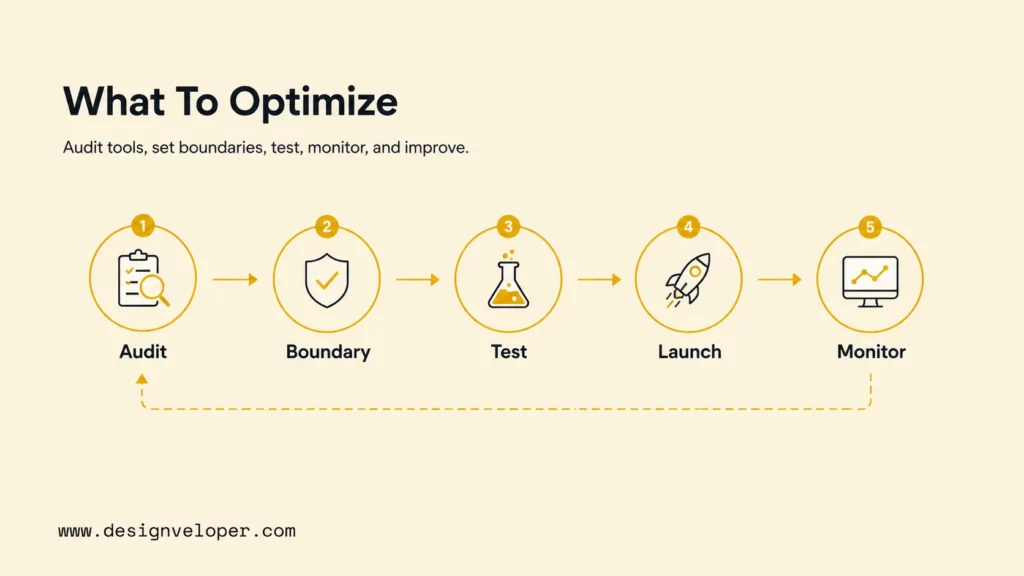
Businesses should optimize governance, workflow design, evaluation, and integration before scaling agentic AI. The first step is an audit of existing AI tools. Some tools will remain useful. Some will become redundant. Others will be too fragile to keep once a better agentic workflow exists.
The audit should list every AI layer, owner, data source, model or vendor, business workflow, cost, known failures, security exposure, and replacement candidate. The business should then prioritize replacements that improve workflow completion without adding unacceptable risk.
A practical optimization sequence looks like this:
- Map the workflow: document current inputs, tools, people, approvals, exceptions, and outputs.
- Define the agent boundary: decide what the agent can read, write, approve, suggest, or escalate.
- Build evaluation cases: include common tasks, rare tasks, ambiguous requests, and high-risk failures.
- Start with supervised rollout: let humans approve actions until the system proves stable.
- Monitor after launch: track quality, latency, cost, escalations, user feedback, and policy breaches.
Experienced IT or development partners become useful when the shift requires deeper integration, orchestration, or production-grade oversight. Designveloper’s software services and delivery process connect AI work to discovery, specification, development, testing, deployment, and support, which is exactly the discipline agentic replacement projects need.
Better Agent Systems Win When They Are Easier To Operate And Govern
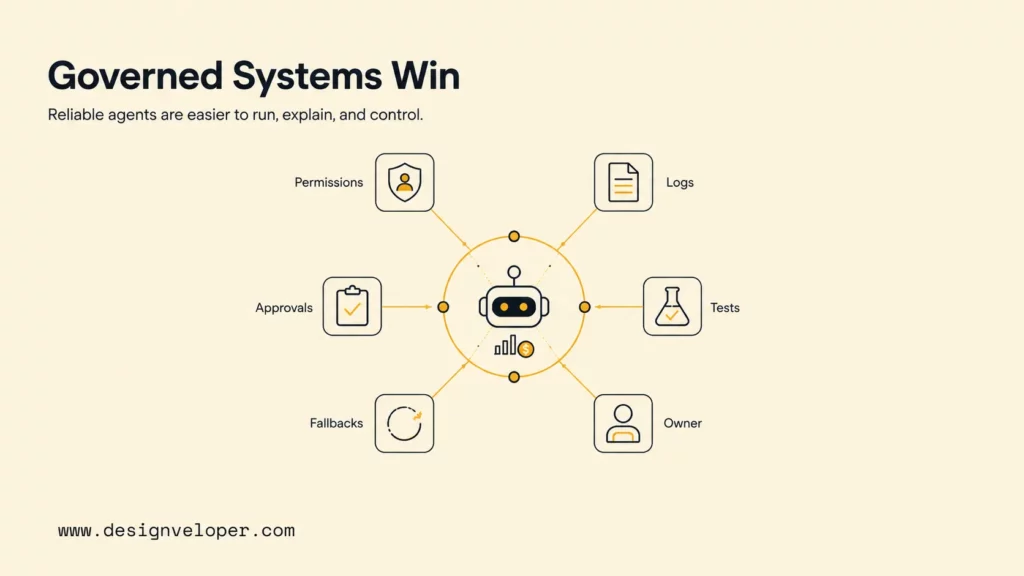
Better agent systems win when they are more reliable, more efficient, and easier to supervise than the AI tools they replace. The real shift is not simply smarter models. The real shift is AI systems that can evaluate, adapt, and improve other AI layers while staying inside a governed operating model.
The best agentic system feels boring in production. It has clear permissions, logs actions, explains decisions. It asks for approval when risk increases. Additionally, it has tests, fallback paths, cost monitoring, and an owner. Those qualities matter more than a flashy demo because agentic AI touches real systems and real users.
Businesses should avoid replacing older AI with agentic AI when the new workflow is harder to understand, harder to audit, or harder to stop. Replacement should create operational clarity. If a team cannot explain what an agent can do, what data it can access, and how failure is handled, the team is not ready to retire the older system.
The safest conclusion is practical: use agentic AI where workflow completion, orchestration, and evaluation create measurable value. Keep older AI where single-task reliability is enough. Replace older AI only when the new agentic system proves better outcomes under real governance.
FAQs About Agentic AI Replacing AI
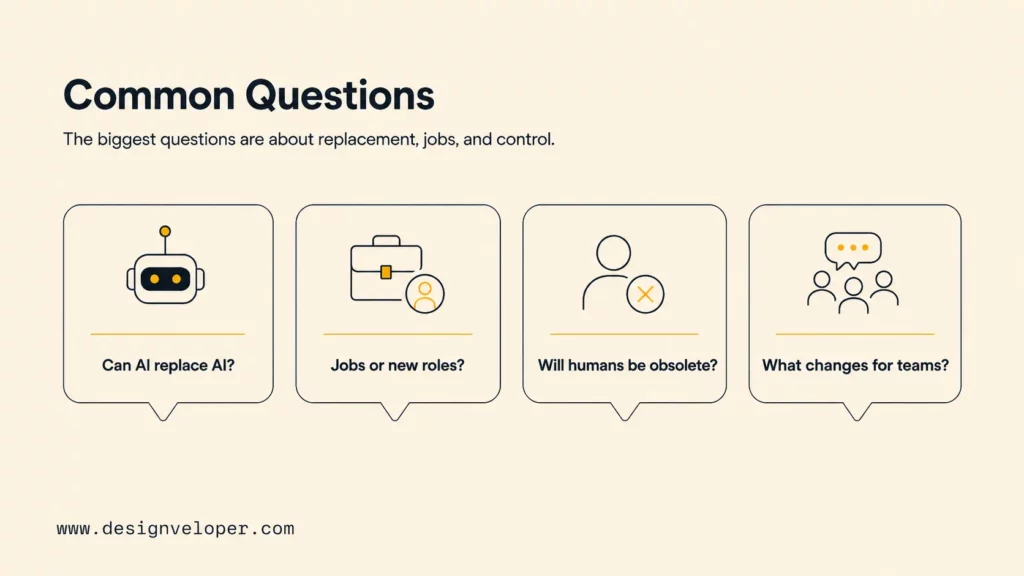
These answers summarize the main business questions around agentic AI replacing earlier AI systems.
Can AI Be Replaced By AI?
Yes. AI can be replaced by newer AI when the newer system performs the same task with better quality, lower cost, deeper workflow completion, or stronger governance. Agentic AI often replaces the workflow around older AI rather than the underlying model itself.
Will AI Replace Jobs Or Create More Opportunities
AI will replace some tasks, redesign many jobs, and create new roles around oversight, workflow design, evaluation, integration, and governance. Agentic AI usually shifts people away from repetitive execution and toward supervision, exception handling, strategy, and accountability.
Will Artificial Intelligence Make Human Workers Obsolete?
Artificial intelligence is unlikely to make human workers obsolete across business operations because companies still need judgment, accountability, empathy, domain knowledge, legal responsibility, and strategic direction. Agentic AI can reduce manual work, but human teams still own outcomes and risk.
What Happens To Human Teams When AI Starts Replacing AI?
Human teams manage fewer isolated tools and more connected agentic workflows. People define policies, approve sensitive actions, review exceptions, improve prompts and evaluation sets, monitor performance, and decide when an older AI layer should be kept, replaced, or retired.
Agentic AI is replacing earlier AI where agents complete more of the workflow with stronger context, better integration, and clearer feedback loops. The strongest businesses will not replace every old AI layer at once. The strongest businesses will replace carefully, measure outcomes, govern autonomy, and keep humans responsible for the decisions that matter.