

As document-intensive enterprises seek ways to scale AI without disrupting core operations, global risk and claims administration company Sedgwick is integrating new AI tools into its legacy systems to process massive volumes of case documentation.
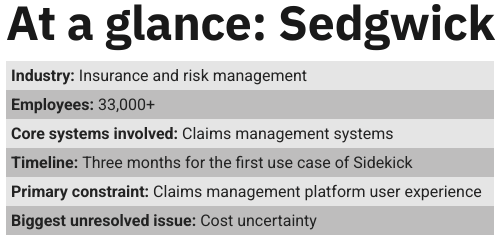
The Memphis, Tenn.-based company, which employs roughly 30,000 people globally, recently expanded its “Sidekick+” platform — launched in 2023 to help claims examiners summarize and analyze documents — with new agentic capabilities designed to support claims workflows and find relevant information more quickly.
Sedgwick developed the proprietary Sidekick tools using OpenAI GPT-4 technology as part of a broader strategy to modernize and scale AI capabilities over time, while continuing to rely on existing claims infrastructure.
“Think of Sidekick as the wrapper that sits around our large language models that gives information to … our clients, our examiners, adjusters,” said Sean Safieh, the company’s CIO of global platforms and digital solutions.
Safieh spoke with InformationWeek about how Sedgwick integrated generative AI and agentic AI capabilities into existing claims workflows while avoiding disruptions to its core systems and for clients.
The constraint: The claims workflow challenge
Claims examiners and adjusters at Sedgwick often must sift through thousands of pages of medical records and other documentation while working under time-sensitive conditions.
For Safieh and his team, the challenge was finding ways to help employees process large volumes of information more efficiently while maintaining the speed and consistency clients expect from claims operations.
“How do we support the examiner in their everyday job with tools to give them information at their fingertips, instead of them searching and hunting [and] reading documentation?” Safieh explained.
Because client-facing technologies also fall under Safieh’s responsibilities at Sedgwick, he and his team had to consider how the AI tools would affect the claimant experience.

Sean Safieh, CIO, Sedgwick
The decision point: Finding the right AI use case
Given Sedgwick’s scale, the company uses a number of technologies, including optical character recognition (OCR), robotic process automation (RPA) and a claims platform with automation resources to support the claims management process, Safieh said. OCR enables RPA bots to see and scan documents.
With the rise of AI, the company sought specific use cases for the technology:
How could AI shorten the amount of time that a claim is open? How could it provide adjusters and examiners with real-time information to support their decision-making?
To drive faster claims resolution and deliver the right information to users, Sidekick is designed to simplify AI prompting for examiners and adjusters by handling the prompting process in the background.
“We give them a button that allows them to just get the information that they need, and we handle all of the prompting in the background,” Safieh said.
What changed, what stayed the same: AI layered into existing systems
While Sidekick was designed to streamline claims workflows, Safieh and his team still had to contend with the architectural realities of building these tools and integrating them into Sedgwick’s existing ecosystem.
Key architectural priorities included:
-
Integrating AI into existing services and APIs.
-
Avoiding disruption to legacy claims platforms.
-
Monitoring system observability and performance.
-
Maintaining human oversight in claims decisions.
Sedgwick’s existing services and APIs simplified the integration process.
“At Sedgwick, we already have an ecosystem built on services and APIs,” Safieh explained. “So, whether it was getting data from the claims platform or pushing data — a note, a diary or information … [it] was actually relatively easy because we had a foundation of services already available to the generative AI, or Sidekick.”
Sidekick does not screen scrape like an RPA tool. Instead, the platform sits in front of the company’s large language models (LLMs) to give a simple, front-end user experience.
On the back end, Safieh and his team must carefully monitor performance to ensure that Sidekick can query legacy systems without breaking them.
“What we needed to do is make sure that the solution worked and we weren’t overtaxing what you can call our legacy systems or claims platforms,” Safieh said. “Observability monitoring and performance monitoring were things that we put in place very early on.”
The Sidekick tools are designed to help examiners and adjusters do their jobs more efficiently within Sedgwick’s existing decision-making framework.
Sedgwick has an intake process, dubbed smart.ly, that determines the validity of client requests and documentation, such as a photo. If a claim meets specific client requirements, such as the type and amount, it will be sent for automated processing. If it does not meet those criteria, it is sent to a human.
The goal is to give examiners more time to interact with claimants and make their decisions.
“There’s always a human in the loop for decision-making when we’re looking at claims processing, and that will continue as we go forward,” Safieh said.
Sidekick reduces the time it takes for examiners and adjusters to sift through documentation. It provides a summary in a minute or two for a document that could take 10 to 15 minutes to read, according to Safieh.
Sidekick also amplified Sedgwick’s ability to audit claims and provide insights.
“Typically … you audit a subset of claims, and you say, ‘Based on this subset and this demographic, we believe we’re doing the right thing,'” Safieh said. “Now, with these tools, we’re auditing every claim.” This includes ensuring that the company’s decisions and the information provided are acceptable.
While Sidekick automates more of the claims management process, it has not altered the company’s culture, according to Safieh. “The consensus or culture … of helping our claimants in their time of need still remains and is deeply rooted,” he said.
The friction: Building trust in AI outputs
Safieh said he knew he and his team would have to build trust with the people who would be using the Sidekick tools internally. Sedgwick approached building that trust by running pilots and then parallel testing.
Through pilots, the team works to ensure the right prompts are in place and that the tool provides the right output. Then, through parallel testing, the output an examiner or adjuster provides is compared with the output from Sidekick.
“In something like a document summarization, we’re seeing 98% to 99% accuracy from what an examiner or adjuster would output [compared] to … Sidekick,” Safieh said.
Sedgwick built a team to facilitate conversations across its operations and different business teams.
“We have to understand what the business case is. We have to understand what the outcome is,” Safieh said. “We built [a] team that is able to have those conversations in the right manner to address those use cases.”
The cost of getting it right: The guardrails behind the AI rollout
The company’s very first GenAI use case with Sidekick took approximately three months to implement.
Sedgwick was already an Azure Cloud user, enabling it to quickly and securely deploy the OpenAI model in its environment, according to Safieh.
He described setting up the architecture to support security, performance and access as the most time-consuming part of the process.
“What may have taken a little bit more time than maybe anticipated was making sure that, one, we’re getting the best results out of the model, and two, how do we deploy this appropriately across the org and teach users how to use it,” he said.
Ensuring that the use of a tool like this is right requires recognition of what could go wrong and putting necessary guardrails in place. The company handles a massive amount of sensitive data during the claims management process and must ensure that Sidekick will not compromise data protection.
Key guardrails included:
-
Keeping sensitive claims data inside Sedgwick’s ecosystem.
-
Preventing company data from training their-party LLMs.
-
Using anonymized data for internal model training.
-
Managing hallucination risk through prompting controls and clean data sets.
-
Maintaining provenance and audibility claims for claims decisions.
-
Architecting the platform to reduce vendor lock-in.
The company ensures that its data is not stored anywhere outside of its ecosystem. It is not used to train third-party LLMs, and for training internal LLMs, the company uses anonymized data, Safieh explained.
The models behind Sidekick also need controls for accuracy.
An AI solution might struggle to interpret a document, such as a messy handwritten note, during intake. AI systems are incentivized to provide answers to prompts, so much so that those answers may be inaccurate or even hallucinated.
“The way we’ve designed the solution is that if it is not able to interpret information, it will define that [inability] as part of the output,” Safieh explained.
He and his team have worked to reduce the risk of hallucinations, first by ensuring the Sidekick tools have access to only clean data sets and second by managing prompting.
“Sidekick really manages what we’re asking and how we’re asking it so that we have repeatable responses or repeatable sets of data that reduce the overall chance of an AI hallucination,” he said.
Provenance is another key area the company has to get right. If a claim decision is challenged, Sedgwick must be able to show how AI was used in the decision-making process.
“The Sidekick solution stores not only the information that’s being provided but also the summary that’s output,” Safieh said. “What we can do at any time is look at the two pieces of information that were provided to the examiner — what did the actual document provide, what did the summary provide — and what was the recommendation that the examiner made.”
Safieh, like other CIOs, is cognizant of the vendor lock-in risk in the AI space. With the technology moving so quickly, the ability to change vendors is appealing. Sedgwick opted to architect its Sidekick solutions with that flexibility in mind.
Sedgwick’s proprietary platforms fulfill the need to be nimble, according to Safieh.
“We own them. We own the roadmap. We own the design. We own the architecture,” he said. “When we look at these solutions and architect them, we make sure that they’re flexible enough to either switch models or leverage multiple models so that we don’t get caught in a vendor lock-in.”
Thus far, Safieh hasn’t run into any unexpected costs related to Sidekick, but he said he is aware this could change as more AI solutions come online and the cost of compute climbs.
“How is the market going to look at monetizing these solutions, and what will we need to do from there?” Safieh asked.
Preparing to scale AI agents: Questions to answer
Safieh said the Sidekick solution has a solid foundation that Sedgwick can use to roll out more AI capabilities.
“From a scalability perspective, as we introduce more and more agents, what we need to do is continue to make sure we have observability in place, performance monitoring in place, and that data security is in place,” he said.
Scaling AI also raises broader architectural questions about orchestration and workflow design, Safieh added:
-
“How do we want the services to be orchestrated, especially with agentic AI?”
-
“Do we stick with services, move to more model context protocol(MCP)?”
-
“And how do we string along sequential steps in the process with the foundation of services?”
The tradeoff: Decisions need to be made quickly
Sidekick has taught Safieh that finding value with AI is different from other technology projects. As a CIO, he has less time to get there. It is all about efficiency.
“Many times with other projects, they are built and executed differently, whether it’s a several-month project, multi-year projects, where there’s a spend allotted to it. You have time to make certain decisions throughout the lifecycle of that project to fix things,” he explained.
“With this type of technology, you make a decision very quickly that it works or it doesn’t work, and you move on.”
What other CIOs might get wrong: Don’t chase every new AI tool
Safieh said that in his conversations with other CIOs, he hears a lot of excitement about the many new tools available in the market. He advised his peers to take a measured approach rather than chasing the latest and greatest offering. Ripping out and replacing tools too often actually slows an enterprise’s velocity, he cautioned.
“If you have a tool that is working, that meets your needs, stick with it as long as you can because it will continue to evolve and change. If it doesn’t meet your needs, then switch,” he said.
The one thing he would do differently: Build trust early on
Looking back, Safieh said the one thing he would do differently is focus on user adoption earlier in the process.
“The earlier you can get people on board and using the solutions and trusting them, the better adoption you’re going to have, the better scalability you’re going to have because everyone’s on board,” he said.