The b2c ecommerce model is a business-to-consumer commerce model where a company sells products or services directly to individual buyers through a website, mobile app, marketplace, social channel, or connected digital storefront. The model works when the brand can help shoppers discover products, complete checkout, receive delivery or digital access, get support, and return for future purchases with as little friction as possible.
B2C ecommerce is no longer only an online store attached to a retail brand. Modern B2C commerce can include direct-to-consumer stores, marketplaces, dropshipping, subscriptions, social commerce, mobile commerce, loyalty programs, AI recommendations, customer support automation, and integrations across payment, inventory, fulfillment, and marketing systems. The U.S. Census Bureau reported that U.S. retail ecommerce sales reached $326.7 billion in Q1 2026, up 9.8% from Q1 2025 and representing 16.9% of total retail sales, which shows why B2C digital channels are now core retail infrastructure rather than a side channel.
For business leaders, the practical question is not simply “should we sell online?” The better question is which B2C ecommerce model fits the product, customer journey, margin structure, fulfillment capability, and technology roadmap. The decision flow below gives a quick view before the detailed sections.
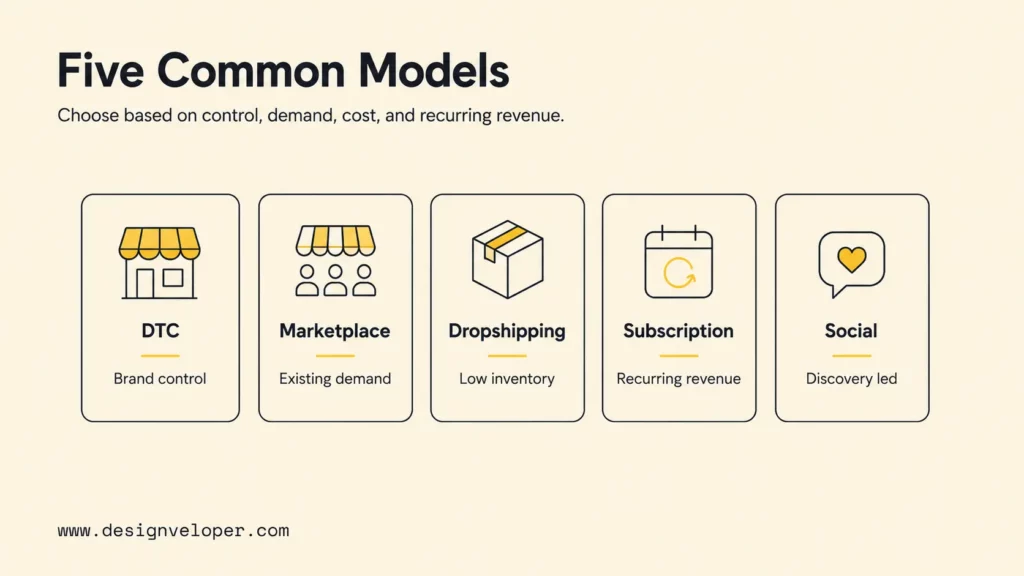
Quick decision guide: Choose a direct-to-consumer store if brand control and customer data matter most, a marketplace when the business needs existing demand, a subscription model when repeat revenue is the core goal, and custom or composable architecture when checkout, inventory, loyalty, or AI workflows define the advantage. Treat the B2C ecommerce model as an operating system for acquisition, conversion, fulfillment, support, and retention, not only as an online catalog.
B2C model decision flow
Own the brand relationship? Start with a direct-to-consumer store, then prioritize CRM, analytics, loyalty, and repeat purchases.
Need existing demand? Use marketplaces, but control fees, ranking dependence, inventory sync, and customer data gaps.
Testing products cheaply? Use dropshipping only with supplier scorecards, delivery promises, and exception handling.
Need recurring revenue? Use subscriptions with billing, churn tracking, dunning, and easy plan changes.
Selling through discovery channels? Use social commerce, but connect catalog feeds, attribution, creator workflows, and owned CRM.
What Is The B2C Ecommerce Model?
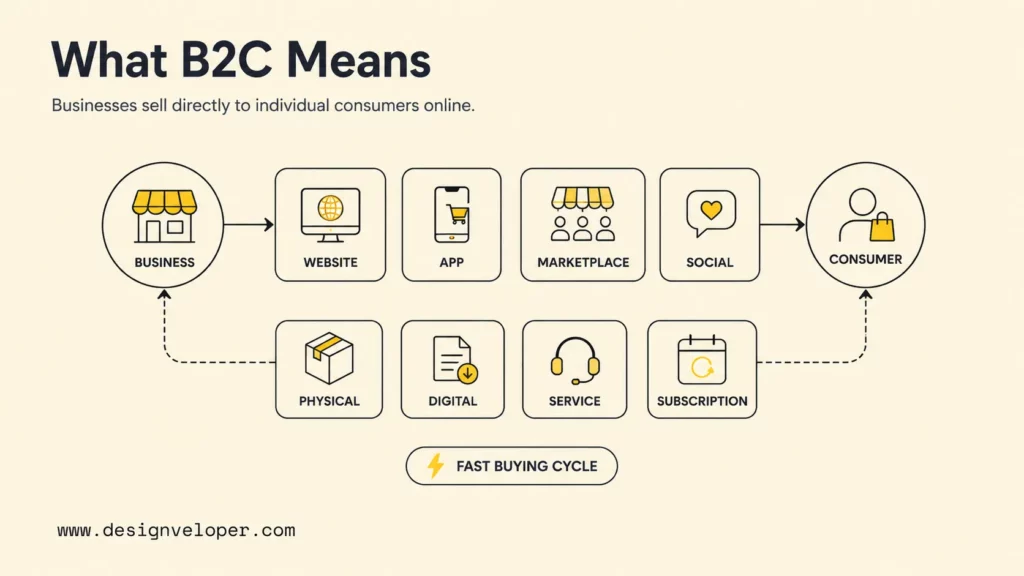
The B2C ecommerce model means a business sells directly to individual consumers online. Salesforce defines B2C ecommerce as selling goods and services directly to consumers, while BigCommerce describes B2C ecommerce as businesses generating revenue through digital channels and online sales to individual consumers. The important point is the buyer type: the customer is a person buying for personal use, not a company buying through a procurement process.
A B2C ecommerce business can sell physical products, digital products, services, subscriptions, bookings, or hybrid offerings. Fashion stores, grocery delivery apps, streaming subscriptions, online pharmacies, beauty brands, electronics retailers, and direct-to-consumer furniture brands can all operate under a B2C ecommerce model. A business may also combine online sales with retail stores, call centers, marketplace listings, and mobile apps.
The B2C ecommerce model usually has shorter buying cycles than B2B commerce. A consumer may compare reviews, check delivery cost, use a discount code, and buy in minutes. That speed creates opportunity, but it also raises the bar for user experience. If the website is slow, payment feels unsafe, shipping is unclear, or returns are difficult, the shopper can leave and buy from another brand.
A strong B2C model therefore depends on three layers working together. The commercial layer defines what the brand sells and how the brand earns money. The customer-experience layer covers discovery, product content, trust, checkout, delivery, support, and retention. The technology layer connects storefronts, payment, inventory, fulfillment, analytics, marketing, CRM, and automation.
How The B2C Ecommerce Model Works
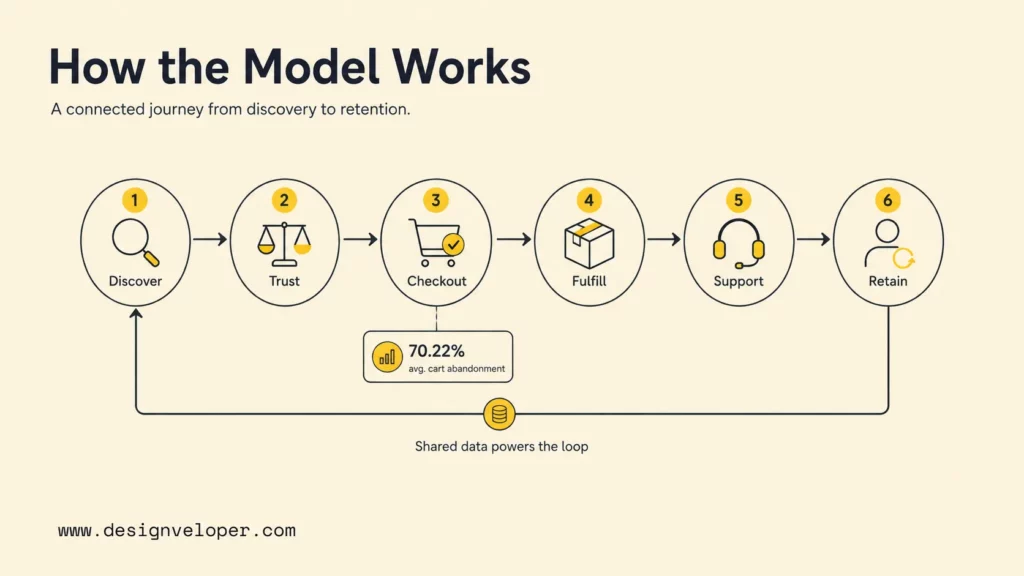
The B2C ecommerce model works by moving an individual shopper from product discovery to purchase, fulfillment, support, and retention. The core flow includes product discovery, checkout, payment, fulfillment, support, and repeat engagement. Every step must be designed because a weak step can reduce conversion even when the product itself is attractive.
Product discovery can happen through search engines, paid ads, social media, marketplaces, email, influencer content, affiliate sites, or direct navigation. The storefront then has to turn interest into confidence with clear product pages, useful media, pricing, reviews, availability, shipping details, and return information. For mobile shoppers, the experience must work on small screens because Salesforce notes that mobile commerce is crucial for B2C businesses and requires responsive design and fast loading.
Checkout is the conversion point where many B2C businesses lose revenue. Baymard Institute’s 2026 cart abandonment benchmark reports a 70.22% average documented online shopping cart abandonment rate across 50 studies. A B2C brand cannot eliminate all abandonment because some shoppers are only comparing prices, but the brand can reduce avoidable friction with transparent costs, guest checkout, trusted payment methods, fast forms, and clear delivery promises.
After payment, the B2C model becomes an operations system. Inventory must be accurate. Orders must route to the right warehouse, store, supplier, or digital delivery service. Customers need tracking, notifications, support, refunds, and returns. Repeat purchase depends on how well the brand handles the first post-purchase experience.
A practical B2C operating flow looks like this:
Acquire attention: shoppers find the product through search, social, ads, marketplace search, referrals, or owned channels.
Build confidence: the storefront shows product content, price, proof, reviews, shipping information, and return rules.
Convert the order: the customer chooses variants, applies discounts, selects delivery, pays, and receives confirmation.
Fulfill the promise: the business ships, delivers, grants digital access, or schedules the service.
Support the customer: the business handles questions, returns, refunds, replacements, and complaints.
Retain the buyer: the brand uses email, loyalty, subscriptions, recommendations, and better service to increase repeat purchases.
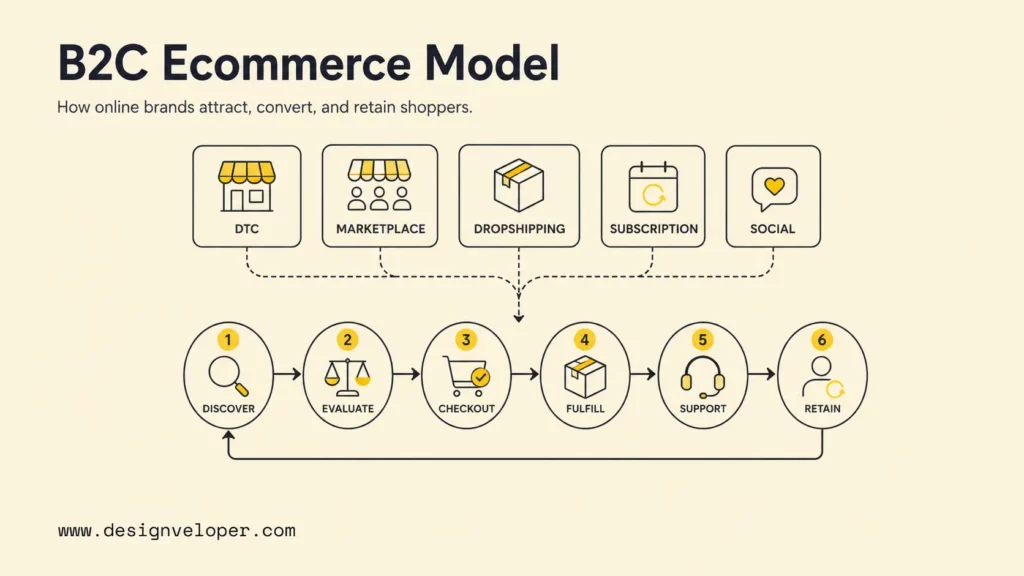
The workflow diagram below shows how those stages connect in a real B2C ecommerce operating system. The key point is that the storefront, operations, and retention loops must share data instead of running as isolated teams.
Demand generation: SEO, ads, marketplaces, social commerce, email, referrals, and creator content create product interest.
Storefront experience: product pages, search, filters, reviews, media, pricing, availability, and promotions turn interest into buying intent.
Checkout and payment: cart, shipping options, taxes, payment methods, fraud checks, and confirmation convert intent into an order.
Order operations: inventory, warehouse, supplier, delivery, tracking, returns, refunds, and support systems fulfill the promise.
Customer data loop: CRM, analytics, loyalty, recommendations, support history, and marketing automation improve repeat purchase.
Optimization loop: teams review conversion, abandonment, acquisition cost, fulfillment quality, retention, and margin before changing the model.
This workflow diagram is useful because most B2C ecommerce problems are not isolated design problems. A checkout issue may come from shipping rules, a retention issue may come from poor fulfillment, and a personalization issue may come from weak customer data integration.
The model succeeds when the commercial promise and the operational system match. A premium skincare brand may win through education, bundles, subscriptions, and customer support. A discount marketplace may win through assortment, price, and logistics. A social commerce brand may win through creator trust and fast impulse checkout. Each B2C business needs a model that fits the way its buyers actually decide.
Main Types Of B2C Ecommerce Models
Main B2C ecommerce models differ by ownership, inventory, customer relationship, and revenue pattern. BigCommerce lists direct-to-consumer selling, dropshipping, online intermediaries, subscription-style fee models, and advertising-based commerce among common B2C structures. The five models below are the most useful for businesses planning a modern digital storefront.
Direct-To-Consumer Brand Store
A direct-to-consumer brand store is an owned ecommerce website or app where a brand sells directly to shoppers. The brand controls product content, pricing, merchandising, checkout experience, customer data, and post-purchase communication. A DTC model is common for fashion, beauty, wellness, furniture, electronics, food, supplements, and digital product companies.
The DTC model works best when the brand can create a differentiated customer experience. The brand can use product education, quizzes, recommendations, loyalty programs, bundles, subscriptions, and personalized campaigns. The tradeoff is that the brand must also handle acquisition, conversion, fulfillment, support, fraud prevention, and retention. DTC control is valuable, but DTC ownership also means operational responsibility.
Online Marketplace
An online marketplace connects sellers with shoppers on a shared platform. Amazon, Etsy, eBay, Walmart Marketplace, Shopee, Lazada, and similar platforms give sellers access to existing buyer demand. The marketplace may own parts of the search, payment, review, dispute, advertising, and fulfillment experience.
Marketplace selling is useful for demand discovery and scale, but marketplace dependency can be risky. Sellers may face fees, ranking changes, policy changes, price competition, limited customer data, and weaker brand ownership. Many B2C businesses use marketplaces as one channel while keeping an owned store for brand storytelling, margin control, and customer retention.
Dropshipping Store
A dropshipping store sells products without holding inventory directly. After the shopper places an order, the merchant forwards the order to a supplier, and the supplier handles packaging and shipping. BigCommerce describes dropshipping as a low-overhead B2C model because the retailer does not need to manage inventory or warehouse space.
Dropshipping can help founders test demand with lower upfront cost, but the model needs careful supplier management. Delivery times, product quality, returns, stock accuracy, and customer support can damage the brand if the supplier experience is poor. A serious dropshipping operation needs supplier scorecards, order tracking, automated exception handling, refund rules, and clear delivery promises.
Subscription-Based Ecommerce
Subscription-based ecommerce charges customers on a recurring schedule for products, services, digital access, replenishment, memberships, or curated boxes. Examples include meal kits, streaming services, beauty boxes, pet supplies, supplements, software, learning platforms, and recurring household goods.
The subscription model can increase predictable revenue, but retention becomes the center of the business. Subscription teams must track churn, skipped renewals, failed payments, product fatigue, cancellation reasons, and customer lifetime value. The technology stack must support recurring billing, plan changes, renewal reminders, dunning emails, customer portals, discounts, and clear cancellation flows.
Social Commerce
Social commerce sells through social platforms, creator content, live shopping, shoppable posts, messaging, and embedded storefronts. It works because product discovery often starts where consumers already spend time. The buying journey can move from short video to product page to checkout with fewer steps than a traditional search journey.
Social commerce is strong for visually driven products and trend-sensitive categories such as fashion, beauty, home goods, food, consumer gadgets, and lifestyle accessories. The risk is platform dependency. Algorithms, ad costs, creator performance, attribution rules, and checkout features can change quickly. B2C teams should connect social commerce to owned CRM, email, analytics, and inventory systems so social demand does not live in a silo.
B2C Ecommerce Vs Other Ecommerce Models
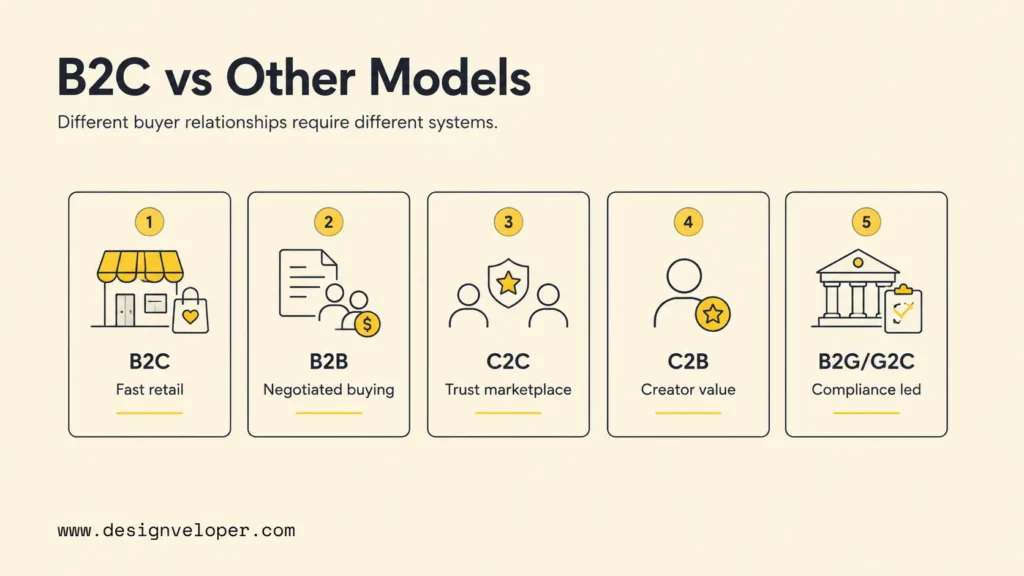
In truth, B2C ecommerce focuses on fast, customer-facing transactions with individual buyers. Other ecommerce models solve different relationship and decision problems. The comparison matrix below helps a business avoid choosing the wrong platform, pricing logic, sales process, or fulfillment design.
Ecommerce model comparison matrix
B2C Individual consumers. Fast, review-driven, price-sensitive decisions. Needs mobile UX, product content, checkout speed, support, and retention.
B2B Business buyers. Planned and negotiated decisions. Needs account pricing, quotes, approvals, bulk ordering, and ERP integration.
C2C Consumers buying from consumers. Trust rules dominate. Needs seller profiles, ratings, escrow, disputes, and moderation.
C2B Businesses buying value from individuals. Needs creator onboarding, payouts, contracts, and reputation systems.
B2B ecommerce often needs account-specific pricing, negotiated terms, purchase orders, approval flows, and repeat bulk orders. B2C ecommerce usually needs fast catalog discovery, clear retail pricing, promotions, reviews, and frictionless payment. C2C ecommerce depends on marketplace trust and moderation because the platform connects individual sellers and buyers. C2B ecommerce reverses the value flow, such as creators, freelancers, influencers, or reviewers providing value to companies.
A company can operate more than one ecommerce model at once. A consumer brand may sell DTC on its own website, wholesale to retailers through B2B portals, and list products on marketplaces. A software company may sell consumer subscriptions and enterprise contracts. The technology question is whether the backend can support different price rules, buyer identities, tax rules, inventory pools, and service expectations without creating operational chaos.
What Makes A B2C Ecommerce Model Successful
A successful B2C ecommerce model is easy to use, trustworthy, operationally reliable, and strong enough to bring customers back. The model is not successful just because the site can accept payment. The model becomes successful when acquisition, conversion, fulfillment, support, and retention work as one system.
Mobile-friendly storefront: product pages, search, filters, cart, and checkout must work smoothly on mobile screens. Slow pages and hard-to-use forms can kill conversion.
Fast and trusted checkout: shoppers need transparent costs, common payment methods, visible security cues, guest checkout, and clear delivery options.
Reliable fulfillment and support: inventory, order routing, tracking, returns, refunds, and support responses must match the promise made on the product page.
Personalized recommendations: product suggestions, bundles, replenishment prompts, and email campaigns should use consented data and real customer behavior.
Strong reviews, loyalty, and post-purchase experience: trust signals, loyalty rewards, useful messages, and good support improve repeat purchase.
Checkout deserves special attention because checkout is where trust, cost, and urgency collide. Baymard’s abandonment benchmark shows how large the leakage can be. A team should regularly test checkout on mobile, slow networks, different payment methods, and edge cases such as out-of-stock products, discount errors, failed payments, and address validation problems.
Success also depends on measurement. B2C teams should track traffic source, product view rate, add-to-cart rate, checkout start rate, payment success rate, conversion rate, average order value, repeat purchase rate, customer acquisition cost, return rate, refund reason, support ticket volume, and customer lifetime value. The best metric set depends on the model. A subscription brand cares deeply about churn. A marketplace seller cares about ranking, ad cost, review quality, and margin after fees. A DTC brand cares about owned-channel retention and product-level profitability.
A B2C ecommerce model succeeds when the brand can profitably acquire a buyer, deliver the promise reliably, and create a reason to return.
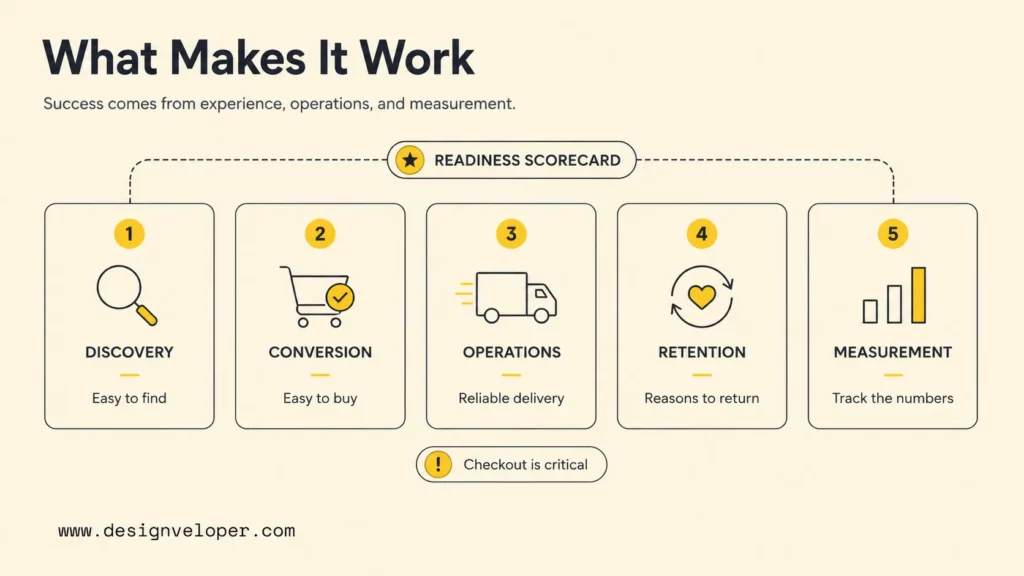
The scorecard below turns those success factors into a simple readiness review for business and technology teams.
B2C ecommerce readiness scorecard
Discovery Product pages, search, filters, reviews, and campaigns help shoppers find the right offer.
Conversion Checkout is fast, transparent, mobile-friendly, and supports trusted payment methods.
Operations Inventory, fulfillment, tracking, returns, and customer support use connected data.
Retention Email, loyalty, subscriptions, recommendations, and support history increase repeat purchases.
Measurement Teams review conversion, CAC, abandonment, AOV, return rate, fulfillment quality, and margin.
A B2C ecommerce model is ready to scale when the readiness signals are visible in the data. If several areas show the not-ready pattern, the next investment should fix the operating system before the business spends more on traffic.
The practical success test is simple: can the brand profitably acquire a customer, deliver the order reliably, and earn another purchase? If the answer is no, the issue may be positioning, traffic quality, product economics, checkout friction, fulfillment reliability, or weak retention. A good B2C ecommerce model makes those problems visible early.
Platform decision framework
Use hosted ecommerce Best for standard catalogs, common promotions, simple fulfillment, and fast launch.
Add middleware Best when inventory, pricing, CRM, fulfillment, or marketplace data needs controlled synchronization.
Build custom modules Best when checkout, subscription, loyalty, personalization, or AI workflows define the brand advantage.
Go composable Best for multi-brand, multi-region, high-scale, or experience-led commerce with specialized systems.
Technology Needed To Run A B2C Ecommerce Business
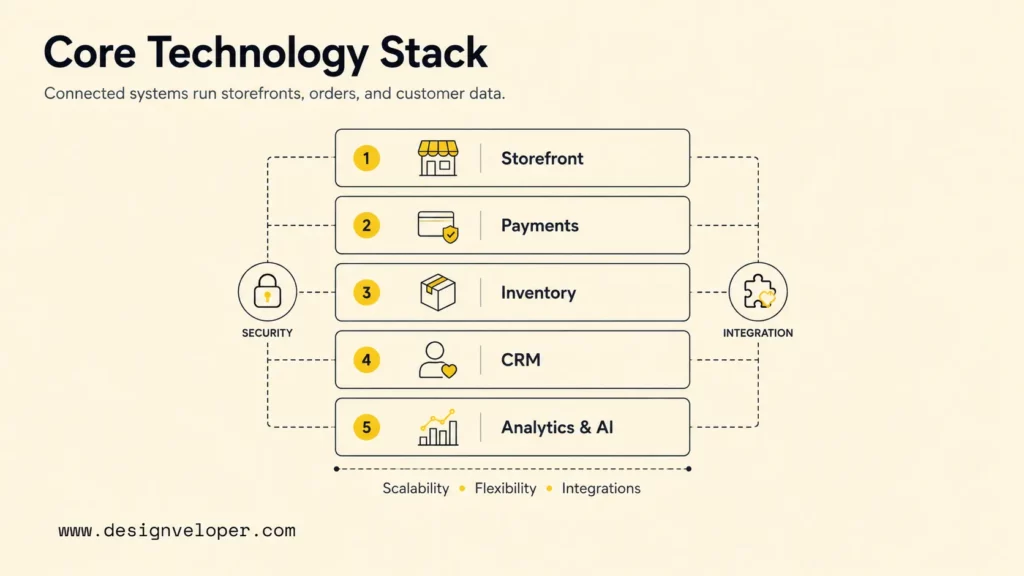
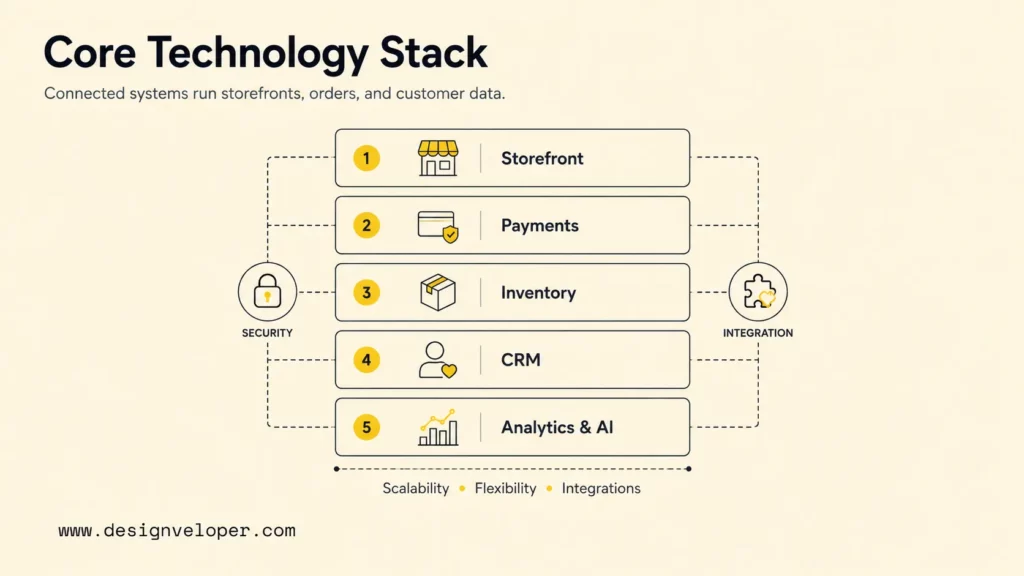
A B2C ecommerce business needs a connected technology stack that supports storefront experience, payment, inventory, fulfillment, customer data, marketing, analytics, automation, and security. Small stores can start with a hosted platform. Growing brands often need deeper integration because order volume, product complexity, fulfillment rules, and customer expectations become harder to manage manually.
Payment and checkout systems: payment gateways, digital wallets, fraud checks, tax calculation, discount logic, and order confirmation.
Inventory, order, and fulfillment tools: inventory availability, warehouse routing, supplier feeds, delivery tracking, returns, and customer notifications.
CRM and marketing automation: email, SMS, segmentation, loyalty, abandoned cart flows, win-back campaigns, and customer service history.
Analytics, AI recommendations, chatbot support, and fraud prevention: reporting, personalization, search relevance, product recommendations, support automation, and transaction risk scoring.
Platform choice should follow business complexity. A simple catalog with standard products can use a hosted ecommerce platform and a small app stack. A brand with subscriptions, loyalty tiers, custom bundles, multiple warehouses, marketplaces, international stores, and AI search may need more custom architecture. BigCommerce’s platform guidance recommends evaluating scalability, flexibility, integrations, and total cost, which is the right decision frame for growing teams.
Integration quality often matters more than the logo on the platform. A storefront that cannot sync inventory accurately will create oversold products. A CRM that cannot see order history will create poor support. A marketing tool that cannot segment by purchase behavior will send irrelevant campaigns. A fulfillment system that does not return tracking events will increase support tickets.
Security and reliability should be part of the first technology plan. B2C commerce handles personal data, payment events, addresses, order history, fraud signals, and customer support records. Teams should use secure payment providers, least-privilege admin access, audit logs, backups, monitoring, and clear incident response procedures. Ecommerce is customer-facing software, so outages and data issues directly affect revenue and trust.
Custom Technology Needs In B2C Ecommerce
Custom technology becomes necessary when the standard platform cannot support the brand’s checkout logic, pricing model, integrations, AI features, or operational workflow. Many B2C businesses can start with off-the-shelf tools. Custom development makes sense when the model becomes differentiated enough that generic plugins create bottlenecks.
Common custom needs include:
Custom checkout or pricing logic: bundles, wholesale-retail hybrids, region-specific payment flows, complex promotions, personalized offers, deposits, or product configuration.
Subscription, loyalty, or membership workflows: renewals, prepaid credits, loyalty points, tier benefits, membership-only products, cancellation saves, and retention dashboards.
ERP, CRM, shipping, and payment integrations: bidirectional sync between storefront, inventory, order management, accounting, warehouse, courier, and support systems.
AI-powered search, personalization, chatbot, or automation features: semantic product search, recommendation logic, product content generation, customer support triage, fraud review, and operations automation.
Designveloper helps B2C teams turn ecommerce ideas into maintainable software. Our web development services, custom software development services, and AI development services cover the engineering work around storefronts, integrations, automation, analytics, and AI-powered customer experiences. For consumer-facing products, the work usually includes discovery, UX flows, architecture, secure APIs, frontend development, backend services, testing, deployment, and post-launch iteration.
Custom development should start with a narrow business problem. For example, a brand may need to reduce support tickets caused by delivery questions, improve product discovery for a large catalog, sync inventory across stores and marketplaces, or create subscription logic that the current platform cannot handle. The implementation plan should define the system of record, integration ownership, error handling, monitoring, and customer-facing fallback when a connected service fails.
Custom ecommerce development should protect the workflows where standard platform features create measurable conversion, fulfillment, retention, or data risk.
The risk matrix below helps decide whether a B2C ecommerce team should stay with platform configuration or move into custom development.
Custom development risk matrix
High impact Inventory, order, or payment data is inconsistent across storefront, warehouse, ERP, and marketplace systems.
High likelihood Plugin overload slows checkout, breaks updates, and leaves core business rules without clear ownership.
Retention risk Subscription, loyalty, or membership logic cannot support real customer behavior without manual fixes.
AI governance risk AI search, recommendations, or chatbot support uses weak data, incomplete review, or no monitoring.
This risk matrix keeps custom work focused. The goal is not to custom-build everything; the goal is to custom-build the workflows where standard ecommerce tools create measurable operational or customer-experience risk.
A practical readiness checklist can prevent overbuilding:
Define the exact workflow that standard platform features cannot support.
Estimate revenue, cost, or operational impact from solving the workflow.
Map systems of record for product, customer, order, inventory, payment, and support data.
Choose whether the feature belongs inside the ecommerce platform, a middleware layer, a custom app, or an external service.
Create acceptance tests for checkout, payment failure, inventory mismatch, return, refund, and support cases.
Plan monitoring, admin controls, and rollback behavior before release.
In conclusion, the strongest b2c ecommerce model is supported by technology that feels invisible to the shopper. The storefront feels fast, checkout feels simple, inventory feels accurate, support feels informed, and recommendations feel useful. Behind that simplicity, the brand needs engineering decisions that connect customer experience with reliable operations.
FAQs About The B2C Ecommerce Model
How Much Does It Cost To Launch A B2C Ecommerce Store?
The cost to launch a B2C ecommerce store depends on platform choice, product complexity, design needs, payment setup, integrations, content, apps, marketing, and fulfillment. A small store can start with a hosted ecommerce platform, a theme, payment gateway, and basic apps. A custom storefront with ERP, CRM, loyalty, subscription, AI search, or marketplace integrations costs more because the project includes architecture, backend development, QA, security, and maintenance.
Which Platform Works Best For A B2C Ecommerce Business?
The best B2C ecommerce platform depends on catalog size, selling model, integration needs, team skill, budget, and growth plan. Shopify and BigCommerce are common hosted options for many retail brands. WooCommerce can fit WordPress-centered teams. Salesforce Commerce Cloud and Adobe Commerce are common in larger, more complex commerce environments. A custom stack can make sense when the business model needs unique checkout, personalization, or backend integration.
What Are The Biggest Risks In B2C Ecommerce?
The biggest risks in B2C ecommerce include weak conversion, high customer acquisition cost, cart abandonment, fulfillment errors, payment fraud, platform dependency, poor mobile UX, bad inventory sync, privacy issues, and low repeat purchase. Each risk should have an owner and metric. For example, checkout teams can track abandonment, operations teams can track late shipments, and support teams can track return reasons.
How Can B2C Brands Improve Repeat Purchases?
B2C brands can improve repeat purchases by delivering the first order reliably, collecting customer preferences with consent, sending useful post-purchase messages, offering loyalty or subscription options, making returns easy, and personalizing recommendations. Repeat purchase also improves when the brand fixes operational pain points such as slow shipping, unclear sizing, product quality issues, and support delays.
How Do B2C Ecommerce Teams Know They Need Custom Development?
B2C ecommerce teams usually need custom development when standard platform features or plugins cannot support the brand’s pricing, checkout, subscription, loyalty, fulfillment, CRM, ERP, marketplace, AI, or reporting requirements. Warning signs include repeated manual work, frequent order errors, fragile plugin chains, poor data sync, limited personalization, slow site performance, and workflows that require staff to copy data between systems.
A strong b2c ecommerce model connects the business model, customer journey, operating system, and technology stack into one measurable growth loop. The practical next step is to choose the model that matches the product and then build only the custom technology needed to protect conversion, fulfillment, retention, and margin.