


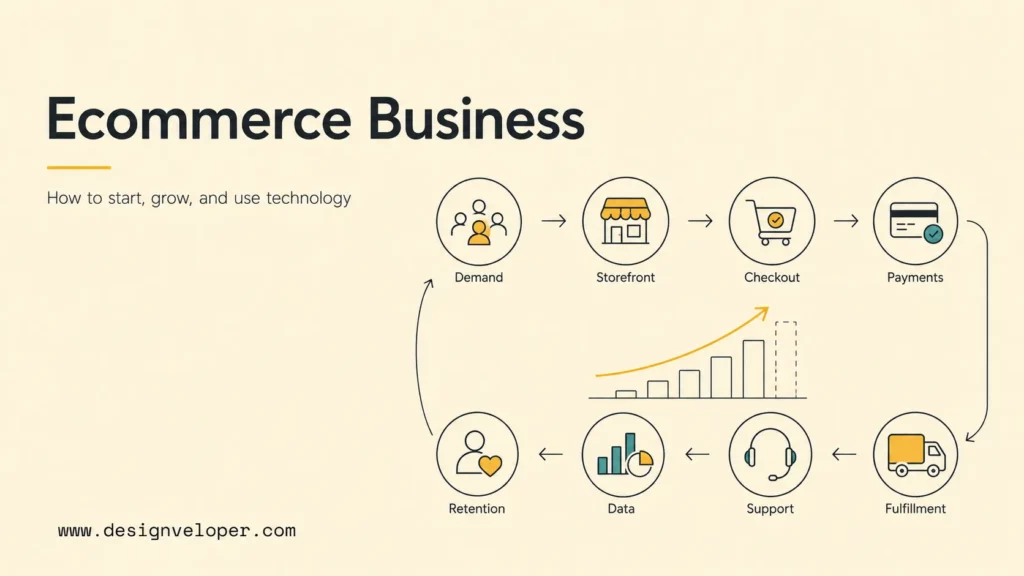
An ecommerce business sells products, services, subscriptions, or marketplace access through digital channels. The business may use a ready-made platform such as Shopify, a marketplace such as Amazon or Etsy, a custom storefront, or a hybrid technology stack. The important point is that ecommerce is not only an online catalog. It is a connected operating system for demand generation, checkout, payments, fulfillment, customer support, data, and retention.
Ecommerce keeps growing because customers expect convenient discovery, mobile checkout, flexible delivery, and quick support. The U.S. Census Bureau’s retail ecommerce sales reports tracks ecommerce as a share of total retail sales, while Salesforce’s ecommerce overview frames ecommerce as buying and selling goods or services over digital channels. For founders, the lesson is practical: a store succeeds only when marketing, product, operations, and technology work together.
Quick decision guide: start with a simple platform if the business sells a small catalog and needs speed. Choose a marketplace when demand already exists there and margin can absorb fees. Build custom technology when the business needs complex catalogs, B2B pricing, custom checkout, marketplace rules, AI personalization, integrations, or operational workflows that standard platforms cannot support cleanly.
| Decision | Best route | Watch-out |
|---|---|---|
| Fast launch | Hosted ecommerce platform or marketplace | Limited differentiation and platform fees |
| Owned brand | D2C storefront with strong content, email, and retention | Customer acquisition cost can rise quickly |
| Operational complexity | Custom web app, integrations, or headless commerce | Needs architecture, QA, and long-term maintenance |
| AI-assisted growth | Personalization, chatbots, forecasting, fraud detection, and content operations | Requires data quality, monitoring, and human review |
| Scaling | APIs, analytics, CRM, ERP, fulfillment, security, and support workflows | Poor data flow can limit growth even if sales increase |
What Is An Ecommerce Business?
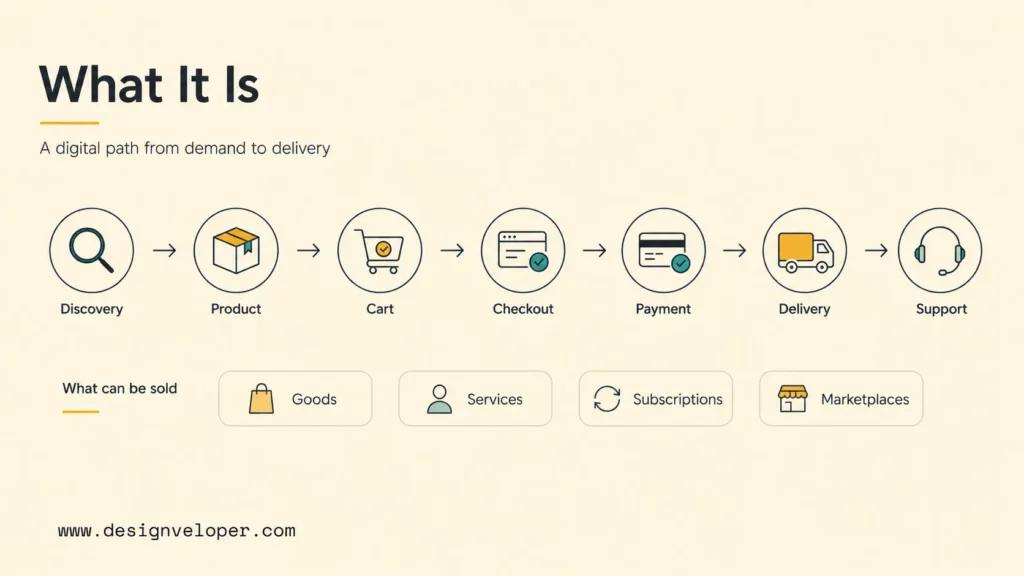
An ecommerce business is a company that completes commercial activity through digital channels. The sale may happen on a website, mobile web app, marketplace, social platform, or subscription portal. The product can be physical goods, digital downloads, services, memberships, software access, or a marketplace transaction between buyers and sellers.
The simplest ecommerce business has a product page, cart, checkout, payment method, shipping process, and customer support channel. A more mature ecommerce business also has inventory management, CRM, email marketing, analytics, customer segmentation, personalized recommendations, fraud checks, return workflows, ERP integration, and data dashboards.
Ecommerce differs from a basic online presence because the website or app handles the commercial workflow, not only brand information. A restaurant website that lists opening hours is a website. A restaurant ordering portal with checkout, delivery options, customer accounts, payment, order tracking, and support is part of an ecommerce business.
Ecommerce is not only selling online; it is designing the full digital path from demand to delivery.
Main Ecommerce Business Models
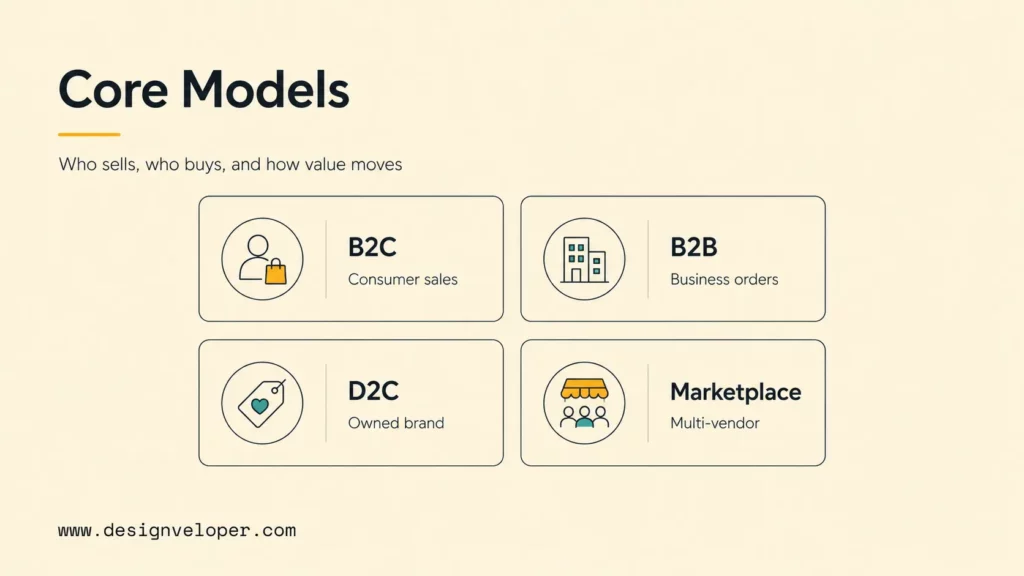
The main ecommerce business models describe who sells, who buys, and how value moves through the digital channel. Choosing the right model helps the founder pick the right platform, pricing strategy, operations stack, and growth channel.
| Model | How it works | Best fit |
|---|---|---|
| B2C ecommerce | A business sells directly to individual consumers. | Retail brands, D2C products, fashion, beauty, food, home goods, and digital products. |
| B2B ecommerce | A business sells to other businesses through digital ordering, quotes, or account-based pricing. | Wholesale, manufacturing, distribution, procurement, and repeat bulk orders. |
| D2C brands | A manufacturer or brand sells directly to customers without relying only on retailers. | Brands that want customer data, margin control, and owned relationships. |
| C2C marketplaces | Consumers sell to other consumers through a platform that supports listings, payments, trust, and dispute handling. | Resale, collectibles, services, peer-to-peer rentals, and local commerce. |
| Subscription ecommerce | Customers pay recurring fees for products, replenishment, memberships, or digital access. | Consumables, curated boxes, education, software, content, and community. |
| Marketplace or platform-based ecommerce | A platform connects sellers, buyers, inventory, payments, reviews, and rules. | Multi-vendor commerce, vertical marketplaces, booking platforms, and service exchanges. |
B2C stores usually optimize conversion rate, product merchandising, mobile checkout, and retention. B2B ecommerce often needs negotiated pricing, purchase orders, role-based approvals, account terms, and ERP integration. Marketplace businesses need trust, moderation, seller tools, payment splitting, dispute workflows, and liquidity on both sides of the transaction.
The model also shapes the technology roadmap. A B2C brand may prioritize storefront speed and lifecycle marketing, while a B2B portal may prioritize account permissions, quote workflows, and ERP data. A marketplace may need seller onboarding, listing quality controls, escrow-like payment logic, reviews, and dispute handling before it can scale safely.
Ecommerce Business Ideas And Delivery Methods
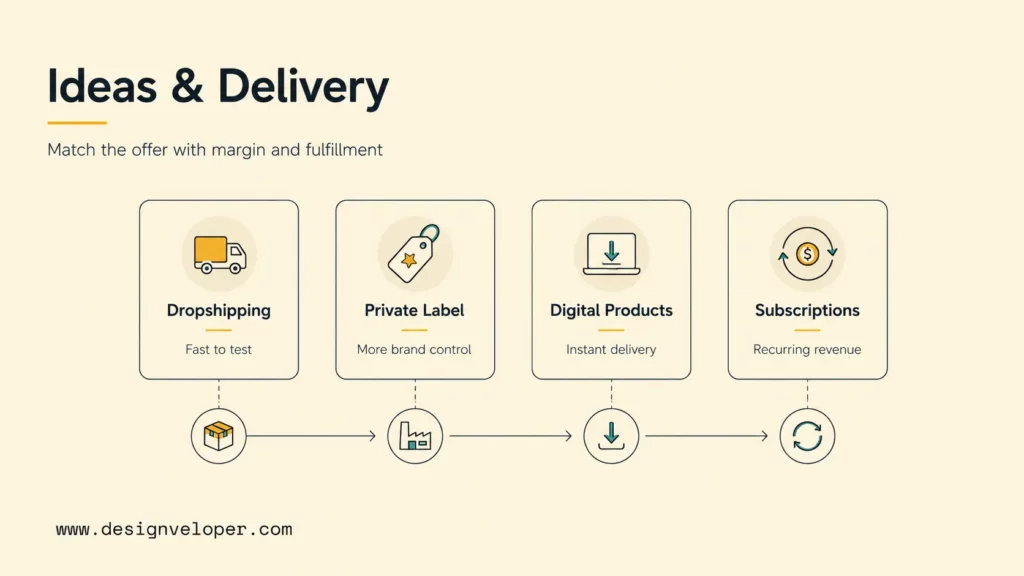
Ecommerce business ideas should be evaluated by margin, demand, fulfillment difficulty, customer acquisition cost, repeat purchase potential, and operational complexity. A strong idea is not only a product that can be listed online. A strong idea has a clear customer, a repeatable sales channel, a reliable delivery method, and enough margin to support marketing, support, and returns.
- Dropshipping. The seller markets products while a supplier handles inventory and shipping. The model is fast to test but can suffer from thin margins, weak quality control, and delivery issues.
- Private label or white label products. The business sells products under its own brand using a manufacturing or sourcing partner. This model gives more brand control but requires supplier management and inventory planning.
- Digital products. Courses, templates, software, ebooks, music, and paid resources can scale well because fulfillment is digital, but discovery and trust still matter.
- Subscription boxes or memberships. Recurring revenue can improve forecasting, but churn, product freshness, and fulfillment consistency become critical.
- Online services or consulting. Ecommerce can sell appointments, packages, retainers, audits, coaching, design work, or specialized services through online booking and payment.
- Niche marketplaces. A marketplace can serve a focused buyer-seller segment, but the hardest work is building trust and supply-demand balance.
Shopify’s ecommerce business blueprint is a useful public starting point for thinking through products, platforms, operations, and marketing. A founder should still validate real demand before building a full store. Interviews, landing pages, pre-orders, small ad tests, and marketplace experiments can reveal whether customers want the offer.
The Technology Behind A Modern Ecommerce Business
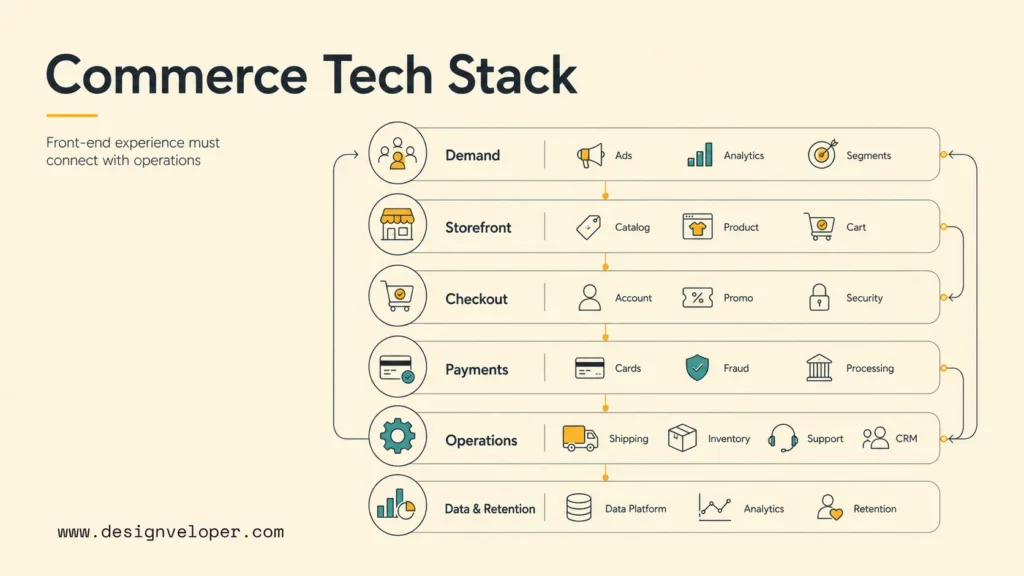
The technology behind a modern ecommerce business connects storefront experience with operations. A store may start with a hosted platform, but growth often depends on checkout performance, payment reliability, inventory accuracy, shipping rules, CRM data, analytics, automation, and security. Technology choices shape both customer experience and internal efficiency.
The operating-system map below shows the core layers that need to work together. A weak layer can limit the entire business: good ads cannot save a broken checkout, and a beautiful storefront cannot scale if inventory and fulfillment data are unreliable.
DemandMarket, audience, channel, product promise, pricing, and offer.
->
StorefrontProduct pages, mobile UX, search, content, cart, and checkout.
->
OperationsPayments, inventory, shipping, returns, CRM, ERP, and support.
GrowthAnalytics, segmentation, campaigns, retention, personalization, and automation.
->
TechnologyPlatform, APIs, data model, security, AI features, and custom workflows.
Ecommerce Platforms, Web Apps, And Custom Storefronts
Most ecommerce businesses start with a hosted platform, marketplace, or website builder because speed matters. Shopify, WooCommerce, BigCommerce, Magento, marketplace storefronts, and custom web apps all solve different problems. Hosted platforms reduce setup time, while custom storefronts give more control over workflows, user experience, integrations, and performance.
A custom web app makes sense when the store needs custom product configuration, B2B pricing, multi-vendor marketplace logic, advanced search, complex promotions, custom checkout, or a customer portal. The tradeoff is responsibility: custom systems need architecture, maintenance, QA, security, and a roadmap.
A practical architecture review should ask where product data lives, which system owns customer records, how inventory updates, what happens when payment or shipping APIs fail, and how the team will measure conversion and retention. Those questions prevent the store from becoming a collection of disconnected apps.
Payment, Shipping, CRM, And ERP Integrations
Payments, shipping, CRM, and ERP integrations turn ecommerce from a storefront into an operational system. Payment tools process orders. Shipping tools generate labels and delivery options. CRM platforms store customer history and campaign data. ERP systems coordinate inventory, finance, procurement, and fulfillment.
Integration quality affects customer trust. If inventory is wrong, customers buy unavailable products. If payment errors are unclear, customers abandon checkout. If CRM data is fragmented, support teams cannot see the customer’s history. Every integration should include error handling, retry logic, monitoring, and clear ownership.
Data Analytics, Customer Segmentation, And Automation
Data analytics helps ecommerce teams understand conversion rate, average order value, repeat purchase rate, customer acquisition cost, refund rate, inventory velocity, and channel performance. Segmentation turns raw customer data into practical groups such as first-time buyers, repeat buyers, high-value customers, inactive customers, and discount-sensitive shoppers.
Automation can support abandoned cart emails, replenishment reminders, back-in-stock alerts, loyalty campaigns, customer support routing, inventory alerts, and financial reporting. Automation should be introduced carefully because a bad rule can send the wrong message, apply the wrong discount, or hide a serious operational problem.
AI Personalization, Chatbots, Fraud Detection, And Forecasting
AI can support ecommerce through product recommendations, personalized search, chatbot support, content generation, fraud detection, demand forecasting, product tagging, review analysis, and customer service summarization. AI is most useful when it has clean data, clear constraints, and human review for sensitive outcomes.
The 2025 Stack Overflow Developer Survey shows how quickly AI tools have entered software work, and the 2025 DORA Report announcement studied AI-assisted software delivery across nearly 5,000 technology professionals. Ecommerce teams can use AI to move faster, but production systems still need monitoring, privacy controls, permission boundaries, and fallback processes.
What Makes An Ecommerce Business Successful
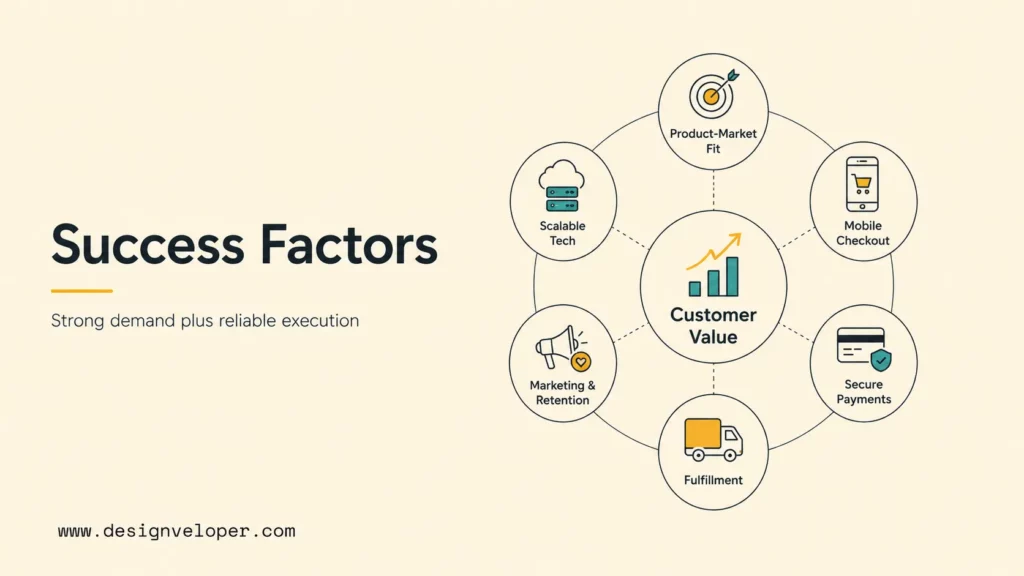
A successful ecommerce business has product-market fit, smooth mobile checkout, secure payments, reliable fulfillment, strong customer support, effective digital marketing, retention loops, and technology that can scale with demand. Success depends on both demand generation and operational reliability.
- Clear product-market fit. Customers understand the offer, trust the brand, and see a reason to buy now.
- Smooth mobile checkout. Mobile shoppers need fast pages, clear pricing, simple forms, preferred payment options, and transparent delivery information.
- Secure payments and data protection. The business must protect customer data, payment flows, accounts, and order history.
- Reliable fulfillment and customer support. Delivery promises, returns, inventory, and support responses must match what the store says.
- Digital marketing and customer retention. Paid ads, SEO, email, social, affiliates, loyalty, and content need measurement and iteration.
- Scalable technology that can support growth. The platform should handle more traffic, more SKUs, more customers, more channels, and more integrations.
Checkout quality deserves special attention. Baymard Institute’s cart abandonment rate research regularly tracks documented cart abandonment studies, and its checkout research shows why forms, fees, account creation, delivery clarity, and trust signals affect revenue. For ecommerce leaders, improving checkout can be as valuable as buying more traffic.
Growth is easier to buy than operational trust; the hard part is keeping the promise after the order is placed.
Common Risks In Ecommerce Business
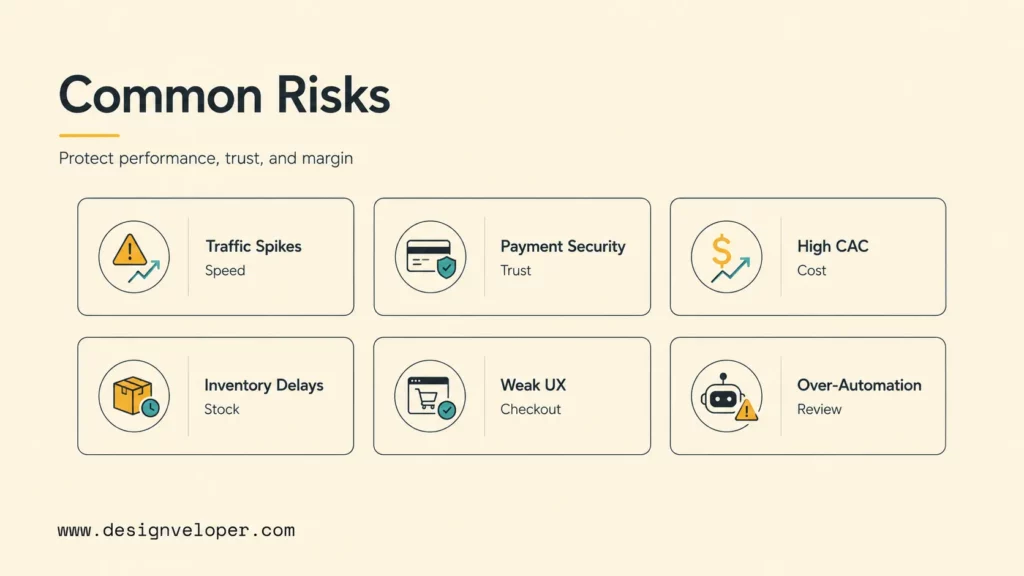
Common risks in ecommerce business include poor performance during traffic spikes, payment and security vulnerabilities, high customer acquisition cost, inventory problems, low trust, weak UX, abandoned carts, legal compliance issues, and overreliance on automation without human review. These risks are practical, not theoretical. Each one can reduce margin or damage customer trust.
- Poor website performance during traffic spikes. Slow product pages and checkout errors can waste campaign spend and frustrate customers.
- Payment and security vulnerabilities. Payment flows, accounts, passwords, and customer data need secure implementation and regular review.
- High customer acquisition cost. Paid channels can become expensive when conversion rate, retention, and average order value are weak.
- Inventory or delivery issues. Overselling, late shipments, and unclear returns can create support volume and refunds.
- Low trust, weak UX, and abandoned carts. Missing reviews, unclear fees, confusing checkout, and poor mobile design reduce conversion.
- Legal, privacy, and tax compliance problems. Ecommerce businesses must handle consumer protection, taxes, privacy notices, marketing consent, and regional rules.
- Overreliance on automation without human review. AI and automation can scale mistakes when rules, data, or prompts are wrong.
Risk management should be built into the operating model. A store should track performance, checkout errors, payment failures, refund reasons, support categories, marketing efficiency, inventory accuracy, and suspicious order patterns. Without monitoring, the team may notice problems only after customers complain publicly.
Human review is especially important for automated refunds, fraud decisions, product recommendations, price changes, customer segmentation, and AI-generated support replies. Automation should reduce repetitive work, but sensitive decisions still need escalation paths and audit trails.
How To Start An Ecommerce Business
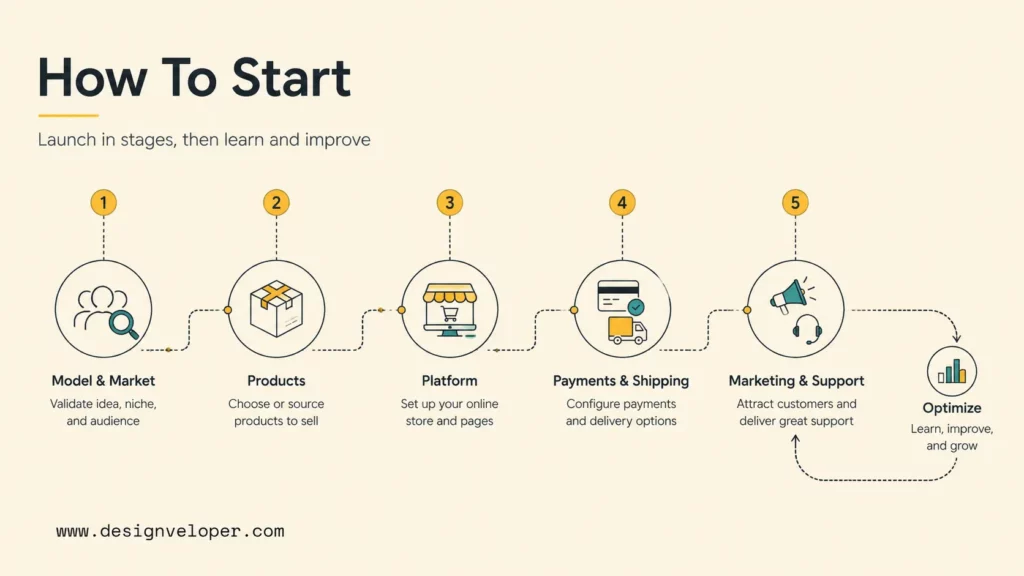
Starting an ecommerce business works best as a staged process: choose the model and market, select products or services, pick the platform or custom store approach, set up payments and fulfillment, then launch marketing, analytics, and support. The first launch should validate a real workflow before the team adds complexity.
Choose The Business Model And Target Market
Choose the business model and target market before choosing technology. A D2C brand, B2B ordering portal, subscription store, marketplace, and digital-product business each need different pricing, operations, trust signals, and software. Define the customer, problem, buying trigger, budget, competitors, and channel strategy.
Select Products, Suppliers, Or Services
Select products, suppliers, or services based on demand, margin, fulfillment difficulty, quality control, differentiation, and repeat-purchase potential. For physical products, evaluate supplier reliability, lead time, packaging, storage, returns, and shipping cost. For digital products or services, evaluate delivery process, support expectations, and refund policy.
Pick An Ecommerce Platform Or Build A Custom Store
Pick an ecommerce platform or build a custom store based on workflow complexity. A hosted platform is usually faster for a simple catalog. A custom store or custom web app becomes more useful when the business needs special checkout rules, advanced search, B2B accounts, multiple vendors, custom fulfillment, or deep integrations.
Set Up Payments, Shipping, And Inventory
Set up payments, shipping, and inventory before launching traffic. Customers need clear prices, trusted payment methods, delivery estimates, return rules, and accurate stock information. The operations team needs alerts for failed payments, low inventory, delayed shipments, refunds, and suspicious orders.
Launch Marketing, Analytics, And Customer Support
Launch marketing, analytics, and customer support as part of the first release. The store should track traffic sources, conversion, checkout drop-off, average order value, repeat purchase, support requests, refunds, and campaign performance. Support should have access to order history, policies, and escalation paths.
The first 30 days after launch should be treated as a learning period. Review which channels bring qualified traffic, which products get attention but no purchase, where checkout drops, which support questions repeat, and which fulfillment steps create delays. Those signals should shape the second release more than internal guesses.
When Ecommerce Technology Needs Custom Development
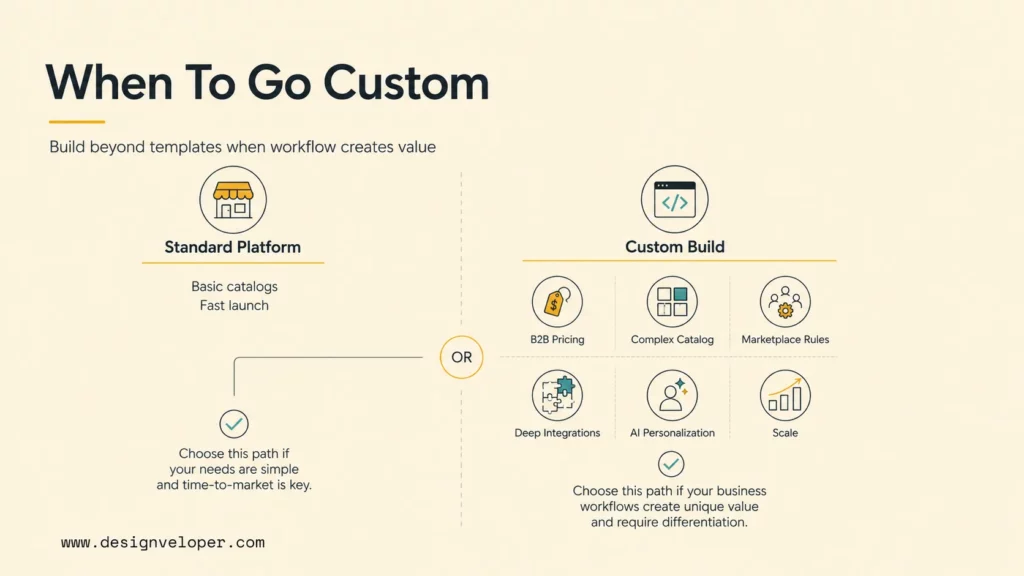
Ecommerce technology needs custom development when off-the-shelf platforms no longer fit the business workflow. Common triggers include complex catalogs, configurable products, B2B pricing, custom checkout, marketplace rules, ERP integration, advanced search, AI personalization, unusual fulfillment, customer portals, and performance or scaling requirements.
This is where IT planning matters. Architecture, APIs, data flow, security, automation, and long-term maintainability shape how well the business can grow. A custom ecommerce system should not be built only because a team wants more control. It should be built because the workflow creates value that standard tools cannot support well.
Designveloper helps businesses build ecommerce websites, web apps, integrations, AI-powered features, and custom digital commerce systems that fit real operational workflows. Our software development services cover web app development, UI/UX, mobile apps, custom software, and support, while our AI development services help teams apply AI to personalization, automation, data workflows, and customer operations with production guardrails.
Public Designveloper work also shows relevant commerce and workflow experience. The Aha ecommerce project reflects commerce-platform work, while projects such as Lumin and HRM show document collaboration and internal workflow thinking that often matters when ecommerce operations become more complex.
FAQs About Ecommerce Business
How Much Does It Cost To Start An Ecommerce Business?
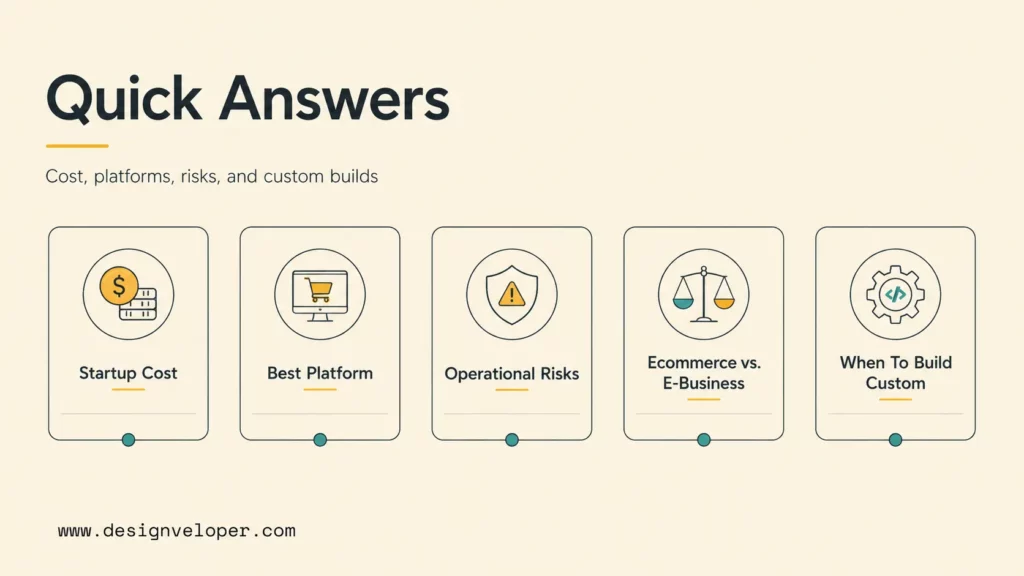
The cost to start an ecommerce business can range from a few hundred dollars for a small marketplace or hosted-platform test to tens of thousands of dollars for a custom storefront, branding, inventory, integrations, marketing, and operations setup. The biggest cost drivers are product sourcing, platform fees, design, development, apps, payment fees, shipping, customer acquisition, and support.
Which Ecommerce Platform Is Best For A New Business?
The best ecommerce platform for a new business depends on product type, budget, technical skill, catalog complexity, integrations, and growth plan. Hosted platforms are usually best for speed. Marketplaces are useful when demand already exists there. Custom storefronts are better when the workflow, brand experience, or integration needs are too specific for standard templates.
What Are The Biggest Operational Risks In Ecommerce?
The biggest operational risks in ecommerce are unreliable inventory, slow fulfillment, unclear returns, payment failures, high acquisition cost, poor mobile checkout, fragmented customer data, weak support, and security or privacy gaps. These risks directly affect revenue, margin, and trust.
What’s The Difference Between Ecommerce Vs E-Business?
Ecommerce usually refers to buying and selling products or services through digital channels. E-business is broader and can include internal operations, online customer service, digital supply chains, data management, process automation, and other business activities supported by digital systems.
When Should An Ecommerce Business Build A Custom Platform?
An ecommerce business should build a custom platform when its workflow is a competitive advantage or when standard tools create repeated workarounds. Strong reasons include B2B pricing, marketplace logic, custom checkout, advanced integrations, customer portals, AI personalization, complex fulfillment, and data workflows that cannot be handled cleanly by standard apps.
A strong ecommerce business starts with a clear model, validates demand, builds a reliable store, connects operations, and uses technology to improve the customer journey. As the business grows, the best technology choices are the ones that make buying easier, operations more reliable, and customer relationships stronger.