


Meta is expanding its 13+ content settings globally to all teen users as the company continues to add more options to help parents manage their kids’ experience in its apps. Ideally, this move will also help Meta avoid further restrictions regarding teen social media usage.
Meta announced what it previously called its PG-13 content setting for young users in October, implementing restrictions that are more in line with what’s acceptable in a PG-13 rated movie.
At launch, these settings were rolled out for teen users in the U.S., U.K., Australia and Canada. Now, Meta is expanding them worldwide.
As explained by Meta: “Facebook’s new 13+ default setting is designed to hide content that’s inappropriate for teens in places like Feed and Reels, and to limit teens’ ability to interact with Profiles, Pages, Groups and Events that primarily post inappropriate content. On Messenger, the 13+ default setting limits teens’ ability to view links to inappropriate Facebook content, or to chat with accounts that primarily share inappropriate content on Facebook.”
In addition, Meta said its more stringent Limited Content settings will be made available in Facebook and Messenger later this year.
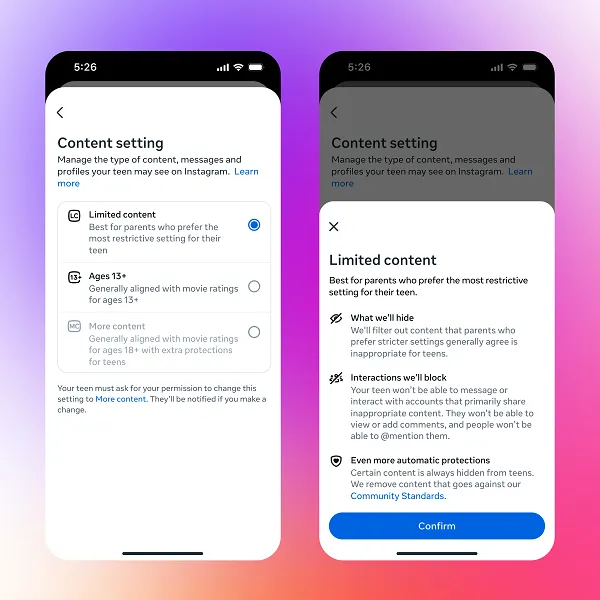
Instagram is also implementing new processes to stop teen users from being exposed to certain topics.
The app will limit exposure to posts about nutrition, weightlifting or how to cope with anxiety, among others, which could further help limit harm for young audiences.
Meta also recently submitted its updated teen safety processes for external assessment, with online safety and security company Alice evaluating the changes and providing insight into their effectiveness.
“Alice created test accounts on Instagram and a leading competitor, and found that Instagram’s protections outperformed the competitor, showing less mature content,” Meta said in an emailed statement. “Where mature content was seen on Instagram Teen Accounts, it was less intense than on the competitor and in movies rated 13+.” Alice’s analysis also identified areas for improvement, which Meta said it has “worked quickly to address.”
Meta is hoping to slow the momentum of teen social media restrictions by implementing more teen safety measures. Many nations are looking to follow Australia’s lead, and implement more definitive age limits for social media use, as well as penalties for violations.
Australia’s under-16 social media ban went into effect last December, making it the first nation to implement major reforms aimed at limiting teen social media use.
Though thus far, responses have been mixed in regards to the effectiveness of the bans. The Australian government’s first report on the ban, which was published in March, suggested that 70% of underage teens are still accessing and using social apps. Meanwhile, academic reports continued to show that the benefits of social media often outweighed the harms for young users.
Still, Meta reported in January that it had removed access to almost 550,000 accounts that it believed belonged to underage users in Australia. So the relative impact to its business could be significant, especially if other regions follow suit and implement more stringent detection measures.
Meta’s 13+ ratings system is designed to make it easier for parents to understand its content rules and restrictions by using a similar ratings measurement as movies do.
Though after a dispute from the Motion Picture Association, Meta does have to be careful about using the term “PG-13.”.
Following Meta’s original announcement of its new content settings system, the MPA issued the company with a cease and desist request, which effectively ordered Meta to stop using the PG-13 classifier, noting, among other concerns, that Meta’s usage in this context is “false and highly misleading.”
Meta was able to come to an agreement with the MPA over the usage of PG-13, though it has had to scale back its references, and now largely uses the term 13+.
Indeed, in an updated blog post on its content ratings system, Meta explained that: “There are lots of differences between social media and movies. We didn’t work with the MPA when updating our content settings, they’re not rating any content on Instagram, and they’re not endorsing or approving our content settings in any way. Rather, we drew inspiration from the MPA’s public guidelines, which are already familiar to parents, as well as feedback from parents.”
Mete further explained that its content moderation systems are not the same as a movie ratings board, “so the experience may not be exactly the same.”
It may seem like a pedantic clarification, as I’m sure most parents don’t expect Meta to follow the exact MPA rules around PG-13 content. But in case of misinterpretation, it is an important update, which may help to clarify what Meta’s content qualifiers actually mean.