


Vibe Coding vs Traditional Coding is really a comparison between intent-first software creation and engineering-first software delivery. Vibe coding uses AI coding tools to turn prompts, rough product ideas, screenshots, and feedback into working code quickly. Traditional coding uses human-led design, implementation, review, testing, and maintenance to keep software understandable and reliable over time.
The speed difference is real, but the risk difference is just as real. Vibe coding can help founders, product managers, designers, and developers explore ideas faster. Traditional coding still matters when a team must own architecture, security, performance, compliance, shared code quality, and long-term maintainability. The useful question is not whether AI replaces developers. The useful question is where fast AI-generated code fits inside a responsible software workflow.
The term “vibe coding” spread after Andrej Karpathy described a style of building where the developer leans into AI-generated changes and spends less time directly editing code. Simon Willison’s widely cited explanation, Not all AI-assisted programming is vibe coding, makes a helpful distinction: using AI while still understanding the code is not the same as accepting AI output mainly by feel. That distinction shapes the whole comparison.
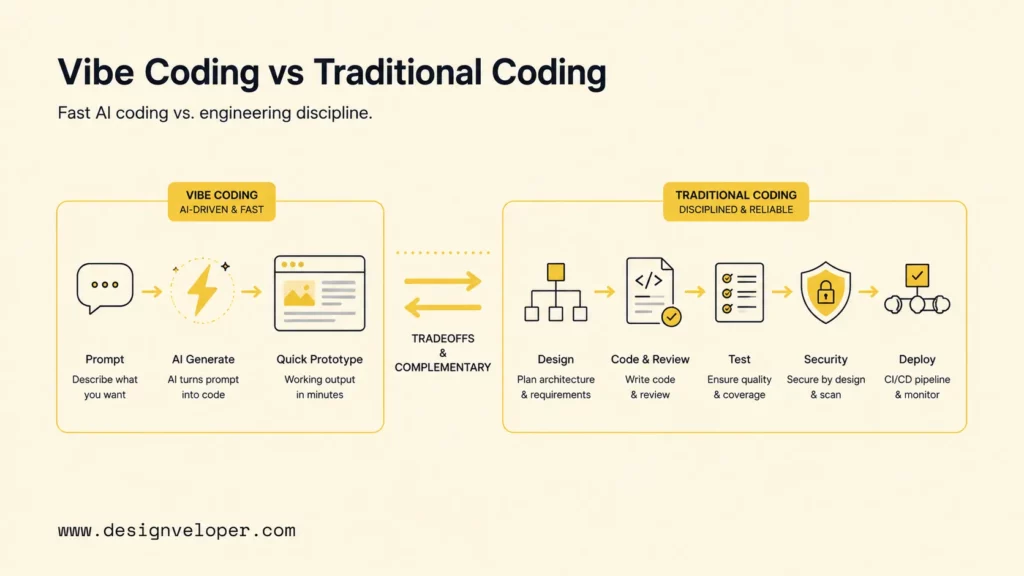
Vibe Coding Vs Traditional Coding: What Is The Difference?
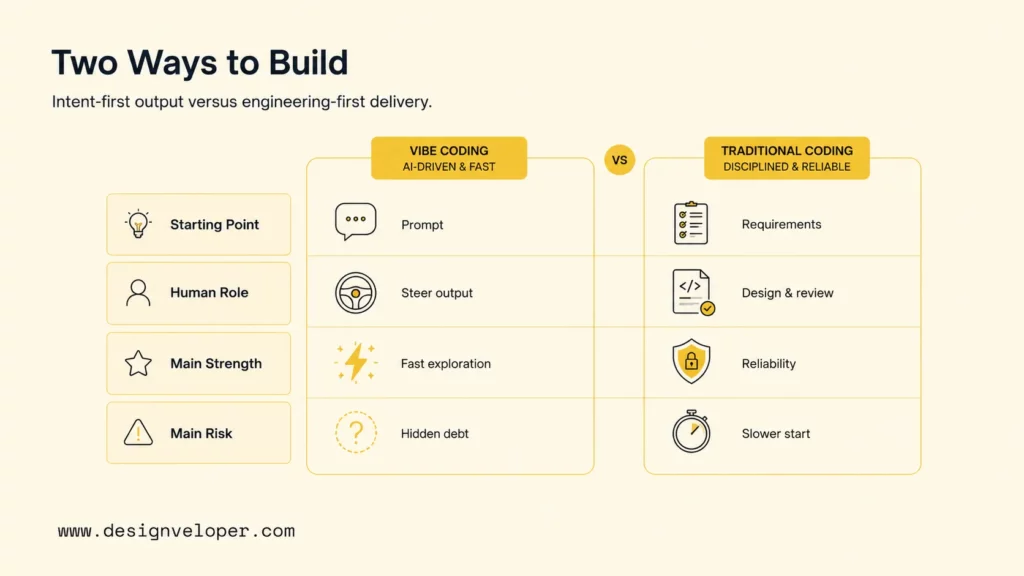
Vibe coding starts from desired behavior, while traditional coding starts from explicit implementation. A vibe-coding session may begin with a prompt such as “build a dashboard where managers can approve refund requests” or “make this onboarding form look like the screenshot.” The AI tool generates a first version, the human tries it, then the human asks for changes. Traditional coding usually begins with requirements, architecture decisions, data models, APIs, components, tests, and reviewable commits.
The difference is not that traditional developers avoid AI. Many strong engineers use GitHub Copilot, Cursor, Claude Code, ChatGPT, or other assistants every day. The difference is the level of control. AI-assisted development keeps the engineer responsible for code comprehension, design decisions, and verification. Vibe coding often pushes more of the implementation detail into the model and relies on feedback loops to steer the result.
A concise comparison helps set the boundary:
| Dimension | Vibe coding | Traditional coding |
|---|---|---|
| Starting point | Intent, prompt, screenshot, rough feature request | Requirements, architecture, code, tests, and design constraints |
| Main strength | Fast exploration and visible prototypes | Control, maintainability, reliability, and shared ownership |
| Human role | Describe, inspect, steer, accept, or reject output | Design, implement, review, debug, test, and maintain |
| Main risk | Code works in a demo but hides design, security, or maintenance problems | Slower early output, especially when the problem is still exploratory |
Recent developer data supports a balanced view. The Stack Overflow 2025 Developer Survey AI section reports broad AI tool usage but also strong concerns about accuracy, security, and privacy. Google’s DORA State of AI-assisted Software Development 2025 report frames AI-assisted software work as a socio-technical change, not only a coding-speed upgrade. Those signals point to the same conclusion: AI coding is useful, but engineering discipline still decides whether the output survives production.
How Vibe Coding Changes The Software Development Workflow
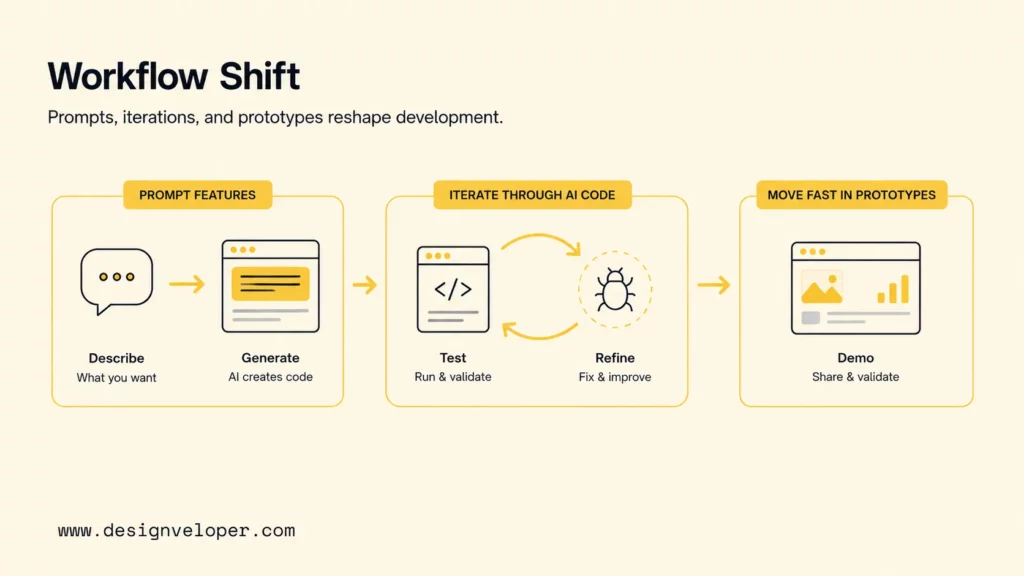
Vibe coding changes the workflow by moving more effort from manual typing to prompt design, output inspection, iterative correction, and product feedback. The visible result is speed. The hidden cost is that the team must work harder to keep context, quality, and ownership from becoming fuzzy.
Prompting Features Instead Of Writing Every Line
Prompting features changes the developer’s first move. Instead of writing every controller, component, migration, and style rule by hand, the human describes the desired feature and lets the AI tool propose code. The prompt may include product behavior, UI state, sample data, constraints, a file path, a framework, or a failing test.
That workflow is powerful when the task has a visible target. A developer can ask for a React component, a FastAPI route, a Prisma model, a test fixture, or a Tailwind layout. OpenAI’s Code Interpreter tool documentation and Anthropic’s tool use documentation show how modern AI systems are increasingly expected to use tools, execute steps, and produce structured work rather than only answer questions.
The prompt-first workflow still needs precision. “Make it better” rarely gives a team maintainable software. Stronger prompts include acceptance criteria, user states, error cases, accessibility expectations, data contracts, and boundaries such as “do not change the database schema” or “only edit the checkout component.”
Iterating Through AI-Generated Code
Vibe coding turns development into a conversational loop. The human asks for a feature, runs the result, notices a defect, asks the AI to fix the defect, then repeats the loop. The loop feels fast because the AI can generate multiple files, styles, tests, or refactors in seconds.
The risk is that each fast iteration can add complexity. A model may patch symptoms instead of removing the root cause. It may add a second state variable instead of fixing data flow. And it may create helper functions that duplicate existing utilities. Without review, the codebase can become a pile of plausible patches.
A practical guardrail is to review each AI-generated change as if a junior teammate submitted it. Read the diff. Run the tests. Ask why the change works. Remove duplicate abstractions. Check whether the code follows existing project patterns. The goal is not to slow the loop for ceremony. The goal is to keep the loop from accumulating hidden debt.
Moving Faster In Prototypes And Early Builds
Vibe coding is strongest when the problem is still exploratory. A founder can test a SaaS dashboard concept. A designer can turn a mockup into an interactive flow. A product manager can validate an internal tool. A developer can scaffold a demo before deciding whether the idea deserves a formal implementation.
GitHub’s Octoverse 2025 report describes AI as a major force in developer workflows and notes momentum around Copilot coding agent and code review features. The useful lesson for prototypes is straightforward: AI coding tools can lower the cost of a first working version.
Prototype speed should not be confused with production readiness. A prototype can use fake data, loose auth, minimal logging, weak error handling, and a quick UI. A production system needs data migrations, tests, monitoring, accessibility, secure integrations, rate limits, deployment controls, and ownership. The workflow should intentionally shift when the code moves from exploration to delivery.
Where Traditional Coding Still Wins
Traditional coding still wins when the team needs strong architecture, deep debugging, security, compliance, and maintainability. AI can help with those tasks, but the responsibility remains human because production software affects users, revenue, data, and operations.
Architecture And System Design
Architecture is where traditional engineering judgment matters most. A model can suggest a folder structure or service design, but the model does not own the consequences when the system grows. Engineers must decide where domain logic belongs, how services communicate, how data flows, how failures are isolated, and how the design will change as requirements expand.
Architecture work also requires business context. A B2B SaaS product may need tenant isolation, audit trails, feature flags, billing integration, and enterprise permissions from the start. A consumer prototype may need speed and visual polish first. AWS’s Well-Architected Framework is a useful reminder that reliability, security, performance, cost, operations, and sustainability are architecture questions, not line-by-line coding questions.
Debugging, Reliability, And Maintainability
Debugging still rewards code understanding. A vibe-coded feature may pass a quick manual test and fail under real data, concurrency, browser differences, permissions, or edge-case inputs. Traditional debugging asks what changed, what invariant broke, what logs prove the failure, and what test will prevent recurrence.
Maintainability is also a human responsibility. A team needs names that match the domain, modules that reflect ownership, tests that explain expected behavior, and code paths that future developers can reason about. The Martin Fowler software quality essay explains why internal quality affects the speed of future change. AI-generated code that nobody understands can make later work slower, even if the first feature arrived quickly.
Security, Compliance, And Production Readiness
Security is the hardest place to rely on vibes. AI-generated code can miss authorization checks, mishandle secrets, log sensitive data, skip input validation, or introduce dependency risks. OWASP’s Top 10 for LLM Applications highlights risks such as prompt injection, sensitive information disclosure, and excessive agency. Those risks become more serious when AI-generated software connects to tools, databases, and user accounts.
Production readiness also includes compliance, observability, deployment, rollback, and incident response. A traditional engineering workflow makes those concerns explicit through code review, threat modeling, CI/CD, automated tests, monitoring, runbooks, and access control. Vibe coding can contribute code, but the team still needs a production gate.
The Real Tradeoffs Between Vibe Coding And Traditional Coding
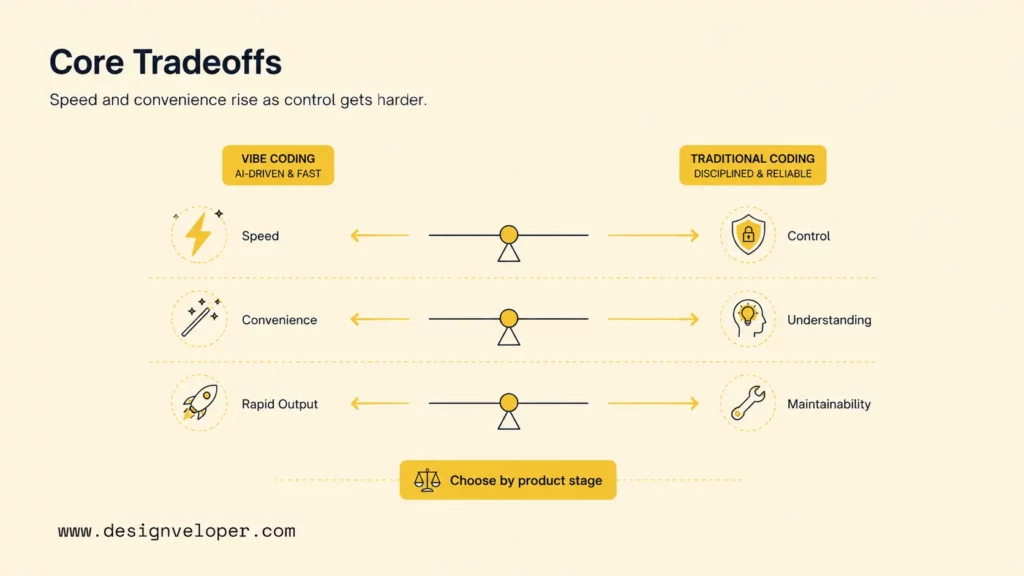
The real tradeoffs are speed versus control, convenience versus code understanding, and rapid output versus long-term maintainability. Teams get the most value when they decide which side of each tradeoff matters for the current stage of the product.
Speed Vs Control
Vibe coding wins on speed when the team wants visible progress quickly. The AI tool can generate screens, routes, tests, SQL queries, scripts, and copy before a human would finish scaffolding. That speed is useful for demos, internal tools, and proof-of-concept work.
Traditional coding wins on control when the cost of a wrong abstraction is high. Payment systems, healthcare workflows, enterprise authentication, customer data pipelines, and shared platform modules need deliberate design. A generated implementation may be fast, but the team needs to know exactly how the implementation handles failure, privacy, and change.
Convenience Vs Code Understanding
AI code generation is convenient because it removes blank-page friction. A developer can ask for a migration, regex, unit test, or UI state machine. That convenience can turn risky when the team stops understanding what was generated. Stack Overflow’s 2025 survey reports that developer concerns about AI accuracy remain high, which matches the day-to-day reality of reviewing plausible but wrong outputs.
A healthy workflow treats generated code as a draft. The human still reads it, simplifies it, aligns it with project conventions, and explains it in review. If nobody on the team can explain a generated module, the module is not ready to become part of a shared codebase.
Rapid Output Vs Long-Term Maintainability
Rapid output can create momentum, but maintainability decides whether momentum lasts. A vibe-coded demo may use global state, repeated helpers, broad try/catch blocks, hardcoded values, and unclear ownership. Those choices may be acceptable for a weekend experiment. Those choices are costly when the product gains users and teammates.
A maintainability checklist should appear before production:
- Does the feature use the same patterns as the existing codebase?
- Are domain rules represented in one clear place?
- Are error states, empty states, and permissions tested?
- Can a teammate modify the feature without reverse-engineering a prompt conversation?
- Does the implementation have logs, metrics, and rollback paths where needed?
How Vibe Coding Compares With Other AI-Native Development Styles
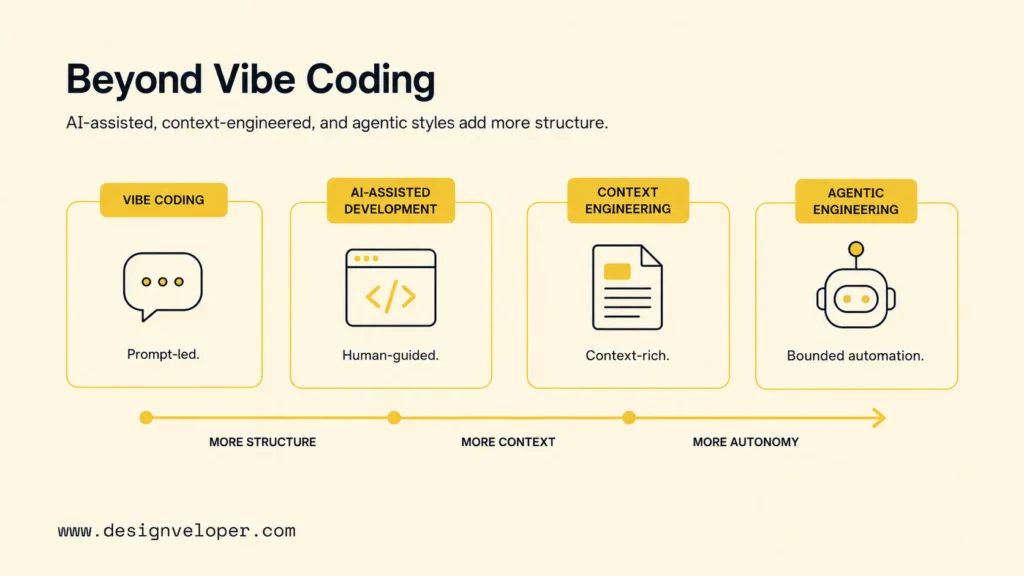
Vibe coding is only one AI-native development style. AI-assisted development, context engineering, and agentic engineering add more structure, context control, and execution discipline. The more critical the software, the more structure the workflow needs.
Vibe Coding Vs AI-Assisted Development
Vibe coding asks AI to drive more of the implementation by intent. AI-assisted development keeps the developer in a more traditional driver seat. The developer may use Copilot for completions, ChatGPT for explanation, Claude Code for a refactor, or an IDE assistant for tests, but the developer remains focused on understanding and controlling the code.
AI-assisted development is often the safer default for professional teams. The workflow gains speed without giving up code review, architecture ownership, and explicit testing. GitHub’s Copilot code review announcement shows how AI assistance is moving into review and quality workflows, not only generation.
Vibe Coding Vs Context Engineering
Context engineering is more deliberate than vibe coding. The team curates instructions, repository context, domain rules, examples, schemas, documentation, test commands, and acceptance criteria so AI tools produce better work. Context engineering treats the prompt environment as part of the development system.
That discipline matters because AI tools are only as useful as the context they can see and follow. A context-engineered workflow may include project-specific coding guidelines, architecture docs, test fixtures, API contracts, security rules, and examples of good commits. The result is still AI-assisted, but the team reduces ambiguity before generation begins.
Vibe Coding Vs Agentic Engineering
Agentic engineering gives AI tools more autonomy but also more structure. An agent may inspect files, run tests, edit code, call tools, open pull requests, and respond to review feedback. OpenAI’s Agents guide and Anthropic’s tool-use documentation show why agents require models, tools, instructions, and guardrails working together.
Agentic engineering can be more disciplined than vibe coding when the agent has clear tasks, bounded permissions, test commands, review gates, and rollback paths. Agentic engineering can be more dangerous when the agent has broad write access, vague goals, or no human approval. The difference is not autonomy alone. The difference is whether autonomy is constrained by engineering process.
Where Vibe Coding Works Best And Where It Breaks Down
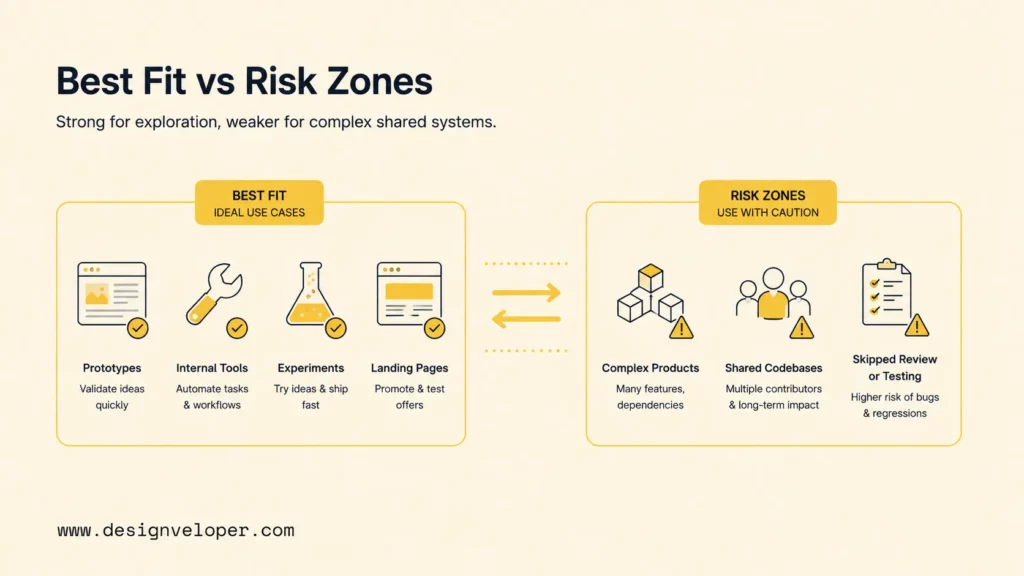
Vibe coding works best where speed, exploration, and visible feedback matter more than long-term ownership. Vibe coding breaks down where the codebase is shared, the domain is complex, or the team skips review and testing.
Best For Prototypes, Internal Tools, And Fast Experiments
Vibe coding is a strong fit for prototypes, throwaway demos, landing-page experiments, small internal utilities, UI variations, migration scripts, dashboards, and first-pass product ideas. The goal is to learn quickly. A team can test whether users understand a workflow, whether a data view is useful, or whether an integration idea is worth formal investment.
The best vibe-coding tasks have clear visual or behavioral feedback. “Generate a settings page with team roles” is easier to evaluate than “design the long-term authorization architecture.” “Create a script that converts CSV files into JSON for a demo” is safer than “rewrite the production billing reconciliation service.”
Riskier For Complex Products And Shared Codebases
Vibe coding gets riskier when many developers share the codebase. Shared code needs stable patterns, reviewable abstractions, ownership boundaries, tests, and conventions. AI-generated changes can accidentally bypass those patterns. A feature that looks correct in isolation may conflict with analytics, accessibility, localization, caching, permissions, or deployment rules.
Complex products also have hidden requirements. A checkout flow may need fraud checks, tax logic, regional restrictions, retries, idempotency, audit logs, customer support visibility, and finance reconciliation. A quick generated implementation may cover the visible UI while missing the operational system behind it.
Weakest When Teams Skip Review, Testing, And Context Management
Vibe coding is weakest when the team treats generated code as finished code. Skipping review, tests, and context management turns AI speed into future debugging work. The warning signs are easy to spot: large unexplained diffs, no tests, inconsistent patterns, repeated generated helpers, vague commit messages, and developers who cannot explain why the code works.
The fix is not to ban AI coding. The fix is to add review, testing, and context. A team can require small diffs, issue-linked prompts, generated tests plus human-reviewed tests, security checks, and a clear acceptance checklist before merging AI-generated code.
How Teams Should Use Vibe Coding Without Sacrificing Engineering Quality
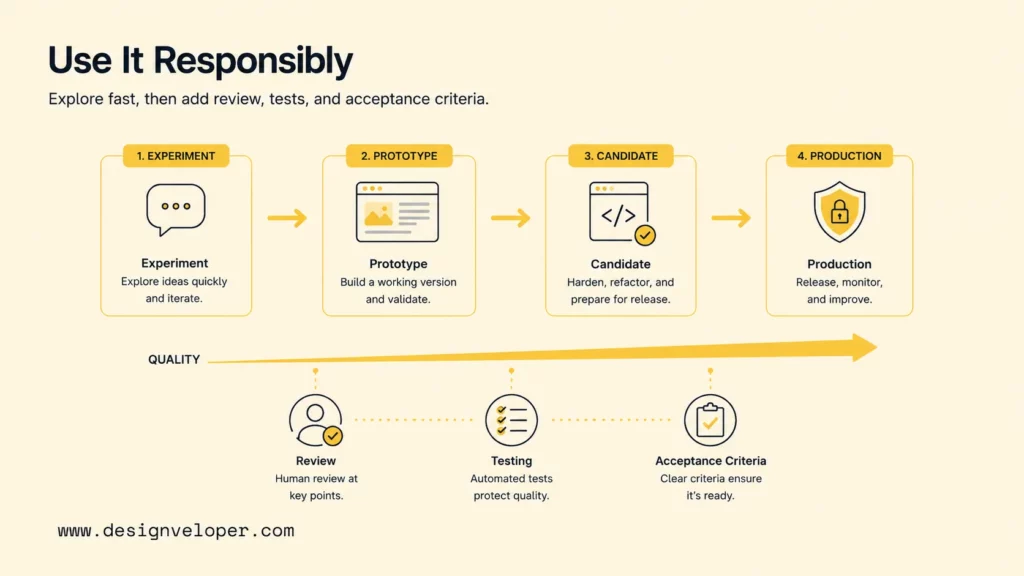
Teams should use vibe coding as an exploration accelerator, then shift to structured engineering before the code becomes production-critical. The workflow should make the transition explicit so prototypes do not quietly become permanent systems.
Use It To Accelerate Exploration, Not Replace Judgment
Vibe coding should help teams explore options faster, not outsource product and engineering judgment. Developers should use AI to create first drafts, compare approaches, generate test ideas, explain unfamiliar APIs, and scaffold UI or scripts. Humans should still decide what belongs in the product, what architecture fits the domain, and what quality bar the code must meet.
A useful team rule is to label vibe-coded work by stage: experiment, prototype, candidate, or production. Experiment code can move quickly. Candidate code must be reviewed and tested. Production code must meet the same quality standards as any other code.
Add Review, Testing, And Acceptance Criteria Early
Review and testing should start before the AI tool generates a large diff. Acceptance criteria give the model and the reviewer a target. A good task includes user behavior, non-goals, edge cases, test commands, and affected files. The model may still miss details, but the team has a clear basis for rejecting or revising output.
A practical AI-generated-code review rubric includes:
- Intent: Does the change solve the requested user or business problem?
- Scope: Did the AI edit only the files and layers it should edit?
- Correctness: Are normal, empty, error, and permission states handled?
- Tests: Do tests cover the behavior and likely regressions?
- Security: Are authentication, authorization, secrets, and input validation handled?
- Maintainability: Can a teammate understand and modify the code later?
- Observability: Are important failures visible through logs, metrics, or alerts?
Shift To Structured Engineering Before Production Scale
The shift to structured engineering should happen when the feature affects real users, money, sensitive data, compliance, or shared product architecture. At that point, the team should stop treating the code as a conversational artifact and start treating it as owned software.
The transition should include design review, threat modeling, code cleanup, test expansion, documentation, monitoring, deployment planning, and an owner for future changes. The team can still use AI heavily during this stage. The difference is that AI operates inside a controlled engineering workflow.
Turning AI-Generated Code Into Production-Ready Software
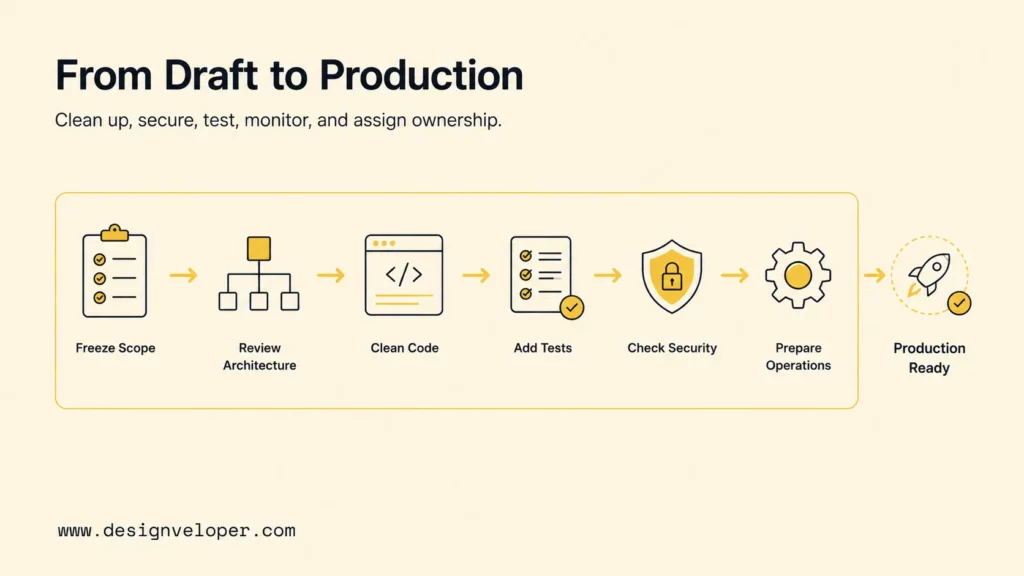
Turning AI-generated code into production-ready software requires the same engineering discipline as any other software, plus extra attention to hidden assumptions from the generation process. The team should verify architecture, security, tests, accessibility, performance, deployment, monitoring, and ownership before a fast prototype becomes a live product feature.
Designveloper treats AI-generated code as a starting point, not the finish line. As an AI-first software and automation partner, we help teams use LLMs, AI agents, and developer tooling inside real delivery workflows. Our web application development services and Agile delivery process connect discovery, architecture, development, QA, deployment, and maintenance so speed does not erase accountability.
A production-ready path usually looks like this:
- Freeze the prototype behavior: define what the AI-generated feature is supposed to do and what is out of scope.
- Review architecture: decide whether the generated structure fits the product’s domain, data flow, and ownership boundaries.
- Clean the code: remove duplicates, hardcoded values, unnecessary abstractions, unused files, and inconsistent patterns.
- Add tests: cover happy paths, errors, permissions, edge cases, and regression-prone logic.
- Check security: review auth, secrets, dependency risks, input validation, logging, and data exposure.
- Prepare operations: add monitoring, rollout plans, rollback steps, documentation, and a maintenance owner.
The strongest teams will not choose vibe coding or traditional coding as a permanent identity. They will use vibe coding for speed, AI-assisted development for leverage, context engineering for repeatability, agentic engineering for bounded automation, and traditional engineering for production ownership. That mix is where AI coding becomes useful without letting fast output quietly become fragile software.