


An AI voice agent for customer service is a software agent that understands spoken requests, uses company data, speaks back naturally, and completes support actions such as checking order status, booking appointments, qualifying leads, or escalating calls to a human. The best voice agents are not just realistic voices. The best voice agents connect speech recognition, intent understanding, knowledge retrieval, business-system actions, audit logs, and safe handoffs.
Business interest is rising because service leaders face pressure to improve first-contact resolution and reduce customer effort. The Gartner customer service AI survey 2026 found that 91 percent of customer service leaders were under pressure to implement AI in 2026, while McKinsey contact center AI analysis describes contact centers as a changing mix of humans and AI rather than a simple replacement story.
This guide explains where an ai voice agent for customer service fits, how the workflow works, which services businesses should evaluate, and how to build voice automation that completes real support tasks without hiding reliability, security, or customer-experience risks.
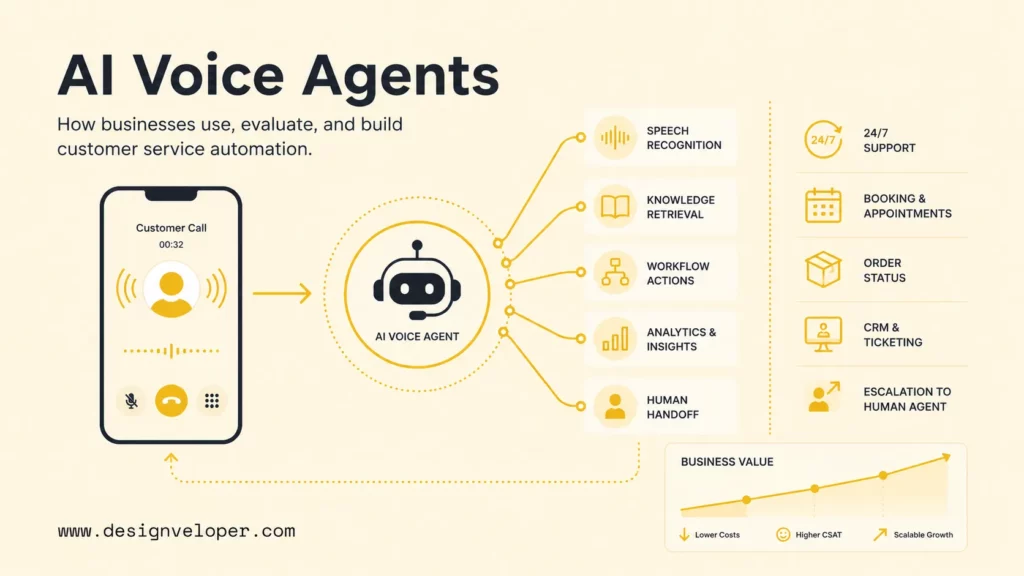
What Is An AI Voice Agent For Customer Service?
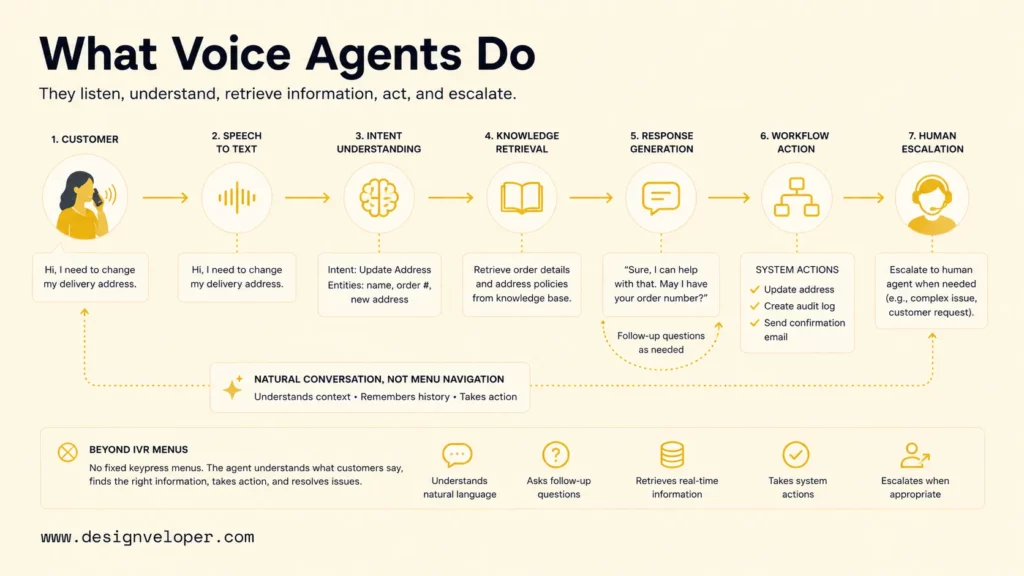
An AI voice agent for customer service is a conversational AI system designed to handle phone or voice-based support interactions. The agent listens to a caller, transcribes speech, identifies intent, retrieves the right business context, generates an answer, speaks the response, and performs approved workflow actions. Voice agents can also summarize calls, create tickets, schedule appointments, update CRM records, or transfer the caller to a human with context.
A voice agent is different from a basic IVR menu. Traditional IVR systems ask customers to press numbers or speak limited commands. AI voice agents can handle more natural language, interruptions, follow-up questions, and multi-step support paths. Technologies such as the OpenAI Realtime API, Google Dialogflow CX, Amazon Connect, and Twilio Voice documentation show how voice, telephony, conversation logic, and integrations can be combined into business workflows.
The practical definition matters because many demos over-focus on how human the voice sounds. Voice quality helps, but task completion matters more. A support voice agent needs accurate entity capture, reliable access to business data, clear escalation rules, privacy controls, QA review, and a monitored path for improvement.
Why Businesses Are Using AI Voice Agents For Customer Service
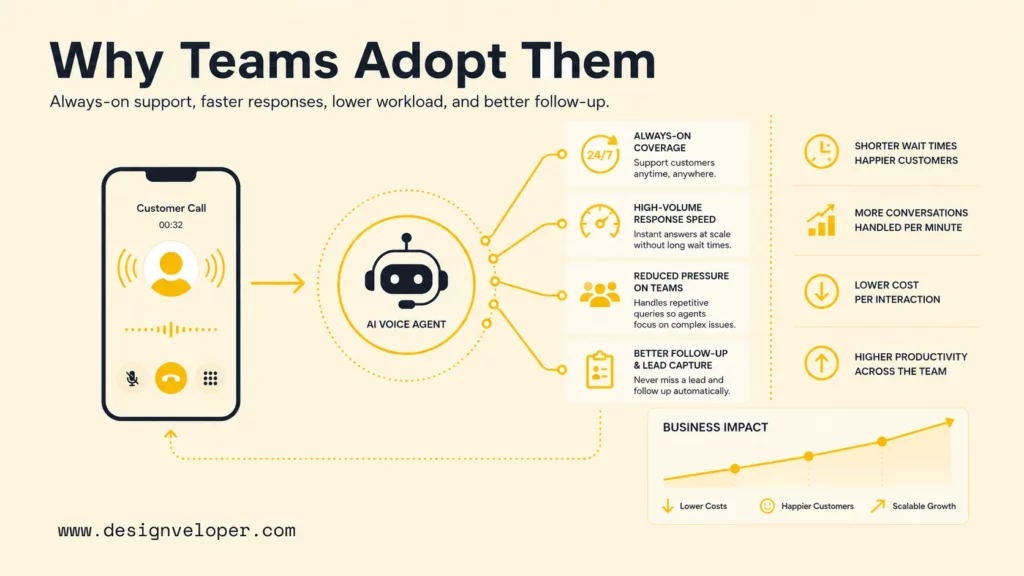
Businesses use AI voice agents because phone support is expensive, uneven, and hard to scale during demand spikes. A well-designed voice agent can answer routine calls quickly, collect clean information, reduce queue pressure, and give human agents more context before escalation.
The strongest business case appears when calls are frequent, repetitive, and structured enough for automation. The weakest case appears when calls are emotionally sensitive, legally risky, or dependent on judgment that the business cannot encode into policies.
24/7 Call Coverage Without Missed Inquiries
AI voice agents give businesses a way to answer calls after hours, during weekends, and across time zones. The agent can capture the caller’s request, answer approved questions, create a callback task, or route urgent cases. That coverage is valuable for clinics, home services, logistics providers, SaaS support, education providers, and appointment-based businesses.
Always-on coverage should still be scoped. A voice agent can handle routine inquiries, booking requests, address changes, and order checks. A voice agent should transfer or defer sensitive requests such as complaints, cancellations with financial consequences, medical advice, or account-security issues when the workflow requires human judgment.
Faster Response For High-Volume Support Requests
High-volume support teams often receive the same questions repeatedly. Customers ask where an order is, whether a booking is confirmed, how to reset an account, when a technician will arrive, or what documents are required. Voice agents can answer those repetitive calls faster than a queue-based human-only process.
Speed needs to be measured beyond average handle time. A good AI voice assistant for business should improve containment rate, first-contact resolution, caller satisfaction, and escalation quality. A fast wrong answer is worse than a slower human handoff, so response speed must be paired with accuracy checks.
Lower Pressure On Human Support Teams
AI voice agents reduce pressure by taking repetitive calls, collecting information before a handoff, summarizing conversations, and letting human agents focus on complex cases. The value is not only fewer calls. The value is better use of human attention.
Frontline agents also need visibility into what the AI did before the handoff. Salesforce’s Agentforce Contact Center announcement highlights live context, transcripts, and routing as part of contact center automation. That kind of operational visibility helps human agents avoid asking callers to repeat everything.
Better Follow-Up And Lead Capture
Voice agents can capture follow-up details while the caller is still engaged. An AI voice sales agent can ask qualifying questions, capture budget and timeline, schedule a consultation, create a CRM record, and route the lead to the right sales owner. Support agents can create callback tasks, tag the issue, and summarize next steps.
Lead capture quality depends on entity accuracy. Names, emails, phone numbers, company names, order IDs, and appointment times are easy to mishear. A reliable workflow repeats critical details for confirmation, validates formats, and sends a written follow-up when appropriate.
Where AI Voice Agents Fit Best In Customer Service
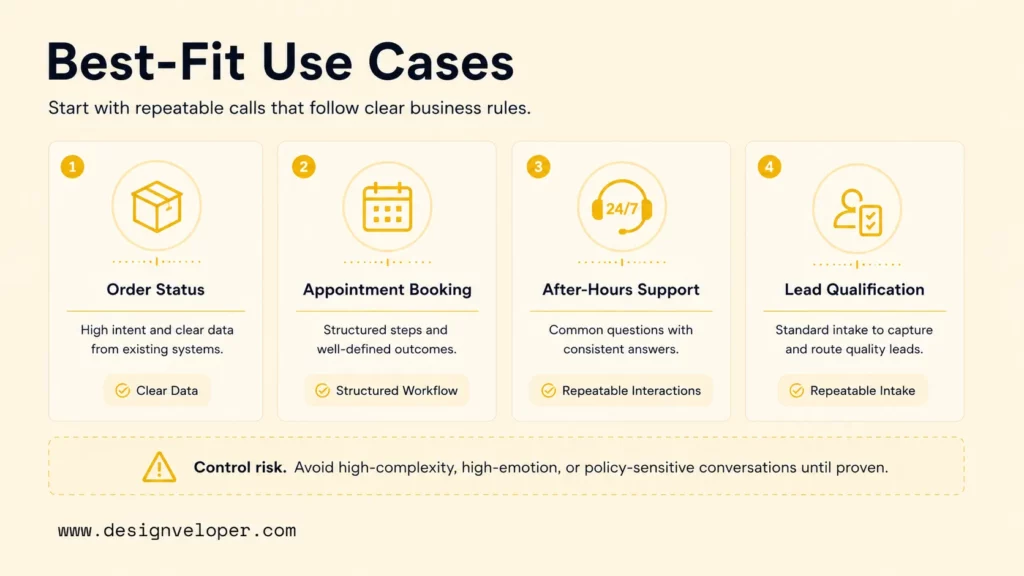
AI voice agents fit best where calls are common, intent categories are clear, backend systems are accessible, and business rules are documented. Voice automation should begin with a narrow workflow, not a full contact center replacement.
The table below shows where voice agents usually create value first.
| Use case | Good fit | Risk to control |
|---|---|---|
| Order status | High-volume questions with clear data sources. | Wrong order matching or outdated shipment data. |
| Appointment booking | Structured scheduling with clear availability. | Time-zone errors, double booking, and missed confirmations. |
| After-hours support | Capturing requests and resolving simple cases outside office hours. | Weak escalation for urgent or emotional cases. |
| Lead qualification | Repeatable sales intake questions and CRM updates. | Misheard contact details and over-aggressive qualification. |
Order Status, Booking, And Account Support
Order status, booking, and account support are strong first use cases because the agent can follow a structured path. The voice agent asks for an identifier, confirms the caller, retrieves a record, reads the answer, and offers next steps. That workflow is easier to test than an open-ended complaint.
Businesses should connect the voice agent to reliable sources such as order management systems, calendars, account databases, or support tools. The voice agent should not guess when records are missing. A safe voice workflow says what it can verify and escalates when the data is unclear.
After-Hours And Overflow Call Handling
After-hours and overflow call handling is valuable because missed calls often become lost revenue or poor service experiences. The voice agent can answer routine questions, collect details, prioritize urgency, and create tasks for the next business day.
The escalation design matters more than the greeting. If an after-hours caller reports a safety issue, payment issue, or urgent service failure, the agent needs a clear rule for transferring, paging, or creating an urgent ticket. Without that rule, after-hours automation becomes a customer-experience risk.
Appointment-Based And Service Businesses
Appointment-based businesses benefit because scheduling conversations follow repeatable patterns. The agent can ask about preferred time, service type, location, customer details, and special requirements. The agent can then check availability and confirm the booking.
Service businesses should test edge cases such as rescheduling, no-show policies, location mismatches, emergency requests, and multilingual callers. A voice agent is useful only when it can handle the common path and transfer the exceptions cleanly.
AI Voice Sales Agent And Lead Qualification Workflows
An AI voice sales agent can qualify inbound calls, respond to campaign inquiries, ask discovery questions, and create follow-up tasks. The best workflows keep the sales motion helpful rather than pushy. The agent should identify fit, urgency, and next steps without pretending to be a senior salesperson.
Lead qualification should be measured by downstream quality. A business should compare booked meetings, valid contact details, sales acceptance rate, and conversion quality. If the agent creates many poor leads, the automation is adding noise rather than value.
How An AI Voice Agent Works In A Business Workflow
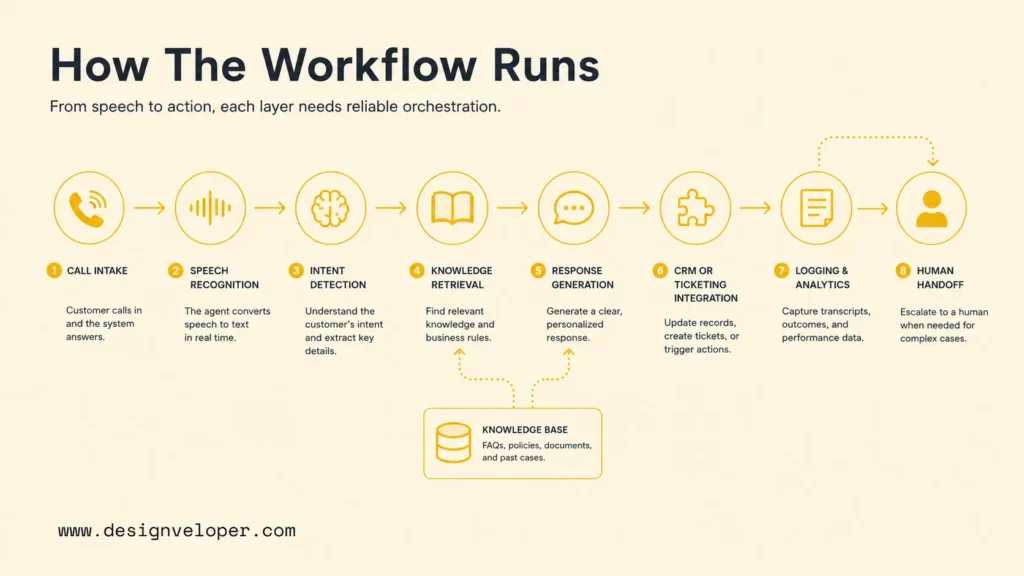
An AI voice agent works by combining speech processing, intent understanding, knowledge retrieval, response generation, system integrations, and escalation logic. Each layer must be designed and tested because one weak layer can break the whole call.
The workflow usually follows this sequence: receive the call, transcribe speech, identify intent, retrieve or update business data, generate a response, speak back naturally, validate critical details, log the conversation, and escalate when rules require a human.
Speech Recognition And Intent Understanding
Speech recognition turns the caller’s voice into text. Intent understanding decides what the caller wants. Both steps are harder than they look because callers interrupt, change topics, speak with accents, give partial information, or use noisy environments.
Reliable voice systems treat transcription confidence and intent confidence as workflow signals. Low confidence should trigger clarification. Sensitive intents should trigger verification or escalation. Voice agents should not keep pushing forward when the system is unsure.
Knowledge Retrieval And Response Generation
Knowledge retrieval gives the agent business-specific answers. The agent may search help-center articles, policy documents, CRM notes, product data, order records, or internal procedures. Response generation turns retrieved information into a spoken answer that matches the company’s tone and support policy.
Retrieval quality is crucial. If the knowledge base is outdated, inconsistent, or missing policy boundaries, the voice agent will fail in a more visible way than a text chatbot. Businesses should clean the knowledge base before scaling voice automation.
CRM, Ticketing, And Scheduling Integrations
CRM, ticketing, and scheduling integrations turn the voice conversation into completed work. A voice agent can create a ticket, update a customer profile, schedule a visit, record a call summary, or trigger a follow-up workflow. Tool-use patterns from OpenAI Agents guide and Anthropic tool use documentation show why agent behavior must be connected to explicit tools and permissions.
Integration design should be conservative. The agent should have the least permissions needed for the workflow. High-impact actions should require confirmation. Every write action should be logged with the caller, timestamp, transcript reference, data source, and result.
Escalation Rules And Human Handoffs
Escalation rules decide when the voice agent stops and a human takes over. It can be based on caller sentiment, low confidence, policy limits, repeated failure, high-value customers, legal risk, account security, refund thresholds, or explicit human requests.
The handoff should include a transcript, summary, detected intent, verified details, attempted actions, and recommended next step. A weak handoff makes callers repeat themselves and damages trust. A strong handoff makes the AI feel like part of the support team rather than a barrier.
What Businesses Should Look For In AI Voice Agent Services
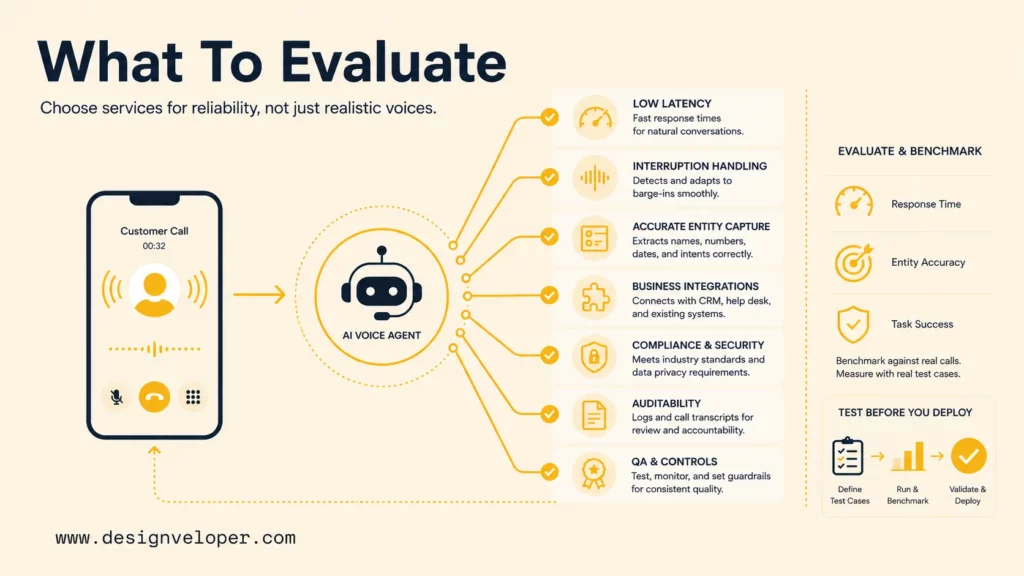
Businesses should evaluate AI voice agent services by workflow reliability, not only voice realism. A service should prove low latency, interruption handling, entity accuracy, integrations, auditability, compliance controls, QA workflows, and clear escalation design.
Vendor demos can be impressive, so buyers should test with real calls. Use anonymized transcripts, noisy audio, unusual names, policy exceptions, frustrated callers, and incomplete information. A voice service that cannot pass realistic tests should not be trusted with live customer traffic.
Low Latency And Natural Interruption Handling
Low latency matters because voice is synchronous. A slow response feels broken on a call even when the answer is correct. Natural interruption handling also matters because callers will pause, correct themselves, ask follow-up questions, and talk over the agent.
A good evaluation should measure time to first response, turn-taking quality, barge-in behavior, silence handling, retry behavior, and recovery after misunderstanding. Voice quality is only convincing when conversation timing feels natural.
Accurate Capture Of Names, Emails, And Order IDs
Accurate entity capture is one of the most important production requirements. Names, emails, order IDs, addresses, dates, and phone numbers drive the downstream workflow. One wrong character can create a failed lookup or a bad customer record.
Voice agents should repeat critical details, spell back uncertain fields, validate formats, and offer SMS or email confirmation when appropriate. Entity capture should be tracked as a separate metric, not hidden inside overall call success.
Business System Integrations And Workflow Actions
Business system integrations decide whether the voice agent can finish the job. A service that only talks cannot resolve order issues, update bookings, create tickets, or qualify leads. The agent must connect safely to the systems where customer work happens.
Teams should ask vendors how integrations handle authentication, rate limits, unavailable systems, duplicate records, partial updates, and rollback. A voice agent should never pretend an action succeeded when the backend failed.
Compliance, Auditability, And QA Controls
Compliance and auditability are essential because voice agents handle personal data, payment-adjacent details, account context, and sometimes sensitive requests. The NIST AI Risk Management Framework gives teams a risk-management framework for AI systems, while the NIST AI RMF 1.0 publication defines a governance-oriented view of trustworthy AI.
Businesses should require transcript retention rules, consent handling, access controls, redaction, call sampling, escalation logs, policy versioning, and incident review. Voice agent security is also becoming a research topic; the Aegis voice agent security research highlights governance, integrity, and security risks for deployed voice agents.
How To Build An AI Voice Agent For Customer Service
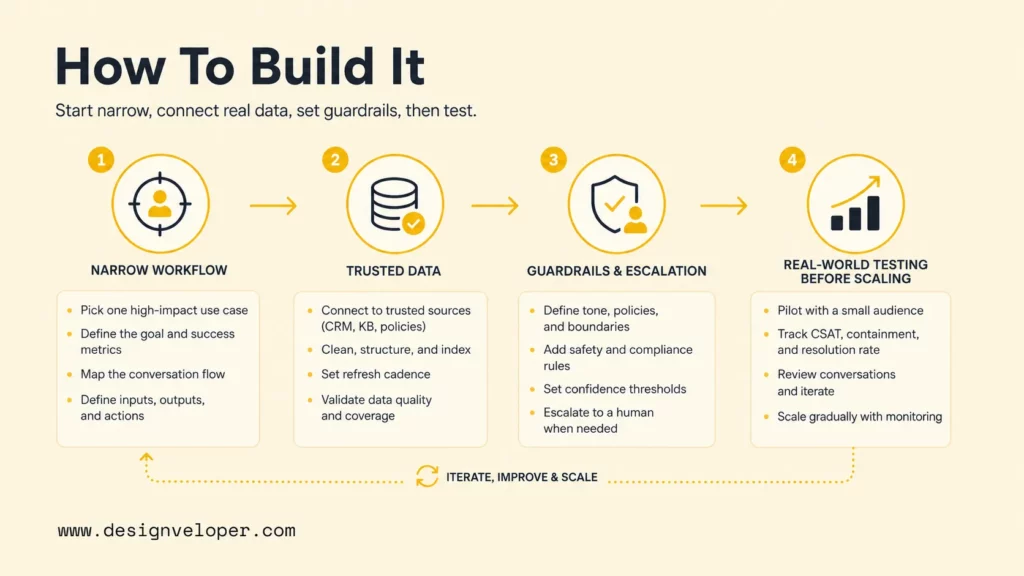
Businesses should build an AI voice agent by starting narrow, connecting trusted data, defining guardrails, and testing with real conversations before scaling. The first build should prove one workflow end to end rather than attempting to replace an entire contact center.
At Designveloper, we treat voice automation as a product engineering project. Through AI development services and broader software services, we map the support workflow, data access, integration points, escalation rules, QA process, and post-launch ownership before recommending a production rollout.
Start With One Narrow Support Workflow
Start with one workflow such as order status, appointment booking, after-hours intake, lead qualification, or password reset guidance. A narrow workflow is easier to script, test, monitor, and improve. It also creates clearer acceptance criteria.
The first workflow should have enough call volume to matter and low enough risk to launch safely. A good pilot has documented intents, known data sources, clear fallback rules, and measurable outcomes.
Connect The Agent To Real Business Data
Connect the agent to real business data only after permissions and data quality are clear. A voice agent needs accurate knowledge articles, CRM fields, order records, booking availability, ticket status, or policy documents depending on the workflow.
Data connections should be read-only at first when risk is high. Write actions can be added after the business validates identity, authorization, logging, and rollback. The goal is to make the agent useful without giving it more power than the workflow needs.
Define Guardrails For Accuracy, Tone, And Escalation
Guardrails define what the agent may say, what the agent may do, when the agent must ask for clarification, and when the agent must transfer to a person. Guardrails also cover tone, prohibited claims, refund language, policy boundaries, privacy notices, and emergency handling.
Good guardrails are written as testable rules. For example, “If order lookup confidence is below 90 percent, ask for a second identifier” is better than “be accurate.” Testable rules make QA and monitoring possible.
Test With Real Conversations Before Scaling
Test the voice agent with real conversation patterns before scaling. Use anonymized call recordings, transcripts, noisy audio, interruptions, angry callers, misspelled names, incomplete order IDs, and policy exceptions. A demo script is not enough.
Designveloper’s delivery process emphasizes discovery, specification, design, development, testing, deployment, and iteration. That delivery rhythm fits AI voice agents because the system needs controlled learning after launch, not a one-time build.
Why AI Voice Agents Succeed Or Fail In Production
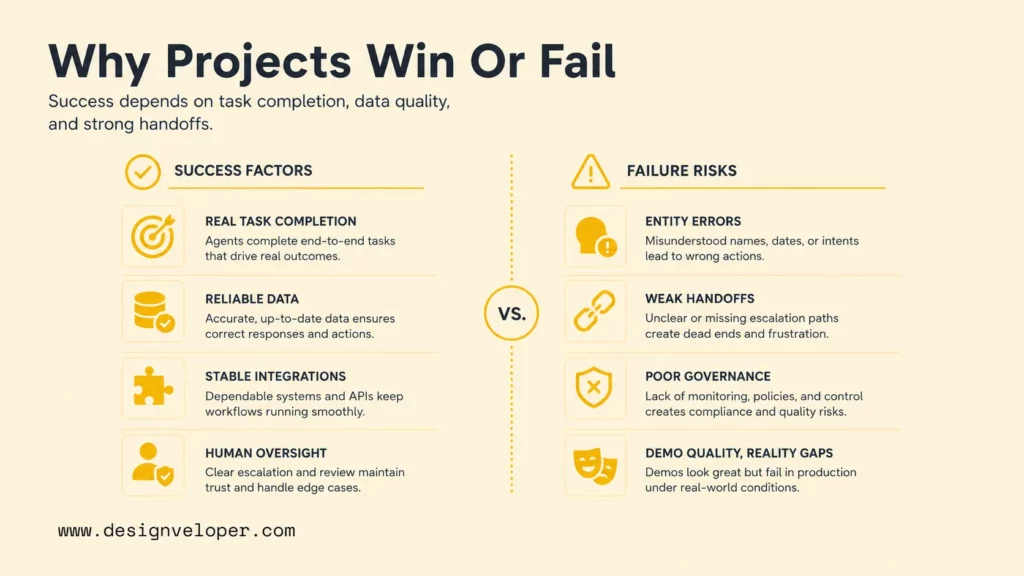
AI voice agents succeed when the workflow is clear, data is reliable, integrations are stable, and humans can supervise exceptions. Voice agents fail when teams optimize demo quality instead of production completion.
Recent customer-service AI rollbacks show why governance matters. Coverage of Sinch research reported by Sinch customer service AI rollback coverage pointed to rollback drivers such as data exposure, hallucinations, brand risk, and lack of auditability. Those failure modes are exactly what production teams need to test before launch.
They Succeed When They Can Complete Real Tasks
Voice agents succeed when they complete a real task that a customer recognizes. Answering a question is useful. Updating a booking, creating a ticket, confirming an order, or routing an urgent case is more valuable because the customer gets a completed outcome.
The success metric should be task completion with quality. A business should track containment, resolution accuracy, entity accuracy, human escalation quality, and customer satisfaction together.
They Fail When Entity Accuracy Breaks Down
Voice agents fail when entity accuracy breaks down. A single wrong digit in an order ID, phone number, address, or appointment time can make the system look incompetent. The failure may also create downstream work for human agents.
Entity accuracy should be designed into the conversation. Confirmation prompts, phonetic spelling, SMS verification, and backend validation can reduce errors. The agent should admit uncertainty and ask again rather than guessing.
They Lose Trust When Handoffs Are Weak
Voice agents lose trust when callers must repeat themselves after transfer. A handoff should include a concise summary, verified details, transcript, sentiment signal, attempted actions, and recommended next step. The human agent should know why the voice agent escalated.
Weak handoffs are often a workflow design problem rather than a model problem. The contact center needs routing logic, agent desktop integration, clear transcript display, and human training on how to continue an AI-assisted call.
They Underperform When Demo Quality Hides Workflow Gaps
Voice agents underperform when a polished demo hides missing business logic. A voice can sound natural while the system lacks CRM access, policy rules, identity checks, escalation logic, or QA controls. The first live calls then expose the gap.
Businesses should test the full workflow under realistic conditions. The agent should handle interruptions, ambiguous intent, system downtime, duplicate records, sensitive requests, and caller frustration. Production readiness comes from workflow proof, not theatrical realism.
The Best Voice Agent Is The One That Can Finish The Job
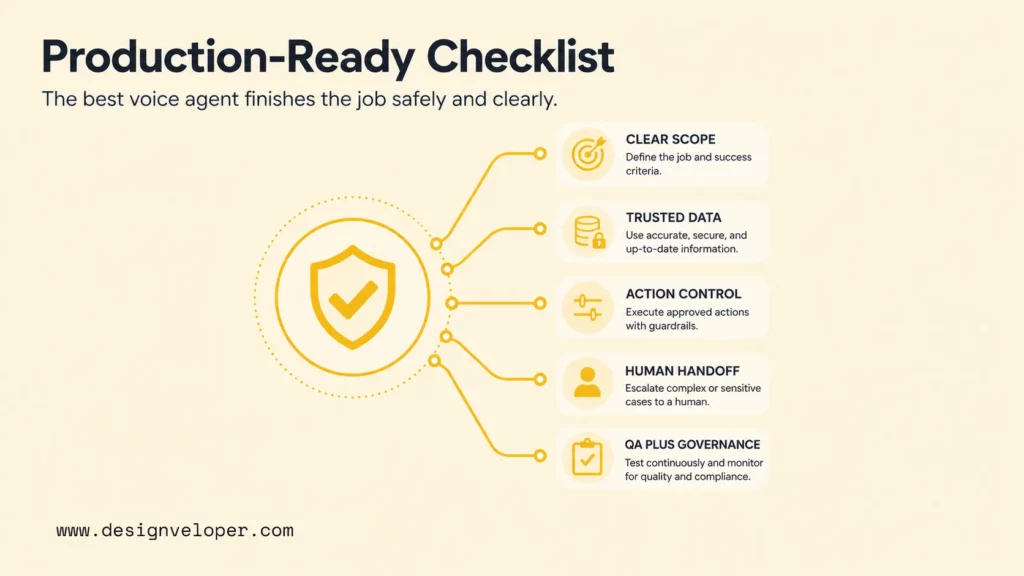
The best voice agent is the one that finishes the customer service job safely. A natural voice is helpful, but a useful voice agent must resolve the caller’s intent, use trusted data, take approved actions, document the result, and transfer smoothly when the case needs a person.
Businesses should evaluate AI voice agent services for businesses with a production checklist:
- Clear scope: one or two support workflows before broad rollout.
- Trusted data: clean knowledge, reliable system access, and clear ownership.
- Action control: limited permissions and confirmation for important updates.
- Human handoff: transfer rules, transcript summaries, and escalation context.
- QA and governance: call sampling, issue review, policy updates, and risk monitoring.
A business that wants to build AI voice agent for customer service should begin with workflow mapping and testing rather than vendor selection alone. The right architecture can combine telephony, speech recognition, LLM reasoning, retrieval, CRM, ticketing, scheduling, analytics, and human review. The wrong architecture turns a good voice model into another disconnected support tool.
FAQs About AI Voice Agents For Customer Service
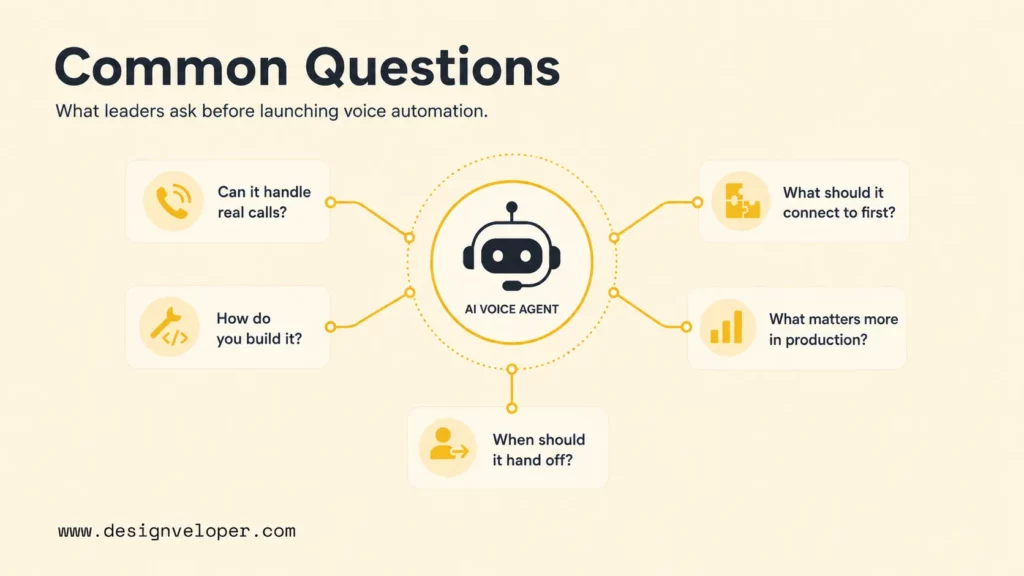
These answers summarize the decisions leaders usually make before investing in voice automation.
Can An AI Voice Agent Handle Real Customer Service Calls?
Yes, an AI voice agent can handle real customer service calls when the workflow is narrow, the data is reliable, and the escalation path is clear. Good first use cases include order status, booking changes, after-hours intake, routine account support, and lead qualification.
What Systems Should An AI Voice Agent Connect To First?
An AI voice agent should connect first to the systems needed for the pilot workflow. Common starting points are help-center knowledge bases, CRM records, order systems, ticketing tools, calendars, and call analytics. Read-only access is often safer before write actions are enabled.
How Do Businesses Build An AI Voice Agent For Customer Service?
Businesses build an AI voice agent by choosing one support workflow, preparing trusted knowledge, connecting business systems, defining guardrails, testing real conversations, and launching with human escalation. The build should include QA metrics and post-launch monitoring from the start.
What Matters More In Production: Voice Quality Or Workflow Accuracy?
Workflow accuracy matters more than voice quality in production. Voice quality affects caller comfort, but workflow accuracy determines whether the agent captures details, finds the right record, follows policy, completes the task, and hands off cleanly.
When Should A Voice AI Agent Transfer A Call To A Human?
A voice AI agent should transfer a call when confidence is low, the caller asks for a person, the case is emotional or high risk, the policy requires approval, the backend system fails, or the caller’s request falls outside the agent’s allowed workflow.
An AI voice agent can improve customer service when the business treats voice automation as a workflow system rather than a talking demo. Start narrow, connect reliable data, control permissions, measure task completion, and keep humans ready for exceptions. That is how voice agents become useful support infrastructure instead of another experiment.