


As Paramount closes in on its acquisition of Warner Bros. Discovery, the media giant is pushing hard on AI initiatives amid a change in C-suite tech leadership.
As reported by CIO Dive, Paramount CTO Phil Wiser will leave the company at the end of May in a planned departure. Wiser was a proponent of expanding AI’s use across the company’s operations.
Even with his departure, Paramount appears ready to further explore AI, at least for internal operations, while the entertainment industry continues to sort out how AI will affect content creation.
At the recent Momentum AI conference hosted by Reuters in New York, Paramount CIO Lakshman Nathan spoke on a panel titled, “Redesigning the Enterprise: Operational Models for Scalable Impact.” He was joined by Sandeep Dave, global chief digital and technology officer at CBRE, and Jake Stauch, CEO and founder of Serval, with Arthur O’Connor, academic rector of the CUNY School of Professional Studies, as moderator.
An AI leadership plan for tumultuous times
Nathan said his role at Paramount focuses on enterprise and community solutions for the company. Parent company Paramount Skydance includes movie studio Paramount, streaming service Paramount+ and television network CBS. Its acquisition of Warner Bros. Discovery is expected to be close by the end of the third quarter of the year.
Paramount Skydance, under the leadership of CEO and chair David Ellison, has been on an aggressive tear picking up entertainment companies, including the merger with Skydance Media, completed last August. David Ellison is the son of Oracle co-founder and CTO Larry Ellison — who is very bullish on AI.
In his remarks at Momentum AI, Nathan said that when AI took off, one of the big things Paramount had to think about was how the media side of the company would handle the technology versus corporate operations.
“We made a very distinct decision that from an enterprise perspective, as long as there’s no IP issues … that we should drive AI,” Nathan said.
His comments are in line with other CIO and CTO panelists at the conference, who spoke energetically about using agentic AI, while also not rushing to scale AI in the process.
In addition to exploring ways AI could improve workday efficiency, Nathan said Paramount needed to develop a governance process — what he described as a learning curve — where privacy and other teams needed to come together to understand the new technology.
Executive buy-in helped empower Paramount’s AI experimental initiatives, Nathan said. The AI conversation with business users in the company often includes tailoring solutions to how the executives work, he said.
Turning that executive backing into an enterprise AI strategy also required Paramount to make bets in a rapidly evolving market where standards were still evolving. The deluge of AI vendors that emerged after AI made headlines complicated decisions about whom to work with and how to deploy those resources, Nathan said. “Our early years were all about, ‘How do we manage that? How do we get this process evolving and build the plane in flight?'”
While AI is arguably in its early to adolescent phases, Paramount created space to explore AI tools, with some vetting, before company-wide deployment, he said. “We had a pretty open environment where we basically allowed folks to go through our corporate website, put in a new tool, and then follow through with our governance process and evaluate that.”
That let Paramount adopt a learn-as-you-go approach as it found ways to work with AI. “We wanted to embrace AI, but we also needed to learn at the same time what we were trying to digest,” Nathan said.
Where AI fits into Paramount’s strategy
Paramount has deployed AI to manage workflows in privacy, legal and other areas, he said. The company has also used AI to build code quickly. “Having an application turn around literally for testing in two days is a game changer,” Nathan said.
That speed has become a significant factor in how the company views its future plans for the technology. Further, AI can also help resolve certain legacy tech questions that emerged from Paramount’s M&A history, which will soon include Warner Bros. Discovery. Indeed, back in 2024, Wiser spoke about Paramount’s efforts to shed legacy systems in favor of general compute. That strategy may continue after his departure. “We’ve gone through so many mergers over the years, we have a lot of legacy companies that come together,” Nathan said.
Despite its proactive approach, Paramount is not rushing to build an AI workflow for every single task in the company, he said. Nathan pointed out opportunities with AI to highlight data, determine whether data is healthy or not, and provide recommendations on potential next steps. “A lot of it’s building off agentic MCPs [model context protocols] across enterprise applications,” he said.
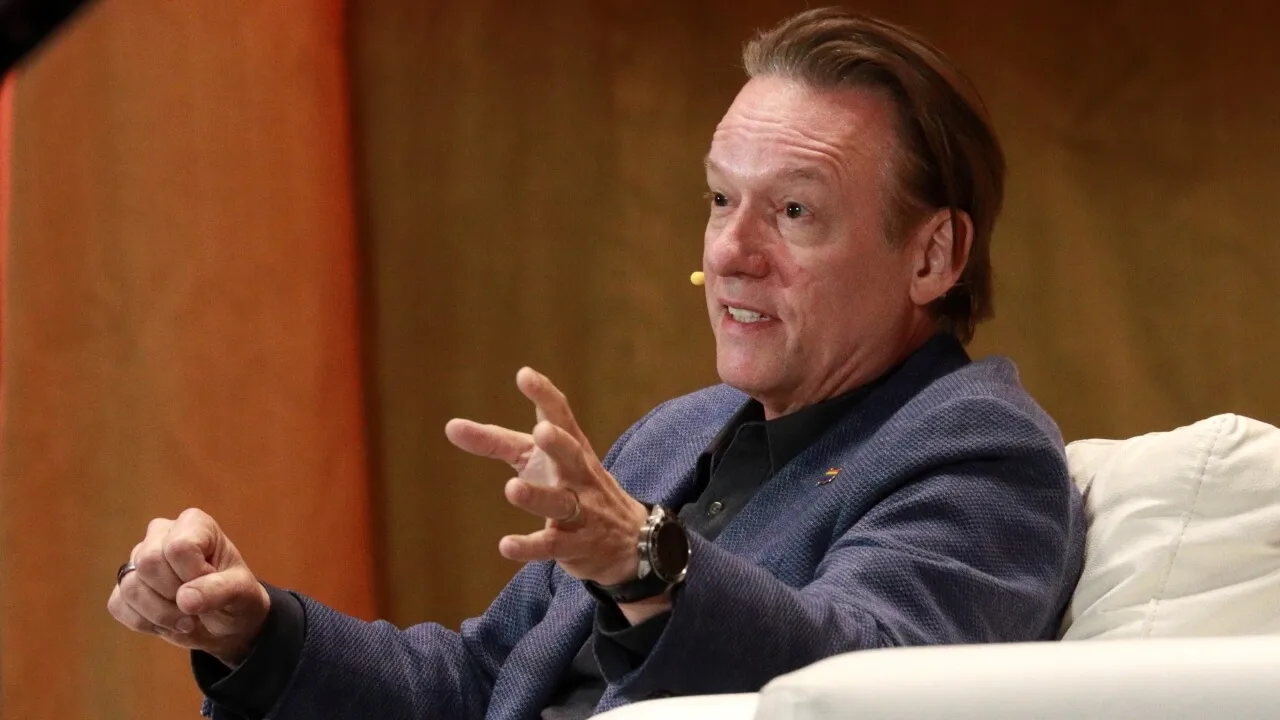
Phil Wiser, speaking at Radio City Musical Hall in 2024 (Photo by Joao-Pierre S. Ruth/InformationWeek)